English
 Le français
 Türkçe




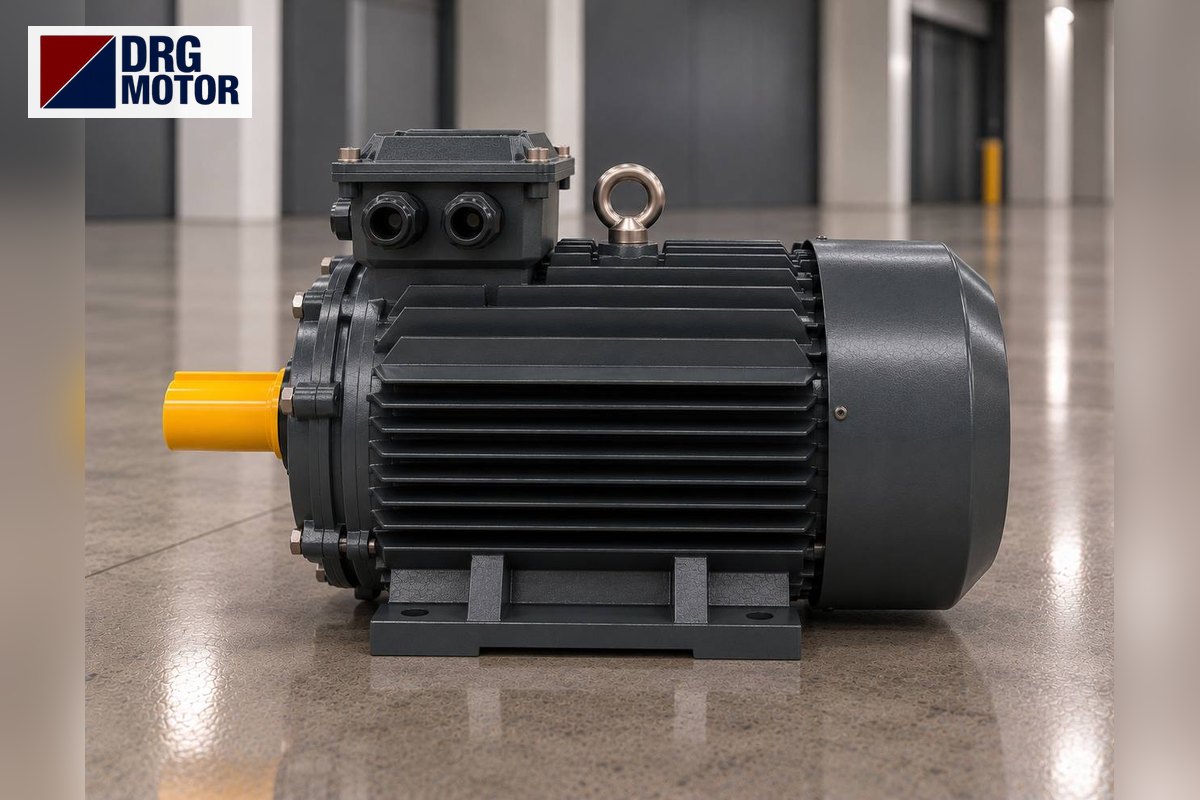

In an asphalt plant, the bitumen pump delivers bitumen heated to 150–180 °C from the tank to the weigh bucket or the mixing drum. These pumps are mostly jacketed positive displacement pumps of internal or external gear type, with a flexible coupling between motor and pump. Two things decide the motor: the high torque at start when bitumen has cooled, and the heat that travels from the pump body towards the shaft.
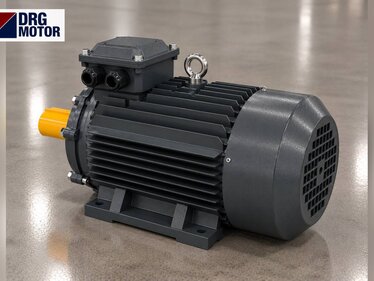
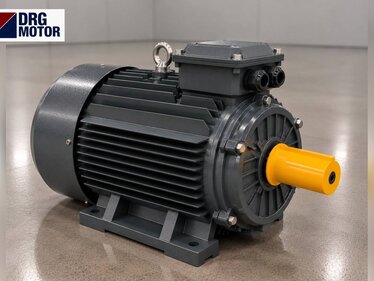
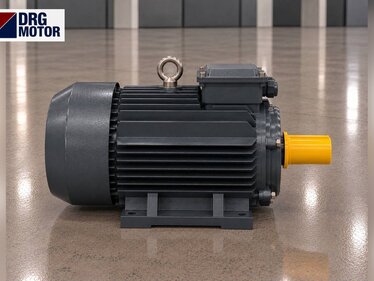
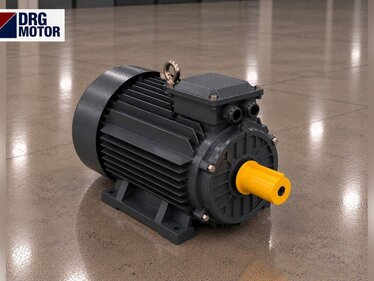
DRG Motor is a manufacturer, supplier and seller of electric motors. It supplies the three-phase IEC asynchronous motor that turns the pump, not the pump body, jacket or relief valve. All options, including 6-pole cast iron models, are on the buy electric motors online page.
The plant's general motor map, meaning drum, elevator, fan and mixer motors, is covered on the asphalt plant electric motors page. Here we deal only with the bitumen pump drive.
What Sets Torque in a Gear Pump? Pressure, Speed and Viscosity
In a centrifugal pump, power rises steeply with speed; a gear pump behaves differently. Each revolution delivers a fixed volume, and the torque the motor sees at the shaft is roughly proportional to line pressure. Flow rises with speed, torque with pressure. In a bitumen line, pressure is set by pipe length, lift to the weigh bucket and, above all, viscosity.
Bitumen viscosity is extremely sensitive to temperature. A value of a few hundred mPa·s around 160 °C can rise tens of times once it drops below 100 °C. In a pump started before heating is complete, line pressure climbs up to the relief valve opening point, and the motor has to carry the torque of that moment.
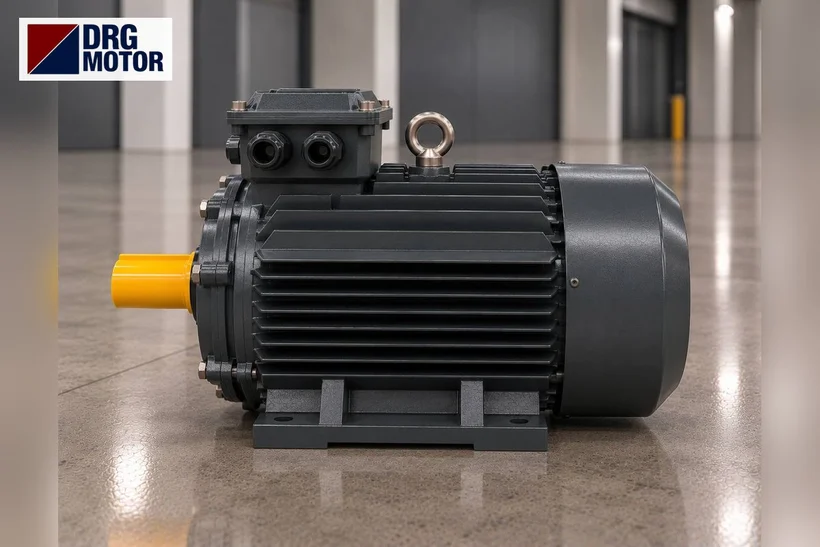
Motor Power from Flow and Pressure: Example Table
Pump shaft power is found with P = Q · p / (600 · η) (Q in l/min, p in bar, P in kW). The values below are examples; overall pump efficiency of 0.75 is assumed. Actual flow, pressure and efficiency are on the pump maker's data sheet.
| Flow (l/min) | Line pressure | Pump shaft power | Possible motor |
|---|---|---|---|
| 250 | 6 bar | 3.33 kW | 4 kW, 6-pole |
| 250 | 10 bar | 5.56 kW | 7.5 kW, 6-pole |
| 400 | 6 bar | 5.33 kW | 7.5 kW (5.5 kW is marginal) |
| 400 | 10 bar | 8.89 kW | 11 kW, 6-pole |
| 600 | 10 bar | 13.33 kW | 15 kW, 6-pole |
You can repeat the calculation with your own flow and pressure in the pump and fan motor power calculator.
Does the relief valve also protect the motor?
Partly. The valve limits pressure, but while it is open the pump still turns at full pressure. Example: an 11 kW DRG-160L-6 (970 rpm, rated torque 108.3 Nm) is chosen for 400 l/min and 10 bar. In normal running the shaft carries about 87.5 Nm. If the valve is set to 14 bar and cold bitumen pushes pressure to that value, torque rises to roughly 122.5 Nm, which is above rated. The motor starts thanks to Ts/Tn 2.0, but if it keeps running like this the overload trips. Set the valve with the motor's rated torque in mind.
Click to see current electric motor prices and order nowSEE PRICES →
Heat Bridge: How Does Pump Heat Reach the Motor?
The jacketed pump body is held at bitumen temperature by thermal oil or an electric heater. Heat flows from the pump shaft to the coupling hub, then to the motor shaft and the drive-end bearing. If the front bearing runs too hot, the grease thins, leaks and the bearing fatigues early. The winding is usually affected not by this heat but by the air in a closed, hot pump room.
For this reason, bitumen pump motors mostly stand foot-mounted (B3) on a common baseplate and connect to the pump through a coupling that leaves a gap. In some designs the motor is flange-mounted on a lantern housing; the lantern is then long enough to leave an air gap between pump and motor. Do not shorten this distance when replacing the motor.
Insulation must not wrap the motor
Pumps and valves are wrapped in insulation blankets to reduce heat loss. If the blanket is extended over the motor, cooling air from the fan cowl is cut off; an IC411 motor cools with air blown by its own fan. The motor frame, fins and fan cowl must always stay uncovered. DRG motors are rated for −15…+40 °C ambient; if the pump room is hotter, ventilation is needed.
What Happens at a Cold Start?
When the plant opens in the morning, the pump body and the bitumen in the pipes may have cooled even if the tank is hot. The motor then tries to shear solid or paste-like bitumen between the gears. The result is either a motor that cannot start and draws high current, or damage to the pump shaft and coupling.
- Jacket heating should run long enough before the pump is started.
- A temperature sensor on the pump body can be interlocked with the motor contactor.
- The overload relay should be set to the nameplate current, not raised to ease starting.
- A motor that does not turn should not be forced repeatedly; retry once heating is complete.
For the effect of starting current on the supply, see star-delta and other starting methods. Since star connection cuts torque to about one third, star-delta is often unsuitable for a pump that starts with cold bitumen.
Pump Duty in Batch and Continuous Plants
In a batch plant the pump fills the weigh bucket, stops and runs again for the next batch. In this regime, which can mean dozens of starts per hour, the motor's thermal load rises with the number of starts; if the pump circulates bitumen back to the tank through a by-pass instead of stopping, the motor is stressed less. In a continuous drum plant the pump delivers bitumen in proportion to aggregate flow; flow is usually set by an inverter and the motor runs in long cycles.
On a motor running at low speed on an inverter, the fan also turns slowly and cooling drops. Since a gear pump demands the same torque at low speed, consider a motor one size larger or a separate fan where the motor will stay at low frequency for long periods. DRG does not sell drives; it supplies the standard motor that runs on one.
Reverse rotation to drain the line
Some plants reverse the pump at the end of a shift to return the bitumen in the pipe to the tank. This is done with a standard three-phase motor and two reversing contactors. Wait for the motor to stop completely before changing direction.
Checks Before Replacing the Motor
- Old motor nameplate: power, speed, voltage, connection
- Mounting: foot-mounted on a baseplate or flanged to a lantern housing
- Shaft diameter, shaft length, key and coupling hub size
- Shaft height (H) and foot hole spacing; alignment on the baseplate
- Pump type, flow and relief valve setting
- Pump room temperature and the motor's distance from insulation blankets
- Plant type: batch or continuous; inverter or not
DRG Motors Suited to Bitumen Pumps
Low speed is preferred on bitumen pumps to move a viscous fluid gently, so we picked four 6-pole models with cast iron housings. The power range covers the example flows and pressures in the table.
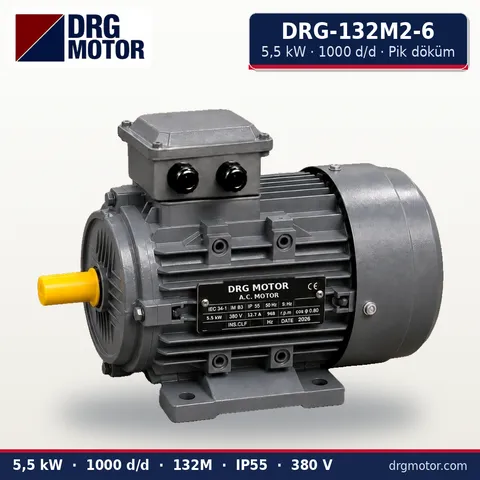
5.5 kW Three-Phase Motor 1000 rpm – DRG-132M2-6 Cast Iron
- 5.5 kW · 1000 rpm (6 poles)
- Cast iron frame · IEC 132M
- Mounting: B3 · B5 · B14 · B35
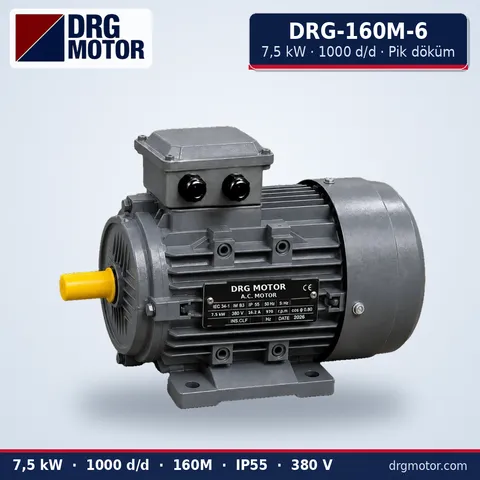
7.5 kW Three-Phase Motor 1000 rpm – DRG-160M-6 Cast Iron
- 7.5 kW · 1000 rpm (6 poles)
- Cast iron frame · IEC 160M
- Mounting: B3 · B5 · B14 · B35
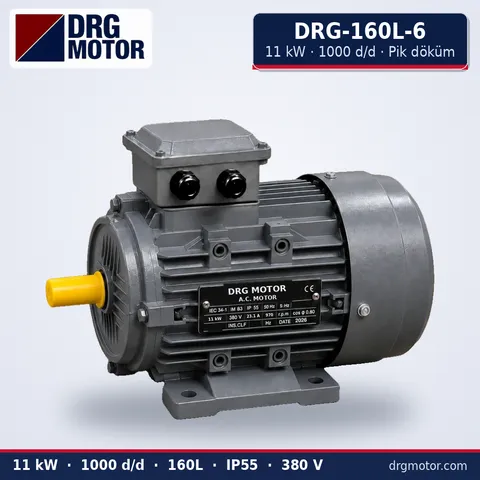
11 kW Three-Phase Motor 1000 rpm – DRG-160L-6 Cast Iron
- 11 kW · 1000 rpm (6 poles)
- Cast iron frame · IEC 160L
- Mounting: B3 · B5 · B14 · B35
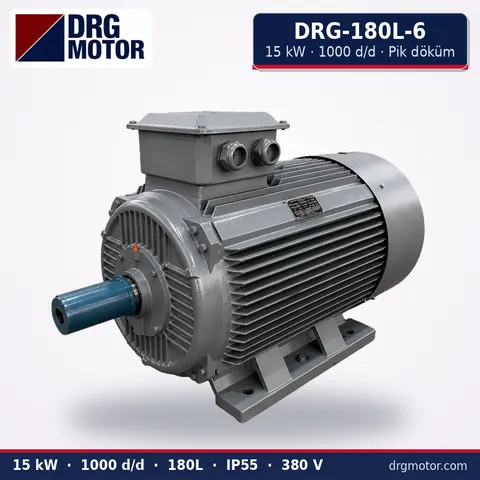
15 kW Three-Phase Motor 1000 rpm – DRG-180L-6 Cast Iron
- 15 kW · 1000 rpm (6 poles)
- Cast iron frame · IEC 180L
- Mounting: B3 · B5 · B14 · B35
Click to see current prices and order these motors nowSEE PRICES →
Bitumen Pump Motor FAQ
What speed should a bitumen pump motor have?
Gear-type bitumen pumps usually run with a 1000 rpm class 6-pole motor or at lower speed through a gearbox. Keep the speed on the pump data sheet when replacing; a faster motor raises flow and pressure.
Why does the bitumen pump motor run hot?
Three causes stand out: heat reaching the shaft from the pump, an insulation blanket wrapped around the motor, and pressure raised by cooled bitumen. Check first that the fan cowl is uncovered and the relief valve setting is right.
Can a flange motor be fitted to a bitumen pump?
Yes, if the pump maker provides a lantern housing design; the B5 flange size is taken from the old motor when ordering. Seating the motor directly on a hot pump flange raises bearing temperature.
Does running the pump with cold bitumen harm the motor?
Yes. If the motor is too loaded to turn, starting current lasts long and the winding heats; if it does turn, the coupling and pump shaft take the strain. Not starting before heating is complete is the safest way.
For a quotation, send a photo of the bitumen pump motor nameplate together with power, speed, mounting (foot or flange), shaft size and the pump flow and pressure via WhatsApp, or prepare a quote list. Phone: +90 (542) 666 11 11 · e-mail: info@drgmotor.com · contact. For other pump applications see pump motors, and for all models visit the online store.