English
 Le français
 Türkçe

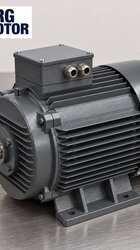
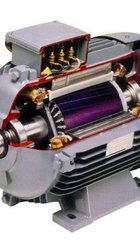
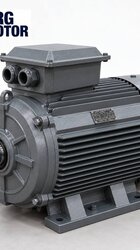
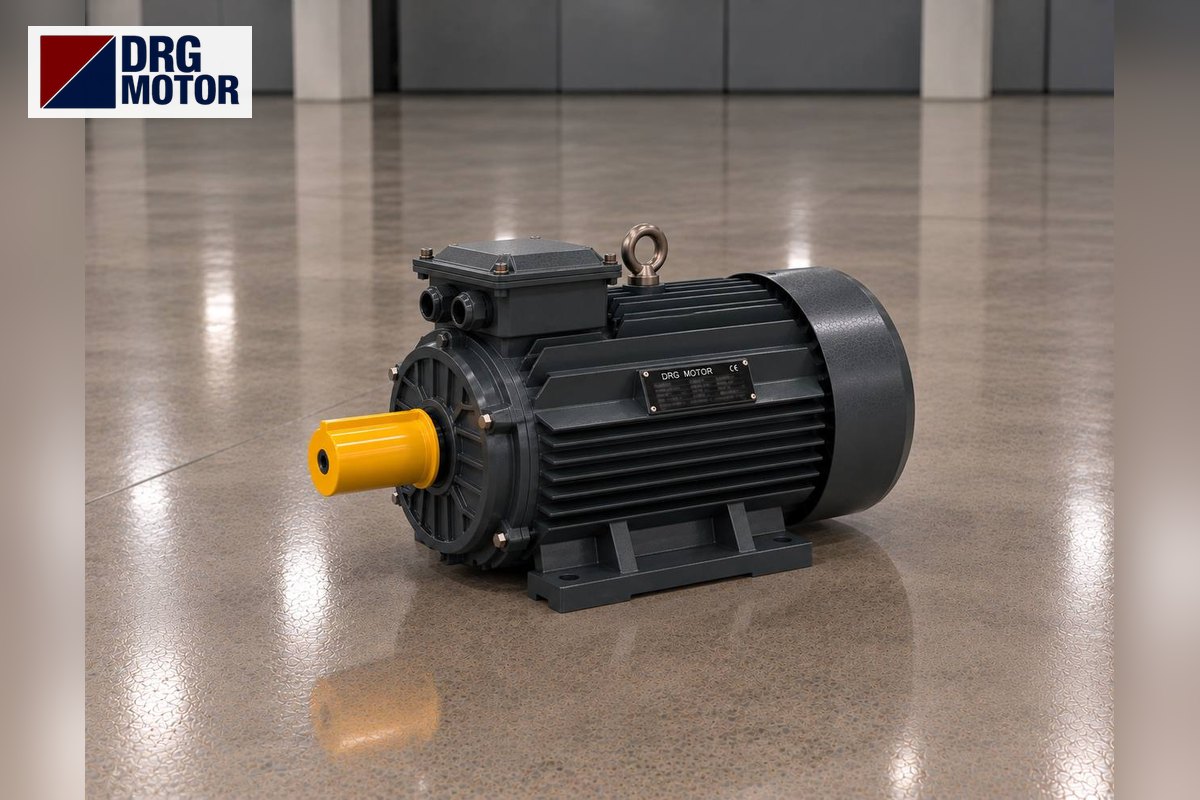

Choosing a central lubrication pump motor starts with one question: is the motor built into the pump body, or is it a separate motor joined to the pump by a flange or coupling? On most small grease pumps on machine tools, presses and mobile machinery the motor is integrated with the pump and is 24 V DC or single-phase; a standard three-phase motor cannot be used there. On large dual-line grease pumps and circulating oil units the motor is a separate three-phase IEC motor and can be replaced directly.
DRG Motor is an electric motor manufacturer, supplier and seller; its smallest model is a 0.25 kW three-phase motor. Suitable models for separately driven lubrication units of this power and above are listed in the DRG online store.
Which Lubrication Systems Take a Standard Motor?
Central lubrication means a single pump sending metered oil or grease through distributors to dozens of bearings. The size and type of the system decide the motor design. The table below separates common systems from the motor’s point of view.
| System | Typical drive | Is a DRG motor suitable? |
|---|---|---|
| Small progressive grease pump | Built-in 24 V DC motor and gears | No, integrated special motor |
| Single-line oil pump (machine tool) | Single-phase or small DC motor | No |
| Large dual-line grease pump | Separate 3-phase flange motor | Yes, if sizes match |
| Circulating oil unit | Bell housing + coupling + 3-phase | Yes |
When the motor of an integrated pump fails, the remedy is the pump maker’s spare motor or a complete pump unit. These motors are not in the DRG range; we do not supply 24 V DC or single-phase motors.
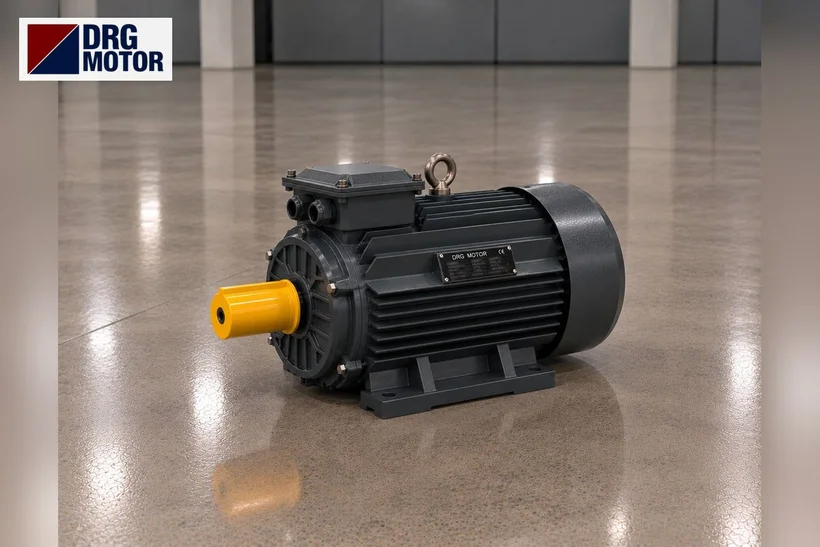
What Does the Motor Do in a Separately Driven Unit?
Dual-line grease pumps
In dual-line systems feeding hundreds of bearings in steel, cement and mining plants, the pump drives its pistons through an eccentric or worm arrangement. The motor is usually 4-pole and sits on the pump flange with a B5 or small flange. The pump pressurises one line; when the distributors are full a pressure switch signals and the changeover valve switches to the other line. The motor runs for a few minutes during this cycle, then stops for the set pause time.
Circulating oil units
Crusher eccentric bearings, mill gearboxes, paper machine cylinders and large compressors are lubricated by units that draw liquid oil from a tank, pump it to the bearings and collect it back. A gear or screw pump is joined to a three-phase motor through a bell housing and flexible coupling. The unit runs without interruption as long as the machine runs; the load is constant torque set by oil viscosity and line pressure. The arrangement follows the same motor-pump logic described on the hydraulic power unit electric motors page.
Click to see current electric motor prices and order nowSEE PRICES →
Motor Power From Flow, Pressure and Viscosity
In a gear pump oil unit motor power is P = Q·p/(600·η) (Q in l/min, p in bar, P in kW). Use the relief valve setting as the pressure, because with cold oil or a dirty filter the pump rises to that value. The rows are examples/assumptions; the exact value comes from the unit plate and the machine maker’s data.
| Example unit | Assumption | Shaft power | Selected motor |
|---|---|---|---|
| Small gear pump unit | 6 l/min · 15 bar · η 0.70 | ≈ 0.21 kW | DRG-711-4 (0.25 kW) |
| Press lubrication unit | 12 l/min · 16 bar · η 0.75 | ≈ 0.43 kW | DRG-801-4 (0.55 kW) |
| Crusher oil unit | 20 l/min · 20 bar · η 0.80 | ≈ 0.83 kW | DRG-90S-4 (1.1 kW) |
| Mill circulation | 30 l/min · 20 bar · η 0.80 | ≈ 1.25 kW | DRG-90L-4 (1.5 kW) |
4-pole motors (about 1450 rpm) are common on lubrication units; gear pumps run quietly and without cavitation at this speed. For example, the 1.1 kW DRG-90S-4 gives 7.27 Nm rated torque at 1445 rpm, with starting torque 2.3 times rated, which helps on the first start with cold, thick oil.
Starting with cold oil
Heavy gear oils such as ISO VG 220–320 thicken in a cold plant in winter. On the first turns both torque and pressure rise, the relief valve opens and the motor briefly draws overcurrent. On units with a tank heater, use an interlock that keeps the motor off until the oil reaches a set temperature; without a heater, the motor may need to be one size larger.
Voltage, Control and Short-Cycle Duty
DRG motors are 230/400 V up to 3 kW and 400/690 V from 4 kW; almost all lubrication units fall in the first group and are star-connected on a 400 V supply. Even when the pump control is 24 V DC, the motor is fed at 400 V through a contactor; do not confuse control voltage with motor voltage. A motor whose plate says 24 V is the built-in type and cannot be swapped for a three-phase motor.
Dual-line grease pumps make many short cycles a day. At each start the motor draws several times its rated current; for example, the 0.55 kW DRG-801-4 has 1.31 A rated current at 400 V and 5.2 times starting current. Leave enough pause between cycles for the motor to cool and set the overload to nameplate current. For contactor and overload selection you can use the overload, fuse and contactor selection tool.
Environment: Grease, Dust and Vibration
A lubrication pump often sits at the foot of the machine it serves, in a dusty, vibrating spot. In crusher and mill plants the fan cover can clog with a mix of dust and grease, cutting cooling. Clean the fan cover at intervals and do not wash the motor with pressurised water. IP55 protection is enough against dust and splashing water. The motor’s own bearing lubrication is a separate subject from the pump’s job; see the article on motor bearing greasing and lubrication intervals.
Checklist Before Ordering the Motor
- Is the motor built into the pump body or separate and flanged (confirm with a photo)?
- Plate voltage: if 24 V DC or single-phase, a standard three-phase motor is not suitable.
- kW and rpm; lubrication units are mostly 4-pole.
- Mounting: B5 large flange, small flange or foot and flange; small flange size is confirmed when ordering.
- Flange spigot, bolt circle and shaft diameter × length (14×30 mm on frame 71, 19×40 mm on 80, 24×50 mm on 90).
- Does the coupling hub and bell housing fit the new motor?
- Oil viscosity, relief valve setting and whether there is a tank heater.
- Pump duty: short cycles, or uninterrupted running with the machine.
DRG Motors for Separately Driven Lubrication Units
4-pole aluminium-frame models covering the 0.21–1.25 kW needs from the worked examples above (not for integrated DC or single-phase pumps):
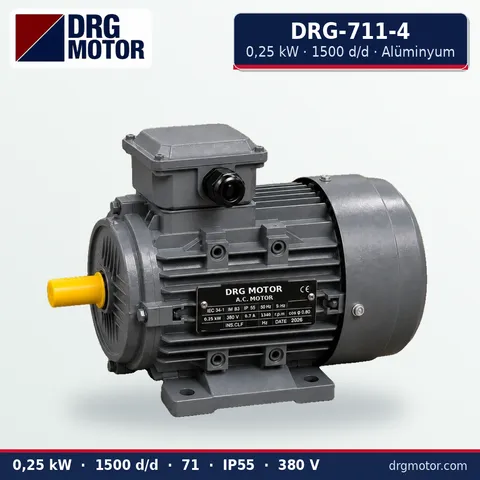
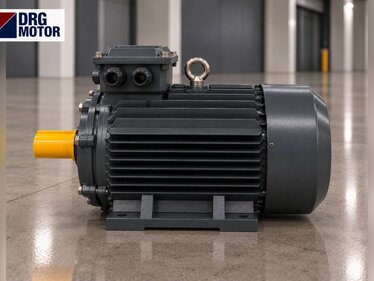
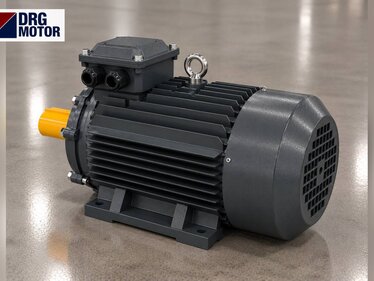
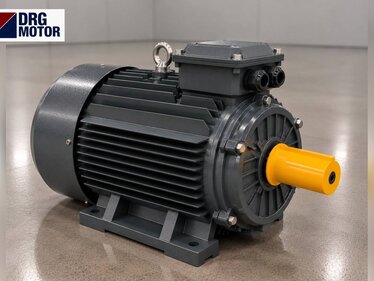
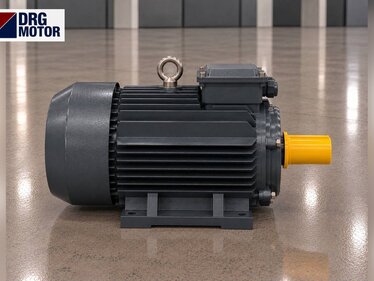
0.25 kW Three-Phase Motor 1500 rpm – DRG-711-4 Aluminium
- 0.25 kW · 1500 rpm (4 poles)
- Aluminium frame · IEC 71
- Mounting: B3 · B5 · B14 · B35
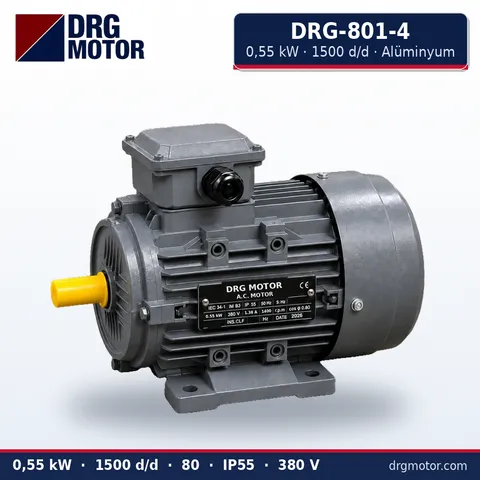
0.55 kW Three-Phase Motor 1500 rpm – DRG-801-4 Aluminium
- 0.55 kW · 1500 rpm (4 poles)
- Aluminium frame · IEC 80
- Mounting: B3 · B5 · B14 · B35
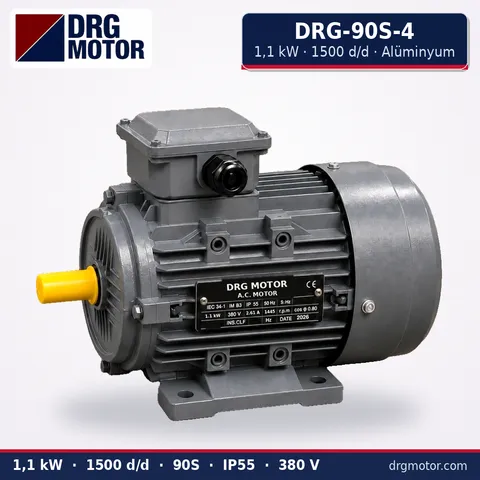
1.1 kW Three-Phase Motor 1500 rpm – DRG-90S-4 Aluminium
- 1.1 kW · 1500 rpm (4 poles)
- Aluminium frame · IEC 90S
- Mounting: B3 · B5 · B14 · B35
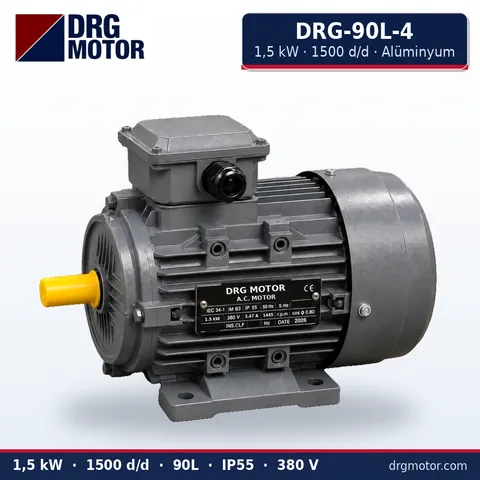
1.5 kW Three-Phase Motor 1500 rpm – DRG-90L-4 Aluminium
- 1.5 kW · 1500 rpm (4 poles)
- Aluminium frame · IEC 90L
- Mounting: B3 · B5 · B14 · B35
Click to see current prices and order these motors nowSEE PRICES →
Central Lubrication Pump Motor FAQ
If the grease pump motor is 24 V, can a three-phase motor be fitted?
No. 24 V DC motors are built into the pump body and the pump mechanism is designed around them. The answer is the pump maker’s spare motor or a new pump. Three-phase motors are used only on separately driven, flanged or coupled units.
How many kW is a lubrication pump motor?
On small integrated pumps it ranges from a few tens to a few hundred watts. On separately driven dual-line grease pumps and circulating oil units it can reach a few kW; the exact value is on the unit plate and in the maker’s catalogue.
Why does the lubrication pump motor trip in winter?
Cold oil viscosity rises, the pump climbs to relief valve pressure and the motor draws high current for a long time. A tank heater, a warm-up interlock or a motor one size larger solves this.
What speed should a lubrication unit motor be?
Gear and screw pumps usually run with a 4-pole motor (about 1450 rpm). A 2-pole motor doubles the flow, strains the suction and makes the pump noisy; keep to the old motor’s speed.
To determine the right motor, send a photo of the pump-motor connection, the motor plate, power, speed, mounting type (foot or flange), shaft size and details of the lubricated machine via WhatsApp, or add it to the quote list. Phone: +90 (542) 666 11 11 · e-mail: info@drgmotor.com · contact. All small three-phase models are in the online store.