English
 Le français
 Türkçe




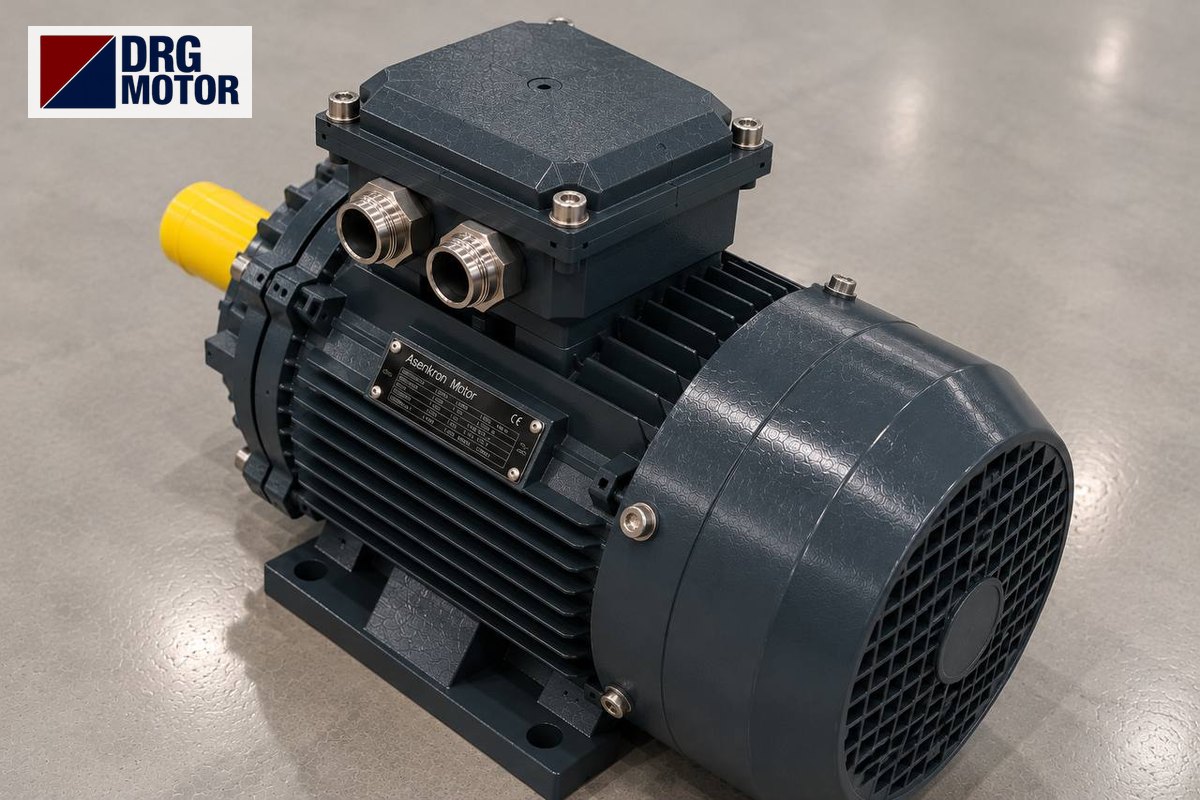

The electric motor of a hydraulic hose crimping press is the motor that turns the pump in the press's hydraulic unit, and what decides the choice is the peak pressure in the last few seconds of the crimp, not the average load. On workshop presses this is usually a 4-pole motor (about 1450 rpm) of a few kW; the exact value is on the press nameplate and in the manufacturer's catalogue.
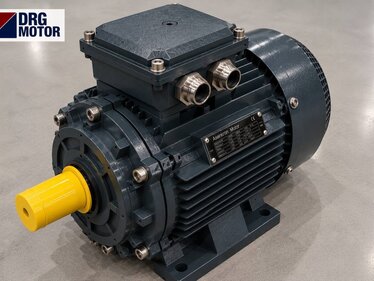
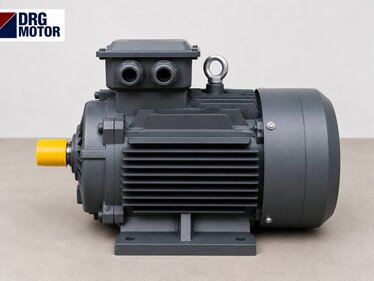
The second question before ordering is the supply: some hose workshops only have 230 V single-phase. DRG Motor is a manufacturer, supplier and seller of electric motors; its range consists of three-phase asynchronous motors. So first confirm the socket voltage, then power, speed and flange. You can see suitable 4-pole models on the buy electric motors online page.
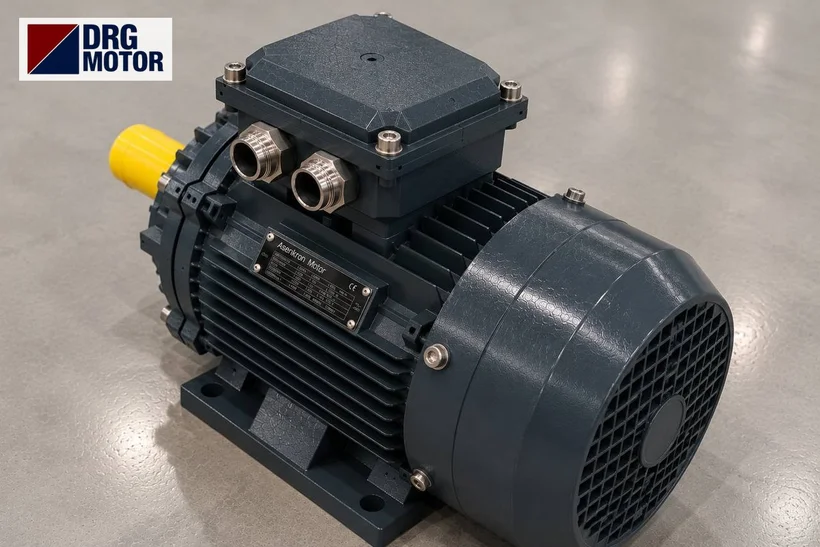
How the Crimping Head Works and What the Motor Supplies
In a radial crimper an eight-segment die set usually sits inside a conical seat. The hydraulic cylinder pushes this seat or the die carriers; thanks to the taper, the cylinder's axial force becomes a radial force closing the dies towards the centre, and the ferrule of the fitting is swaged onto the hose.
The motor's job is not to produce this force directly but to supply the torque the pump needs to raise the oil to the required pressure. Until the dies touch the hose the resistance is low; once the ferrule metal starts to flow, pressure rises quickly and motor torque reaches the peak of the cycle. When the crimp diameter is reached, a limit switch or adjustable pressure switch shifts the valve and the die opens.
Changing the die set (e.g. from 1/2" to 1" hose) does not change motor power; it only changes the closing travel and the pressure reached. Larger multi-spiral hoses go to higher pressure; the largest hose size the press allows is in the manufacturer's table.
A Short Pressure Peak: Cycle Example and Power Calculation
Pump power is P = Q · p / (600 · η) (Q l/min, p bar, P kW). The general method is in the hydraulic pump electric motor selection article; here we look only at the cycle specific to a crimping press.
Example and assumptions: two-stage gear pump, large stage 6 cm³/rev, small stage 2.5 cm³/rev; motor 1445 rpm; cylinder bore 140 mm; the cylinder must push 400 kN at the end of the crimp; pump efficiency 0.85. The cylinder area is ≈ 15,394 mm², so 400 kN needs ≈ 260 bar. During approach both stages deliver together (12.28 l/min); as pressure rises the large stage is unloaded and the small stage (3.61 l/min) does the crimp.
| Cycle step | Pressure / flow | Motor shaft power | Duration (example) |
|---|---|---|---|
| Die approach (60 mm) | 40 bar / 12.28 l/min | 0.96 kW | ≈ 4.5 s |
| Crimping (20 mm) | 260 bar / 3.61 l/min | 1.84 kW | ≈ 5.1 s |
| Die opening | 30 bar / 12.28 l/min | 0.72 kW | a few seconds |
| Loading hose and fitting | motor stopped or idling | ≈ 0 | operator-dependent |
The peak power is 1.84 kW, so the next standard rating is 2.2 kW. A 1.5 kW motor would run at about 1.23 times its rated torque at this peak (≈ 12.2 Nm / 9.91 Nm); it stays below breakdown torque (≈ 22.8 Nm) so the press does not stall, but it heats up during back-to-back crimps through the day. In a workshop doing series work, the 2.2 kW DRG-100L1-4 (rated torque 14.5 Nm) is the more comfortable choice.
The table also shows the benefit of the two-stage pump: reaching 260 bar with a single 6 cm³/rev pump would need 6 × 1.445 × 260 / 510 ≈ 4.4 kW. Before upsizing the motor, check that the pump's unloading valve switches at the correct pressure.
Click to see current electric motor prices and order nowSEE PRICES →
If the Workshop Has Only 230 V Single-Phase
Some hose crimping presses are sold with a 230 V single-phase motor; others require 400 V three-phase. DRG's range does not include single-phase motors. The known way to run a three-phase motor on a 230 V single-phase supply is a frequency inverter (drive) with single-phase input and three-phase output; DRG does not sell drives, and this solution is described here only as a concept.
Such a drive outputs 3 × 230 V. DRG motors up to 3 kW are wound for 230/400 V; on a 230 V three-phase output they are connected in delta. Motors of 4 kW and above are wound for 400/690 V, so they do not get full voltage from such a drive. The drive must be rated to supply the current at the crimping peak for a short time; sizing follows the drive manufacturer's documentation.
In a workshop with three-phase, the 2.2 kW motor draws 4.52 A at 400 V and about 7.6 times this at direct-on-line start. If the press stands in a far corner of the workshop, check the cable cross-section with the motor cable size calculator; a thin, long extension cable causes voltage drop at the crimping peak.
Mounting the Motor on the Unit: Vertical Flange, Bell Housing and Coupling
On bench crimping presses the power unit usually sits inside or below the frame; the motor stands vertically (shaft down) on the tank lid and connects to the pump through a bell housing and flexible coupling. This design uses a B5 large-flange motor; some small units use a B14 small flange, so confirm the B14 dimensions against the old motor when ordering.
B5 flange dimensions to check are M 165 / N 130 / P 200 mm with a 24×50 mm shaft on frame 90L, and M 215 / N 180 / P 250 mm with a 28×60 mm shaft on frame 100L. Going from 1.5 kW to 2.2 kW moves from frame 90L to 100L, so the bell housing and coupling hub change too; this is the hidden cost of upsizing.
On a vertical motor the fan cover faces up, and chips, wire fragments or hose cutting dust can fall onto it. Keep the top of the fan cover clear; DRG motors are IP55 and IC411, i.e. frame-cooled by a fan, so cooling depends on the fan air.
Symptoms of the Wrong Motor on a Crimping Press
If the motor is undersized, speed drops at the end of the crimp, the motor hums and the overload relay trips; the die stops before fully closing and the ferrule is under-crimped. That means a leaking hose assembly.
Reverse rotation is another frequent error: if two phases are swapped when connecting a three-phase motor, the gear pump delivers no oil and the motor runs while the die does not move. If a higher-speed (2-pole) motor is fitted, the flow doubles; the dies close faster, but peak power doubles too and the pump may exceed its speed limit.
Pre-Order Check for a Crimping Press Motor
- Has the socket voltage been measured: 230 V single-phase or 400 V three-phase?
- Old motor nameplate: kW, rpm, voltage (230/400 V or 400/690 V), current.
- Does the motor stand vertically; is the flange B5 or B14? Bolt circle and spigot diameter measured?
- Do the shaft diameter and length match the bore of the coupling hub?
- Is the pump single-stage or two-stage; does the unloading valve work?
- Has the maximum pressure allowed by the press (gauge or nameplate) been noted?
- Has the pump rotation arrow been marked?
DRG Motors Suitable for Hose Crimping Presses
These 4-pole models cover the 1.5–3 kW range common on workshop crimping presses and can be ordered with a B5 flange.
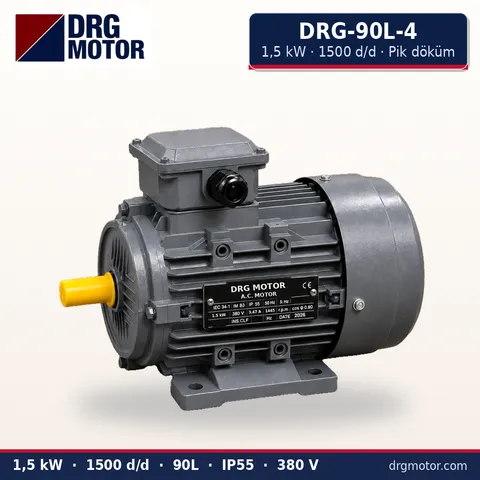
1.5 kW Three-Phase Motor 1500 rpm – DRG-90L-4 Cast Iron
- 1.5 kW · 1500 rpm (4 poles)
- Cast iron frame · IEC 90L
- Mounting: B3 · B5 · B14 · B35
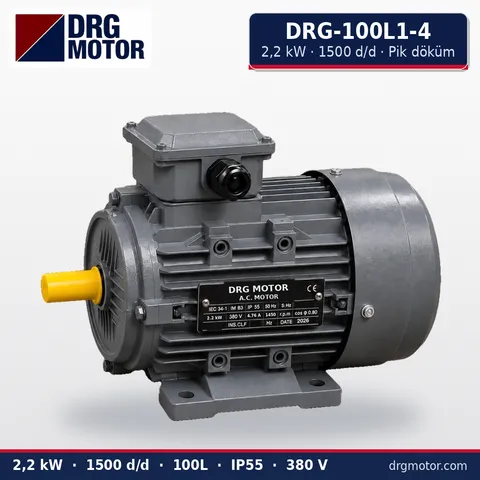
2.2 kW Three-Phase Motor 1500 rpm – DRG-100L1-4 Cast Iron
- 2.2 kW · 1500 rpm (4 poles)
- Cast iron frame · IEC 100L
- Mounting: B3 · B5 · B14 · B35
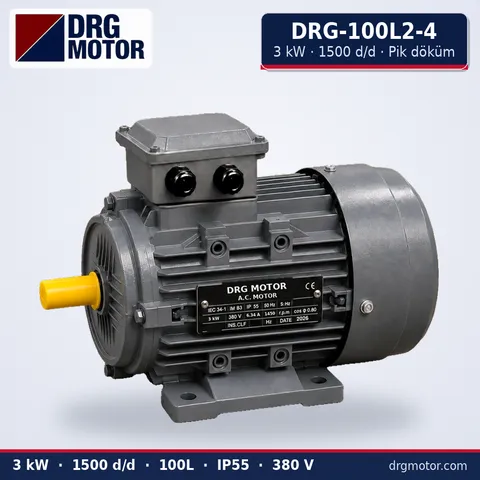
3 kW Three-Phase Motor 1500 rpm – DRG-100L2-4 Cast Iron
- 3 kW · 1500 rpm (4 poles)
- Cast iron frame · IEC 100L
- Mounting: B3 · B5 · B14 · B35
Click to see current prices and order these motors nowSEE PRICES →
Other ratings used on hydraulic units are on the hydraulic power unit electric motors page.
Hose Crimping Machine Motor: Frequently Asked Questions
What kW motor does a hose crimping machine use?
Workshop presses usually use a 4-pole motor of a few kW; the exact value is on the press nameplate. In the example cycle above the peak power is 1.84 kW, so 2.2 kW was chosen.
Can a hose press be plugged into a 230 V socket?
Yes, if the press comes with a single-phase motor. To run a press with a three-phase motor on 230 V single-phase you need an inverter with single-phase input, and a 230/400 V motor up to 3 kW is connected in delta.
Does changing the die require a more powerful motor?
No. The die set changes with hose size; motor power is set by the press's maximum pressure and pump flow. If the press capacity is not enough for a larger hose, it is the press that changes, not the motor.
The crimper motor runs but the die does not close: why?
The most common cause is reverse rotation; swapping two phases fixes it. Then check the oil level, suction strainer and the directional valve coil.
For a quote, send a photo of the motor nameplate, its power, speed, mounting (vertical flange, B5 or B14), shaft size and the press model via WhatsApp, or add the models to the quote list. Phone: +90 (542) 666 11 11 · e-mail: info@drgmotor.com · contact. All models are in the online store.