English
 Le français
 Türkçe




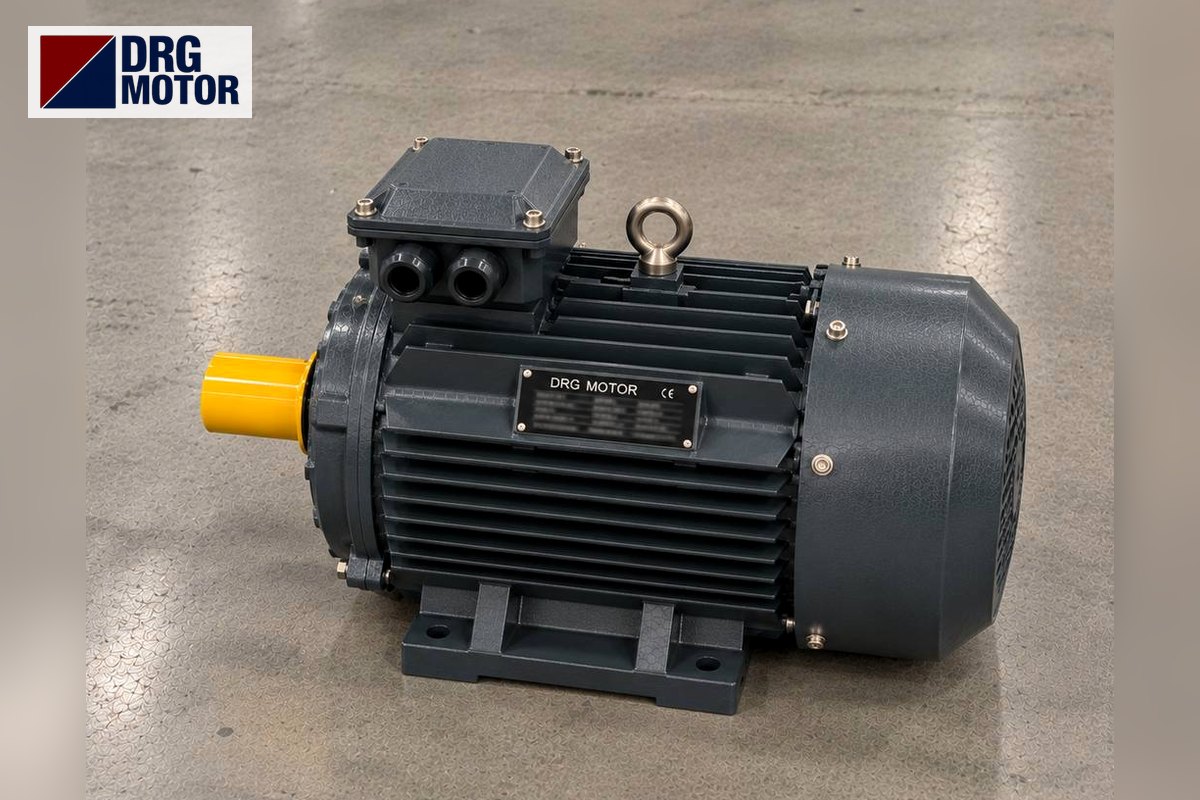

An electric motor frame size is defined in the IEC standard by the shaft centre height (H): numbers such as 90, 100, 112, 132 and 160 state the height of the shaft axis above the feet, in millimetres. Below you will find the real foot, foot-hole and shaft dimensions of DRG three-phase electric motors, frame by frame.
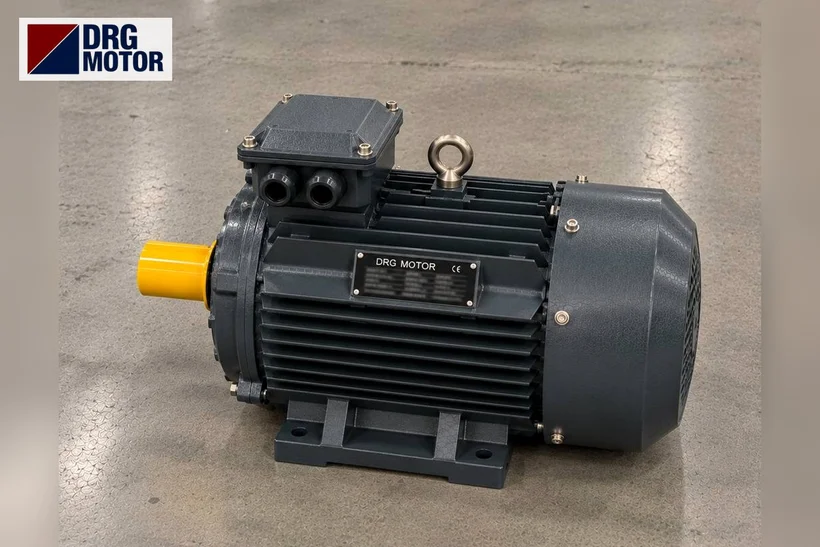
DRG Motor is a manufacturer, supplier and seller of electric motors. You can pick three-phase models in the frame size you need, by power and speed, in the online motor shop, and see the whole range together in the three-phase asynchronous electric motors category.
What is a frame size (IEC frame) and what do the letters mean?
A motor's mounting dimensions are not arbitrary; they are standardised with letter codes under IEC 60072. The frame number (56, 63, 71, 80, 90, 100, 112, 132, 160, 180, 200, 225, 250, 280, 315, 355) is in fact the H dimension: the height of the shaft axis above the feet. When fitting a motor to a machine, these letters matter most:
- H – shaft centre height (axis to foot base).
- A – centre pitch of the two foot holes across the width.
- B – centre pitch of the foot holes along the length.
- C – distance from the shaft shoulder to the front foot holes.
- D – shaft diameter, E – length of the shaft extension.
- K – diameter of the foot holes (bolt size), L – overall length of the motor.
For a given frame number, A, B and H are fixed, so any motor in the same frame fits the same foot holes. Changing power or pole count usually affects only the B length and the overall length L.
Shaft centre height (H) and foot-hole pitch table
The values below are the real dimensions from the DRG three-phase electric motor catalogue. H gives the frame number; A and B set the hole positions when you fix the motor to a base or chassis.
| Frame (IEC) | Shaft centre height H (mm) | A – side hole pitch (mm) | B – length hole pitch (mm) |
|---|---|---|---|
| 90S | 90 | 140 | 100 |
| 90L | 90 | 140 | 125 |
| 100L | 100 | 160 | 140 |
| 112M | 112 | 190 | 140 |
| 132M | 132 | 216 | 178 |
| 160M | 160 | 254 | 210 |
| 160L | 160 | 254 | 254 |
Note the difference between 90S and 90L: both share the same H and A (90 and 140 mm); only the foot length B differs (100 vs 125 mm). So the frame number alone is not enough — confirm the B dimension before ordering.
Click to see current electric motor prices and order nowSEE PRICES →
Shaft diameter (D) and shaft length (E)
The shaft diameter is the most critical dimension when coupling the motor to a coupling, pulley or gearbox. The table below lists each frame's shaft diameter D, shaft extension length E and foot-hole size K.
| Frame (IEC) | Foot hole K | Shaft diameter D (mm) | Shaft length E (mm) |
|---|---|---|---|
| 90S | 4–Φ10 | 24 | 50 |
| 90L | 4–Φ10 | 24 | 50 |
| 100L | 4–Φ12 | 28 | 60 |
| 112M | 4–Φ12 | 28 | 60 |
| 132M | 4–Φ12 | 38 | 80 |
| 160M | 4–Φ14.5 | 42 | 110 |
| 160L | 4–Φ14.5 | 42 | 110 |
To see how the shaft diameter grows with power in a separate reference, the motor shaft diameter by kW table lists every power step. For shaft end, key and coupling fit see shaft diameter, key and coupling standards; to step through ordering by foot and frame size see the frame-size order guide.
How frame size relates to power and poles
The frame number depends not on power alone but on the combination of power and speed (pole count). The same power at a lower speed (more poles) usually moves up one frame, because delivering that power at low speed needs higher torque and therefore a larger frame. Below you can see how frame and power progress across 4-pole (1500 rpm) DRG models.
| Model | Frame | Power (4-pole) | Shaft diameter D (mm) |
|---|---|---|---|
| DRG-90L-4 | 90L | 1.5 kW | 24 |
| DRG-112M-4 | 112M | 4 kW | 28 |
| DRG-132M-4K | 132M | 11 kW | 38 |
| DRG-160M-4 | 160M | 11 kW | 42 |
For example, 11 kW can be offered both in the standard 160M frame model and in a compact 132M frame model; their foot and shaft dimensions differ, so choose the frame to match your existing machine. At lower powers, the difference between the 1.5 kW 90L frame and the 4 kW 112M frame shows in both the shaft diameter (24 vs 28 mm) and the foot width (140 vs 190 mm).
Frames 56–80 and 180–355
The IEC series runs from frame 56 to frame 355. The exact millimetre values in this article are for the 90–160 frames whose dimensions are verified in the DRG catalogue. The small frames from 56 to 80 and the large frames from 180 up follow the same logic: the frame number is still the H dimension, and A, B, D and E grow step by step. If you need the exact dimensions of a motor in that range, tell us the target frame and we will share the verified foot and shaft dimensions of the relevant model. To convert an IEC frame number to its NEMA equivalent, the IEC–NEMA frame conversion article helps.
Send a photo of your current motor nameplate and we will find the suitable DRG model together.Send on WhatsApp
Click to see current prices of electric motors for each frame sizeSEE PRICES
Frequently asked questions
What does the frame number (90, 112, 160) mean?
The frame number gives the height of the shaft above the base (the H dimension) in millimetres. For example, frame 160 means the shaft axis sits 160 mm above the foot base.
Can the same frame have a different shaft diameter?
In the standard range the shaft diameter is fixed for a given IEC frame; for example D=24 mm in frame 90 and D=28 mm in frame 112. Choose your coupling or pulley to that value and confirm the figure on the motor nameplate to be sure.
What is the difference between 90S and 90L?
H, A and the shaft dimensions are the same; the difference is in the foot length B (100 mm on 90S, 125 mm on 90L). Choose according to the length pitch your machine's foot holes match.
Should I choose the frame by power or by speed?
By both. First set the required power and speed (pole count); the frame follows from that combination. If in doubt, share your current motor's nameplate and we will determine the right frame together.
Electric Motors Related to This Topic — Models and Current Prices
Suitability is not decided by power alone: compare the speed, voltage, mounting, shaft and fixing dimensions of your machine with the product data; if unsure, send us the nameplate of your current motor.
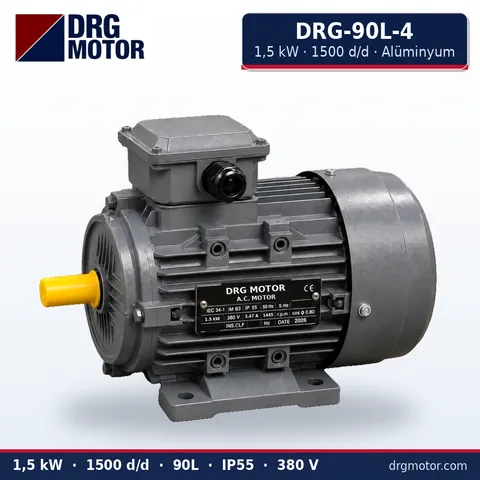
1.5 kW Three-Phase Motor 1500 rpm – DRG-90L-4 Aluminium
- 1.5 kW · 1500 rpm (4 poles)
- Aluminium frame · IEC 90L
- Shaft: 24 × 50 mm

4 kW Three-Phase Motor 1500 rpm – DRG-112M-4 Aluminium
- 4 kW · 1500 rpm (4 poles)
- Aluminium frame · IEC 112M
- Shaft: 28 × 60 mm
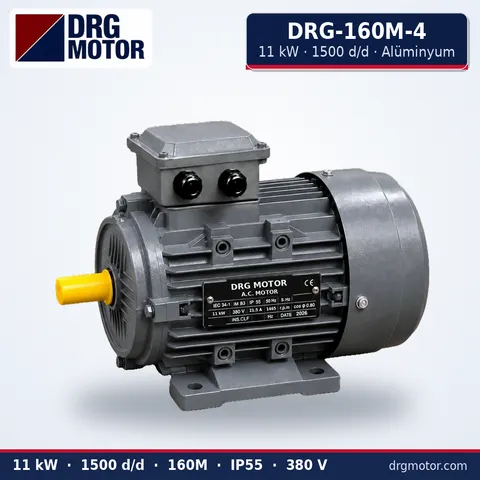
11 kW Three-Phase Motor 1500 rpm – DRG-160M-4 Aluminium
- 11 kW · 1500 rpm (4 poles)
- Aluminium frame · IEC 160M
- Shaft: 42 × 110 mm
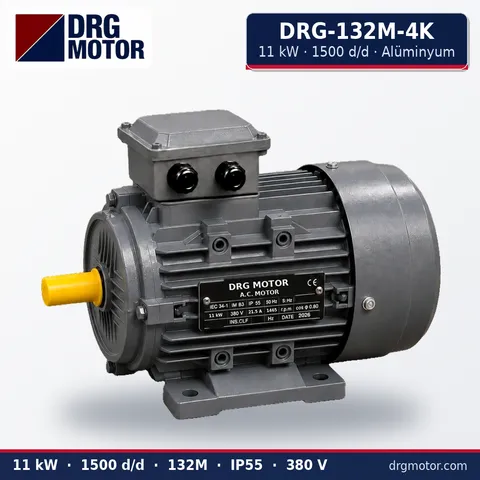
11 kW Compact Three-Phase Motor 1500 rpm – DRG-132M-4K Aluminium
- 11 kW · 1500 rpm (4 poles)
- Aluminium frame · IEC 132M
- Shaft: 38 × 80 mm
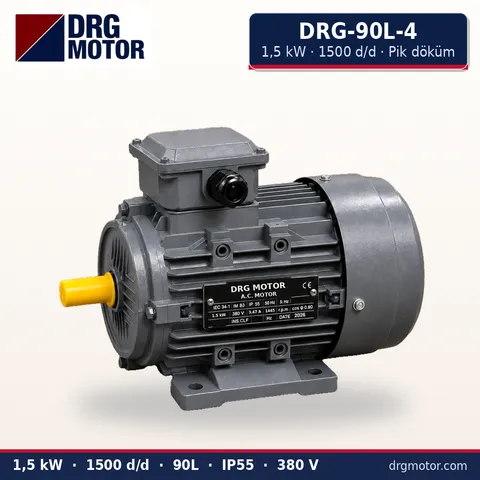
1.5 kW Three-Phase Motor 1500 rpm – DRG-90L-4 Cast Iron
- 1.5 kW · 1500 rpm (4 poles)
- Cast iron frame · IEC 90L
- Shaft: 24 × 50 mm
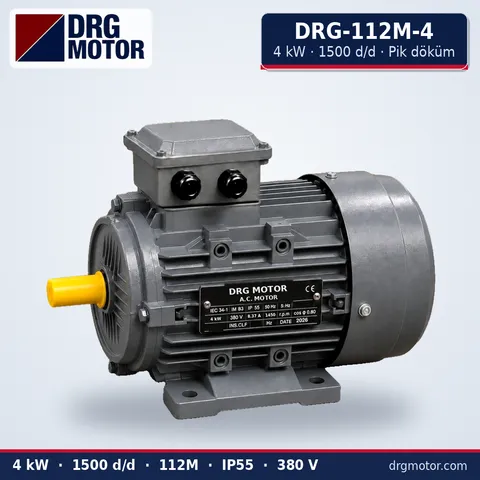
4 kW Three-Phase Motor 1500 rpm – DRG-112M-4 Cast Iron
- 4 kW · 1500 rpm (4 poles)
- Cast iron frame · IEC 112M
- Shaft: 28 × 60 mm