English
 Le français
 Türkçe




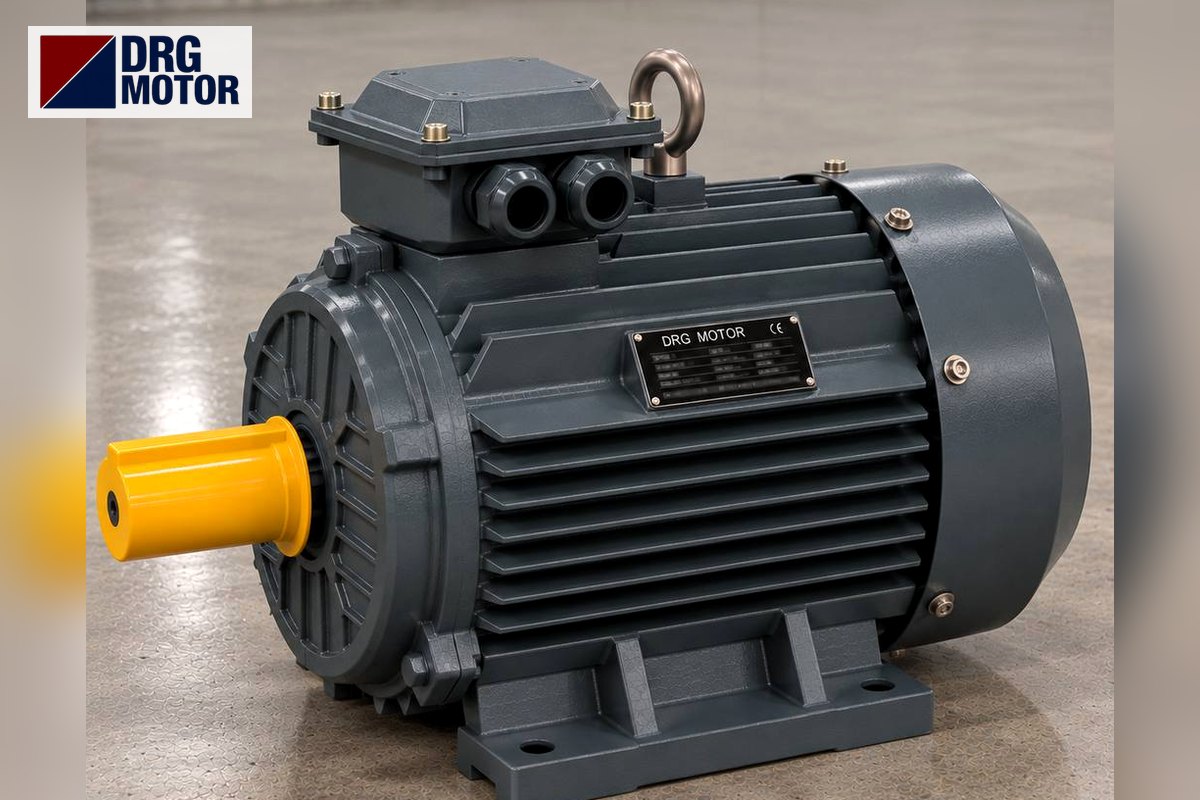

An IEC frame code is a short label that summarises the mechanical size of an electric motor: the leading number gives the shaft centre height (the distance from the base up to the shaft axis) in millimetres, and the following S, M or L letter describes the axial distance between the foot mounting holes (short / medium / long). So when you read 80M, 90L or 132S, you learn two physical facts about the motor at a glance.
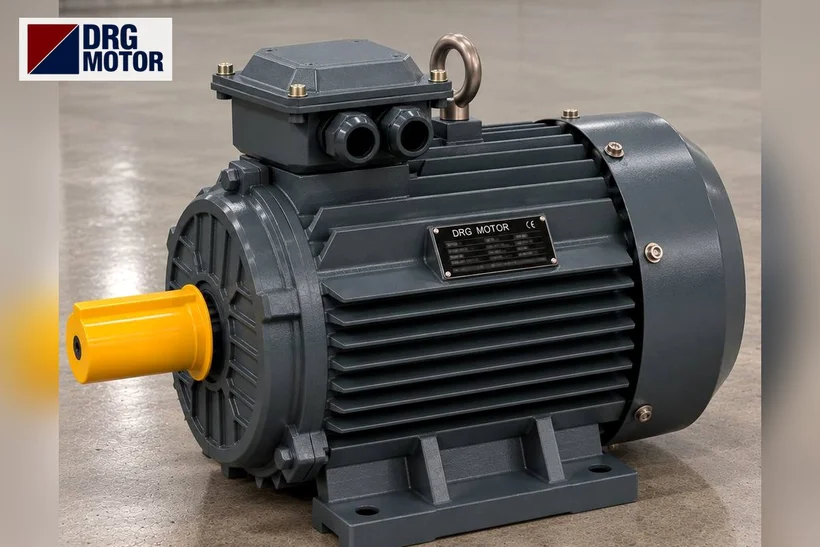
DRG Motor is a manufacturer, supplier and seller of electric motors. You can review three-phase models in different frame codes by power and speed in the online motor shop and see them all together in the three-phase asynchronous electric motors category.
What does the number mean?
The two- or three-digit number at the start of the frame code shows the height of the shaft axis above the base (the foot mounting plane) in millimetres. In an 80 frame the shaft axis sits 80 mm above the base; in a 132 frame it is 132 mm. This dimension is critical for shaft alignment, because it decides where the shaft will line up when you connect the motor to a gearbox, a coupled shaft or a pulley.
On the IEC side these numbers are not arbitrary but follow standard steps: 56, 63, 71, 80, 90, 100, 112, 132, 160, 180, 200 and higher. The larger the number, the physically larger the frame. When you replace a motor with another one, matching this number matters so the shaft height off the ground stays the same.
What do S, M and L mean?
Motors with the same centre height are not always the same length. The letter is exactly what tells them apart: it shows the axial spacing of the foot mounting holes. In short:
| Letter | Meaning | Frame length |
|---|---|---|
| S | Short — short foot hole spacing | Shortest frame |
| M | Medium — medium foot hole spacing | Medium frame |
| L | Large/Long — long foot hole spacing | Longest frame |
As the frame gets longer while the centre height stays the same, a more powerful stator-rotor package fits inside. That is why an L variant of a given number usually delivers more power than the S variant. For example, in the DRG range a 90S frame has 100 mm foot hole spacing, while a 90L frame keeps the same 90 mm centre height but increases the foot spacing to 125 mm.
Click to see current electric motor prices and order nowSEE PRICES →
Reading 80M, 90L and 132S together
Now we can read the codes piece by piece:
- 80M → shaft axis 80 mm above the base; M is a medium foot hole spacing. A small-power three-phase motor in the 80 frame.
- 90L → shaft axis 90 mm; L is a long foot hole spacing. The long version of the 90 frame, slightly more powerful than 90S.
- 132S → shaft axis 132 mm; S is a short foot hole spacing. The short version of the 132 frame.
As you can see, the letter never gives the power directly; first the number sets the frame family, then the letter sets the length within that family. To check exact dimensions (A, B, shaft diameter, etc.) you can look at the IEC 56–355 figures in the electric motor frame size table article.
Frame code and power (approximate)
A frame code is not a power rating, but each frame family maps to a certain power range. The same power can be built in different frames; the table below gives a general idea for the 1500 rpm (4-pole) class with DRG models:
| Frame code | Approx. power (4-pole) | Example DRG model |
|---|---|---|
| 90L | 1.5 kW | DRG-90L-4 |
| 100L | 2.2 kW | DRG-100L1-4 |
| 112M | 4 kW class | DRG-112M-4K |
| 132S | 5.5 kW | DRG-132S-4 |
These values are approximate; as the pole count (speed) changes, a different power fits the same frame. For instance, a 132S frame carries 5.5 kW at 4 poles but may sit in a lower power class at 2 poles. So always read the frame code together with the pole/speed and voltage data.
Reading a DRG product code
A DRG model code carries the IEC frame code inside it. Take DRG-90L-4-AL:
- DRG → the brand,
- 90L → the IEC frame code (90 mm centre height, long frame),
- 4 → the pole count (4 poles ≈ 1500 rpm),
- AL → aluminium housing (GG means cast iron housing).
Some codes carry an extra letter; for example the K in DRG-112M-4K denotes a more compact frame solution for the same power. Once you can read the code, a glance at the nameplate tells you the size and mounting family of the motor in hand.
Send a photo of your current motor nameplate and we will find the suitable DRG model together.Send on WhatsApp
Click to pick the model matching your electric motor frame code and see current pricesSEE PRICES
Frequently asked questions
Does the number in the frame code show the power?
No. The number shows the shaft height above the base (centre height, mm); it is not power. The same frame can hold different powers depending on the pole count. For power, read the kW value on the nameplate.
Are 90S and 90L the same motor?
The shaft centre height is 90 mm on both, but the L frame is longer (larger foot hole spacing) and usually carries more power. Because the mounting hole spacings differ, always compare foot dimensions before swapping one for the other.
Where do I find my motor's frame code?
The frame code is printed on the motor's rating plate (the type/frame line). If you cannot see it, you can determine the number by measuring the shaft centre height and the letter by measuring the foot hole spacing.
Is matching the old motor's frame code enough?
The frame code gives the size family; but the pole/speed, voltage, shaft diameter and mounting type (foot/flange) must also match. To be sure, share the nameplate details over WhatsApp and we will identify the suitable model together.
Electric Motors Related to This Topic — Models and Current Prices
Suitability is not decided by power alone: compare the speed, voltage, mounting, shaft and fixing dimensions of your machine with the product data; if unsure, send us the nameplate of your current motor.
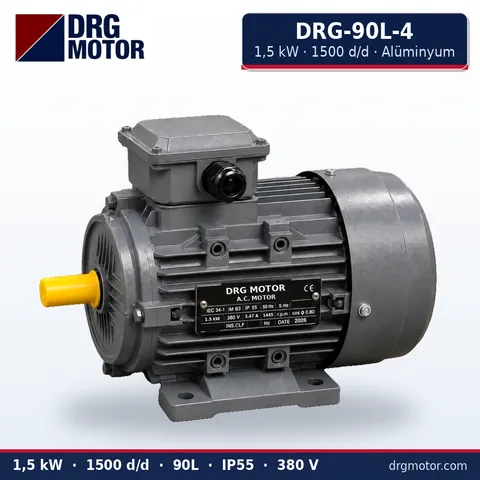
1.5 kW Three-Phase Motor 1500 rpm – DRG-90L-4 Aluminium
- 1.5 kW · 1500 rpm (4 poles)
- Aluminium frame · IEC 90L
- Shaft: 24 × 50 mm
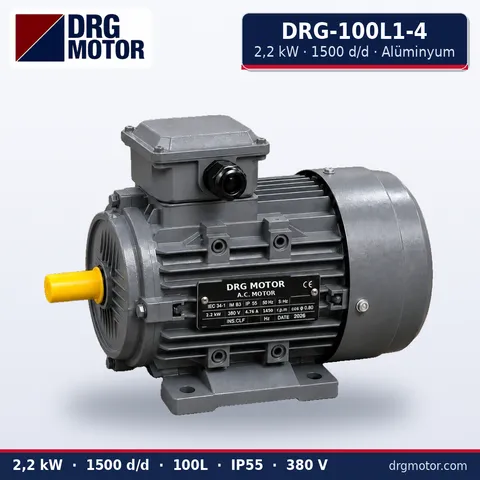
2.2 kW Three-Phase Motor 1500 rpm – DRG-100L1-4 Aluminium
- 2.2 kW · 1500 rpm (4 poles)
- Aluminium frame · IEC 100L
- Shaft: 28 × 60 mm
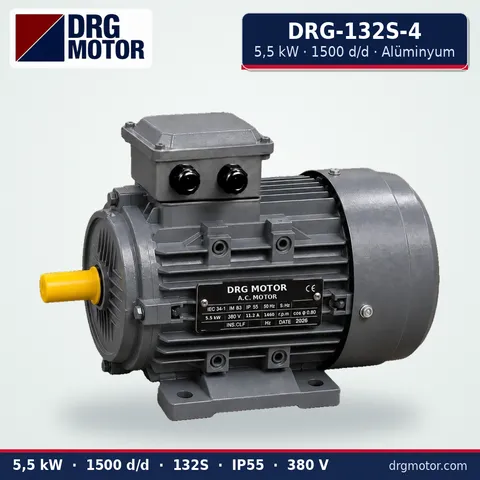
5.5 kW Three-Phase Motor 1500 rpm – DRG-132S-4 Aluminium
- 5.5 kW · 1500 rpm (4 poles)
- Aluminium frame · IEC 132S
- Shaft: 38 × 80 mm
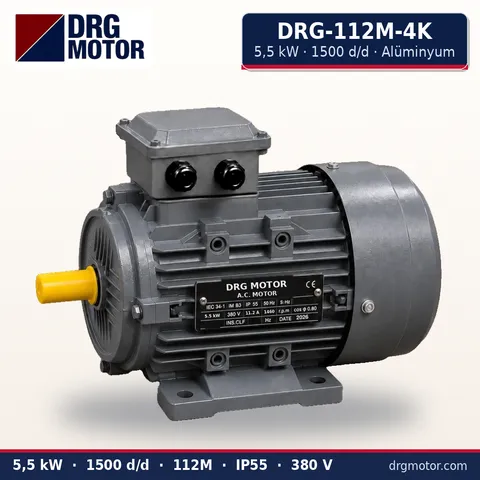
5.5 kW Compact Three-Phase Motor 1500 rpm – DRG-112M-4K Aluminium
- 5.5 kW · 1500 rpm (4 poles)
- Aluminium frame · IEC 112M
- Shaft: 28 × 60 mm
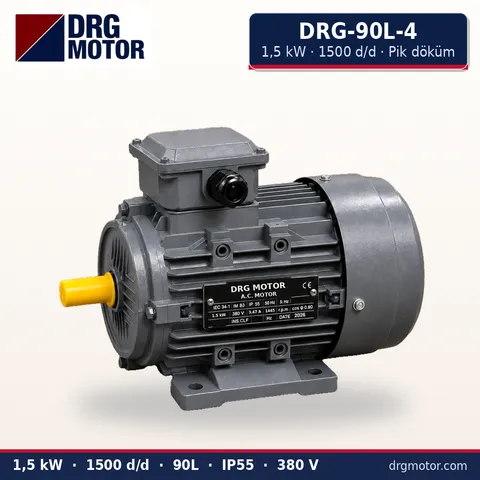
1.5 kW Three-Phase Motor 1500 rpm – DRG-90L-4 Cast Iron
- 1.5 kW · 1500 rpm (4 poles)
- Cast iron frame · IEC 90L
- Shaft: 24 × 50 mm
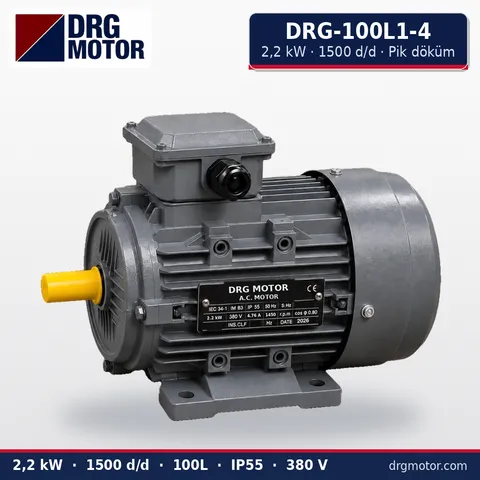
2.2 kW Three-Phase Motor 1500 rpm – DRG-100L1-4 Cast Iron
- 2.2 kW · 1500 rpm (4 poles)
- Cast iron frame · IEC 100L
- Shaft: 28 × 60 mm