English
 Le français
 Türkçe




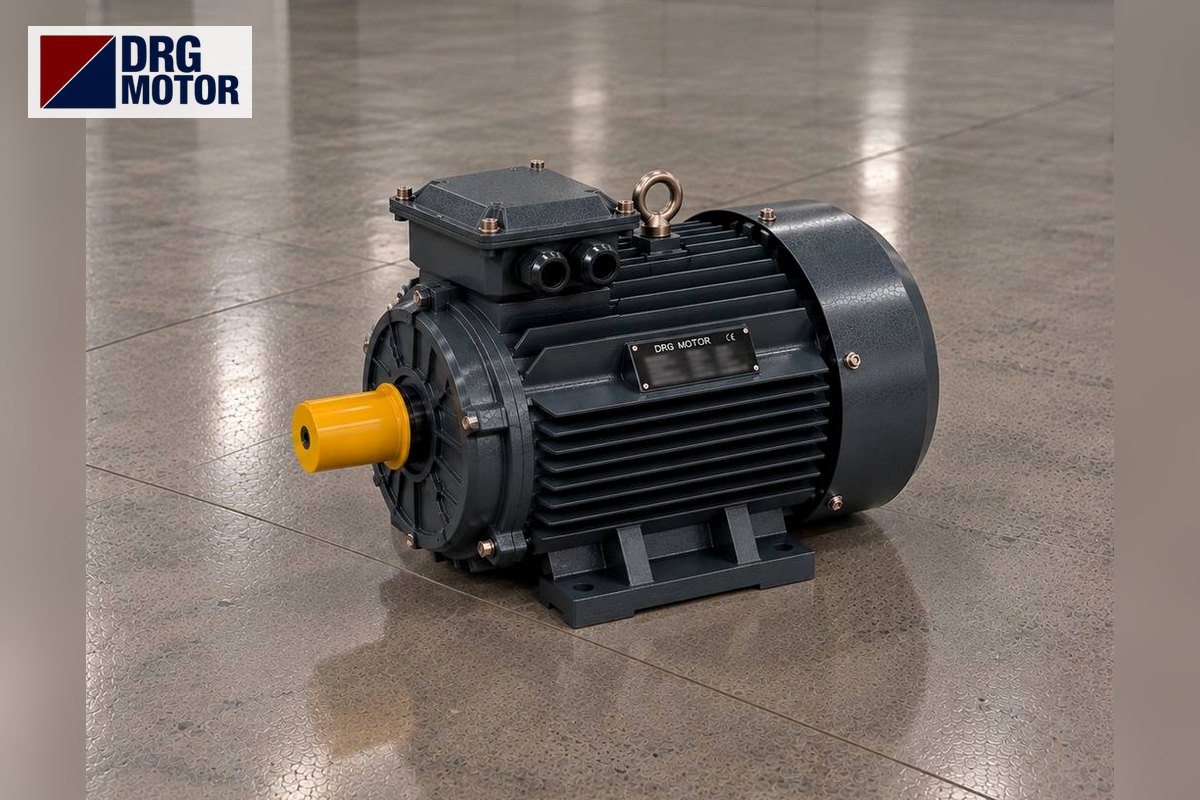

Synchronous speed is the rotation speed of the rotating magnetic field in an asynchronous electric motor, found from ns = 120 · f / p, where f is the supply frequency (50 Hz in Turkey) and p is the number of poles. The rotor's actual speed is always slightly below this synchronous speed; the difference is called slip. For example, at 50 Hz a 4-pole electric motor has a synchronous speed of 1500 rpm, while its nameplate (actual) speed is about 1450 rpm.
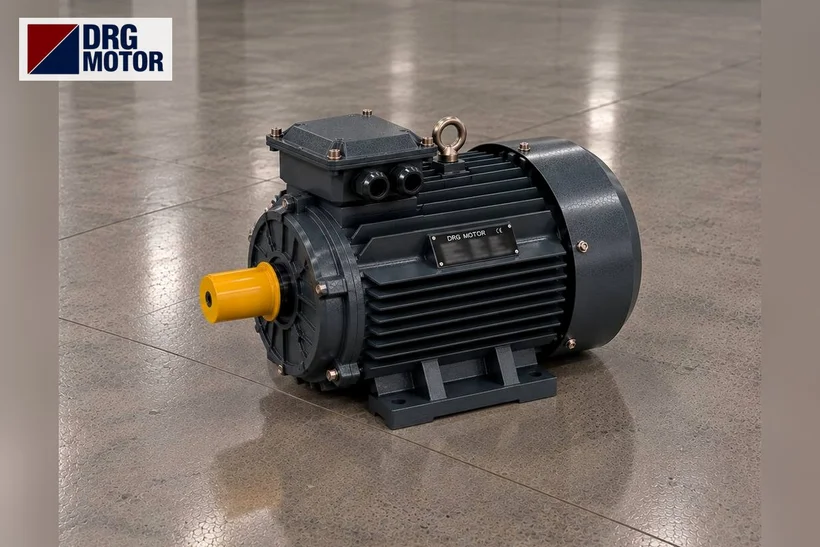
DRG Motor is a manufacturer, supplier and seller of electric motors. You can compare three-phase asynchronous electric motors in different pole and speed classes in the online electric motor shop, and see the same models together in the three-phase asynchronous electric motors category.
What is synchronous speed and how is the formula used?
When a three-phase asynchronous electric motor is energised, the stator windings create a magnetic field that rotates at a fixed speed. This is the synchronous speed (ns), and it depends on only two things: the supply frequency and the number of poles formed by the windings:
ns = 120 · f / p (ns: synchronous speed rpm, f: frequency Hz, p: number of poles)
Since the frequency on the Turkish grid is 50 Hz, the only variable that sets synchronous speed is the pole count. More poles mean a lower synchronous speed, which is why the same power rating is offered in different speed options.
Synchronous speed for 2, 4 and 6 poles
Below are the 50 Hz synchronous speeds and typical nameplate speeds for the three most common pole classes. The nameplate speed is slightly below synchronous speed because of slip.
| Poles | Synchronous speed (50 Hz) | Typical nameplate speed | Approx. slip |
|---|---|---|---|
| 2 poles | 3000 rpm | ~2900 rpm | ~3% |
| 4 poles | 1500 rpm | ~1450 rpm | ~3% |
| 6 poles | 1000 rpm | ~960 rpm | ~4% |
The check is simple: 2 poles ns = 120 · 50 / 2 = 3000 rpm, 4 poles 120 · 50 / 4 = 1500 rpm, 6 poles 120 · 50 / 6 = 1000 rpm. Always use the total number of poles for p, not the number of pole pairs.
Click to see current electric motor prices and order nowSEE PRICES →
Why is the actual speed below synchronous speed?
In an asynchronous electric motor the rotor must lag slightly behind the rotating field to produce torque. If the rotor reached full synchronous speed, there would be no relative motion between field and rotor, no voltage would be induced in the rotor bars, and torque would fall to zero. So every loaded asynchronous electric motor runs below synchronous speed, at its actual (rated) speed:
Actual speed = Synchronous speed − Slip
As load increases, slip grows and speed drops a little more; at no load the speed is very close to synchronous. The speed printed on the nameplate is the actual speed at rated load.
How is slip percentage calculated?
Slip (s) is the difference between synchronous speed and actual speed, relative to synchronous speed, usually given as a percentage:
s (%) = (ns − n) / ns · 100 (n: actual/rated speed)
Examples, using the nameplate speeds of the DRG 4 kW models:
- 2 poles, ns = 3000 rpm, n = 2905 rpm → s = (3000 − 2905) / 3000 · 100 ≈ 3.2%
- 4 poles, ns = 1500 rpm, n = 1450 rpm → s = (1500 − 1450) / 1500 · 100 ≈ 3.3%
- 6 poles, ns = 1000 rpm, n = 968 rpm → s = (1000 − 968) / 1000 · 100 ≈ 3.2%
In standard three-phase asynchronous electric motors the rated slip is usually between 2% and 5%; it rises a little at low powers and low speeds.
Why does the nameplate read 2900 / 1450 / 960?
Catalogues and nameplates show 2900, 1450 or 960 instead of the round 3000, 1500, 1000 because of slip. The 3000, 1500 and 1000 rpm figures are only theoretical synchronous speeds; the motor never quite reaches them. The nameplate carries the actual speed measured at rated load, a few percent below synchronous. That is why an electric motor searched for as "3000 rpm" usually shows a value in the 2900s on its nameplate — not an error, but the natural result of slip.
Worked examples with DRG models
DRG models that offer the same 4 kW power in three pole classes make the relationship between synchronous speed and actual speed concrete. The model codes link straight to the product page, with both aluminium and cast iron options.
| Model | Poles / Synchronous speed | Nameplate speed | Rated current (400 V) |
|---|---|---|---|
| DRG-112M-2 (aluminium) | 2 poles / 3000 rpm | 2905 rpm | 7.45 A |
| DRG-112M-4 (aluminium) | 4 poles / 1500 rpm | 1450 rpm | 7.95 A |
| DRG-132M1-6 (aluminium) | 6 poles / 1000 rpm | 968 rpm | 8.99 A |
The same power means higher torque as speed falls: the 6-pole 968 rpm model delivers noticeably more torque than the 2-pole one. The cast iron counterparts share the same electrical values; for instance the DRG-112M-4 cast iron model is also in the 1500 rpm class. To check speed and current you can use the electric motor calculator and the motor current chart.
What to watch when choosing a speed
If you are replacing an existing electric motor, read the nameplate speed and pick the same pole class: a 2900s speed means 2 poles, a 1450s speed means 4 poles, a 960s speed means 6 poles. For a new application the speed and torque required by the driven machine decide. Before any measurement or wiring, switch off the power, verify it is de-energised, and have only qualified electrical personnel carry out the work; set values according to the motor nameplate and panel documentation.
Send a photo of your current motor nameplate and we will find the suitable DRG model together.Send on WhatsApp
Once you have chosen the right speed and pole class, you can compare all power and speed options in the shop.
See three-phase asynchronous electric motor models at the speed you need, with current prices in the shopSEE PRICES
Frequently asked questions
What is the difference between synchronous speed and actual speed?
Synchronous speed is the theoretical speed of the rotating field (ns = 120 · f / p). Actual speed is the speed at which the rotor turns under load, lower by the amount of slip. The gap is called slip.
Does synchronous speed change on a 60 Hz grid?
Yes. With 60 Hz in the formula the synchronous speeds rise: 3600 rpm at 2 poles, 1800 rpm at 4 poles, 1200 rpm at 6 poles. Because the Turkish grid is 50 Hz, the standard values are 3000/1500/1000 rpm.
Is a high slip percentage a problem?
A slip of 2–5% is normal in standard three-phase asynchronous electric motors. A markedly larger speed drop at rated load can indicate overload or a voltage issue; compare against the nameplate values.
I want 3000 rpm but the nameplate says 2900 — is that wrong?
No. 3000 rpm is the synchronous speed; the 2900s figure on the nameplate is the actual speed caused by slip. The "3000 rpm" class refers to a 2-pole electric motor.
Electric Motors Related to This Topic — Models and Current Prices
Suitability is not decided by power alone: compare the speed, voltage, mounting, shaft and fixing dimensions of your machine with the product data; if unsure, send us the nameplate of your current motor.
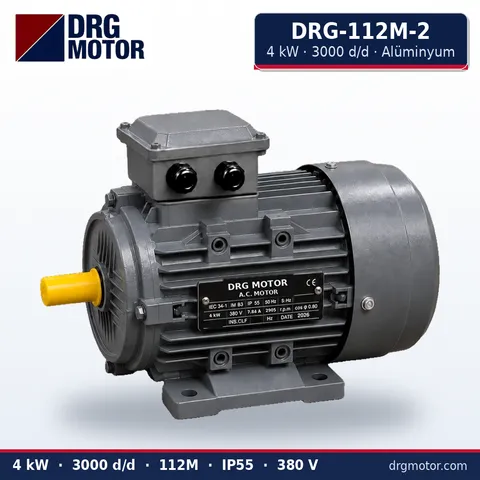
4 kW Three-Phase Motor 3000 rpm – DRG-112M-2 Aluminium
- 4 kW · 3000 rpm (2 poles)
- Aluminium frame · IEC 112M
- Shaft: 28 × 60 mm
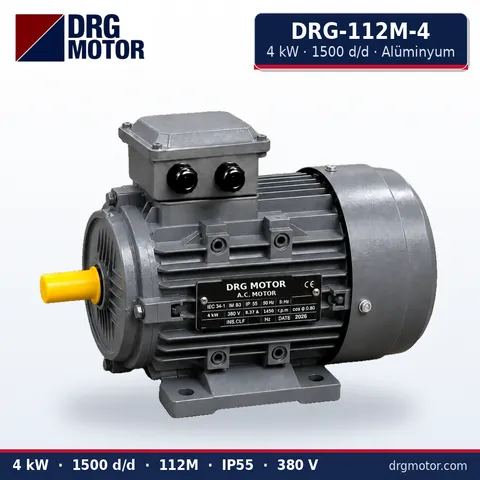
4 kW Three-Phase Motor 1500 rpm – DRG-112M-4 Aluminium
- 4 kW · 1500 rpm (4 poles)
- Aluminium frame · IEC 112M
- Shaft: 28 × 60 mm
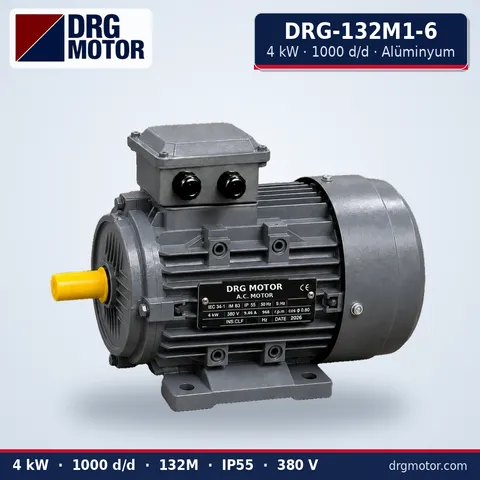
4 kW Three-Phase Motor 1000 rpm – DRG-132M1-6 Aluminium
- 4 kW · 1000 rpm (6 poles)
- Aluminium frame · IEC 132M
- Shaft: 38 × 80 mm
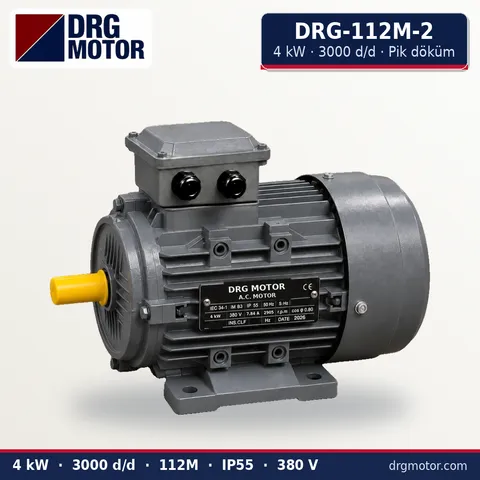
4 kW Three-Phase Motor 3000 rpm – DRG-112M-2 Cast Iron
- 4 kW · 3000 rpm (2 poles)
- Cast iron frame · IEC 112M
- Shaft: 28 × 60 mm
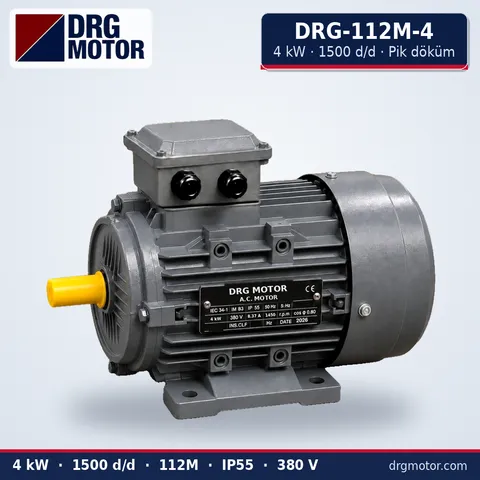
4 kW Three-Phase Motor 1500 rpm – DRG-112M-4 Cast Iron
- 4 kW · 1500 rpm (4 poles)
- Cast iron frame · IEC 112M
- Shaft: 28 × 60 mm
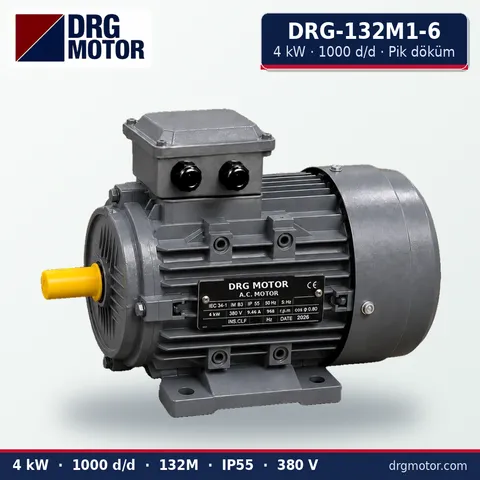
4 kW Three-Phase Motor 1000 rpm – DRG-132M1-6 Cast Iron
- 4 kW · 1000 rpm (6 poles)
- Cast iron frame · IEC 132M
- Shaft: 38 × 80 mm