English
 Le français
 Türkçe

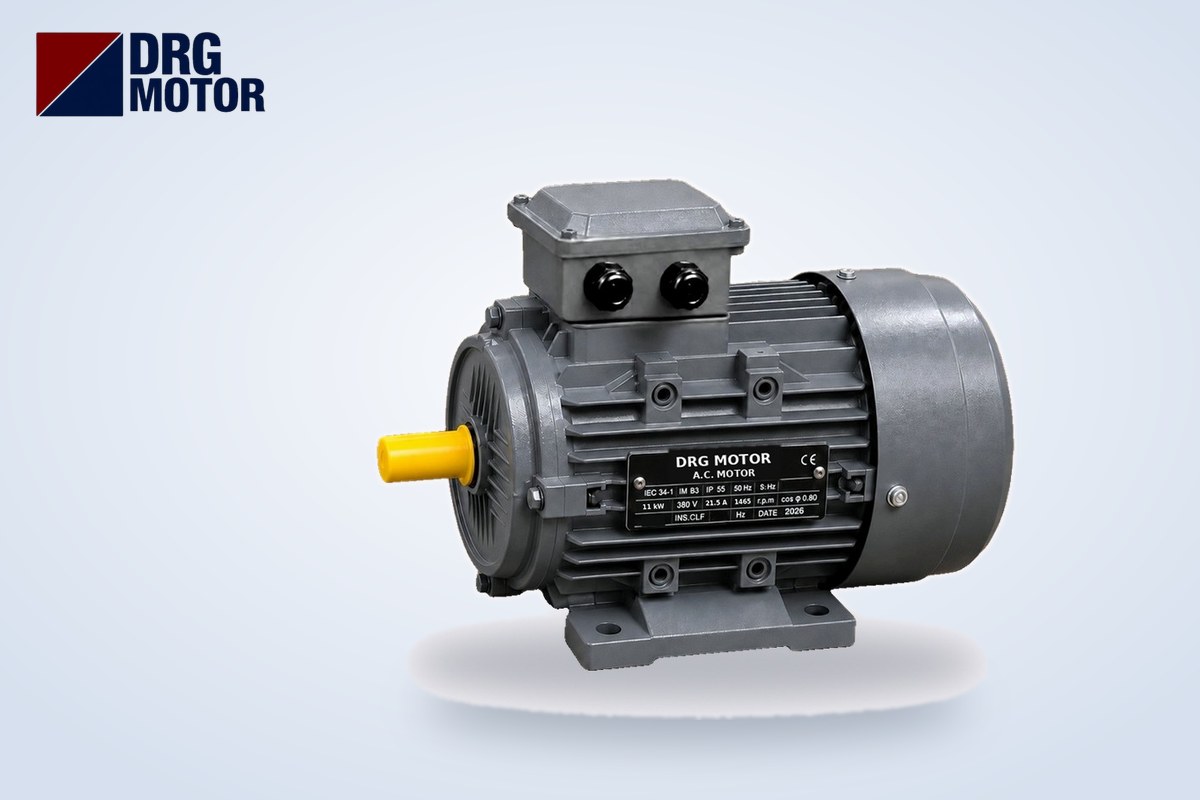

The motor power for a hydraulic pump is found with P (kW) = p (bar) × Q (L/min) / (600 × η_pump), where p is the highest working pressure set on the relief valve, Q is the flow delivered by the pump and η_pump is the overall pump efficiency from the pump catalogue. Example: for a unit requiring 160 bar and 25 L/min, with η_pump = 0.85, 160 × 25 / (600 × 0.85) = 7.84 kW; the next standard rating above that is 11 kW, and its 4-pole (1500 rpm) match is DRG-160M-4 (11 kW, frame 160M). The result is never rounded down: 7.5 kW does not cover the required 7.84 kW.
Three things change the power: the valve setting (power rises in direct proportion to pressure), the flow, which is pump displacement multiplied by motor speed, and the pump efficiency, which depends on the pump type. You can pick the motor that matches your calculated power by frame among the 4-pole models on the Buy Electric Motors Online page.
Where the Formula Comes From and Which Values to Use
Hydraulic power is pressure multiplied by volumetric flow. Since 1 bar = 100,000 Pa and 1 L/min = 1/60,000 m³/s, bar × L/min equals 100,000 / 60,000 = 1.667 W; dividing by 1000 to get kW gives the constant 600. Choose the values as follows:
- p: the highest pressure the circuit will see, i.e. the relief valve setting. Not the pressure the cylinder works at "most of the time".
- Q: the actual pump flow. For a fixed-displacement pump Q = V × n / 1000 (V: cm³/rev, n: rated motor speed).
- η_pump: the overall pump efficiency from the pump catalogue (volumetric and mechanical losses together). The examples in this article use 0.85; enter your own pump's value. This is a pump value, not a motor value.
- Result: the kW you get is always rounded up to the next standard rating: 2.2 – 3 – 4 – 5.5 – 7.5 – 11 – 15 – 18.5 – 22 kW.
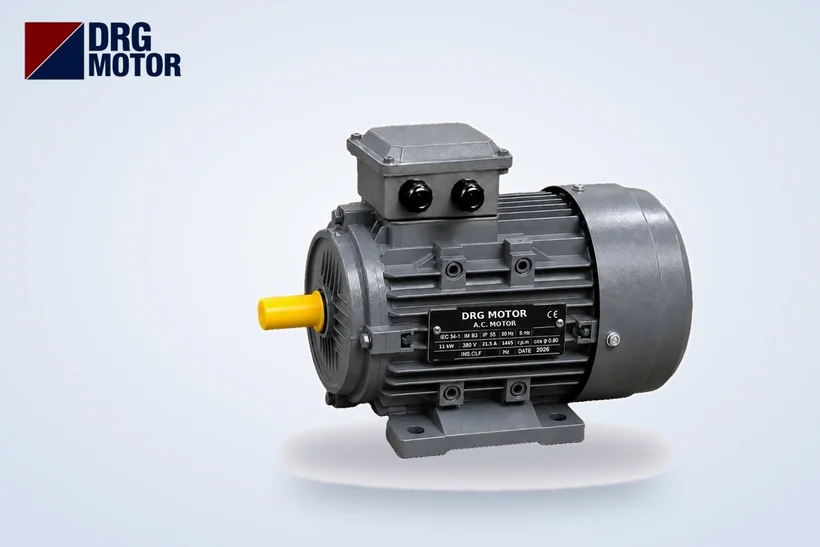
Worked Example: Which Motor Does 160 bar × 25 L/min Need?
Step by step: 160 × 25 = 4000; 600 × 0.85 = 510; 4000 / 510 = 7.84 kW. In the standard series the first rating after 7.5 kW is 11 kW, i.e. DRG-160M-4. Torque check: the torque required at the pump shaft is 9550 × 7.84 / 1465 ≈ 51.1 Nm; since DRG-160M-4 has a rated torque of 71.7 Nm, the motor keeps a margin even at full load. The pump size needed for this flow is 25 × 1000 / 1465 ≈ 17.1 cm³/rev.
A more economical alternative is often asked about: with a 16 cm³/rev pump the flow becomes 16 × 1460 / 1000 = 23.36 L/min and the power drops to 7.33 kW. In that case DRG-132M-4 (7.5 kW, rated torque 49.1 Nm) is sufficient; required torque ≈ 47.9 Nm. The margin is narrow: if the valve will be set above 160 bar, or the unit runs for long periods with cold oil, stay with 11 kW.
Pressure × flow → motor power table (η_pump = 0.85)
Each cell gives the kW from the formula, with the standard kW to select in brackets.
| Pressure (bar) | 10 L/min | 20 L/min | 30 L/min | 40 L/min | 60 L/min |
|---|---|---|---|---|---|
| 70 | 1.37 (2.2) | 2.75 (3) | 4.12 (5.5) | 5.49 (5.5) | 8.24 (11) |
| 100 | 1.96 (2.2) | 3.92 (4) | 5.88 (7.5) | 7.84 (11) | 11.76 (15) |
| 160 | 3.14 (4) | 6.27 (7.5) | 9.41 (11) | 12.55 (15) | 18.82 (22) |
| 210 | 4.12 (5.5) | 8.24 (11) | 12.35 (15) | 16.47 (18.5) | 24.71 (30) |
| 250 | 4.9 (5.5) | 9.8 (11) | 14.71 (15) | 19.61 (22) | 29.41 (30) |
For units that come out at 30 kW, see the 4-pole models of 30 kW and above in the store. Intermediate values can be calculated with the electric motor calculators.
Why Is a 1500 rpm Motor Preferred on a Hydraulic Power Unit?
Flow is not set by the pump alone; it is displacement times speed: Q (L/min) = V (cm³/rev) × n (rpm) / 1000. For example, an 8 cm³/rev gear pump driven by DRG-112M-4 (rated 1450 rpm) delivers 11.6 L/min. To get the same 25 L/min with the 2-pole DRG-160M1-2 (rated 2945 rpm), a smaller pump of ≈ 8.5 cm³/rev is enough, while the power stays the same — because power depends on pressure and flow, not on speed.
Even so, most hydraulic power units use a 4-pole motor: for some gear and vane pumps the maximum speed permitted by the catalogue is below 3000 rpm, the risk of cavitation on the suction side grows with speed, and noise and wear are lower.
Matching Table for the 4-Pole Motors in Our Store
The table below is read the other way round: for each standard rating, assuming η_pump = 0.85, it shows the maximum flow the motor can carry at 160 bar, and the pump displacement that delivers that flow at the motor's rated speed. If your pump displacement is below this value, the motor is sufficient.
| Model | kW | Rated speed (rpm) | Rated torque (Nm) | Frame | Max. flow at 160 bar (L/min) | Required displacement (cm³/rev) |
|---|---|---|---|---|---|---|
| DRG-100L1-4 | 2.2 | 1450 | 14.5 | 100L | 7.0 | 4.8 |
| DRG-100L2-4 | 3 | 1450 | 19.8 | 100L | 9.6 | 6.6 |
| DRG-112M-4 | 4 | 1450 | 26.3 | 112M | 12.8 | 8.8 |
| DRG-132S-4 | 5.5 | 1460 | 36 | 132S | 17.5 | 12.0 |
| DRG-132M-4 | 7.5 | 1460 | 49.1 | 132M | 23.9 | 16.4 |
| DRG-160M-4 | 11 | 1465 | 71.7 | 160M | 35.1 | 23.9 |
| DRG-160L-4 | 15 | 1465 | 97.8 | 160L | 47.8 | 32.6 |
| DRG-180M-4 | 18.5 | 1470 | 120.2 | 180M | 59.0 | 40.1 |
| DRG-180L-4 | 22 | 1470 | 142.9 | 180L | 70.1 | 47.7 |
Links go to the cast iron version; between 2.2 and 11 kW the same code is also in the store with an aluminium frame.
Bell Housing, Coupling and Shaft Fit: B5 and B35 Mounting
On a hydraulic power unit the motor is connected to the pump through a bell housing and a flexible coupling. A flange is needed on the motor side: units mounted vertically or horizontally on top of the tank use the flange-only B5, while horizontal units where the motor is also bolted to the base frame by its feet use foot + flange B35. When ordering the bell housing, the following motor-side dimensions are requested; values are from the catalogue B5 table:
| Frame | Power (4-pole) | Shaft D×E (mm) | Key F (mm) | M (mm) | N (mm) | P (mm) | S (mm) | T (mm) | LA (mm) |
|---|---|---|---|---|---|---|---|---|---|
| 100L | 2.2 kW / 3 kW | 28×60 | 8 | 215 | 180 | 250 | 14.5 | 4 | 13 |
| 112M | 4 kW | 28×60 | 8 | 215 | 180 | 250 | 14.5 | 4 | 14 |
| 132S | 5.5 kW | 38×80 | 10 | 265 | 230 | 300 | 14.5 | 4 | 14 |
| 132M | 7.5 kW | 38×80 | 10 | 265 | 230 | 300 | 14.5 | 4 | 14 |
| 160M | 11 kW | 42×110 | 12 | 300 | 250 | 350 | 18.5 | 5 | 15 |
| 160L | 15 kW | 42×110 | 12 | 300 | 250 | 350 | 18.5 | 5 | 15 |
| 180M | 18.5 kW | 48×110 | 14 | 300 | 250 | 350 | 18.5 | 5 | 15 |
| 180L | 22 kW | 48×110 | 14 | 300 | 250 | 350 | 18.5 | 5 | 15 |
N is the spigot (pilot) diameter the bell housing locates on; M is the bolt circle; S is the hole diameter. The motor half of the coupling is bored to shaft diameter D and keyway width F, and the hub must not be longer than shaft length E. A point to watch: between 4 kW (frame 112M) and 5.5 kW (frame 132S) the shaft grows from 28 mm to 38 mm and flange N from 180 mm to 230 mm, so when increasing power the old bell housing and coupling often cannot be reused. Since 11 kW and 15 kW share the same 160 frame (42×110 shaft, N 250), that step does not change the connecting parts. If vertical (V1) mounting is required, state it in the order.
Motor Selection for Intermittent Load: A Press Cycle Example
On press, shear or mould-clamping units the motor does not run at peak power all the time. A sample cycle at a flow of 20 L/min: approach at 40 bar for 8 s, pressing at 160 bar for 6 s, idle circulation at 10 bar for 16 s (total 30 s). The phase powers are 1.57, 6.27 and 0.39 kW respectively. In terms of heating, the equivalent power is found with the root mean square: √[(1.57²×8 + 6.27²×6 + 0.39²×16) / 30] ≈ 2.93 kW.
Based on heating, 3 kW looks sufficient, but peak torque must also be checked. The 6.27 kW peak requires ≈ 41.3 Nm from DRG-100L2-4; that is ≈ 2.09 times the motor's rated torque of 19.8 Nm and comes very close to the breakdown torque (2.3 × 19.8 ≈ 45.5 Nm). DRG-112M-4, at the same peak, runs at ≈ 41.3 Nm, ≈ 1.57 times its rated torque, comfortably below its breakdown torque of 60.5 Nm. The right choice for this cycle is 4 kW. Rule: equivalent power determines heating, peak power determines torque; if the peak phase lasts longer than a few seconds or the cycle is very frequent, size directly for peak power.
Starting, Connection and Commissioning Checklist
The 2.2 and 3 kW 4-pole motors in the store are 230/400 V and are connected in star on a 380–400 V supply; 4 kW and above are 400/690 V, run in delta on the supply and are therefore suitable for star-delta starting. Because torque in star drops to about one third, the pump must be unloaded at start: the unloading (by-pass) valve open, or the directional valve in its centre position open to tank. Check the starting method on the star-delta and other motor starting methods page and the supply cable with the motor cable size calculator.
- Is the pressure in the calculation the actual relief valve setting?
- Was the flow recalculated as pump displacement × rated motor speed / 1000?
- Was the kW rounded up to the next standard rating, and was peak torque checked for intermittent load?
- Does the pump's permitted speed range include 1500 rpm?
- Do the bell housing spigot diameter N, bolt circle M and coupling bore D match the motor frame?
- B5 or B35; if mounted vertically, is that stated in the order?
- Is the terminal connection made according to the rated voltage (Y or Δ)?
- At first start, does the rotation match the arrow on the pump body? A gear pump turning the wrong way will not draw oil.
- Are the tank oil level and suction line correct?
Suitable 4-Pole Motors for Hydraulic Pumps
Cast iron frame; model – power – speed – IEC frame:
- DRG-100L1-4 – 2.2 kW – 1500 rpm – 100L
- DRG-100L2-4 – 3 kW – 1500 rpm – 100L
- DRG-112M-4 – 4 kW – 1500 rpm – 112M
- DRG-132S-4 – 5.5 kW – 1500 rpm – 132S
- DRG-132M-4 – 7.5 kW – 1500 rpm – 132M
- DRG-160M-4 – 11 kW – 1500 rpm – 160M
- DRG-160L-4 – 15 kW – 1500 rpm – 160L
- DRG-180M-4 – 18.5 kW – 1500 rpm – 180M
- DRG-180L-4 – 22 kW – 1500 rpm – 180L
Click to see current prices and order these motors nowSEE PRICES →
If you are choosing a motor for a centrifugal (water) pump, the method is different; see the article on matching a motor to a centrifugal pump by kW and speed.
Frequently Asked Questions
What size motor do I need for a hydraulic pump?
Multiply the pressure (bar) by the flow (L/min) and divide by 600 × η_pump. For 100 bar and 20 L/min with η_pump = 0.85 you get 3.92 kW; the motor to choose is 4 kW (DRG-112M-4).
How do I calculate flow from pump displacement?
Q = V × n / 1000. An 8 cm³/rev pump with a 4 kW motor rated at 1450 rpm delivers 11.6 L/min. Use the motor's rated speed in the calculation, not the synchronous 1500.
Should a hydraulic unit use 1500 rpm or 3000 rpm?
The power is the same at both speeds. If the pump catalogue allows it, 3000 rpm gives the same flow with a smaller pump; 1500 rpm is still the common choice.
Can a hydraulic pump motor be started star-delta?
Yes, if the motor is 400/690 V (4 kW and above in the store) and the pump is unloaded at start.
Send us your pressure, flow, pump displacement and bell housing dimensions and we will determine the right motor together: phone +90 (542) 666 11 11, e-mail [email protected], contact page. You can order the rating you select directly from the 120 models in our online store.