English
 Le français
 Türkçe




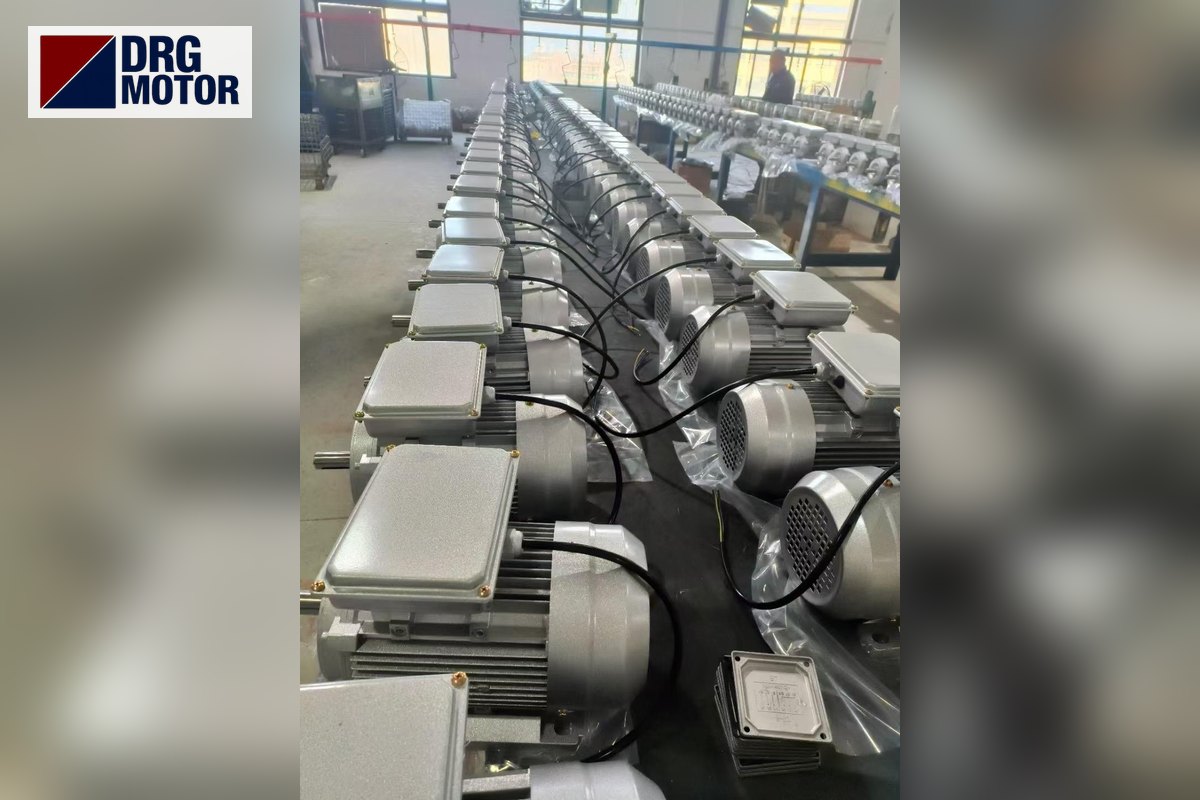

When the hydraulic pump motor of a car lift burns out, replace it with a motor that has the same power and speed as on the old nameplate, suits the workshop supply (single-phase or three-phase) and connects to the pump with the same flange and shaft dimensions. On two-post and scissor workshop lifts this is usually a motor of a few kW with 2 or 4 poles; the exact value is on the lift manufacturer's nameplate and in its catalogue.
Three things decide the replacement: how many seconds the lift needs to reach the top with a loaded car (power and speed), the voltage line on the nameplate (230 V single-phase or 400 V three-phase) and how the motor sits on the power unit (standard IEC flange or a connection specific to the unit block). Do not order before these three are clear.
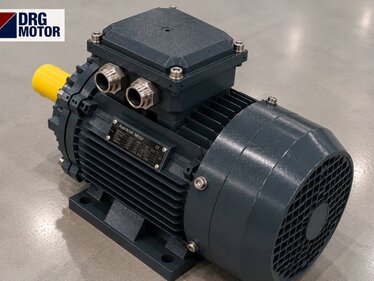
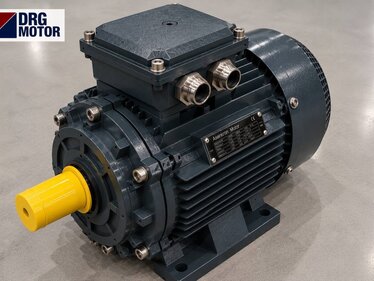
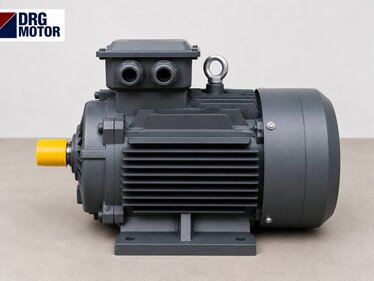
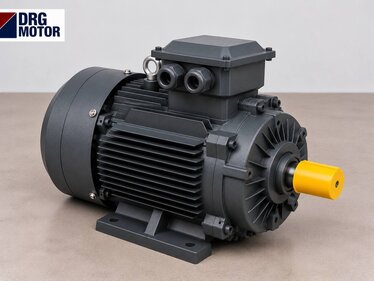
DRG Motor is a manufacturer, supplier and seller of electric motors; its range covers three-phase asynchronous IEC motors. You can filter the small 2- and 4-pole models that fit a lift unit by power and speed on the buy electric motors online page.
The Lift Motor Runs Only When Lifting; Gravity Does the Lowering
In the power unit the motor turns the gear pump inside the tank; the pump pushes oil through a check valve into the cylinders and the arms rise. When the up button is released the motor stops, the check valve holds the oil in the cylinder and the mechanical safety locks carry the load.
The motor does not run at all during lowering. The locks are released, the lowering valve (solenoid or manual) opens and the weight of the car pushes the oil back to the tank through a flow restrictor. The load the motor sees is therefore a lifting cycle repeated a few times per hour, each under a minute. The motor does not run at full load for long periods, but it starts under a loaded car in every cycle.
The main cause of overheating is misuse: if the button is held after the platform reaches the top, the pump keeps delivering against the relief valve at maximum pressure, the motor draws full current and the energy turns into heat in the oil. On lift motors that burn out often, check this habit and the relief valve setting first.
From Lifting Time to Motor Power: Worked Example
Lift motor power can be checked from the load and lifting speed as well as from pressure and flow: P = m · g · v / η. The general pressure-and-flow method is explained in the hydraulic pump electric motor selection article; here we take the route specific to lifts.
Example and assumptions: a 3-tonne car plus about 300 kg of arms and carriages, 3,300 kg in total; lifting height 1.8 m; pump efficiency 0.85 and a further 0.85 for cylinder and line losses, so overall η ≈ 0.72. With a 45-second lift the speed is 40 mm/s; the power lifting the load is 3,300 × 9.81 × 0.04 ≈ 1.29 kW, the power needed at the motor shaft is 1.29 / 0.72 ≈ 1.79 kW and the next standard rating is 2.2 kW.
| Lifting time (1.8 m) | Platform speed | Motor shaft power | Standard rating to choose |
|---|---|---|---|
| 30 s | 60 mm/s | 2.69 kW | 3 kW – DRG-100L2-4 |
| 45 s | 40 mm/s | 1.79 kW | 2.2 kW – DRG-100L1-4 |
| 60 s | 30 mm/s | 1.34 kW | 1.5 kW – DRG-90L-4 |
| 90 s | 20 mm/s | 0.90 kW | 1.1 kW |
The table is only an example: the same lift needs more power if it rises faster and less if it rises slower. If you do not want to change the lift speed, take the old motor's kW and speed exactly; the calculation is for a reasonable estimate when the nameplate is unreadable.
Click to see current electric motor prices and order nowSEE PRICES →
If the Nameplate Says Single-Phase: 230 V vs 400 V
Some lifts sold for home garages have a 230 V single-phase capacitor motor on the unit; the nameplate shows a single voltage (230 V) and there is a capacitor box on the motor. DRG's range has no single-phase motors; in that case the replacement must again be single-phase and a direct swap with a standard three-phase motor is not possible.
If the workshop has 400 V three-phase, the unit can be converted to a three-phase motor, but the motor is not the only change: the contactor in the control box must be three-pole, the overload relay must match the new motor's current and the cable must have four cores. For example the 2.2 kW DRG-100L1-4 draws 4.52 A at 400 V and 7.6 times this current at start. You can check overload relay and contactor ranges on the motor overload, fuse and contactor selection page.
DRG motors up to 3 kW are wound for 230/400 V and connected in star on a 400 V supply; since most lift units stay in this power range, terminal wiring is simple. Panel and terminal work must be done by a qualified electrician.
How the Motor Attaches to the Power Unit: Flange, Shaft and Position
On a lift unit the motor sits either vertically on top of the tank or horizontally at the side; in both cases the housing is carried by the flange, not by feet. There are two different designs here and you need to know which one you have before dismantling.
The first design is a unit where the motor is connected to the pump through a bell housing and a flexible coupling via a standard B5 large flange. In this case an IEC-dimension motor is a direct replacement: on frame 90L the shaft is 24×50 mm, flange bolt circle M 165 mm, spigot diameter N 130 mm, flange outer diameter P 200 mm; on frame 100L the shaft is 28×60 mm, M 215, N 180, P 250 mm.
The second design is common on compact units: the motor end shield bolts directly to the aluminium centre block and the pump is driven by a flat or slotted tang on the end of the motor shaft. The shaft and flange of these motors are not IEC standard; a standard motor cannot be fitted to such a unit and a special motor is required. Alternatively the unit can be converted to an IEC bell housing and coupling connection; that decision should be taken together with the unit manufacturer.
2 Poles or 4 Poles: Speed Changes the Lifting Time
Gear pump flow is proportional to speed. If you replace a 2-pole motor (about 2900 rpm) with a 4-pole motor (about 1450 rpm), the lift still raises the same load but at half speed: a 45-second lift becomes 45 × 2895 / 1450 ≈ 90 seconds.
The reverse is riskier. With a 2-pole motor on a 4-pole unit the flow doubles; the pump may exceed its speed limit, cavitation starts at the suction and the required power also approaches double. So read the speed from the nameplate and choose the same. For a 2-pole unit the 2.2 kW DRG-90L-2 (2895 rpm, 7.26 Nm) is a typical match for this duty.
The environment matters too: lift columns are exposed to tyre and brake dust and, near a wash bay, to moisture. DRG motors are IP55; even so, never aim a pressure washer directly at the motor. In winter cold oil raises the current on the first lift; 4-pole models with a starting torque ratio of 2.3 handle this load.
Checklist Before Replacing the Lift Motor
- Photo of the nameplate: kW, speed, voltage line (230 V single-phase, 230/400 V or 400/690 V).
- Is there a capacitor box on the motor? If so, the motor is single-phase.
- Is the motor connected to the pump by bell housing and coupling, or directly to the unit block?
- Have the flange bolt circle (M), spigot diameter (N), shaft diameter and length been measured?
- Does the motor stand vertically or horizontally? Is vertical mounting stated in the order?
- Do the contactor and overload relay in the control box suit the new motor's current?
- Has the rotation arrow on the pump body been noted? Direction will be checked at first start.
- Have the tank oil level and suction strainer been checked? A pump without oil strains the motor for nothing.
DRG Motors Suitable for Car Lift Power Units
The models below fall within the power and speed range common on standard bell-housing-and-coupling lift units; a 2895 rpm model has been added for 2-pole units.
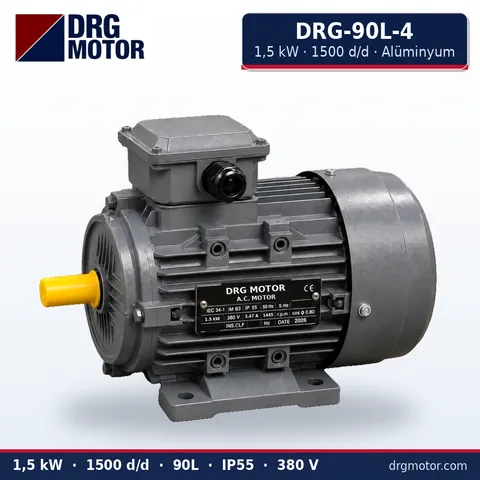
1.5 kW Three-Phase Motor 1500 rpm – DRG-90L-4 Aluminium
- 1.5 kW · 1500 rpm (4 poles)
- Aluminium frame · IEC 90L
- Mounting: B3 · B5 · B14 · B35
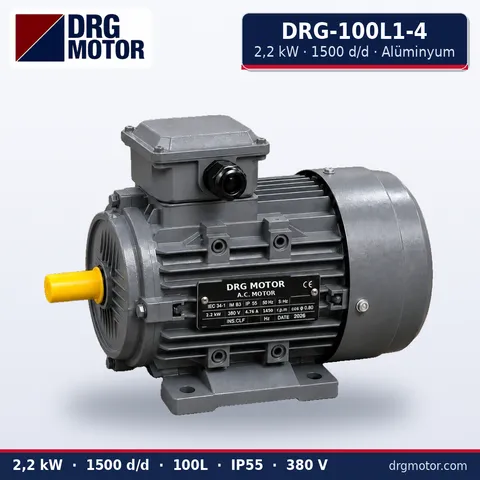
2.2 kW Three-Phase Motor 1500 rpm – DRG-100L1-4 Aluminium
- 2.2 kW · 1500 rpm (4 poles)
- Aluminium frame · IEC 100L
- Mounting: B3 · B5 · B14 · B35
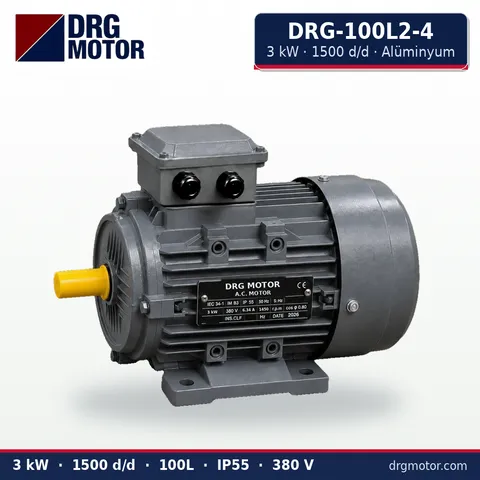
3 kW Three-Phase Motor 1500 rpm – DRG-100L2-4 Aluminium
- 3 kW · 1500 rpm (4 poles)
- Aluminium frame · IEC 100L
- Mounting: B3 · B5 · B14 · B35
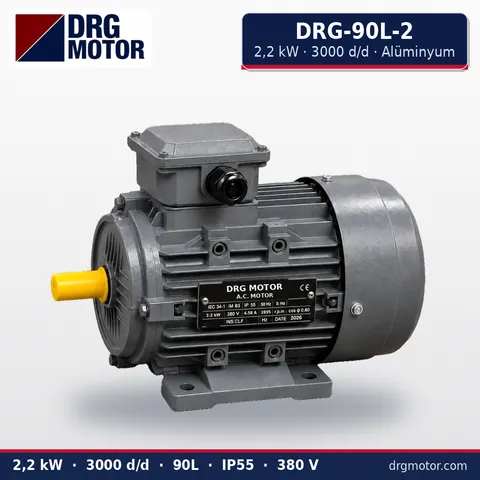
2.2 kW Three-Phase Motor 3000 rpm – DRG-90L-2 Aluminium
- 2.2 kW · 3000 rpm (2 poles)
- Aluminium frame · IEC 90L
- Mounting: B3 · B5 · B14 · B35
Click to see current prices and order these motors nowSEE PRICES →
You can find all hydraulic unit motors on the hydraulic power unit electric motors page and lifting applications on the lifting and handling machine motors page.
Car Lift Motor: Frequently Asked Questions
What kW should a car lift motor be?
The same kW as on the old motor's nameplate. If the plate is unreadable, estimate from the load, lifting height and time: a lift raising 3,300 kg to 1.8 m in 45 seconds needs 2.2 kW with the assumptions above.
Can a three-phase motor replace a single-phase lift motor?
Yes, if the workshop has 400 V three-phase, but the contactor, overload relay and cable change too. With only 230 V single-phase a three-phase motor will not run directly; a single-phase motor is needed.
The lift motor runs but the platform does not rise; is the motor at fault?
Usually not. First check the rotation direction (a gear pump turning backwards delivers no oil), the tank oil level and whether the lowering valve is stuck open. If the motor turns and its current is normal, the problem is on the hydraulic side.
Does the motor need to run while the lift is lowering?
No. On a standard lift, lowering is done by the weight of the car with the lowering valve open; the motor runs only for lifting and for a short up movement to release the locks.
For a quote, send a photo of the motor nameplate, its power, speed, mounting (flange, vertical or horizontal), shaft size and the lift type via WhatsApp, or add the models to the quote list. Phone: +90 (542) 666 11 11 · e-mail: info@drgmotor.com · contact. You can review suitable models in the online store.