English
 Le français
 Türkçe




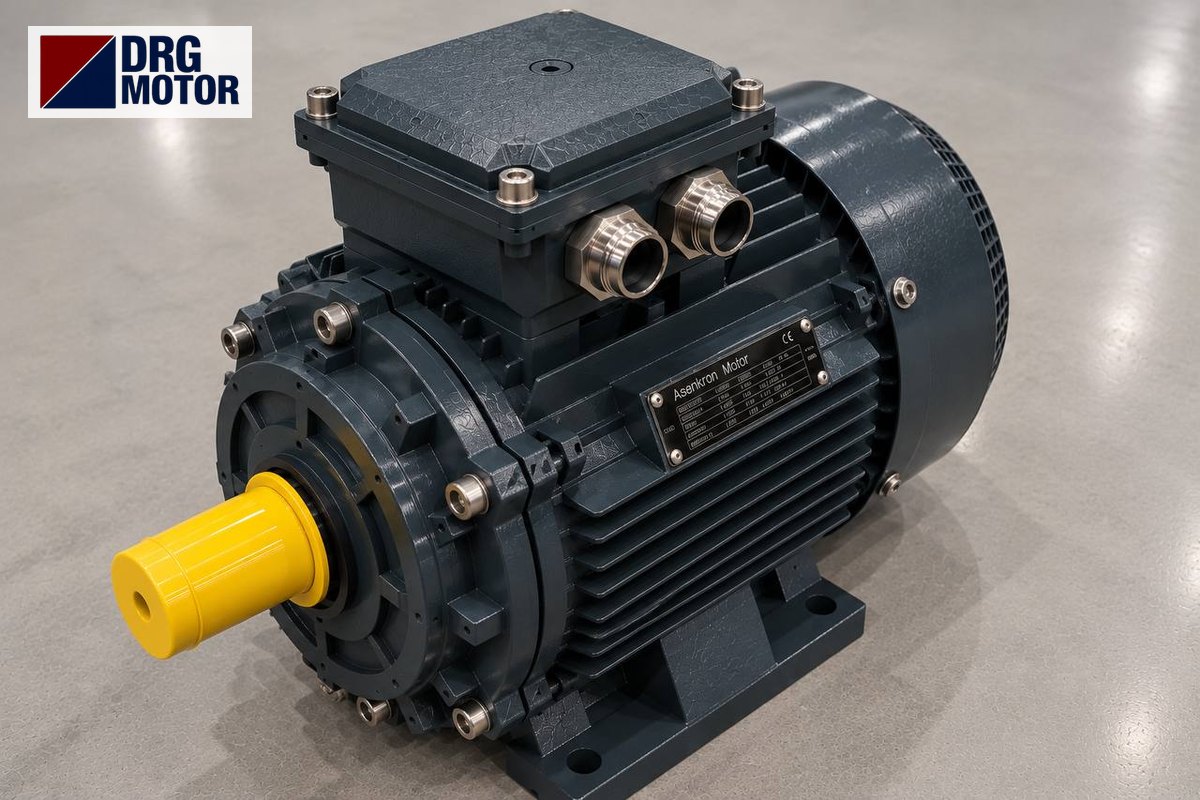

A dry mortar mixer (horizontal ploughshare mixer) has two separate electric motor duties: a 4-pole main motor that turns the ploughshare shaft through a gearbox, and 2-pole motors that directly drive the knife choppers on the drum side wall. For the main motor, the deciding factors are the starting torque with a full drum and a flange that fits the gearbox input; for the chopper motor, they are high speed and how the knife hub is attached to the motor shaft.
DRG Motor is a manufacturer, supplier and seller of electric motors. Suitable three-phase IEC motors for both duties can be selected by power, speed and frame on the buy electric motors online page.
How Do Ploughshares Keep the Material Airborne?
In products such as ready-mix plaster, tile adhesive and grout, sand, cement, lime and very small proportions of additives (cellulose ether, polymer powder, fibre) must become homogeneous within a few minutes. Ploughshare-shaped tools on the shaft rotating in a horizontal cylindrical drum scrape material from the drum wall and throw it towards the centre and upwards; the mix soon behaves like a suspended, fluidised bed.
This only happens if the tool tip speed is above a certain value. In other words, the main shaft speed is part of the mixing quality; changing the motor speed or the gearbox ratio also changes the recipe's mixing time.
Additive lumps are not broken up by the ploughshares. For that job, choppers carrying star-shaped knife packs are mounted on the side or bottom wall of the drum; they run independently of the main shaft and much faster.
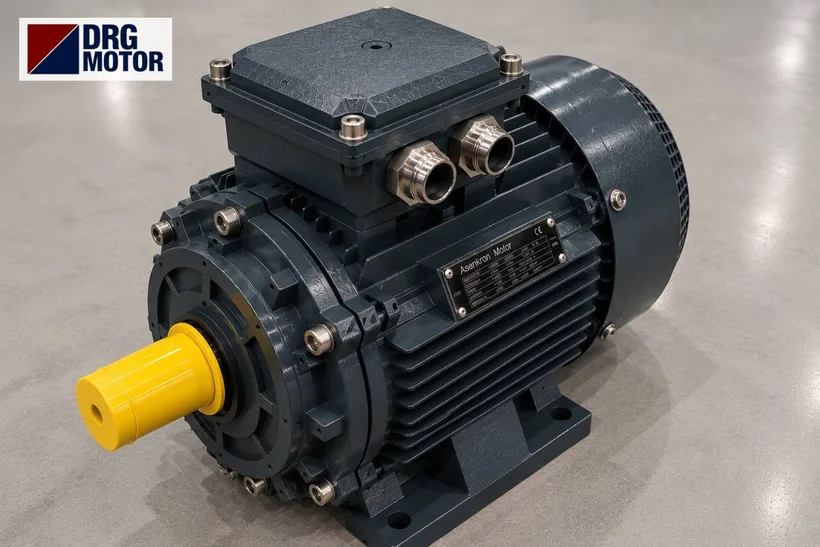
Main Shaft Drive: Starting Torque and Gearbox
The main motor must be able to start with a full drum. After a power cut or emergency stop, tonnes of mix remain in the drum; the settled bed of sand and cement resists the first turn above rated torque. So in selecting the main motor, the Ts/Tn ratio matters as much as kW.
Example: the DRG-160L-4 is 15 kW, 1465 rpm, with a rated torque of 97.8 Nm and a Ts/Tn ratio of 2.2. The DRG-180M-4 is 18.5 kW, 1470 rpm, 120.2 Nm with a ratio of 2.0. Starting torque is about 215 Nm for the 15 kW model and about 240 Nm for the 18.5 kW model; the gap is smaller than expected because of the 15 kW model's higher Ts/Tn ratio.
The main shaft is usually driven by a bevel-helical or parallel shaft gearbox; the motor connects to the gearbox input with a B5 flange. You can find suitable motors on the motors for bevel-helical gearboxes page. DRG does not sell gearboxes; it supplies the motor that fits your existing gearbox's input flange.
Worked example: tool tip speed and gearbox ratio
Assumption: drum inner diameter 1.4 m, main shaft speed 60 rpm. Tool tip speed is v = π × 1.4 × 60 / 60 ≈ 4.4 m/s. To reach this speed with a 1465 rpm motor, the gearbox ratio should be about 24.4. At this speed, 15 kW means roughly 2390 Nm on the shaft, excluding gearbox losses. These values are purely illustrative; the actual diameter and speed are in the machine maker's data sheet.
Click to see current electric motor prices and order nowSEE PRICES →
Chopper Motor: 3000 rpm and the Knife Hub
Chopper motors are usually 2-pole and run without a gearbox. As an assumption, a 250 mm knife pack turned at 2895 rpm by the DRG-100L-2 reaches a tip speed of about 37.9 m/s. The number and power of choppers depend on drum volume; small machines have one, larger ones several.
When replacing, first check where the knife hub sits. If the knives are mounted on a separate bearing housing shaft coupled to the motor, a standard B35 or B5 motor can be used. If the knife pack is fitted directly onto an extended motor shaft, this is a special-shaft application and cannot be covered by a standard IEC motor; in that case, discuss switching to a bearing housing with a standard shaft with the machine maker.
Choppers should be switched on after the main shaft is turning and the material is moving. A chopper motor starting inside a stationary bed draws starting current for a long time and trips its overload.
| Feature | Main shaft motor | Chopper motor |
|---|---|---|
| Poles / speed | 4-pole, about 1465 rpm | 2-pole, about 2900 rpm |
| Transmission | Gearbox (B5 input) | Direct or via coupling |
| Starting condition | Starts with full drum | While material is moving |
| Main risk at shaft end | Gearbox input coupling | Knife hub and seal |
| Example DRG model | DRG-160L-4 | DRG-132S1-2 |
Sand Dust and Conditions Under the Silo
Quartz sand and cement dust are abrasive. Shaft seals keep the drum tight; if a seal leaks, dust reaches the bearing housings first and then the motor flange. DRG motors are IP55, but on a chopper flange with a leaking seal the motor sits under constant dust: fix the seal first.
In most plants the mixer stands in an enclosed floor below the silos and weighing hopper. For shaft-fan cooling (IC411), leave space in front of the motor fan cover; dust-clogged fins raise winding temperature. Ambient must stay within −15…+40 °C and 1000 m altitude.
A cast iron frame is preferred for a vibrating mixer chassis and for dust resistance; DRG cast iron motors cover 0.55–355 kW.
Protection and Start-Up Sequence
The main motor and each chopper should have their own overload relay and contactor. At 400 V, the DRG-160L-4 draws a rated 27.3 A; with an Is/In ratio of 7.8 about 213 A is seen at start-up. For the DRG-100L-2, rated current is 5.71 A with a ratio of 7.8. You can determine overload, fuse and contactor values with the motor overload, fuse and contactor selection tool.
Recommended sequence: the main shaft starts, feed gates open, the mix begins to move, then the choppers come on. If the main shaft is stopped before the discharge door opens, the mix settling in the drum makes the next start heavier.
If you are wondering how this differs from concrete mixers, see our concrete mixer electric motor selection article on wet mixes and twin-shaft plant mixers; dry mortar contains no water, and the load comes from the weight and friction of the sand bed.
Effects of the Wrong Choice on a Dry Mortar Line
- Choosing a 6-pole main motor lowers tool tip speed; the material cannot enter the fluidised state and mixing time increases.
- An underpowered main motor is strained when restarting with a full drum after a power cut.
- Fitting a 4-pole motor to a chopper does not break up fibre and pigment lumps; additive distribution suffers.
- Connecting a motor with a different shaft diameter to the gearbox via a bushing shortens coupling and bearing life.
Pre-order checklist
- Which motor: main shaft or chopper? A nameplate photo for each
- Main motor gearbox input flange: outside diameter, bolt circle, spigot
- Chopper knife hub: separate bearing housing or on the motor shaft?
- Shaft diameter and length, key width
- Mounting: foot (B3), flange (B5) or foot-and-flange (B35)
- Is the motor horizontal or mounted at an angle?
DRG Motors Suitable for Dry Mortar Mixers
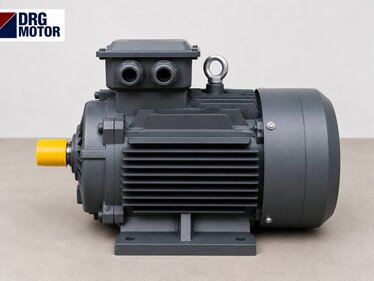
The first two models are 4-pole motors for the ploughshare mixer main shaft gearbox; the last two are 2-pole cast iron motors for choppers. Power is selected according to drum volume and the machine maker's nameplate.
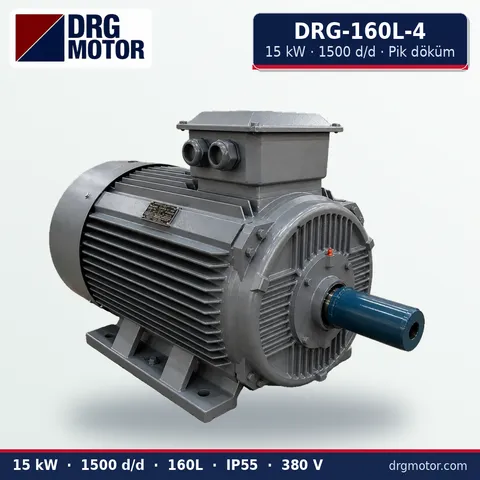
15 kW Three-Phase Motor 1500 rpm – DRG-160L-4 Cast Iron
- 15 kW · 1500 rpm (4 poles)
- Cast iron frame · IEC 160L
- Mounting: B3 · B5 · B14 · B35
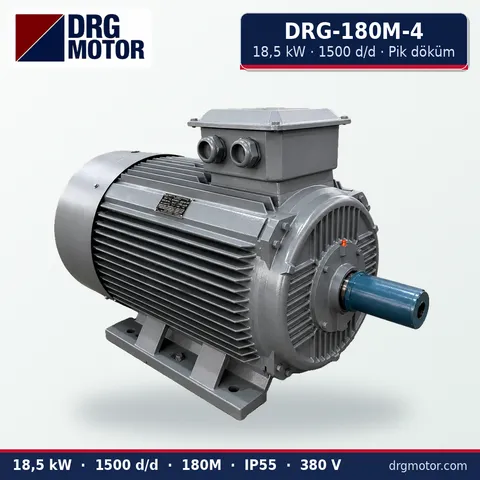
18.5 kW Three-Phase Motor 1500 rpm – DRG-180M-4 Cast Iron
- 18.5 kW · 1500 rpm (4 poles)
- Cast iron frame · IEC 180M
- Mounting: B3 · B5 · B14 · B35
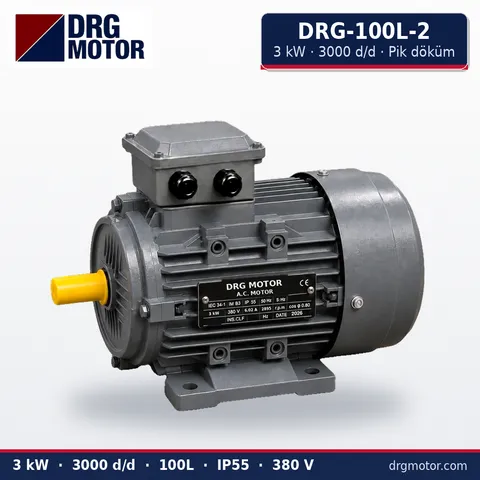
3 kW Three-Phase Motor 3000 rpm – DRG-100L-2 Cast Iron
- 3 kW · 3000 rpm (2 poles)
- Cast iron frame · IEC 100L
- Mounting: B3 · B5 · B14 · B35
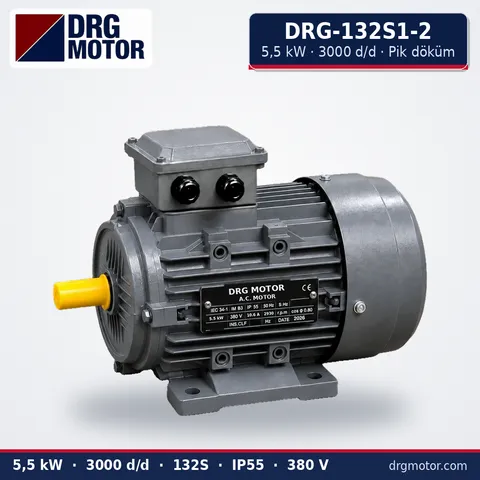
5.5 kW Three-Phase Motor 3000 rpm – DRG-132S1-2 Cast Iron
- 5.5 kW · 3000 rpm (2 poles)
- Cast iron frame · IEC 132S
- Mounting: B3 · B5 · B14 · B35
Click to see current prices and order these motors nowSEE PRICES →
Dry Mortar Mixer Motor: Frequently Asked Questions
What speed should a ploughshare mixer chopper motor have?
Choppers are usually driven directly by 2-pole motors with a synchronous speed of about 3000 rpm. For example, the DRG-100L-2 has a rated speed of 2895 rpm. Confirm the exact value from the machine data sheet.
The dry mortar mixer will not start with a full drum; is the motor too small?
First check the gearbox, shaft seals and discharge door. If these are sound, check whether the motor's nameplate power matches the machine maker's value. Consult the maker before going above the nameplate power.
Can chopper knives be mounted directly on the motor shaft?
Some machines are built that way, but it is a special-shaft application and cannot be covered by a standard IEC motor. If there is a separate bearing housing and coupling, a standard DRG motor can be used.
Is an aluminium frame acceptable for the main shaft motor?
DRG aluminium frame motors go up to 11 kW. They can be used on small laboratory and pilot mixers; main shafts of 15 kW and above need a cast iron frame.
For a quotation, send which motor it is (main shaft or chopper), a nameplate photo, its power, speed, mounting type (foot/flange), shaft size and the mixer's drum volume via WhatsApp, or add the models to the quote list. Phone: +90 (542) 666 11 11 · Email: info@drgmotor.com · Contact. All models are in our online store.