English
 Le français
 Türkçe




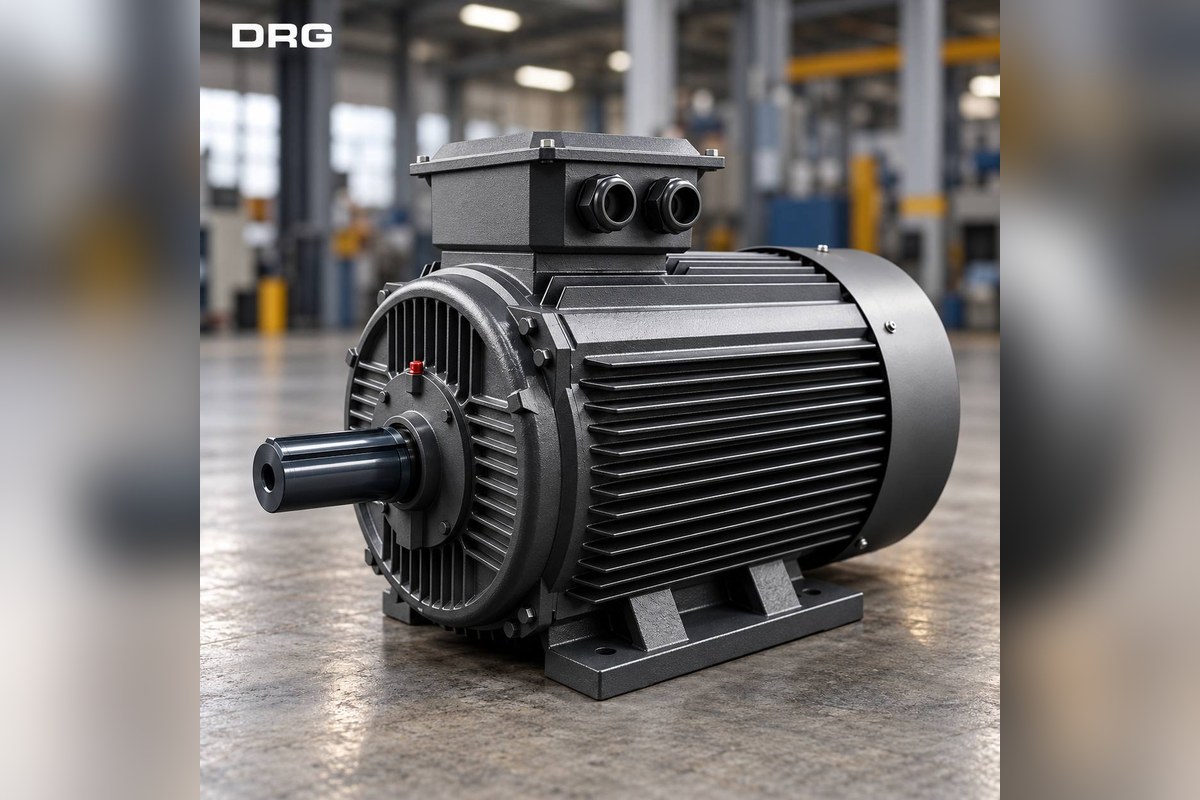

When replacing a pillar drill motor, a small 4-pole three-phase motor of 0.55–1.5 kW is enough in most cases: on a typical workshop drill with a 20–25 mm drilling capacity, the 0.75 kW, 1420 rpm DRG-802-4 draws 1.75 A at 400 V, and in the 32 mm class the 1.1 kW DRG-90S-4 draws 2.48 A. The correct power is on the old motor's nameplate; on a drill with an unreadable plate, the drilling capacity, belt steps and mounting type decide the choice. On belt-driven drills the speed is set by the pulley step, not by the motor, so do not change the number of poles.
The real work with a drill motor is the connection: the motor is fixed vertically to the head, shaft pointing up, by flange or with a foot bracket, it runs forward and reverse for tapping, and in a workshop without three-phase it is fed by an inverter. The wiring, rotation and overload setting must always be done by a qualified electrician; swarf or a glove wrapped around the chuck can cause serious injury with a wrongly wired emergency stop. You can filter suitable small motors by power and speed on the Buy Electric Motors Online page.
The 3 most common mistakes when replacing a drill motor
- Fitting a 2-pole motor that happens to be available: a 2-pole motor roughly doubles the spindle speed on every step; even the slowest step stays too fast for large drills and taps, and the drill bit burns.
- Ordering without measuring the flange: for motors flange-mounted to the head, the bolt circle, spigot diameter and shaft length must match exactly. Two motors of the same power can have different flanges.
- No interlock in the forward-reverse panel: if both contactors pull in at the same time, a phase-to-phase short circuit occurs. A reversing circuit built for tapping needs both mechanical and electrical interlocking.
How many kW are needed? Power by drilling capacity
On a pillar drill, the value that sets the power requirement is the largest diameter the machine can drill in steel. The ranges below are cautious general values; the exact power is on the drill maker's nameplate. The model column is the DRG 4-pole model suggested for the lower end of each range; for hard materials or frequent tapping, choose one size up:
| Drilling capacity (steel) | Typical power range | DRG model | Current 400 V |
|---|---|---|---|
| 13–16 mm | 0.37–0.55 kW | DRG-712-4 · 0.37 kW | 0.92 A |
| 20–25 mm | 0.55–0.75 kW | DRG-802-4 · 0.75 kW | 1.75 A |
| 32 mm | 1.1–1.5 kW | DRG-90S-4 · 1.1 kW | 2.48 A |
| 40 mm | 1.5–2.2 kW | DRG-90L-4 · 1.5 kW | 3.3 A |
If the drilling capacity is unknown, two clues help: the chuck or Morse taper size (larger tapers are for larger diameters) and the frame size of the old motor. If the old motor rises well above its rated current under load, or the speed drops noticeably when drilling with a large bit, the motor is too small. You can also see rated currents by power and voltage on the motor current chart page.
Click to see current electric motor prices and order nowSEE PRICES →
Belt steps: how does motor speed reach the spindle?
A belt-driven pillar drill has opposed stepped pulleys on the motor and on the spindle. Spindle speed is n₂ = n₁ × d₁ / d₂ and spindle torque roughly T₂ = T₁ × d₂ / d₁ (belt losses neglected). The table below was calculated in Python for the 0.75 kW DRG-802-4 (1420 rpm, 5.04 Nm) with an example four-step pulley pair:
| Step | Motor / spindle pulley | Spindle speed | Spindle torque |
|---|---|---|---|
| 1 | 50 / 110 mm | 645 rpm | 11.1 Nm |
| 2 | 70 / 90 mm | 1104 rpm | 6.5 Nm |
| 3 | 90 / 70 mm | 1826 rpm | 3.9 Nm |
| 4 | 110 / 50 mm | 3124 rpm | 2.3 Nm |
The table shows two things. First, without changing motor power, spindle torque rises to 11.1 Nm on the slow step; this is the torque that drives a large drill and turns a tap. Second, even the slowest step is 645 rpm. Taking a cutting speed of 20 m/min in steel, the required spindle speed is found from n = 1000 × vc / (π × d):
| Drill diameter | Required speed (steel) | Suitable step |
|---|---|---|
| 10 mm | 637 rpm | step 2 |
| 16 mm | 398 rpm | step 1 |
| 20 mm | 318 rpm | step 1 too fast |
| 25 mm | 255 rpm | countershaft / gears |
| 32 mm | 199 rpm | countershaft / gears |
So a single stepped-pulley drive cannot slow down enough for diameters above 16 mm; large-capacity drills have a countershaft (two-stage) drive or a geared head. When the motor of such a drill is replaced, the motor speed must stay the same; otherwise the whole step table shifts. For calculations with your own pulley sizes, use the pulley and belt calculator.
Vertical mounting: flange or foot?
On pillar drills the motor is fixed to the back of the head in one of two ways:
Flange-mounted, shaft up
The motor sits on the head by its flange, the shaft points up and the pulley is on top of the motor shaft. In this layout the flange dimensions are critical. The B5 (large flange) dimensions in the DRG catalogue are P 160 / M 130 / N 110 mm on frame 71 and P 200 / M 165 / N 130 mm on frames 80 and 90; the shaft is 14 × 30 on 71, 19 × 40 on 80 and 24 × 50 mm on 90. Many drills use the smaller B14 flange instead; as B14 dimensions are not in the catalogue, measure the outer diameter, bolt circle, spigot diameter and hole thread on the old motor's flange and send them to us. For flange details, see the technical drawings page.
Foot-mounted motor on a sliding bracket
On most small workshop drills the motor is bolted by its feet to a sliding bracket used to tension the belt. Here the values to measure are foot hole spacing (A × B), shaft height and shaft diameter; on frame 80, A × B is 125 × 100 mm. As the tensioning lever slides the motor, drilling new holes in the slide is often enough even if the foot holes differ slightly.
In vertical shaft-up mounting no rain or oil drips into the motor, but swarf and coolant falling from the pulley can reach the fan cowl. Refit the pulley guard and point the terminal box gland sideways or downwards.
Forward-reverse wiring for tapping
A three-phase motor is reversed by swapping two phases. For tapping, this is done by a two-contactor reversing circuit, a foot pedal or a depth switch. We describe contactor wiring and interlocking in detail in three-phase motor forward-reverse wiring; here are two points on the motor side.
Each reversal is a new start for the motor. The starting current of the DRG-802-4 is 6.6 times rated current, about 11.6 A at 400 V, and its starting torque is 2.3 times rated. Frequent reversals heat the motor, so the overload relay must be set to rated current, not starting current. On a drill used for series tapping, choosing a motor one size up adds heating margin. The overload, fuse and contactor selection tool helps with relay and contactor choice.
No three-phase in the workshop: single-phase motor or inverter?
In a 220 V workshop there are two routes. The first is a single-phase motor; it has a starting capacitor and a centrifugal switch, and reversing needs a change of connections. The second is a three-phase motor with a single-phase-input frequency inverter: the inverter gives a 3 × 230 V output, the motor must be rated 230/400 V and connected in delta. All DRG models below 4 kW are 230/400 V. In this connection the motor current is about √3 times the 400 V current: about 3.03 A for the DRG-802-4 and about 4.3 A for the DRG-90S-4. The inverter's rated output current must be above this.
An inverter brings two extra benefits on a drill: it reverses without contactors and gives fine speed adjustment between pulley steps. But at low frequency the motor's own fan slows down as well; for long heavy drilling at very low speed it is better to put the belt on a slow step. You can see the speed-torque relationship with the VFD frequency, torque and power calculator.
Which DRG motor should I buy? Small power table
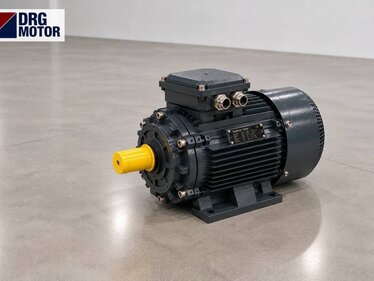
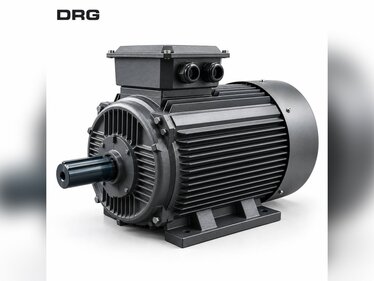
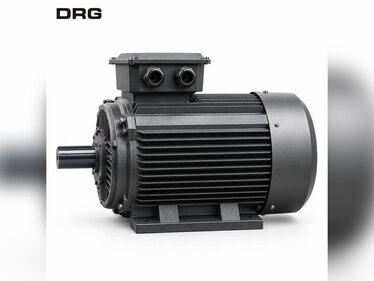
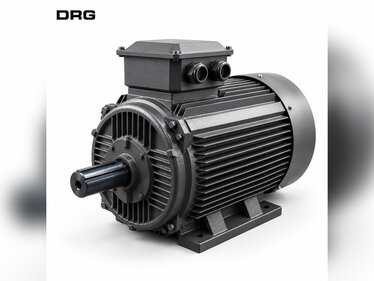
The most common range on pillar drills is 0.37–2.2 kW, 4-pole motors. The aluminium-frame models are light and easy to handle on a vertical head mounting:
| Model | Power / speed | Frame | Current 400 V |
|---|---|---|---|
| DRG-712-4 | 0.37 kW / 1340 rpm | 71 · aluminium | 0.92 A |
| DRG-801-4 | 0.55 kW / 1400 rpm | 80 · aluminium | 1.31 A |
| DRG-802-4 | 0.75 kW / 1420 rpm | 80 · aluminium | 1.75 A |
| DRG-90S-4 | 1.1 kW / 1445 rpm | 90S · aluminium | 2.48 A |
| DRG-90L-4 | 1.5 kW / 1445 rpm | 90L · aluminium | 3.3 A |
| DRG-100L1-4 | 2.2 kW / 1450 rpm | 100L · aluminium | 4.52 A |
Fill in this checklist before ordering:
- kW, speed, voltage and connection on the old motor's nameplate
- Mounting: flange (B5 / B14) or foot; shaft up or not
- Flange outer diameter, bolt circle, spigot diameter, number of holes and thread
- Shaft diameter and length (D × E), key width, pulley bore
- Number of steps and pulley diameters
- Is there a forward-reverse (tapping) circuit; foot pedal and interlock
- Supply: three-phase 400 V, or single-phase 230 V with inverter
- Overload relay setting range and emergency stop arrangement
As an example, the model that stands out for a workshop drill with a 20–25 mm capacity:
- Power: 0.75 kW
- Rated speed: 1420 rpm
- Frame: 80 · aluminium
- Current 400 V: 1.75 A
- Current 380 V: 1.84 A
- cos φ: 0.75
- Rated torque: 5.04 Nm
- Starting torque: 2.3 × Tn
- Shaft D × E: 19 × 40 mm
- Bearing: 6204-ZZ-C3
- Voltage: 230/400 V (Δ/Y)
DRG Motor is a manufacturer, supplier and seller of electric motors; our motors are guaranteed for 2 years from the delivery date against material and manufacturing defects (warranty certificate). For dimension checks, see the technical drawings page.
Motors in this power range
- DRG-712-4 – 0.37 kW – 1340 rpm – 71 aluminium
- DRG-801-4 – 0.55 kW – 1400 rpm – 80 aluminium
- DRG-802-4 – 0.75 kW – 1420 rpm – 80 aluminium
- DRG-90S-4 – 1.1 kW – 1445 rpm – 90S aluminium
- DRG-90L-4 – 1.5 kW – 1445 rpm – 90L aluminium
- DRG-100L1-4 – 2.2 kW – 1450 rpm – 100L aluminium
Click to see current prices and order these motors nowSEE PRICES →
Frequently Asked Questions
What kW should a pillar drill motor be?
The usual range is 0.37–0.55 kW for drills with a 13–16 mm capacity in steel, 0.55–0.75 kW for 20–25 mm, 1.1–1.5 kW for 32 mm and 1.5–2.2 kW for 40 mm. The exact value is on the old motor's nameplate.
What speed should a drill press motor have?
Most belt-driven drills run with a 4-pole motor of about 1400–1450 rpm; spindle speed is set by the pulley step. A 2-pole motor doubles every step.
How many amps does a 0.75 kW drill motor draw?
The 4-pole DRG-802-4 draws 1.75 A at 400 V and 1.84 A at 380 V; its cos φ is 0.75. Connected in delta on a single-phase-input inverter, the motor current is about 3.03 A.
How do I change the rotation of a drill motor?
On a three-phase motor, two of the supply phases are swapped; for tapping this is done with two interlocked contactors or by an inverter. The wiring must be done by a qualified electrician.
Send us the old motor's nameplate or dimensions and we will narrow down the right DRG model together: phone +90 (542) 666 11 11, e-mail info@drgmotor.com, contact page. For all models and current prices, see Buy Electric Motors Online.