English
 Le français
 Türkçe




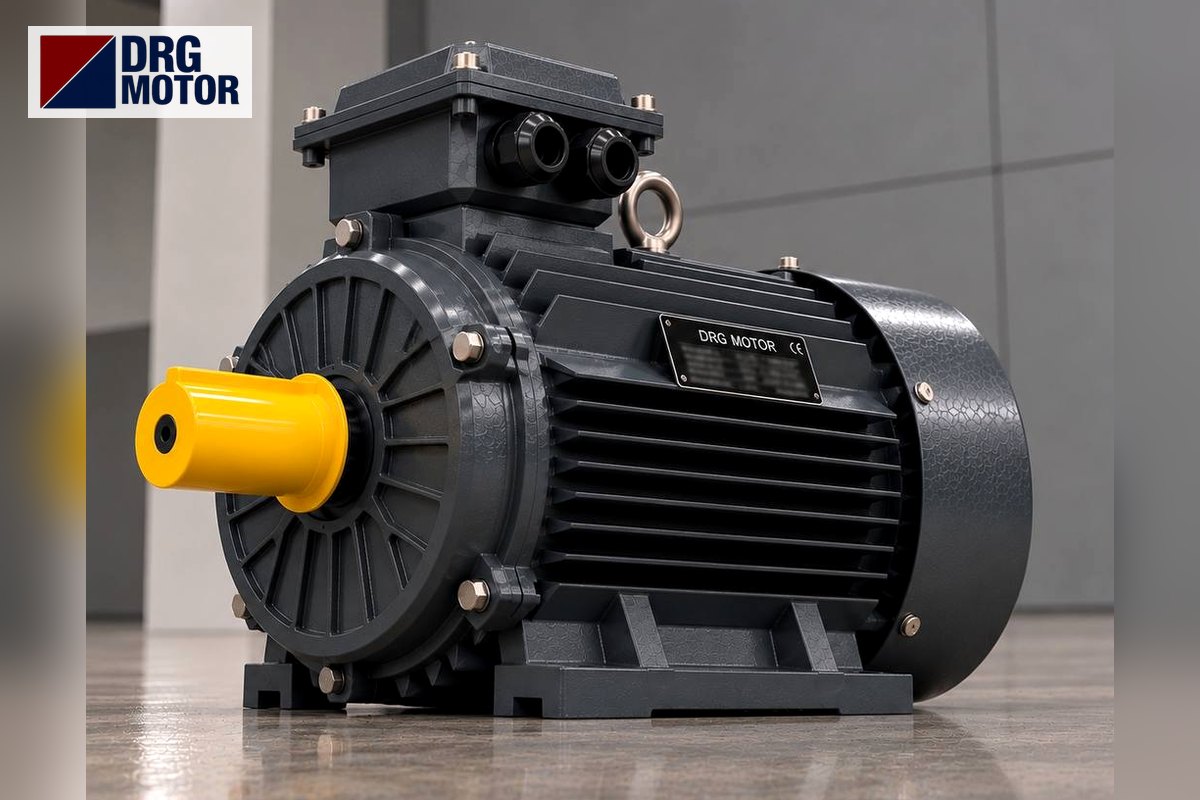

A compressor motor's overload relay usually trips not because the motor is really faulty, but because the current it draws rises above the set threshold. The most common causes are a wrong (too low) overload setting, the load rising with tank pressure, very frequent start-stop, a heavy start under load, and a phase loss on the supply side. Correct diagnosis means ruling these out one by one.
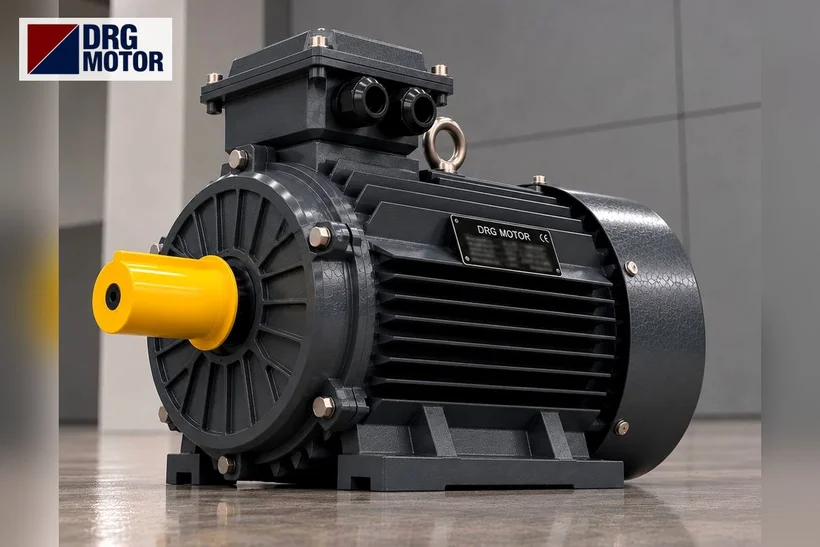
DRG Motor is a manufacturer, supplier and seller of electric motors. You can review three-phase models suited to your compressor by power and speed in the online motor shop, and see the same motors together in the three-phase asynchronous electric motors category.
Why does a compressor motor trip the overload?
An overload relay continuously watches the current the motor draws. If the current stays above the set threshold for a certain time, the relay opens the control circuit and stops the motor. So a tripping overload is often not a fault but a warning: the motor is drawing more current than the set value. The table below summarises the causes most often seen on compressors and the first checks to make.
| Possible cause | What happens | First check |
|---|---|---|
| Wrong overload setting | The relay is set below the motor's real current and trips early | Compare the setting with the rated current on the motor nameplate |
| High pressure / overload | As the tank pressure rises the motor draws more current | Review the pressure switch setting and the unloader arrangement |
| Frequent start-stop | High current and heat build up at every start; the relay sees the total heat | Assess the starts per minute and the tank volume |
| Heavy (loaded) start | The start takes longer, so the high current lasts longer | Check whether the unloader valve opens at start |
| Phase loss / voltage issue | Current in the remaining phases rises, the motor struggles single-phased | Have the three phases and the terminal voltages measured |
Before any measurement or check, switch off the power, confirm it is de-energised, and have all electrical work done only by qualified electrical personnel. This article is guidance, not a field-intervention instruction.
The overload setting: the most overlooked detail
A large share of compressor overload trips come from the relay being set to the wrong current. The overload must be set to the real current the motor draws, which is the rated current printed on the motor nameplate. Do not pick the value from memory or copy it from another motor; base it on the nameplate of the motor in that panel, and have the setting made by qualified electrical personnel. Always take the exact amp figure from the motor nameplate and the relay documentation, never from this article.
To confirm your motor's rated current you can use the motor current chart, and to check power and current together the electric motor calculator. Set too close below the nameplate value, the relay trips needlessly on normal starting current; set too high, it fails to protect the motor. Strike this balance using only the rated current on the nameplate.
Click to see current electric motor prices and order nowSEE PRICES →
Pressure and load: how a compressor strains the overload
Unlike most applications, a compressor's load is not constant. As the pressure in the tank rises, the opposing force the motor must overcome grows, and so does the current drawn. If the pressure switch upper limit is set too high, or the relief/return arrangement is not working properly, the motor can exceed its rated current at the tank's highest pressure, and the overload trips at that point.
Likewise, a problem on the compressor's mechanical side (a blockage rather than a dirty air filter, lack of oil, a seizing head) increases the work demanded of the motor. When the overload trips, look not only at the electrical side but also at the pressure setting and the mechanical state of the compressor.
Frequent start-stop and heavy starting
Compressors cut in when the pressure drops and stop when the tank is full, rather than running continuously. At every start the motor briefly draws several times its rated current. If the tank is small or there is a leak, the motor cuts in very often; the heat from these frequent starts builds up, and the overload can trip from the total heating even when each individual start looks normal.
Many piston compressors also perform a heavy (loaded) start: if the head pressure has not fully released at start, the motor has to start against the load as well. The start then takes longer and the high starting current lasts longer, so the overload can see this extended current and trip. A properly working unloader valve that releases the pressure at start is the most practical way to prevent such trips. Where heavy starting is frequent, a lower-speed (more-pole) motor giving higher torque also eases the start.
Phase loss and voltage problems
If one phase of the three-phase supply is lost, the motor is left single-phased; the current in the remaining two phases rises quickly, and a correctly set overload trips to protect the motor. In this case the motor often cannot start and only hums. A loose terminal, a blown phase fuse or a weak supply can cause this. When the supply voltage drops below the rated value, the motor also draws more current to do the same work, and the overload can trip again. The presence of all three phases and the terminal voltages must be measured by qualified personnel.
Three-phase DRG models for compressors
The table below lists the aluminium-frame DRG three-phase models in the power range often used in compressor applications. The model codes link straight to the product page; the voltage on all of them is 400/690 V (Δ/Y). The rated current is given so you can compare it while checking the overload setting against the motor nameplate.
| Model | Power | Rated speed | Rated current (400 V) |
|---|---|---|---|
| DRG-112M-2-AL | 4 kW | 2905 rpm | 7.45 A |
| DRG-112M-4-AL | 4 kW | 1450 rpm | 7.95 A |
| DRG-132S1-2-AL | 5.5 kW | 2930 rpm | 10.1 A |
| DRG-132S-4-AL | 5.5 kW | 1460 rpm | 10.7 A |
| DRG-112M-4K-AL | 5.5 kW | 1460 rpm | 10.7 A |
| DRG-132S2-2-AL | 7.5 kW | 2930 rpm | 13.7 A |
If you are replacing your current motor, compare not only the power but also the speed (pole count), the shaft diameter and the mounting type (B3 foot, B5/B14 flange) against the nameplate. The compressor pulley or coupling is chosen by shaft diameter, so this dimension is critical.
See current prices to choose a three-phase motor with the right power and speed for your compressorSEE PRICES
Send a photo of your current motor nameplate and we will find the suitable DRG model together.Send on WhatsApp
Frequently asked questions
The compressor trips the overload at the first start but not afterwards; why?
This is a typical heavy-start symptom. If the head pressure does not release at start, the motor starts under load, the starting current lasts longer and the overload trips. Have the unloader valve that releases pressure at start checked, and make sure the overload is set to the rated current on the motor nameplate.
If I set the overload a bit higher, will it stop tripping?
It may stop the tripping temporarily but leaves the motor unprotected and hides the real cause. The overload must be set only to the rated current on the motor nameplate. If it keeps tripping, the root cause (pressure, frequent starting, phase loss) must be found; have the setting made by qualified personnel.
Which speed should I choose for a compressor?
If you are replacing a motor, use the speed on its nameplate and keep the same pole count. In setups where heavy loaded starting is frequent, a lower-speed (more-pole) model of the same power gives higher torque and so eases the start.
How do I tell whether the overload or the motor is at fault?
First confirm the overload is set correctly and all three phases arrive intact. If the setting is right, the supply is sound and the compressor pressure is normal, yet the motor still draws excess current and heats up, the problem may be in the motor or on the mechanical side; have the measurements done by qualified electrical personnel.
Electric Motors Related to This Topic — Models and Current Prices
Suitability is not decided by power alone: compare the speed, voltage, mounting, shaft and fixing dimensions of your machine with the product data; if unsure, send us the nameplate of your current motor.
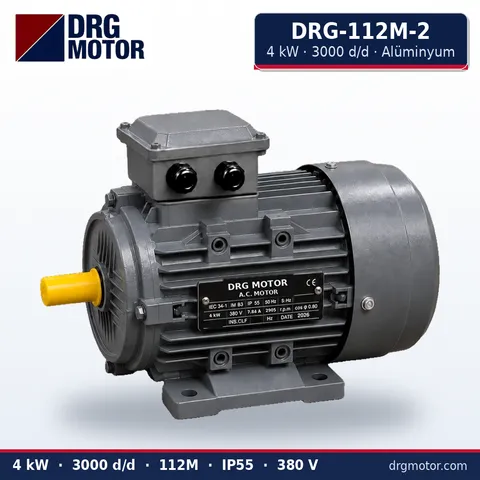
4 kW Three-Phase Motor 3000 rpm – DRG-112M-2 Aluminium
- 4 kW · 3000 rpm (2 poles)
- Aluminium frame · IEC 112M
- Shaft: 28 × 60 mm
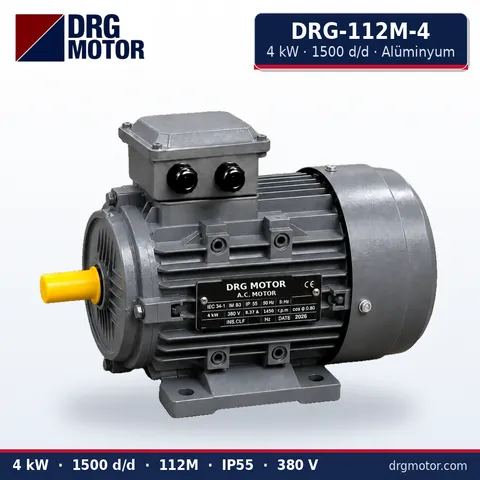
4 kW Three-Phase Motor 1500 rpm – DRG-112M-4 Aluminium
- 4 kW · 1500 rpm (4 poles)
- Aluminium frame · IEC 112M
- Shaft: 28 × 60 mm
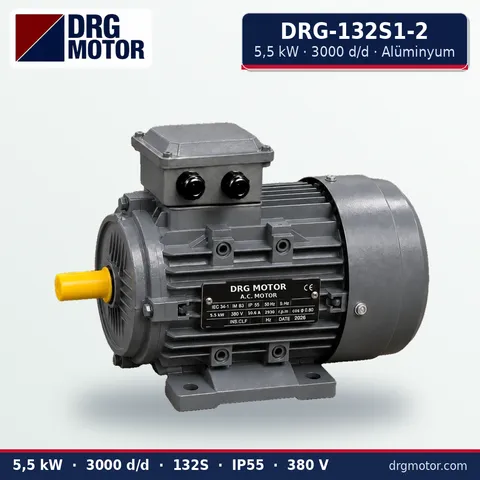
5.5 kW Three-Phase Motor 3000 rpm – DRG-132S1-2 Aluminium
- 5.5 kW · 3000 rpm (2 poles)
- Aluminium frame · IEC 132S
- Shaft: 38 × 80 mm
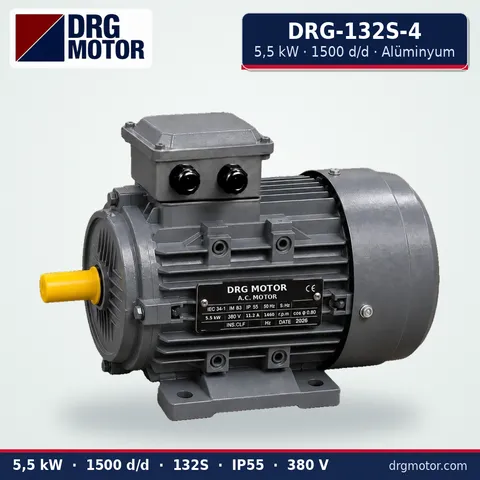
5.5 kW Three-Phase Motor 1500 rpm – DRG-132S-4 Aluminium
- 5.5 kW · 1500 rpm (4 poles)
- Aluminium frame · IEC 132S
- Shaft: 38 × 80 mm
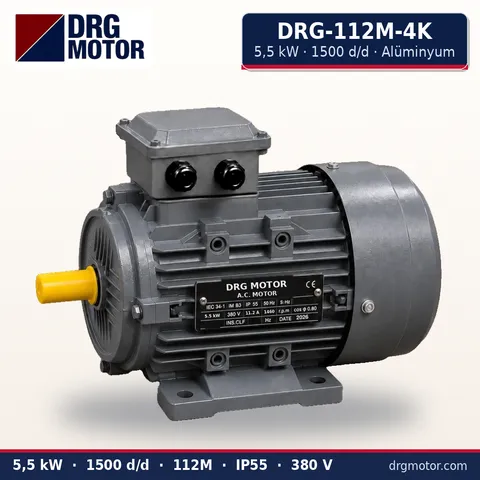
5.5 kW Compact Three-Phase Motor 1500 rpm – DRG-112M-4K Aluminium
- 5.5 kW · 1500 rpm (4 poles)
- Aluminium frame · IEC 112M
- Shaft: 28 × 60 mm
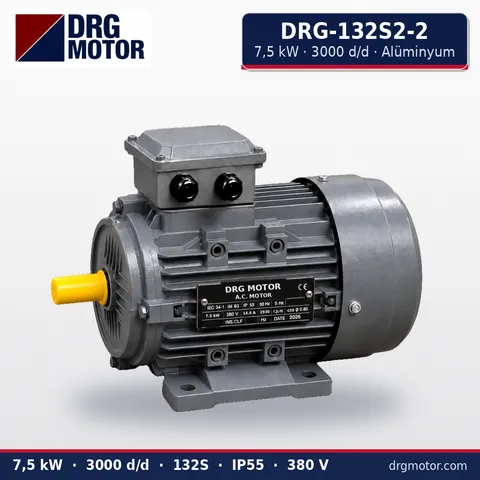
7.5 kW Three-Phase Motor 3000 rpm – DRG-132S2-2 Aluminium
- 7.5 kW · 3000 rpm (2 poles)
- Aluminium frame · IEC 132S
- Shaft: 38 × 80 mm