English
 Le français
 Türkçe




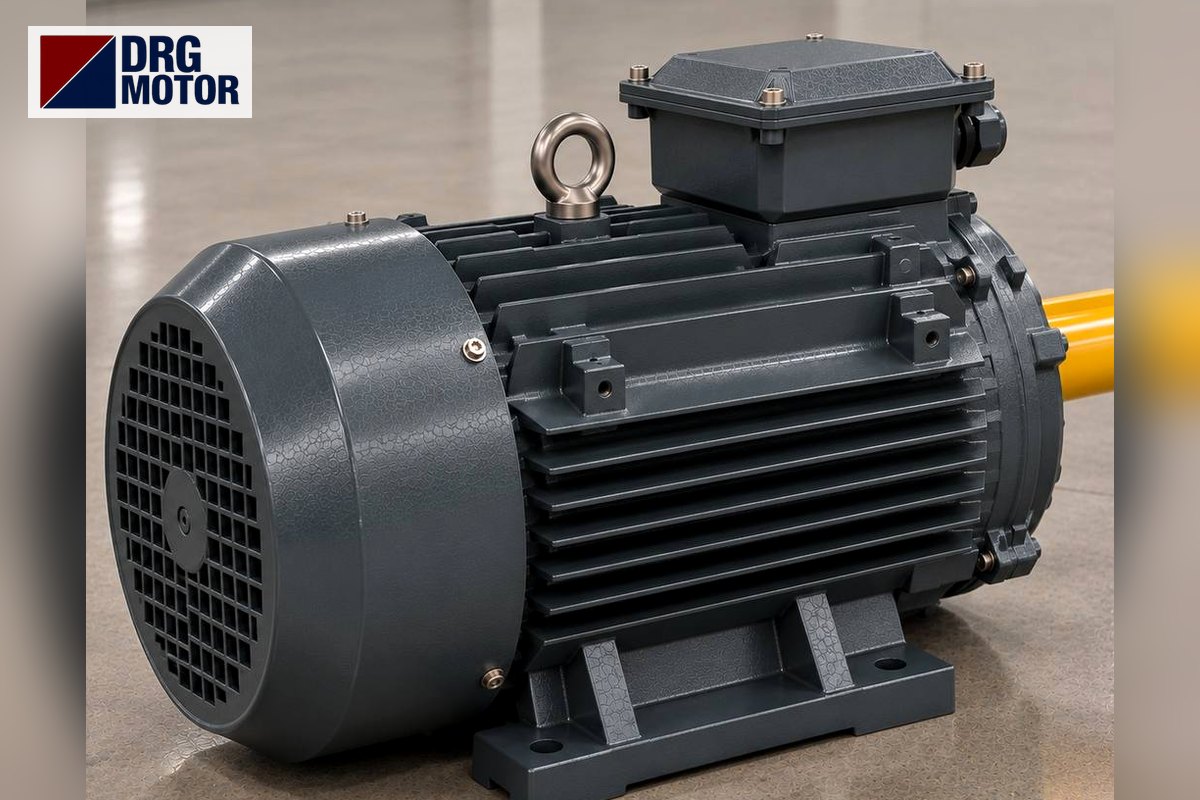

Choosing the right electric motor model starts with clarifying your need: how much power, which speed, what mounting, which housing and which voltage. Think these five points through together and the risk of over- or under-sizing disappears, so you can calmly find the electric motor that best fits your need.
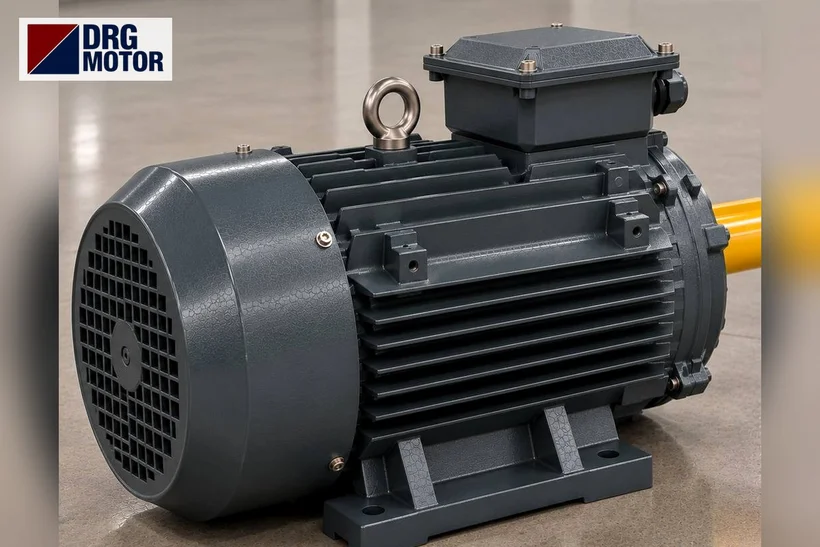
DRG Motor is a manufacturer, supplier and seller of electric motors. By working through the steps below you can find the right model by power and speed in the online electric motor shop and see the same models together in the three-phase asynchronous electric motors category.
Why getting the model right matters
The goal of electric motor selection is not to find the "strongest" or the "smallest" model, but the one the job actually needs. Pick one too large and you lose space and add start-up load; pick one too small and the electric motor strains, heats up and trips its protection often. The model that best fits your need runs smoothly, lasts long and is easy to install. A few minutes of need analysis before buying is the healthiest approach.
1. Power: the real demand of the job
The first value to set is power. Electric motor power is given in kW (or horsepower) and is chosen by the load your machine has to turn. Powers come in standard steps: 4 kW, 5.5 kW, 7.5 kW, 11 kW and so on. If you need an in-between value such as "6 kW", the nearest standard step (for example 7.5 kW) is used. Base the power on the real load, not a guess; if you are unsure our electric motor calculator will guide you.
2. Speed and number of poles
The same power exists at different speeds, so power alone is not enough. Speed is set by the number of poles: 2 poles about 3000 rpm, 4 poles about 1500 rpm, 6 poles about 1000 rpm. Pumps and fans usually run at higher speed, while conveyors and mixers run slower. Decide the rotation speed your machine needs up front and you remove the risk of picking the wrong pole count.
3. Mounting type: foot or flange?
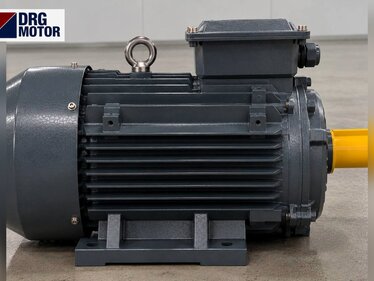
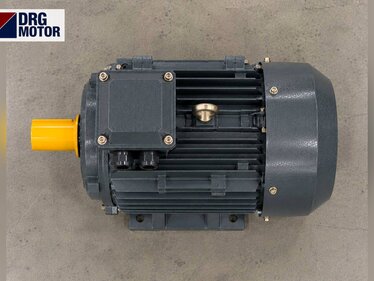
How the electric motor attaches to the machine also drives the model. The foot type (B3) bolts onto a base or frame; flange types (B5, B14) connect the electric motor straight to the machine by a flange; B35 is both foot- and flange-mounted. Skip the mounting type and you may receive the right power but the wrong connection. When ordering, state the mounting type together with the shaft diameter and flange size.
4. Housing material: aluminium or cast iron?
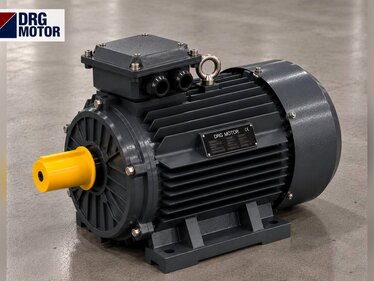
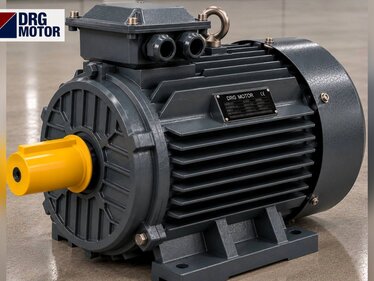
In the DRG range the housing comes in two materials. An aluminium housing is light and easy to handle; it is usually preferred at medium powers and in mobile or hand-lifted applications. A cast-iron housing is heavier and more impact-resistant; it stands out in vibrating, demanding or heavy-industry uses. Choose between them by looking at your application's weight and durability expectations.
Click to see current electric motor prices and order nowSEE PRICES →
5. Voltage and connection
Three-phase asynchronous electric motors are supplied with a 400/690 V (Δ/Y) connection and run in delta (Δ) on a 400 V three-phase supply. Confirm your installation's voltage and connection up front; to see the current it will draw in advance, the motor current chart helps. Connection and commissioning must always be done by a qualified electrician, with the power cut and the absence of voltage verified.
Example matching by application
Below are a few 1500 rpm (4-pole) aluminium-housed DRG models with their power and torque values. You can reach full technical detail from each model's page.
| Model | Power | Speed | Torque |
|---|---|---|---|
| DRG-112M-4 | 4 kW | 1500 rpm | 26.3 Nm |
| DRG-132S-4 | 5.5 kW | 1500 rpm | 36.0 Nm |
| DRG-112M-4K | 5.5 kW | 1500 rpm | 36.0 Nm |
| DRG-132M-4 | 7.5 kW | 1500 rpm | 49.1 Nm |
| DRG-160M-4 | 11 kW | 1500 rpm | 71.7 Nm |
| DRG-132M-4K | 11 kW | 1500 rpm | 71.7 Nm |
For a medium-sized pump or fan, for instance, the 4–5.5 kW class is often enough, while a tougher conveyor or crusher may call for the 7.5–11 kW class. Where space is tight, compact (4K) housed models offer the same power in a smaller size.
Avoiding over- and under-sizing
The two most common mistakes are picking too large "to be safe" and staying too small out of budget worry. The large choice adds needless space and start-up load; the small one strains the electric motor constantly. The right approach is to add a small margin to the real load and settle on the nearest standard power. The model that best fits your need is neither excess nor short.
Checklist before you buy
- Power (kW): Is the load the machine will turn clearly defined?
- Speed (poles): Which of 3000 / 1500 / 1000 rpm is the required rotation speed?
- Mounting: Foot (B3) or flange (B5/B14); are the shaft diameter and flange size known?
- Housing: Aluminium or cast iron?
- Voltage: Is the supply 400 V three-phase and is the Δ/Y connection suitable?
- Nameplate: Do the details of the electric motor in hand match what is ordered?
Answer these six points and your model almost defines itself. If any point is still unclear, write to us.
Send a photo of your current motor nameplate and we will find the suitable DRG model together.Send on WhatsApp
Once you have picked the electric motor model that best fits your need, click to see current prices and orderSEE PRICES
To confirm your chosen model together, open the relevant product page in our online electric motor shop and compare the technical values.
Frequently asked questions
Is knowing only the power enough to pick a model?
No. Power is the starting point; the model is not fully defined until speed, mounting type, housing and voltage are set. Many electric motors share the same power at different speeds and mountings.
Isn't buying an electric motor larger than I need safer?
An oversized model takes up needless space and stresses the supply more at start-up. Keep the safety margin reasonable and settle on the nearest standard power.
How do I decide between aluminium and cast iron?
If lightness and easy handling matter, aluminium stands out; if resistance to impact and vibration matters, cast iron does. Your application's conditions decide.
Can I get help choosing the model?
Of course. Share your application and the nameplate or dimensions of the electric motor you have, and we will determine the DRG model that best fits your need together.
Electric Motors Related to This Topic — Models and Current Prices
Suitability is not decided by power alone: compare the speed, voltage, mounting, shaft and fixing dimensions of your machine with the product data; if unsure, send us the nameplate of your current motor.

4 kW Three-Phase Motor 1500 rpm – DRG-112M-4 Aluminium
- 4 kW · 1500 rpm (4 poles)
- Aluminium frame · IEC 112M
- Shaft: 28 × 60 mm
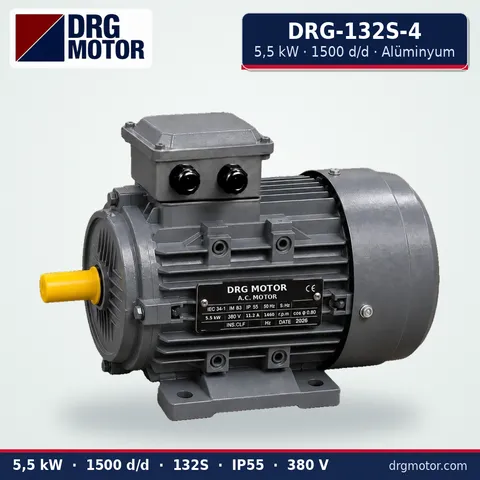
5.5 kW Three-Phase Motor 1500 rpm – DRG-132S-4 Aluminium
- 5.5 kW · 1500 rpm (4 poles)
- Aluminium frame · IEC 132S
- Shaft: 38 × 80 mm
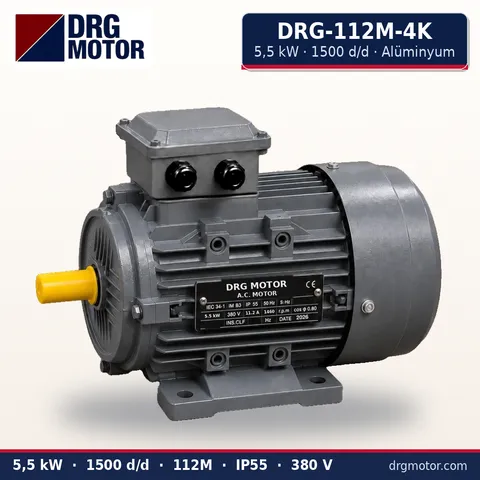
5.5 kW Compact Three-Phase Motor 1500 rpm – DRG-112M-4K Aluminium
- 5.5 kW · 1500 rpm (4 poles)
- Aluminium frame · IEC 112M
- Shaft: 28 × 60 mm
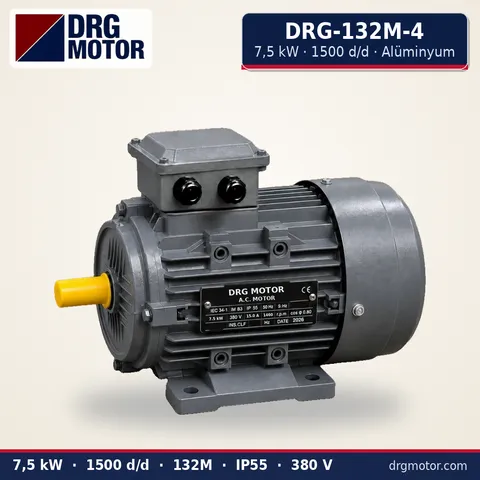
7.5 kW Three-Phase Motor 1500 rpm – DRG-132M-4 Aluminium
- 7.5 kW · 1500 rpm (4 poles)
- Aluminium frame · IEC 132M
- Shaft: 38 × 80 mm
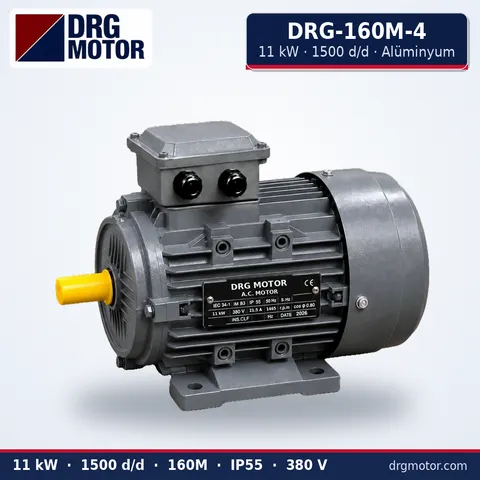
11 kW Three-Phase Motor 1500 rpm – DRG-160M-4 Aluminium
- 11 kW · 1500 rpm (4 poles)
- Aluminium frame · IEC 160M
- Shaft: 42 × 110 mm
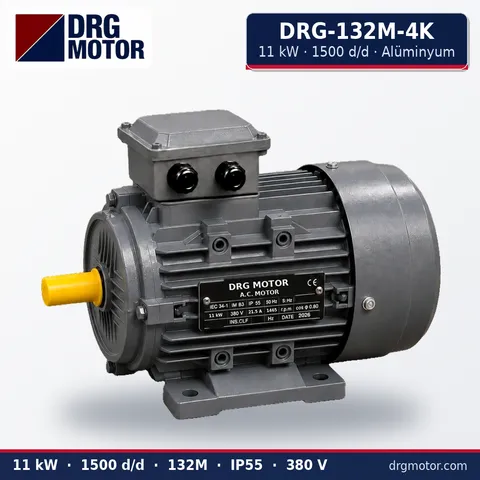
11 kW Compact Three-Phase Motor 1500 rpm – DRG-132M-4K Aluminium
- 11 kW · 1500 rpm (4 poles)
- Aluminium frame · IEC 132M
- Shaft: 38 × 80 mm