English
 Le français
 Türkçe




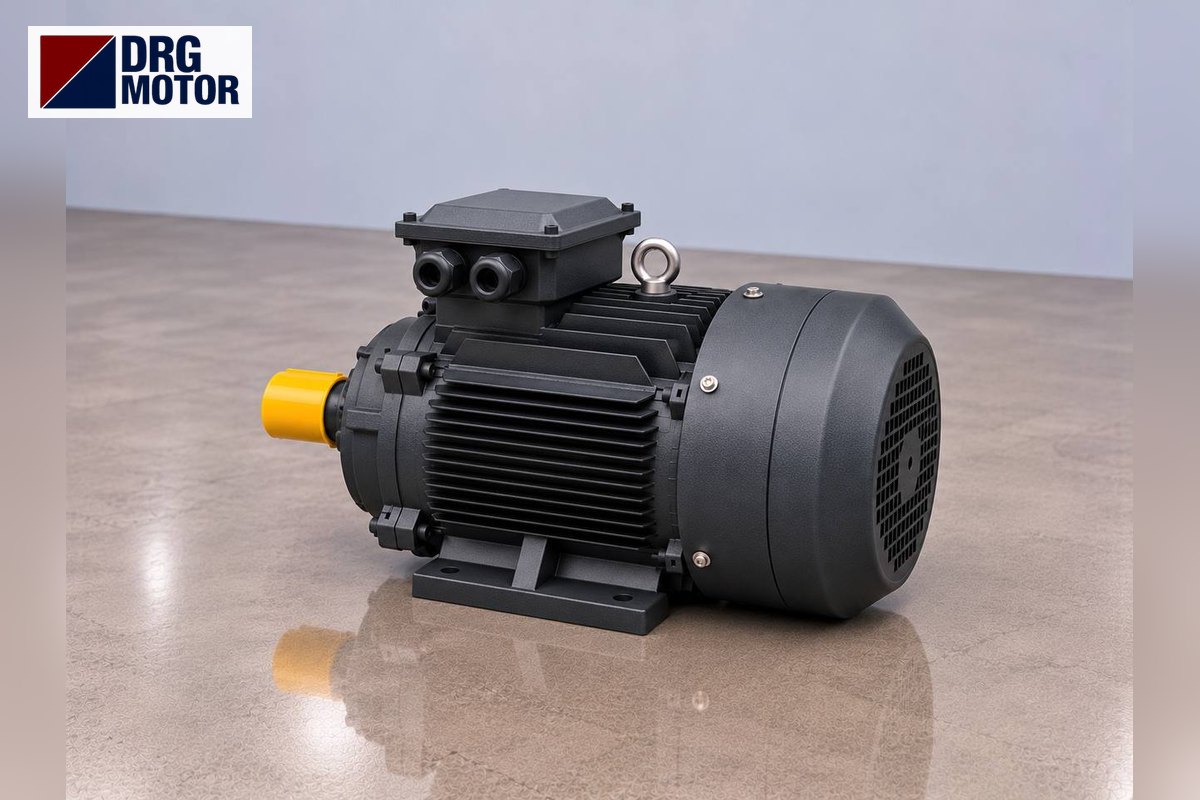

If you are about to renew the WAT electric motor driving a pump, two things decide whether the pump will run as before: the motor's rated speed and the coupling between motor and pump. This article summarises why speed must be read from the nameplate, what to check on the coupling side and what information to bring to DRG MOTOR.
Speed class and rated speed are not the same for a pump
A centrifugal pump's flow and head depend directly on shaft speed. "A 3000 rpm motor" is therefore not enough: 3000 rpm is a class, while the motor's actual speed under load is printed on the nameplate. WAT nameplates may carry separate lines for 50 Hz and 60 Hz; the sample nameplate in the catalogue shows 1461 rpm at 50 Hz and 1766 rpm at 60 Hz for the same motor. On a 50 Hz supply, use the value on the 50 Hz line.
As an example, the DRG catalogue gives 1450 rpm rated speed for the 3 kW 4-pole motor and 2930 rpm for the 5.5 kW 2-pole motor. A few tens of rpm between old and new motor shift the pump's duty point slightly; moving from 2 to 4 poles changes the pump curve entirely. The pump loads the motor differently at start and at full flow: starting with the valve open, the risk of dry running or a closed valve should also be noted. So the same kW and the same speed class should not be taken as sufficient; the kW/speed, flow and head on the pump nameplate must be assessed with the motor data.
What to check on the coupling side
A flexible coupling usually sits between a foot-mounted motor and the pump. Check the following when replacing:
- Shaft diameter and key: do the hub bore and keyway suit the new motor shaft? In the DRG range, for instance, frame 100L has a 28×60 mm shaft with an 8 mm key, frame 132S a 38×80 mm shaft with a 10 mm key.
- Shaft height (H): pump and motor axes must be at the same height. The frame number gives the shaft height in mm; a different frame means a height difference and shims.
- Coupling gap: if motor length and shaft length differ, the gap between the two coupling halves changes and baseplate holes may shift.
- Alignment: after fitting, measure angular and axial misalignment; it stresses bearings and the coupling element.
The WAT catalogue recommends a locating bearing at the drive end of the motor in pump applications. If your pump applies axial load, include that information; the bearing arrangement needs to be reviewed in that respect. In close-coupled (monobloc) designs where the motor shaft carries the impeller, the shaft is often pump-specific, so the use of a standard motor on such pumps must be assessed separately together with the shaft dimensions and pump design. This assessment covers the selection of the electric motor to be connected to the existing equipment.
Send DRG MOTOR photos of the pump and motor nameplates, the coupling hub size and the baseplate layout, so the option is evaluated together with the pump.
DRG MOTOR options that can be assessed
DRG Motor is a manufacturer, supplier and seller of electric motors. Examples that can be assessed on technical data for pump drives (all in the DRG online shop):
- DRG-100L2-4 – 3 kW, 4 poles, 100L, rated speed 1450 rpm, 230/400 V, shaft 28×60 mm.
- DRG-132S1-2 – 5.5 kW, 2 poles, 132S, rated speed 2930 rpm, 400/690 V, shaft 38×80 mm.
- DRG-160M1-2 – 11 kW, 2 poles, cast iron, 160M, rated speed 2945 rpm, shaft 42×110 mm.
More options for pump drives are on the pump motors page. To see how much the pump loads the motor from a current measurement, the motor current chart is a starting point.
Frequently asked questions
The new motor runs a few rpm faster; is that a problem for the pump?
Small speed differences change flow and absorbed power slightly. Without knowing the pump's duty point and the motor's power margin, the effect cannot be stated firmly; the pump nameplate and measured current should be assessed together.
Can I reuse my coupling on the new motor?
If shaft diameter and key size are the same, the hub may be reusable; the condition of the hub and flexible element must be checked separately. If dimensions differ, the hub has to be changed.
My WAT motor says IP56 and the pump room is damp; what should I do?
DRG motors are IP55. If there is water spray, condensation or washing, send the ambient information so any need for extra protection can be assessed.
Information to send to DRG MOTOR
- Photo of the WAT nameplate, full type code and rated speed on the 50 Hz line
- Pump nameplate: type, flow, head, recommended kW and speed
- Mounting (foot, B5 flange, close-coupled) and shaft diameter × length
- Coupling type, hub bore and baseplate hole spacing
- Starting method and starts per hour (booster set, circulation, etc.)
- Pump room conditions: humidity, water spray, temperature
Send the details via WhatsApp, the quote list, by phone on +90 (542) 666 11 11 or to info@drgmotor.com. The option is defined by reviewing the pump's needs alongside the motor's technical data. Contact
See current prices of DRG MOTOR electric motors and order online in our storeSEE PRICES →
Technical Sources
- WAT Motor Sanayi ve Ticaret A.Ş. — Ürün Kataloğu (Product Catalogue, Turkish edition) — IM tr 24.0 — Technical information, motor nameplate fields (Teknik Bilgiler) — printed page 23 (PDF page 25).
- WAT Motor Sanayi ve Ticaret A.Ş. — Ürün Kataloğu (Product Catalogue, Turkish edition) — IM tr 24.0 — Mounting arrangements, including the locating bearing note (Yapı Şekilleri) — printed page 12 (PDF page 14).
- WAT Motor Sanayi ve Ticaret A.Ş. — Ürün Kataloğu (Product Catalogue, Turkish edition) — IM tr 24.0 — IE3 three-phase aluminium motors, dimensions B3 — printed pages 43–44 (PDF pages 45–46).