English
 Le français
 Türkçe




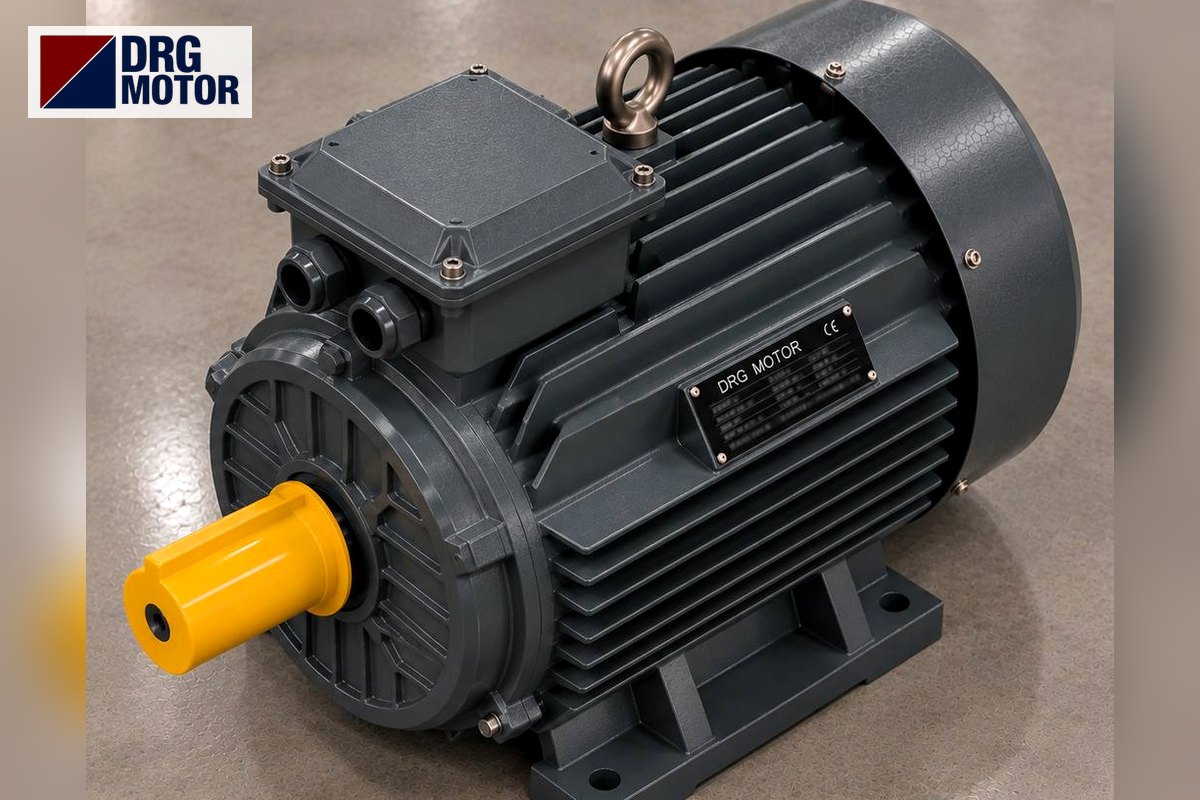

The synchronous speed of an asynchronous electric motor comes from one short formula: n = 120 × f / p, where f is the mains frequency (50 Hz in Türkiye) and p is the number of poles. More poles mean lower speed; at 50 Hz, 2 poles give 3000, 4 poles 1500 and 6 poles 1000 rpm.
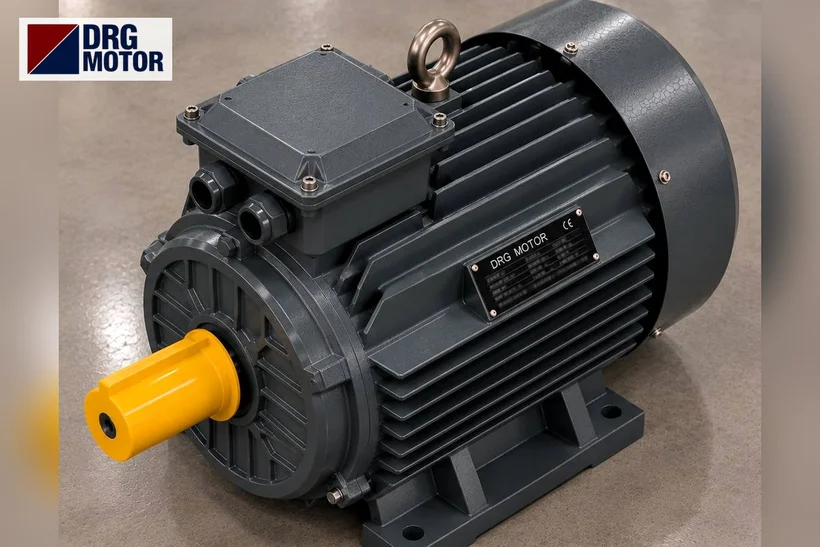
DRG Motor is a manufacturer, supplier and seller of electric motors. It is based in İzmir and ships quickly across all of Türkiye, that province included. Once you have worked out speed and poles, pick the right model by power and speed in the online electric motor shop and see the same products together in the three-phase asynchronous electric motors category.
How is synchronous speed calculated?
The logic is this: a three-phase winding, fed by the grid, creates a rotating magnetic field. The speed of that field is the synchronous speed, and it depends on only two things — frequency and pole count. Since frequency is fixed at 50 Hz, the one variable that sets the speed is how many poles the winding is wound for.
A small note: in the formula p usually means the number of poles. Some references use pole pairs; then n = 60 × f / (p/2). The result is the same as long as you do not mix them up. For 50 Hz and 4 poles: 120 × 50 / 4 = 1500 rpm.
How poles set the speed
Poles come in even numbers (2, 4, 6, 8...) because every pole needs an opposite. Each step up drops the synchronous speed one level. For 50 Hz the table is:
| Poles | Formula (120×f/p) | Synchronous speed |
|---|---|---|
| 2 | 120×50/2 | 3000 rpm |
| 4 | 120×50/4 | 1500 rpm |
| 6 | 120×50/6 | 1000 rpm |
| 8 | 120×50/8 | 750 rpm |
So a plate reading "1500 rpm" is a 4-pole electric motor; "3000 rpm" is a fast 2-pole machine. In the field, "how many poles do I need?" is really the same question as "how many rpm do I want at the shaft?"
Click to see current electric motor prices and order nowSEE PRICES →
Slip and the difference from real speed
Here is the detail people ask about most. The shaft of an asynchronous electric motor does not turn at the synchronous speed; it lags slightly behind. That gap is called slip, and it is necessary for the motor to make torque. With no slip there would be no induced current in the rotor and no turning force.
The real (loaded) speed is: n_real = n_sync × (1 − s). At full load the slip s is a small fraction, which is why the plate speed of a 1500 rpm synchronous motor is usually written as 1400–1470 rpm. A figure like 1455 is not an error — it is the normal result of slip.
Same power, different speed: a 4 kW example
Power and speed are independent. You can order the same 4 kW at three different speeds; only the pole count changes, and with it the shaft speed and torque. The slower one gives more torque for the same power but grows in frame size.
| Model | Poles | Synchronous speed | Current (400 V) |
|---|---|---|---|
| DRG-112M-2 | 2 | 3000 rpm | 7.45 A |
| DRG-112M-4 | 4 | 1500 rpm | 7.95 A |
| DRG-132M1-6 | 6 | 1000 rpm | 8.99 A |
You can review all three: 4 kW 3000 rpm, 4 kW 1500 rpm and 4 kW 1000 rpm. Pumps and fans usually want 2 or 4 poles; conveyors, mixers and kneaders that need torque often use 6 poles. If you want to run the numbers yourself, the electric motor calculator makes it easy.
What to watch when choosing speed
First rule: choose speed to suit the machine, and do not fall for "higher speed is stronger". Power in kW is fixed; speed only tells you how fast the shaft turns. If you are replacing an old electric motor, note the speed and pole count on its plate, and confirm them together with the coupling or pulley dimensions.
Where you are not sure, do not guess. Tell us the plate of your current motor and the machine it drives, and we will settle speed, poles and power together.
Frequently asked questions
How many rpm does a 4-pole electric motor run at?
At 50 Hz the synchronous speed is 1500 rpm (120×50/4). Under load, slip makes the plate speed a little lower, usually in the 1400–1470 rpm range.
Are speed and power the same thing?
No. Power (kW) is the work taken at the shaft; speed (rpm) is how fast the shaft turns. The same power is built at different speeds; as the pole count changes the speed changes, while power can stay the same.
What is the speed at 60 Hz?
The formula stays the same, with 60 in place of f. For 4 poles, 120×60/4 = 1800 rpm synchronous. Since the Turkish grid is 50 Hz, values here are worked out for 50 Hz.
Why does the plate read 1455 rather than 1500?
That is the real speed under load. An asynchronous electric motor turns slightly below the synchronous speed; the difference is slip, and it is completely normal.
To see the current price of the electric motor matching the speed and pole count you need, visit the shop.SEE PRICES
Send a photo of your current motor nameplate and we will find the suitable DRG model together.Send on WhatsApp
Electric Motors Related to This Topic — Models and Current Prices
Suitability is not decided by power alone: compare the speed, voltage, mounting, shaft and fixing dimensions of your machine with the product data; if unsure, send us the nameplate of your current motor.

4 kW Three-Phase Motor 1500 rpm – DRG-112M-4 Aluminium
- 4 kW · 1500 rpm (4 poles)
- Aluminium frame · IEC 112M
- Shaft: 28 × 60 mm
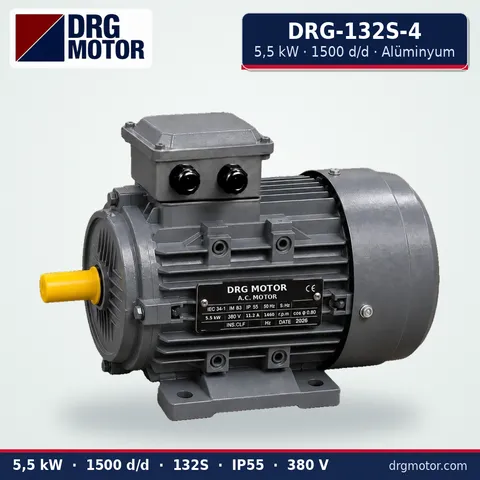
5.5 kW Three-Phase Motor 1500 rpm – DRG-132S-4 Aluminium
- 5.5 kW · 1500 rpm (4 poles)
- Aluminium frame · IEC 132S
- Shaft: 38 × 80 mm
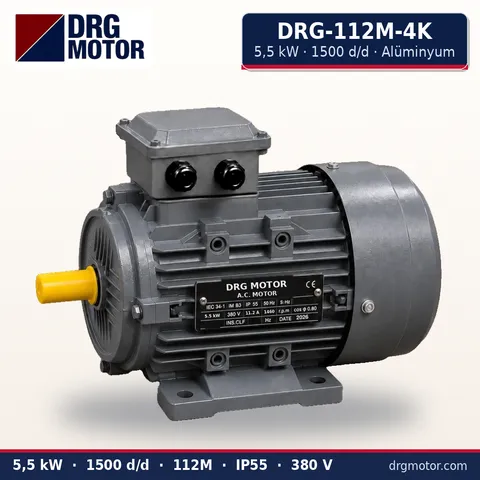
5.5 kW Compact Three-Phase Motor 1500 rpm – DRG-112M-4K Aluminium
- 5.5 kW · 1500 rpm (4 poles)
- Aluminium frame · IEC 112M
- Shaft: 28 × 60 mm
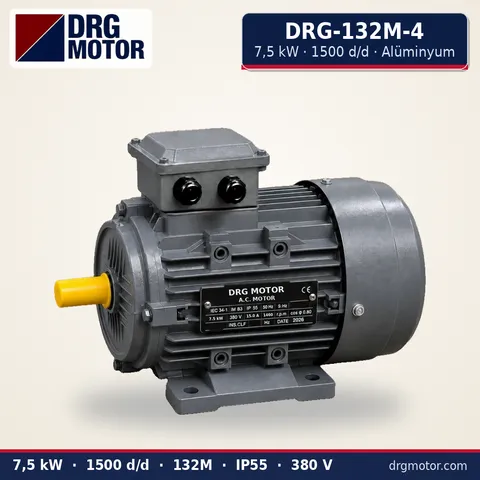
7.5 kW Three-Phase Motor 1500 rpm – DRG-132M-4 Aluminium
- 7.5 kW · 1500 rpm (4 poles)
- Aluminium frame · IEC 132M
- Shaft: 38 × 80 mm
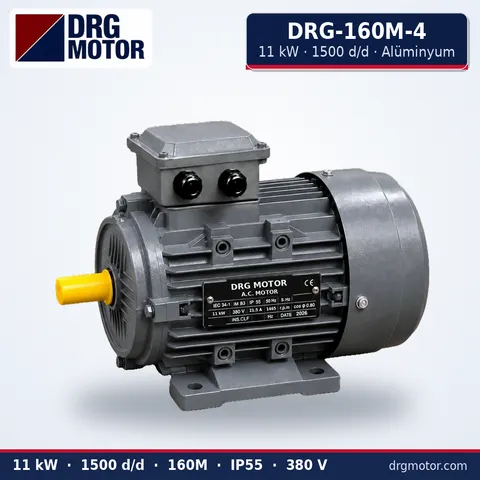
11 kW Three-Phase Motor 1500 rpm – DRG-160M-4 Aluminium
- 11 kW · 1500 rpm (4 poles)
- Aluminium frame · IEC 160M
- Shaft: 42 × 110 mm
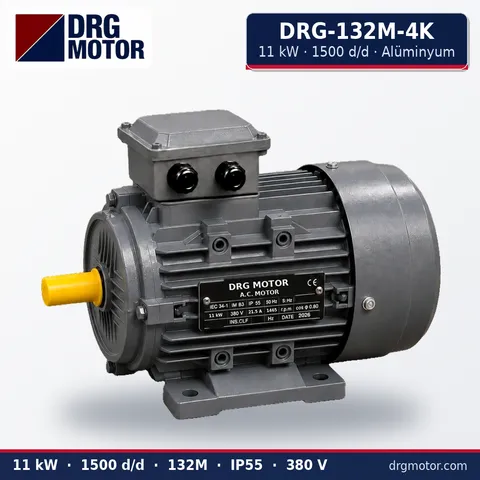
11 kW Compact Three-Phase Motor 1500 rpm – DRG-132M-4K Aluminium
- 11 kW · 1500 rpm (4 poles)
- Aluminium frame · IEC 132M
- Shaft: 38 × 80 mm