English
 Le français
 Türkçe




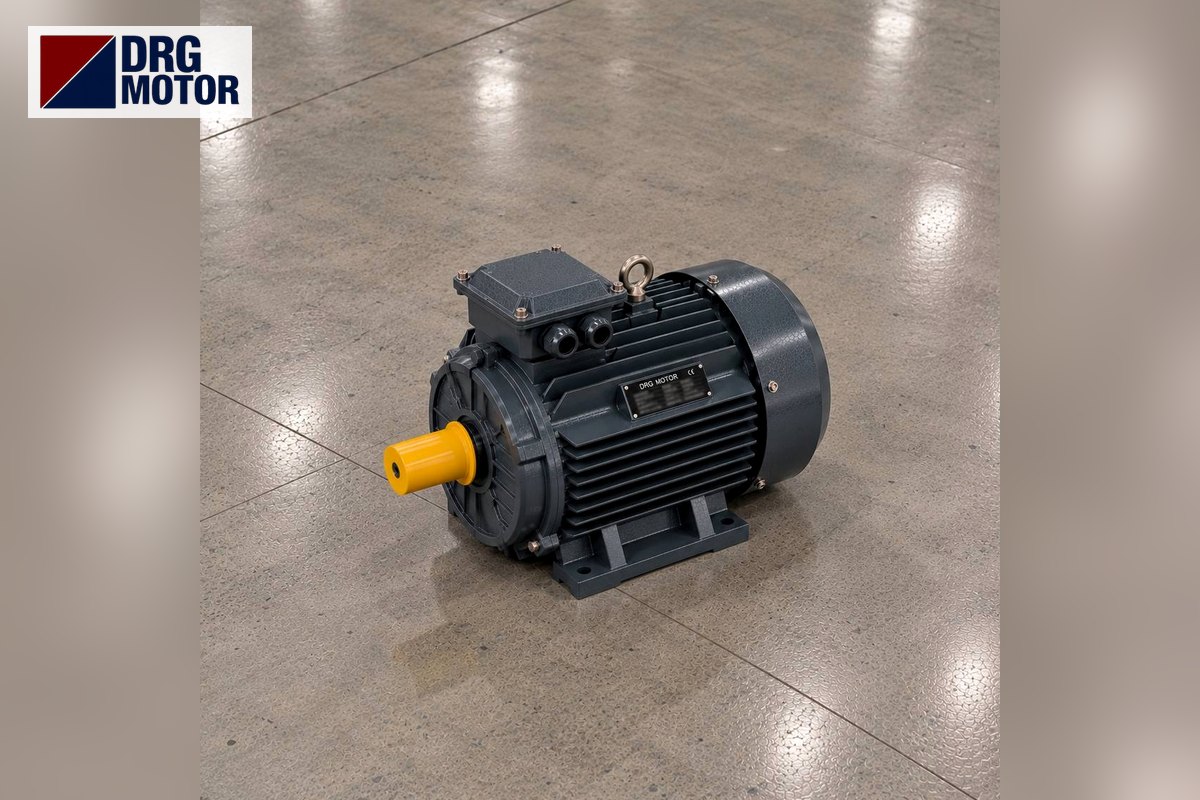

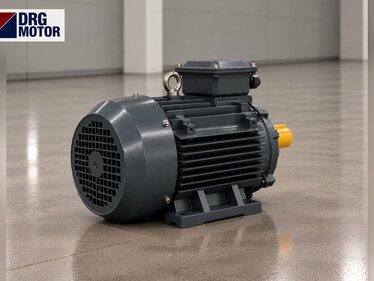
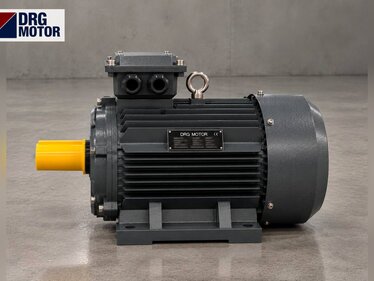
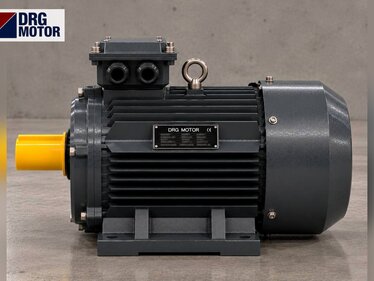
An asynchronous electric motor is a brushless AC motor that turns because the rotating magnetic field of its stator induces current in the rotor. The rotor never quite catches the field; that small speed gap, called slip, is what produces torque. Rugged, low-maintenance and able to run straight off the mains, it is the workhorse of industry: pumps, conveyors, fans and machine tools all lean on it.
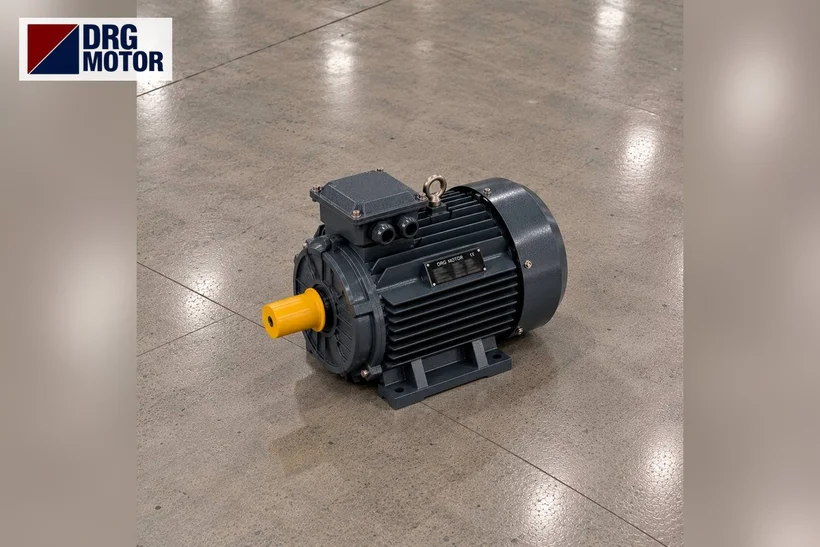
DRG Motor is a manufacturer, supplier and seller of electric motors. It is based in İzmir and ships quickly across all of Türkiye, that province included. You can pick the three-phase asynchronous model that fits your job in the online electric motor shop and browse the full range in the three-phase asynchronous electric motors category.
What is an asynchronous electric motor?
The word "asynchronous" comes from the rotor not turning at the same (synchronous) speed as the mains field. Three-phase windings build a magnetic field that chases itself around the stator; this field induces a voltage in the rotor bars, the induced current creates its own field, and the interaction of the two fields turns the shaft. There is no external supply to the rotor and no brushes. The most common type is the squirrel-cage rotor: aluminium or copper bars shorted by two end rings, simple and durable. That plainness is exactly why these motors are cheap to maintain and long-lived.
How does the rotating field do the work?
Each of the three phases carries a current shifted by 120 degrees. Seat the windings in the frame at those angles and a rotating field appears. The field runs ahead, the rotor tries to catch up from behind. If the rotor ever caught the field, induction would stop and torque would fall to zero; so the rotor always lags a little. That lag is the heart of how the motor works. Add load and the rotor slows slightly, slip grows, the motor draws more current and delivers more torque.
Synchronous speed, slip and the speed formula
The speed of the field is called synchronous speed, found from n = 120 · f / p, where f is frequency (50 Hz in Türkiye) and p is the pole count. A 4-pole motor has a synchronous speed of 1500 rpm and runs just below that under load, typically in the 1440-1480 rpm band. The difference is the slip. Shaft torque follows from power and speed: T = 9550 · P / n (with P in kW and n in rpm the answer is in Nm). For example, a 5.5 kW motor at 1500 rpm makes about 35 Nm. These two relations let you estimate what a motor will do before you even read its nameplate.
Click to see current electric motor prices and order nowSEE PRICES →
Where are asynchronous motors used?
Almost any fixed-speed load that needs turning is handed to an asynchronous motor. In the field that looks like:
- Pumps and fans: centrifugal pumps, extractors, pressure-boosting sets.
- Material handling: belt conveyors, bucket elevators, screw feeders.
- Compressors and hydraulics: screw and piston compressors, hydraulic power units.
- Machines and tools: lathes, mills, grinders, mixers, wood and stone working.
- Agriculture and food: feed crushers, flour mills, filling and packaging lines.
When speed control is needed, a drive is added outside the motor; the motor itself is still the same asynchronous machine. Where a clean, fixed speed is enough, running straight off the mains does the job. If you want to work the numbers, the electric motor calculator shows the power, speed and torque link at a glance.
The DRG three-phase asynchronous range
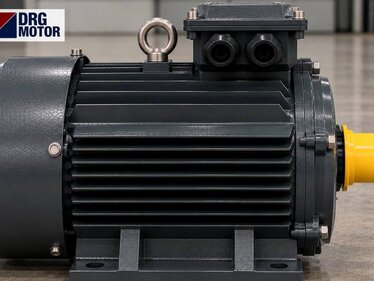
DRG's aluminium-frame three-phase asynchronous motors are built to IEC frame sizes; the commonly requested outputs on the 1500 rpm (4-pole) side are below. All are squirrel-cage, IP55 and suited to a 400 V supply. Smaller ratings use 230/400 V, while 4 kW and above use 400/690 V as standard.
| Model | Power | Speed | Product page |
|---|---|---|---|
| DRG-90L-4 | 1.5 kW | 1500 rpm | view DRG-90L-4 |
| DRG-112M-4 | 4 kW | 1500 rpm | view DRG-112M-4 |
| DRG-132S-4 | 5.5 kW | 1500 rpm | view DRG-132S-4 |
| DRG-132M-4 | 7.5 kW | 1500 rpm | view DRG-132M-4 |
| DRG-160M-4 | 11 kW | 1500 rpm | view DRG-160M-4 |
Each model's product page carries its frame size, connection and mounting details. For a wider power range, use the filters on the online electric motor shop page.
What to check when choosing an asynchronous motor
The choice comes down to five items: power (the kW the load wants), speed (pole count; 2-pole ~3000, 4-pole ~1500, 6-pole ~1000 rpm), frame and mounting (foot-mounted B3, flange B5/B14), voltage (if your supply is 400 V, the star/delta connection follows from that) and environment (dust, moisture, ambient temperature). If you are replacing an existing motor, the safest route is to match the old nameplate's power-speed-frame trio exactly.
Common mistakes in the field
- Confusing the speed: buying a 3000 rpm motor instead of 1500 means a very different torque and behaviour at the same power.
- Wrong connection: leaving a motor in star when it should be in delta for 400 V causes low output and overheating.
- Skipping the frame: if the flange type (B5 or B14) does not match, the motor will not seat; confirm dimensions before ordering.
- Blocking the cooling: a clogged fan cowl or a motor pushed against a wall runs hotter than it should.
Send a photo of your current motor nameplate and we will find the suitable DRG model together.Send on WhatsApp
To compare asynchronous three-phase motor models and order right awaySEE PRICES
Frequently asked questions
What is the difference between an asynchronous and a synchronous motor?
A synchronous motor's rotor turns at exactly the field speed and usually needs separate excitation. In an asynchronous motor the rotor always lags a little (there is slip) and needs no external supply to the rotor, which makes it simpler and tougher.
Is there a single-phase asynchronous motor?
There is, but industry's load is carried by three-phase types. DRG's three-phase asynchronous range targets that need; small single-phase household uses fall outside this series.
Why does a 4-pole motor run near 1450 rather than 1500?
1500 rpm is the synchronous (field) speed. To produce torque the rotor turns a touch behind the field; that gap is the slip and it grows a little as load rises. So 1440-1480 rpm under load is normal.
How do I know which power to pick?
The kW and speed the load wants decide it. If you are replacing a motor, carry over the nameplate values; on a new build, check the needed torque with T = 9550 · P / n. If you are unsure, send a photo of the nameplate and we will settle it together.
Electric Motors Related to This Topic — Models and Current Prices
Suitability is not decided by power alone: compare the speed, voltage, mounting, shaft and fixing dimensions of your machine with the product data; if unsure, send us the nameplate of your current motor.
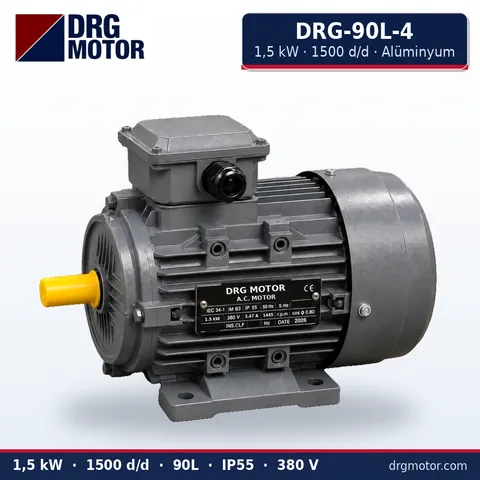
1.5 kW Three-Phase Motor 1500 rpm – DRG-90L-4 Aluminium
- 1.5 kW · 1500 rpm (4 poles)
- Aluminium frame · IEC 90L
- Shaft: 24 × 50 mm

4 kW Three-Phase Motor 1500 rpm – DRG-112M-4 Aluminium
- 4 kW · 1500 rpm (4 poles)
- Aluminium frame · IEC 112M
- Shaft: 28 × 60 mm
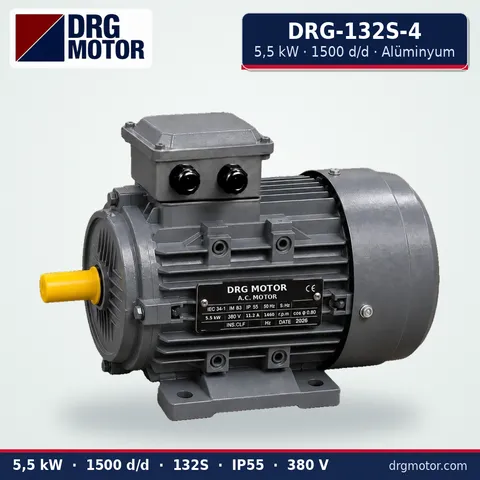
5.5 kW Three-Phase Motor 1500 rpm – DRG-132S-4 Aluminium
- 5.5 kW · 1500 rpm (4 poles)
- Aluminium frame · IEC 132S
- Shaft: 38 × 80 mm
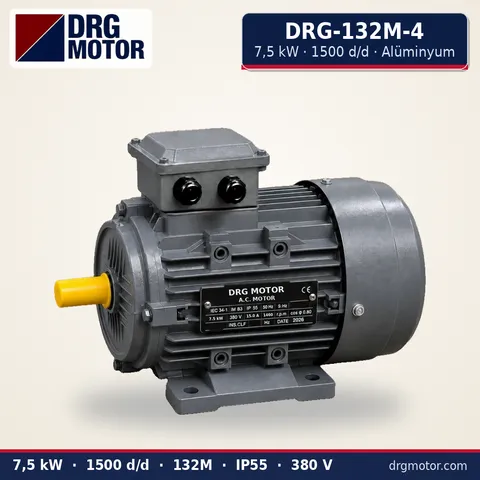
7.5 kW Three-Phase Motor 1500 rpm – DRG-132M-4 Aluminium
- 7.5 kW · 1500 rpm (4 poles)
- Aluminium frame · IEC 132M
- Shaft: 38 × 80 mm
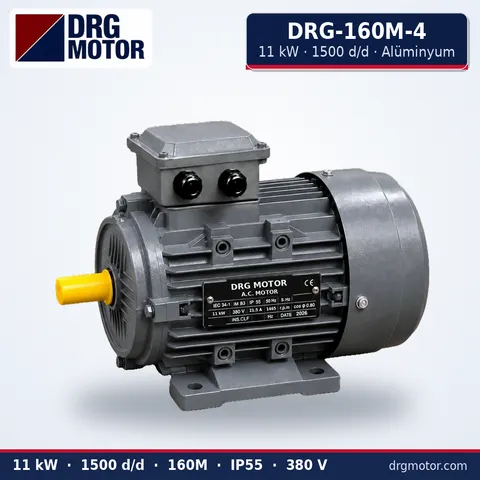
11 kW Three-Phase Motor 1500 rpm – DRG-160M-4 Aluminium
- 11 kW · 1500 rpm (4 poles)
- Aluminium frame · IEC 160M
- Shaft: 42 × 110 mm