English
 Le français
 Türkçe




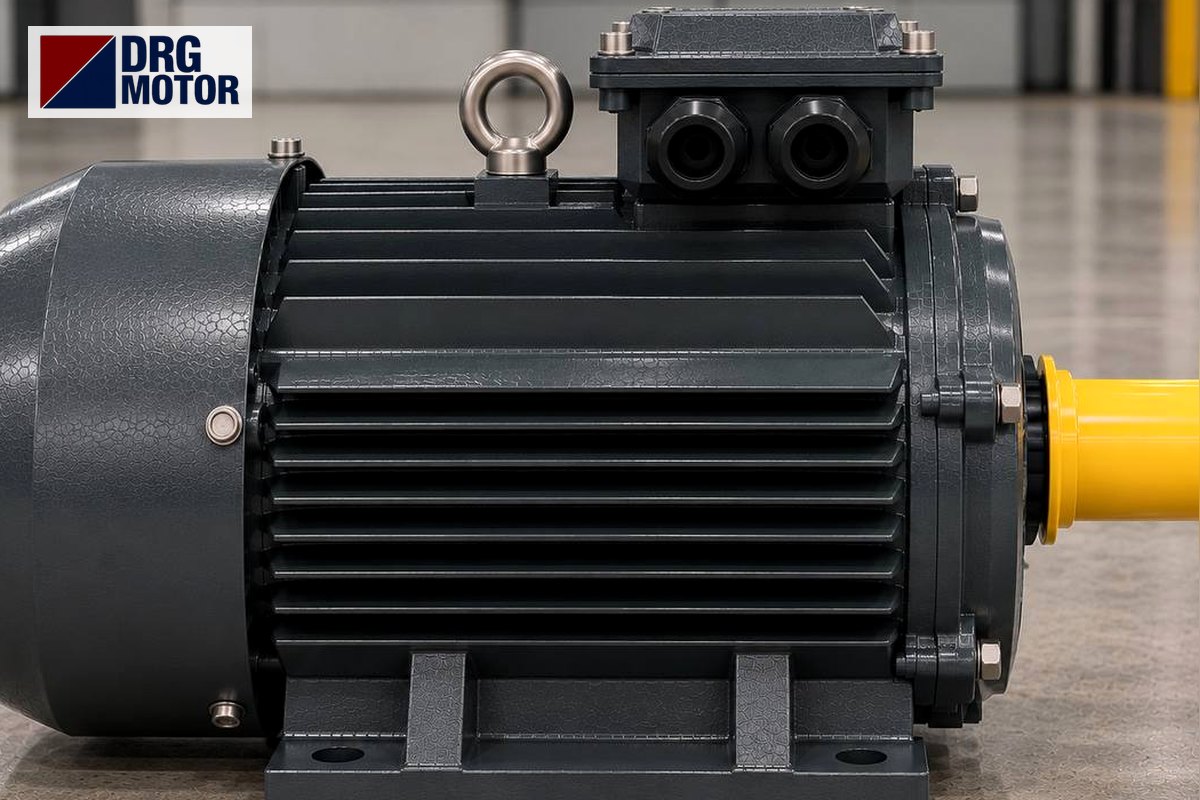

In an asynchronous electric motor running on alternating current, rotation comes not from magnets pulling on each other but from a magnetic field that is built up, already spinning, inside the windings. Three-phase AC carries three currents shifted 120° apart in time; placed in the stator, these currents produce a genuinely rotating field, and the rotor follows it from just behind.
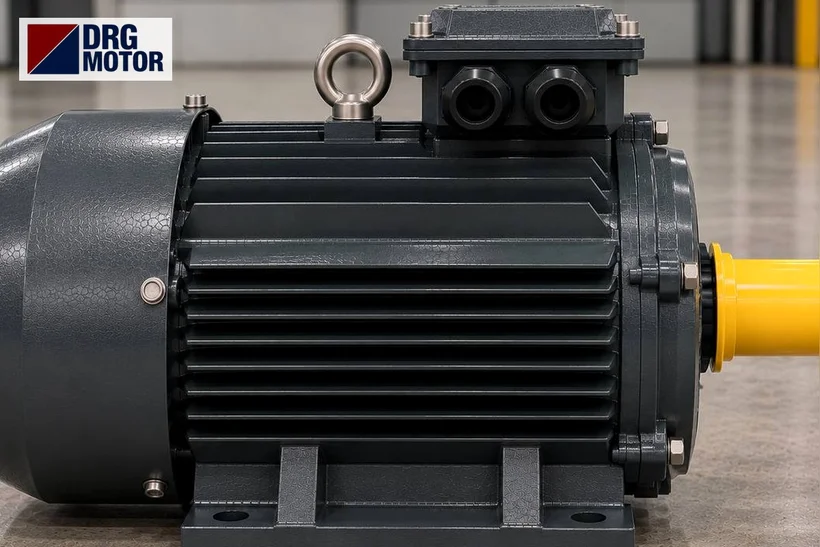
This article looks at one thing only: why alternating current makes the shaft turn. DRG Motor is a manufacturer, supplier and seller of electric motors; you can study models that work on this same principle by pole count and speed in the online electric motor shop and see them all in the three-phase asynchronous electric motors category.
Why alternating current? Why can't DC spin it?
Feed a winding with steady (direct) current and you get a fixed magnet; its north and south poles do not move, so on its own it starts no rotation. The difference with alternating current is that it reverses direction tens of times a second. On a 50 Hz grid the current completes fifty full cycles every second. That constant reversal produces a changing magnetic field even in a stationary winding. A single phase manages this, but it only grows and shrinks the field along one axis. Rotation comes from three phases working together.
How the 120° phase shift builds a rotating field
Two separate 120° angles interlock here, and that is the whole trick. The first is in space: three winding groups are set around the stator circle at 120° from one another. The second is in time: the currents of the three phases are themselves shifted 120°, so one reaches its peak while the others peak at different moments.
Picture the result. At the first instant the first winding makes the strongest field, and the field "points" there. A moment later the second phase peaks and the field shifts to its direction; then the third phase takes over. As the three phases follow one another in turn, the direction of the combined magnetic field keeps advancing around the stator. Nothing moves mechanically; what rotates is the field itself, born from the timing of the currents. This is the rotating magnetic field, and it is exactly the heart of an AC asynchronous electric motor.
Click to see current electric motor prices and order nowSEE PRICES →
Synchronous speed: what sets the field's pace?
The rotating field does not spin at a random rate. Its speed depends on two things: the grid frequency and the number of poles the windings form. The relationship is simple: synchronous speed equals 120 times the frequency divided by the pole count. With 50 Hz fixed, you set the field's speed by changing the pole count. Wind an electric motor of the same power with a different pole count and its speed class changes:
| Poles | Synchronous speed | Example DRG model | Power |
|---|---|---|---|
| 2 poles | 3000 rpm | DRG-112M-2-AL | 4 kW |
| 4 poles | 1500 rpm | DRG-112M-4-AL | 4 kW |
| 6 poles | 1000 rpm | DRG-132M1-6-AL | 4 kW |
All three models in the table are 4 kW and aluminium-housed; the only difference between them is the pole count, and that directly sets how fast the field turns. In other words, the answer to "how many rpm" lies not in the mechanics but in the geometry of the field the windings build from alternating current.
Why does the rotor turn? The birth of torque
As the stator's rotating field sweeps past the rotor bars, it drives a changing magnetic flux through them. The changing flux induces a voltage in the rotor; in a short-circuited squirrel-cage rotor this voltage immediately drives a current. The current-carrying rotor then builds its own field, and the two fields try to catch each other. The torque that turns the shaft comes from here: the rotor chases the field sweeping over it.
There is a subtle rule. If the rotor reached exactly the same speed as the field, the flux through the bars would no longer change; with no change, the induced current and the torque both fall to zero. So the rotor never quite catches the field and always runs a touch behind. The name "asynchronous", meaning "not in step", comes precisely from this.
Slip: why it can never be zero
The ratio describing how far the rotor lags the synchronous speed is called slip. As load rises the rotor slows a little more, the gap widens, the induced current grows, and the electric motor produces more torque. As the load eases the rotor nears synchronous speed but never touches it. This is exactly why the rated speed on the nameplate is slightly below the synchronous value; a model with 1500 synchronous rpm, for instance, runs a little under that on load. This small gap is not a flaw, it is the working principle itself.
If you are unsure about power and speed, the electric motor calculator gives a first idea, and you can see the current range for the panel side in the motor current chart.
Seeing the principle in DRG models
Don't leave the theory on paper. Every model in the shop has its pole count, speed and current at 400 V on the nameplate; these three figures are the visible face of the chain described above. A 2-pole model means a fast-spinning field, a 6-pole model a slower field with higher torque. Deciding the speed your job needs and choosing the pole class to match is the plainest way to turn the principle into practice. DRG Motor is based in İzmir and delivers quickly by cargo across the whole of Türkiye, that city included; you can review your chosen model in the online shop and ask for a quote.
Once the working principle is clear, click to see the current price of the electric motor with the pole count and speed you needSEE PRICES
Send a photo of your current motor nameplate and we will find the suitable DRG model together.Send on WhatsApp
Frequently asked questions
Does the rotating field really rotate, or is it a metaphor?
Physically nothing rotates; what turns is the direction of the combined magnetic field born from the 120° shift of the three phases. Because that direction advances around the stator, its effect is the same as a spinning magnet and it drags the rotor along.
What happens if you swap two phases?
Swap the order of any two of the three phases and the field's direction of travel reverses, so the shaft starts turning the other way. The direction of rotation depends directly on phase order. Have the wiring done by authorised electrical personnel after cutting power and confirming it is de-energised.
Why isn't the speed exactly 1500 or 3000?
1500 and 3000 are synchronous speeds, that is, the speed of the field. To produce torque the rotor always stays a little below it, and the gap widens somewhat as load rises. That is why the rated speed is below the synchronous value.
Which pole class should I choose?
Choose by the speed your job needs: 2 poles for high speed, 4 poles for medium speed, 6 poles for slow, high-torque work. We can settle the model that best fits your need together.
Electric Motors Related to This Topic — Models and Current Prices
Suitability is not decided by power alone: compare the speed, voltage, mounting, shaft and fixing dimensions of your machine with the product data; if unsure, send us the nameplate of your current motor.
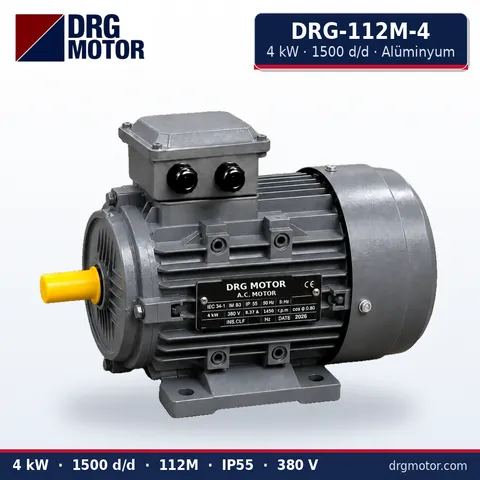
4 kW Three-Phase Motor 1500 rpm – DRG-112M-4 Aluminium
- 4 kW · 1500 rpm (4 poles)
- Aluminium frame · IEC 112M
- Shaft: 28 × 60 mm
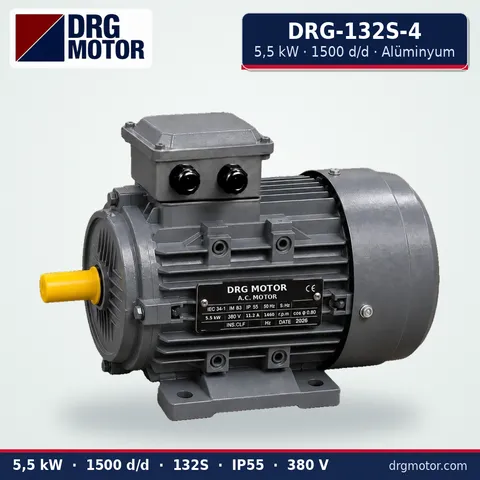
5.5 kW Three-Phase Motor 1500 rpm – DRG-132S-4 Aluminium
- 5.5 kW · 1500 rpm (4 poles)
- Aluminium frame · IEC 132S
- Shaft: 38 × 80 mm
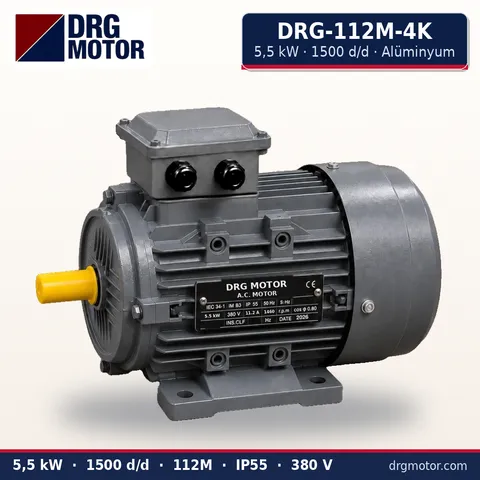
5.5 kW Compact Three-Phase Motor 1500 rpm – DRG-112M-4K Aluminium
- 5.5 kW · 1500 rpm (4 poles)
- Aluminium frame · IEC 112M
- Shaft: 28 × 60 mm
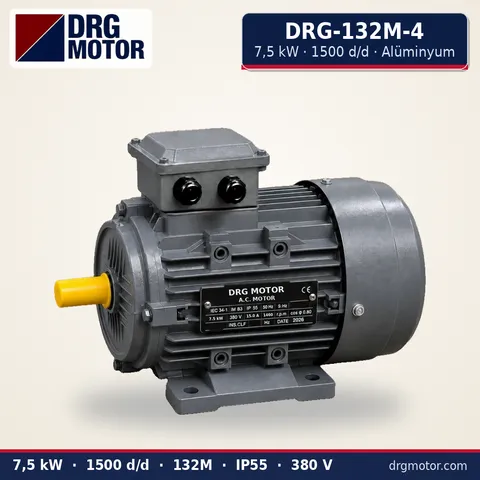
7.5 kW Three-Phase Motor 1500 rpm – DRG-132M-4 Aluminium
- 7.5 kW · 1500 rpm (4 poles)
- Aluminium frame · IEC 132M
- Shaft: 38 × 80 mm
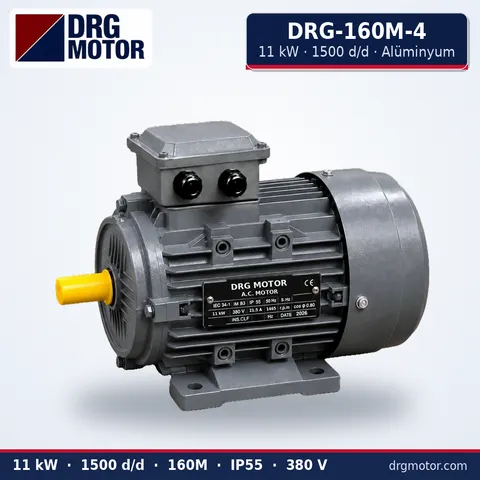
11 kW Three-Phase Motor 1500 rpm – DRG-160M-4 Aluminium
- 11 kW · 1500 rpm (4 poles)
- Aluminium frame · IEC 160M
- Shaft: 42 × 110 mm
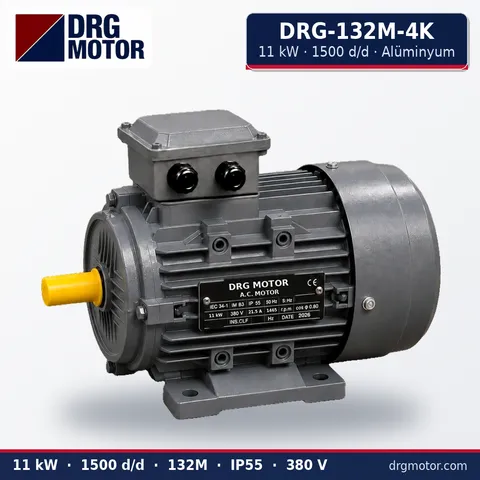
11 kW Compact Three-Phase Motor 1500 rpm – DRG-132M-4K Aluminium
- 11 kW · 1500 rpm (4 poles)
- Aluminium frame · IEC 132M
- Shaft: 38 × 80 mm