English
 Le français
 Türkçe




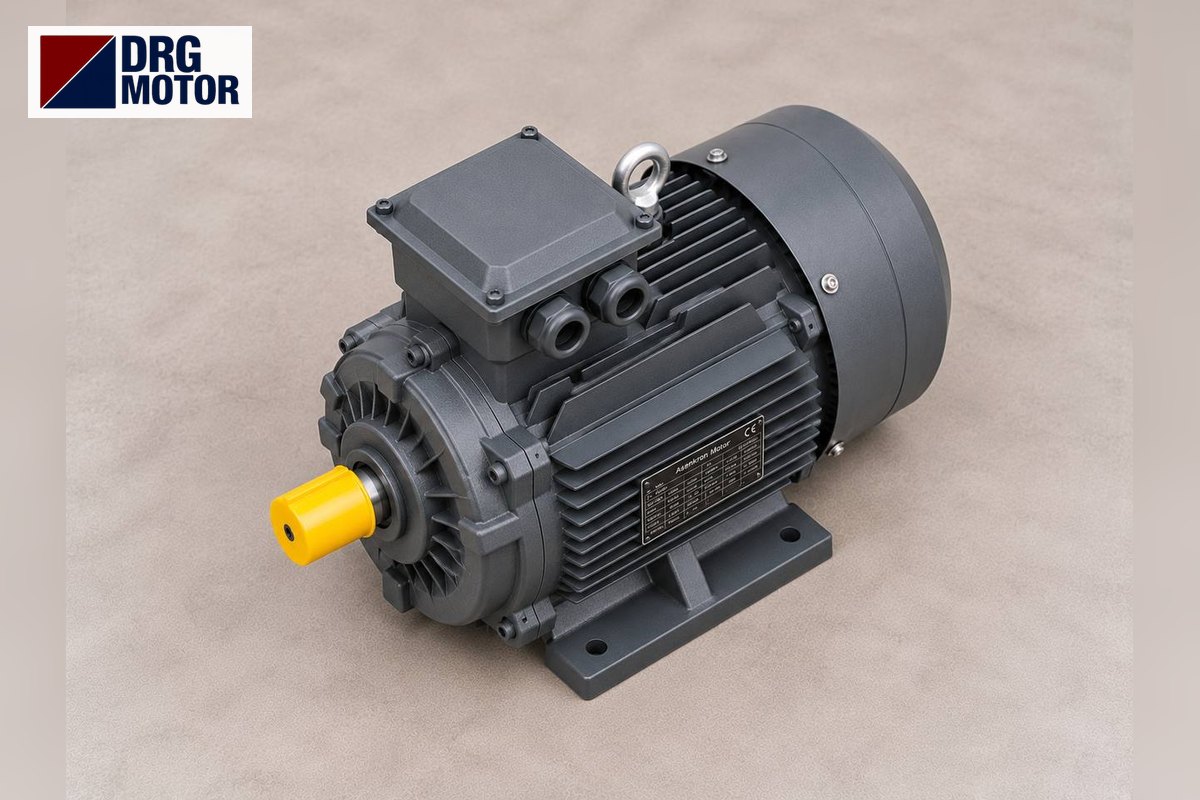

If the WAT three-phase electric motor in your plant needs replacing, the first question is usually "What can go in its place?" This article explains which data identify the existing motor, why WAT offering several frame options for the same output matters during replacement, and which figures are needed to assess a DRG MOTOR option.
First, find out which WAT family the motor belongs to
On WAT's official product pages, three-phase motors fall into two main groups: aluminium-frame motors listed from 0.12 to 55 kW in frame sizes 63–250, and cast-iron motors from 0.55 to 355 kW in frame sizes 80–355. The quickest way to tell the frame material is the type code on the nameplate: according to the WAT catalogue, a G or P in the code (e.g. Q3HG, Q3EP) means cast iron; without it the frame is aluminium.
Besides these two families, the catalogue also includes brake motors, Q3D motors with integrated inverters and F300/F400 smoke-extraction motors. This assessment covers the selection of the electric motor to be connected to the existing equipment. If your motor has a brake, a separate fan or a drive integrated into the motor, say so as well; these features change the assessment. Applications such as smoke extraction carry specific certification requirements; the certification requirement must be checked separately before selecting a motor.
Same kW, different frame: the real pitfall
The WAT catalogue lists standard, HS, compact and super-compact types with different frames and shafts for the same output. For example, the 1.5 kW 2-pole standard Q3H90L2C has a 90 frame and a 24×50 mm shaft, while the compact Q3H80M2DE of the same output has an 80 frame and a 19×40 mm shaft. So "1.5 kW, 3000 rpm" does not tell you that the existing coupling or foot holes will suit a new motor; even with matching kW and speed class, the frame code and shaft size have to be compared separately.
The mounting arrangement can also be read from the code: in the WAT type code FA indicates a B5 flange, PA indicates B35 (feet + flange) and FB/FC indicate B14 variants; if that field is empty the motor is foot-mounted (B3).
Which DRG MOTOR range can be considered?
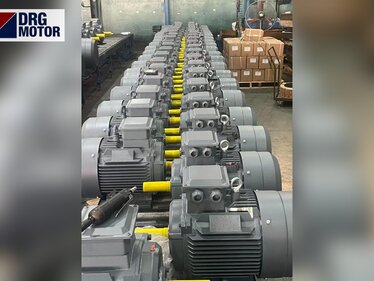
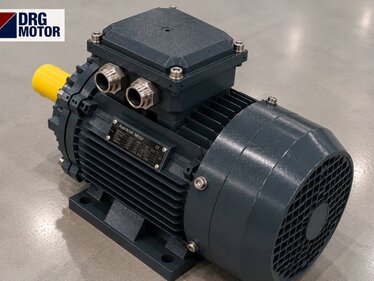
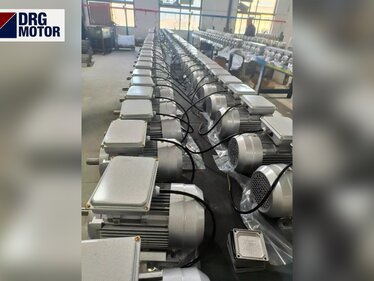
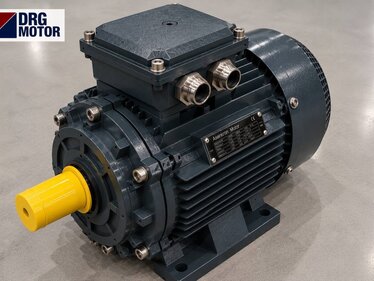
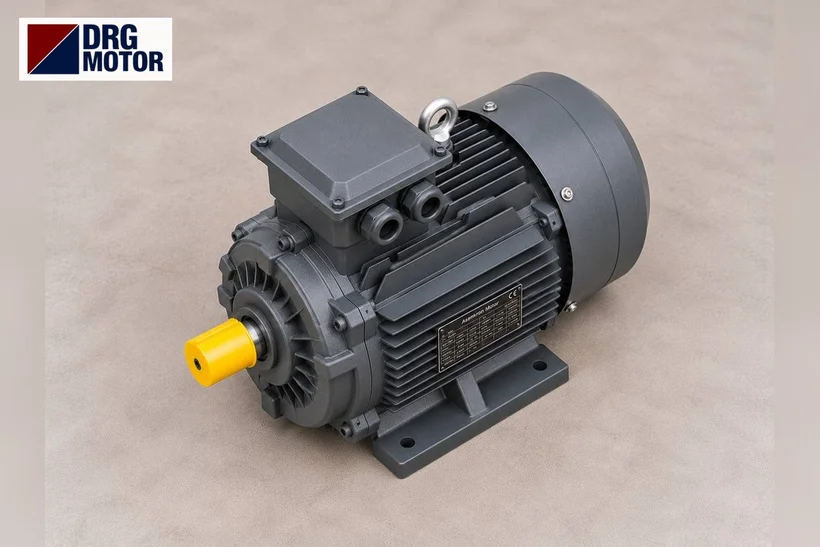
DRG Motor is an electric motor manufacturer, supplier and seller. The shop range consists of three-phase asynchronous IEC motors: aluminium frame 0.25–11 kW and cast-iron frame 0.55–355 kW, in the 1000, 1500 and 3000 rpm speed classes. In the DRG MOTOR online shop, models up to 3 kW are listed as 230/400 V and those of 4 kW and above as 400/690 V; any special voltage or different frequency requirement must be stated separately. Protection is IP55, insulation class F, cooling IC411. Mounting is offered as B3, B5 and B35; B14 is available but its dimensions are confirmed at order. You can browse the range on the three-phase asynchronous electric motors page.
Examples of options from different power steps that can be assessed:
- DRG-90L-4 – 1.5 kW, aluminium, 90L frame, 24×50 mm shaft, rated speed 1445 rpm
- DRG-132S-4 (cast iron) – 5.5 kW, 132S frame, 38×80 mm shaft, rated speed 1460 rpm
- DRG-160M-4 (cast iron) – 11 kW, 160M frame, 42×110 mm shaft, rated speed 1465 rpm
These models are examples only; which one is suitable becomes clear once the existing motor's dimensions and the machine's operating conditions are reviewed together. If you share a nameplate photo and the mounting dimensions of your current motor, options from the DRG MOTOR electric motor shop range are assessed on technical grounds.
To compare foot holes, flange and shaft dimensions, see the DRG MOTOR technical drawings.
Voltage, protection class and environment
The standard design in the WAT catalogue is 400 V 50 Hz; the catalogue gives 230 VΔ/400 VY for 2-, 4- and 6-pole three-phase motors up to 3 kW and 400 VΔ/690 VY above 3 kW. Whether a motor suits the existing supply must be determined by checking the nameplate voltage, frequency, manufacturer tolerances and connection arrangement together. Protection is given as IP56 as standard. If your current motor runs in high humidity, dust or outdoors, say so; whether an IP55 motor suits that environment must be assessed separately. If the cause of the failure is known (overload, water ingress, bearing, phase loss), that information also directly affects the selection.
Common questions before replacement
My WAT nameplate says IE3; does that matter?
Yes, the efficiency class on the nameplate is part of identifying the existing motor. Photographing and sending the whole nameplate is enough; the assessment is made with all nameplate data.
What if the nameplate is unreadable?
Shaft diameter and length, distance between foot holes, shaft centre height and any flange dimensions can be measured and sent. Without the nameplate, however, estimating power and speed carries uncertainty; the machine builder's documents should also be checked if available.
Can an aluminium motor be considered instead of a cast-iron WAT electric motor?
Frame material alone does not decide it; dimensions, environment and vibration conditions are reviewed together. If cast iron was chosen because of a harsh environment, that choice should be kept.
What to send to DRG MOTOR
- A clear photo of the WAT nameplate and the full type code (e.g. Q3H…, Q3HG…)
- Output (kW), rated speed on the nameplate and number of poles
- Voltage, frequency and the connection data on the nameplate
- Mounting arrangement (foot, B5 flange, B35) and frame number
- Shaft diameter × length and any flange dimensions
- The driven machine, daily operating hours and ambient conditions
- The cause of the old motor's failure, if known
You can send this information to DRG MOTOR via WhatsApp (+90 542 666 11 11), the quote list, by phone or to info@drgmotor.com; a suitable option is then determined from the technical data and operating conditions. Other channels are on the contact page.
See current prices of DRG MOTOR electric motors and order online in our storeSEE PRICES →
Technical Sources
- WAT Motor Sanayi ve Ticaret A.Ş. — WAT Product Catalogue (Turkish edition) — IM tr 24.0 — Contents, PDF pages 4–5; Protection class, PDF page 10 (printed page 8); Electrical connection and voltage & frequency, PDF page 12 (printed page 10); Motor type codes, PDF pages 18–19 (printed pages 16–17); IE3 three-phase aluminium motors, electrical data 50 Hz, PDF page 38 (printed page 36); IE3 three-phase aluminium motors, dimensions B3, PDF page 44 (printed page 42).
- WAT Motor Sanayi ve Ticaret A.Ş. — Three-phase aluminium frame motors product page — Standard specifications.
- WAT Motor Sanayi ve Ticaret A.Ş. — Three-phase cast-iron frame motors product page — Standard specifications.