English
 Le français
 Türkçe




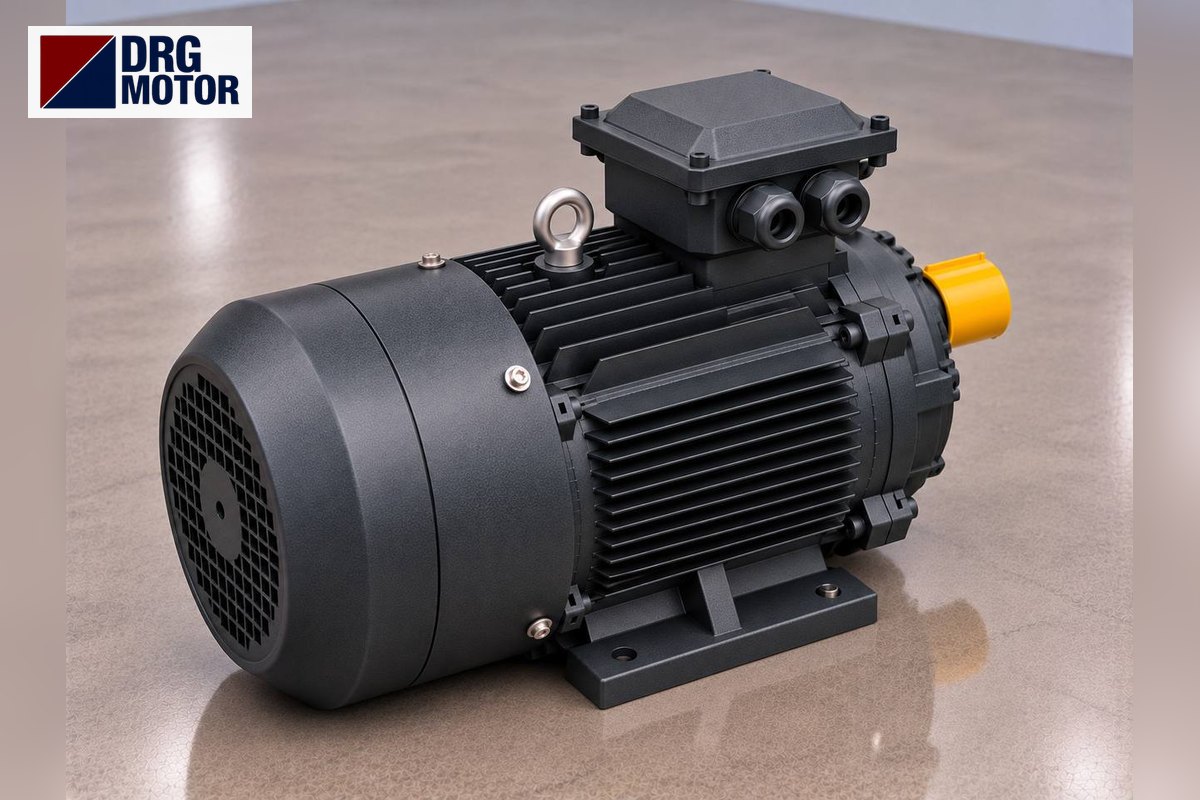

A 7.5 kW WAT electric motor is usually connected by a coupling to a pump, fan, conveyor or gearbox input. Two questions stand out in a replacement: will the existing coupling hub fit the new motor's shaft, and will the new motor bring the machine up to speed under load? This article summarises what to measure on the coupling side, how to describe the starting load, and which values to look at in DRG MOTOR 7.5 kW data.
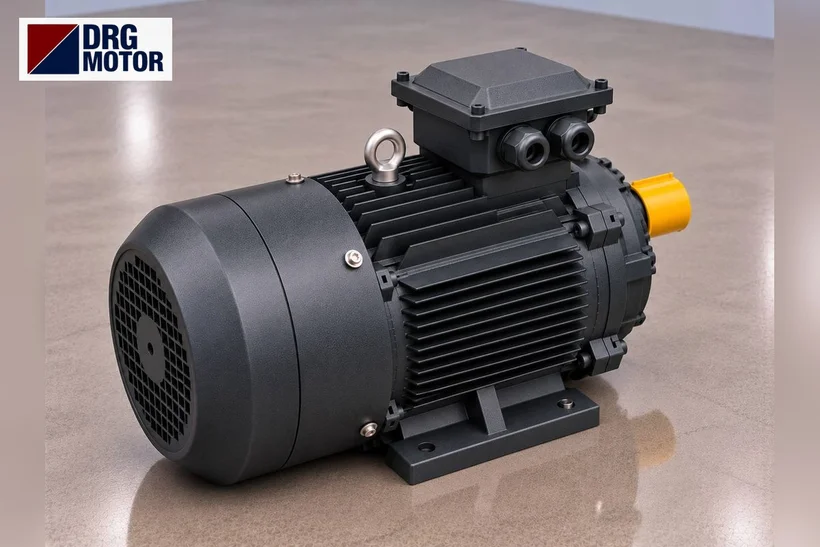
Know the shaft first: WAT 7.5 kW frame and shaft options
In the WAT IM tr 24.0 catalogue, 7.5 kW motors come as the standard Q3H132S2D and HS-type Q3HS132S2D at 2 poles and Q3H132M4D at 4 poles, with frame 132 and a 38×80 mm shaft; the cast-iron Q3HSG132S2D and Q3HG132M4D are also frame 132. In contrast, the 2-pole compact Q3H112M2DE has frame 112 and a 28×60 mm shaft. On a coupled drive this difference is decisive: a coupling hub bored to 28 mm will not go onto a 38 mm shaft, and the shaft height changes by 20 mm. The same 7.5 kW and speed class do not mean the coupling can be reused.
What to check on the coupling side
This section is general practice; coupling selection and alignment must be done by competent technical staff according to the machine design.
- Hub bore and key: Compare the existing hub bore and keyway width with the new motor's shaft diameter and key width. If the hub is to be re-machined, whether enough wall thickness remains must be assessed separately.
- Shaft length: The hub's seating length and the motor shaft extension (E) should match; a short shaft can stop the hub seating fully.
- Shaft height and misalignment: The new motor's shaft centre must be at the same height as the driven shaft. A different frame may need shims or a spacer plate; radial and angular alignment must be redone after mounting.
- Flexible element: If the old motor vibrated or was noisy before failing, a worn coupling element or misalignment may be among the causes; a new motor can inherit the problem with the old coupling.
- Belt and pulley: Pulley diameter, belt tension and the side load on the shaft should be stated separately.
Describing the starting load
The load a motor must overcome at start varies widely by application. A centrifugal pump starting against a closed valve, a belt conveyor starting full and a large-blade fan may all carry the same 7.5 kW nameplate yet stress the motor differently. For the assessment we need:
- Whether the machine starts unloaded or under load (full conveyor, full mixer, crusher, etc.)
- Approximate starting time; whether the motor trips at start
- How many starts per hour
- Starting method: direct, star-delta, soft starter or inverter
The starting method directly affects starting torque; with reduced-voltage starting the motor's starting torque also falls. On a heavy-starting machine, the starting arrangement therefore has to be reviewed together with the new motor. Panel and connection changes must be assessed by competent technical staff.
Values to check in DRG MOTOR 7.5 kW data
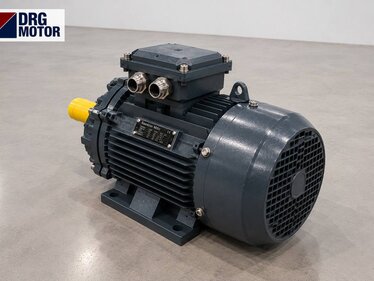
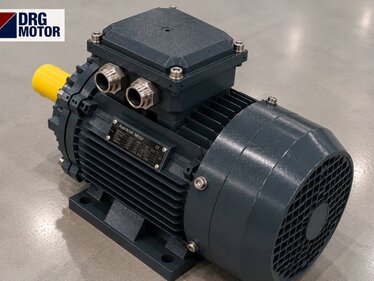
DRG Motor is an electric motor manufacturer, supplier and seller. Torque and starting ratios of DRG options that can be assessed for 7.5 kW:
| Model | Rated speed / torque | Ts/Tn – Tmax/Tn – Is/In | Shaft D×E / key F |
|---|---|---|---|
| DRG-132S2-2 (cast iron) | 2930 rpm / 24.4 Nm | 2.0 – 2.3 – 7.9 | 38×80 / 10 |
| DRG-132M-4 (cast iron) | 1460 rpm / 49.1 Nm | 2.0 – 2.3 – 7.5 | 38×80 / 10 |
| DRG-160M-6 (cast iron) | 970 rpm / 73.8 Nm | 2.0 – 2.1 – 7.0 | 42×110 / 12 |
Ts/Tn is the ratio of starting torque to rated torque, Tmax/Tn the breakdown torque ratio and Is/In the ratio of starting current to rated current. These are catalogue values; adequacy cannot be stated without comparing them with the machine's real starting demand. The 7.5 kW models have the 400/690 V design; rated current at 400 V is 13.7 A for DRG-132S2-2, 14.3 A for DRG-132M-4 and 15.4 A for DRG-160M-6. The same models also exist with aluminium frames; all are in the DRG MOTOR electric motor shop, and general industrial use is covered on the general purpose electric motors page.
When you send DRG MOTOR the coupling dimensions, starting conditions and a WAT nameplate photo, torque and shaft data are compared with the machine's needs for the assessment. The motor current chart can be used to compare currents.
Questions on coupling and starting
Can I reuse the old coupling on the new motor?
It may be possible if the hub bore, keyway and hub length suit the new shaft and the flexible element is sound. A worn coupling can cause vibration and bearing stress on the new motor; competent staff should assess it.
Should I choose the next power up for a heavy-starting machine?
Not always. Starting problems can come from the starting method, low supply voltage or mechanical binding. Increasing power can also change frame, shaft and coupling dimensions.
How does a frame-132 motor in place of a compact WAT electric motor affect the coupling?
The shaft grows from 28 mm to 38 mm and the shaft height rises by 20 mm; the coupling hub and alignment have to be reconsidered.
Information to send to DRG MOTOR
- WAT nameplate photo and full type code
- Shaft diameter × length and key width
- Coupling type, hub bore and hub length (pulley diameter if belt-driven)
- Shaft height and mounting arrangement
- The driven machine; whether it starts loaded or unloaded
- Starting method and number of starts per hour
- Any vibration, noise or overheating observed before failure
You can send this information via WhatsApp (+90 542 666 11 11), the quote list, by phone or to info@drgmotor.com; the option is assessed together with the machine's starting and connection conditions. Other channels are on the contact page.
See current prices of DRG MOTOR electric motors and order online in our storeSEE PRICES →
Technical Sources
- WAT Motor Sanayi ve Ticaret A.Ş. — WAT Product Catalogue (Turkish edition) — IM tr 24.0 — IE3 three-phase aluminium motors, electrical data 50 Hz, PDF pages 38–39 (printed pages 36–37); IE3 three-phase aluminium motors, dimensions B3, PDF pages 45–46 (printed pages 43–44); IE3 three-phase cast-iron motors, electrical data 50 Hz, PDF page 76 (printed page 74); IE3 three-phase cast-iron motors, dimensions B3, PDF pages 77–78 (printed pages 75–76).