English
 Le français
 Türkçe




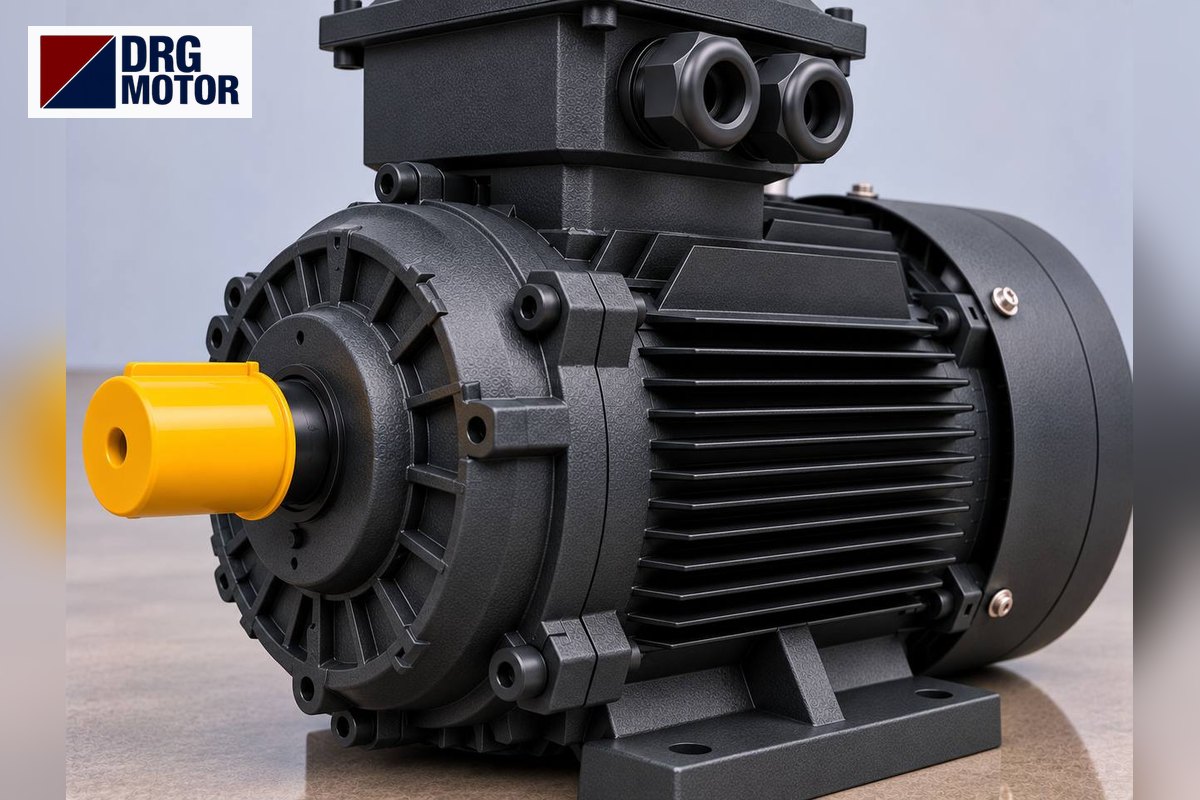

Before you replace a VOLT three-phase motor, you need to read from the nameplate which supply voltage and which connection the winding was designed for. This article explains which fields to check on the nameplate of a VOLT electric motor running on a 380/400 V network, how to interpret the voltage pair, and what information to collect so that a new motor can be evaluated.
380 V or 400 V? Reading the voltage pair on the nameplate
On site, the three-phase network is still often called "380". VOLT's three-phase motor technical catalogue (REV 23.08), however, gives voltage as pairs such as 230/400 V and 400/690 V, while the nameplate example in the manufacturer's operating manual shows an older notation such as "Δ380". Finding different notations on VOLT motors from different periods is therefore normal. Rather than treating 380 V and 400 V as the same value, whether a motor suits the existing supply should be determined by checking the nameplate voltage and frequency, the manufacturer's tolerances and the connection arrangement together.
In a voltage pair, the lower value corresponds to delta (Δ) and the higher value to star (Y). A winding marked 230/400 V therefore runs in star on a 400 V network, while one marked 400/690 V runs in delta on a 400 V network. The VOLT manual states that on a 400 V network star connection applies up to 3 kW for 2- and 4-pole motors and up to 2.2 kW for 6-pole motors. Do not generalise from catalogue tables about which frame uses which voltage pair; for your own motor, the nameplate is what counts.
Which nameplate fields should be checked?
The three-phase nameplate example in the VOLT manual includes type code, mounting (such as IM B3), protection and insulation class, efficiency class, voltage and connection symbol, frequency, current, kW, cosφ, speed (1/min), serial number and standard; the manual's additional nameplate example (VM 315L-6) also shows bearing and grease data. For a replacement, the key items are:
- Type code: a code such as V3EA 112 M4A carries the efficiency series, frame material, frame size, number of poles and core length together.
- Voltage and connection symbol: which voltage the Δ and Y marks refer to.
- Current: helps you understand which value the existing protection was set to.
- Rated speed: the 1/min value on the plate, i.e. the speed under load; do not confuse it with a speed class such as 1500 or 3000.
- Frequency lines: if the plate has separate lines for 50 Hz and 60 Hz, compare using the line for your network frequency.
- Serial number: according to the manual it has 12 digits; the first 6 are the production serial, the next 4 the production year and the last 2 the production week.
A different voltage pair may mean a different connection
If the new motor has a different voltage pair, the terminal box connection and often the starting arrangement must be reconsidered. In the DRG MOTOR online store, models up to 3 kW are listed as 230/400 V and those of 4 kW and above as 400/690 V; any special voltage or different frequency requirement should be stated separately. For example, the 380 V connection of DRG-100L-2 (3 kW) is given as star, and that of DRG-112M-4 (4 kW) as delta. If a 400/690 V motor is being considered in place of a motor whose plate reads 4 kW and 230/400 V, the panel arrangement may be affected, especially where star-delta starting is used. Such changes must be assessed by competent technical personnel.
Two nameplates showing the same kW and the same speed class do not mean both motors connect to the same panel in the same way; the voltage pair, current and terminal box position must be compared separately.
When you share your nameplate photo and the starting information from the panel with DRG MOTOR, the voltage and connection data can be read together to decide which options are worth examining.
Rated current and protection setting
A motor protection relay is usually set according to the nameplate current. Because a motor's current changes with supply voltage, DRG product data lists current separately for 380 V, 400 V and 415 V; for DRG-112M-4, for example, 8.37 A at 380 V and 7.95 A at 400 V. The VOLT manual specifies a supply tolerance of ±5% on voltage and ±2% on frequency. For approximate currents by power and voltage, see the motor current chart; updating the protection setting for a new motor remains a job for competent personnel.
DRG options that can be evaluated
DRG Motor is a manufacturer, supplier and seller of electric motors. The range in the DRG electric motor online store consists of three-phase asynchronous IEC motors (IP55, class F insulation, B3/B5/B35 mounting). Once your nameplate data is clear, the models below are options that can be evaluated for a dimensional and connection comparison; suitability cannot be stated before your data is reviewed:
- DRG-100L-2: 3 kW, 2 poles, aluminium frame, 230/400 V, rated 2895 rpm, shaft 28×60 mm
- DRG-112M-4: 4 kW, 4 poles, aluminium frame, 400/690 V, rated 1450 rpm, shaft 28×60 mm
- DRG-160M-4: 11 kW, 4 poles, cast iron frame, 400/690 V, rated 1465 rpm, shaft 42×110 mm
For other powers and frames, see General Purpose Electric Motors.
Frequently Asked Questions
My nameplate only says "Δ380 V". What does that mean?
It shows the winding was designed to run in delta on a 380 V network. This older notation alone does not tell you which voltage pair the new motor should have; it must be assessed together with the full nameplate and the panel information.
The nameplate is worn off. How can I find the voltage?
Frame size can be estimated by measuring shaft height and foot holes, but voltage and current cannot be derived from dimensions. In that case the type code, serial number, panel and protection data should be reviewed together by competent personnel; a definite answer may not always be possible.
The nameplate has two frequency lines. Which one applies?
If your network is 50 Hz, use the 50 Hz line. Power, voltage and speed on the 60 Hz line may differ, so comparing with that line would be misleading.
Information to send to DRG MOTOR
- A clear photo showing the whole nameplate
- Full type code and serial number
- kW, rated speed (1/min) and nameplate current
- Voltage pair and Δ/Y symbols, network voltage and frequency
- Starting method (direct-on-line, star-delta, soft starter, etc.)
- A photo of the terminal box taken by competent personnel with the power off, and the cable entry direction
- Mounting type (foot/flange) and shaft size
- The machine the motor drives
Send this information to DRG MOTOR via WhatsApp, through the quote list, or at +90 (542) 666 11 11 and info@drgmotor.com, so that a suitable option can be evaluated by reviewing the nameplate data together with your plant's connection arrangement.
See current prices of DRG MOTOR electric motors and order online in our storeSEE PRICES →
Technical Sources
- VOLT Elektrik Motorları — Product Technical Catalogue, Three-Phase Motors (Ürün Teknik Kataloğu, 3 Fazlı Motorlar) — REV 23.08 — IE3 electrical data tables (Tables 13–18; voltage, type code, power) — printed pages 14–16.
- VOLT Elektrik Motor Sanayi ve Ticaret A.Ş. — Volt Electric Motors Introduction and Operating Manual (Tanıtma ve Kullanma Kılavuzu) — 2015/001 edition — Section 3, Electric Motor Models (model coding system) — printed page 4; Section 4.1, Environmental Conditions (supply voltage and frequency tolerance) — printed page 6; Section 8.3, Installation (star/delta connection) — printed page 9; Section 12, Motor Nameplates — printed pages 18–19.