English
 Le français
 Türkçe




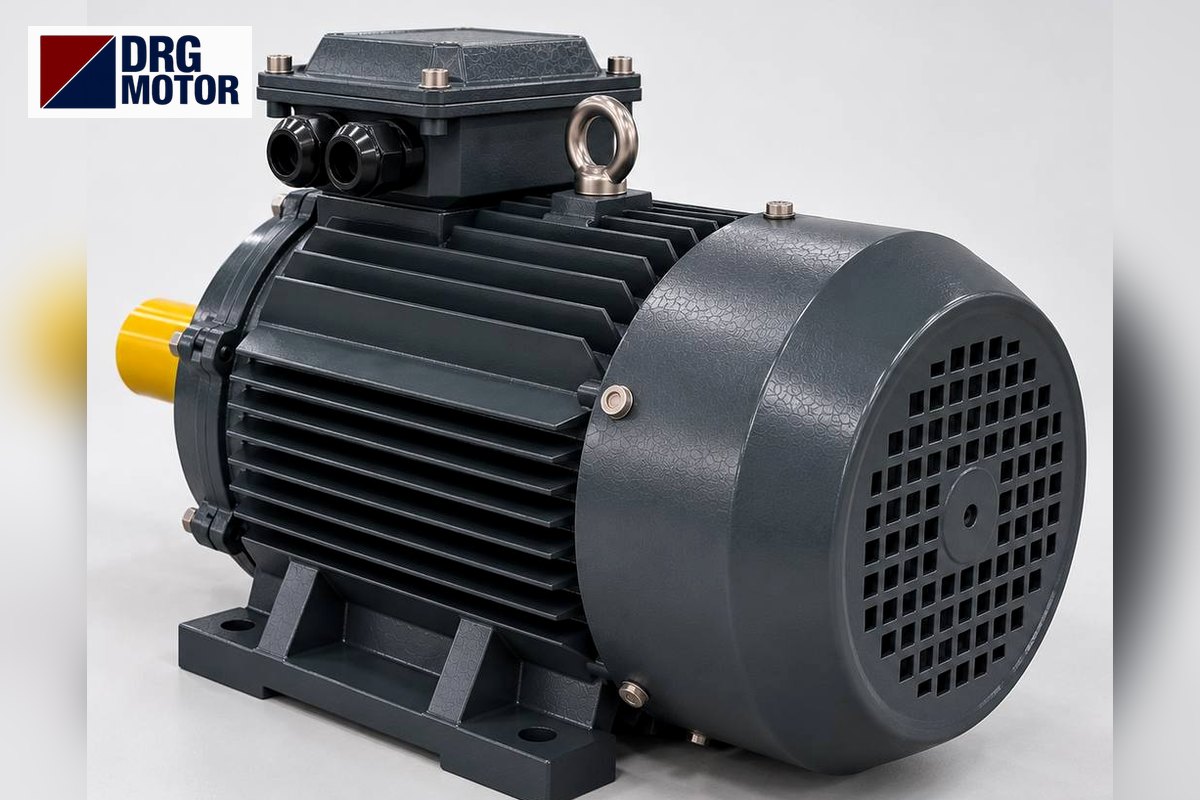

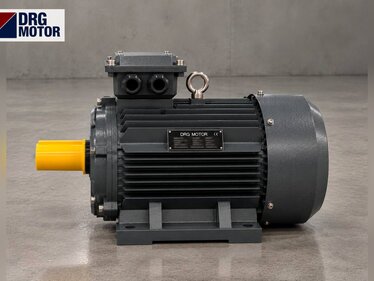
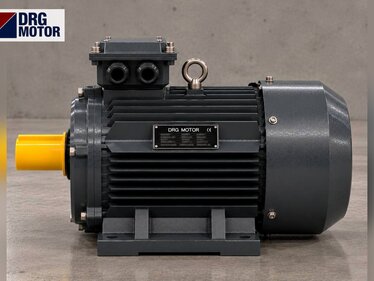
The nameplate of an electric motor is its identity card. Power, voltage, current, speed, protection and insulation — everything you need when buying or sourcing a spare — is printed on that small metal plate bolted to the frame. Once you can read a three-phase asynchronous electric motor nameplate line by line, you avoid both ordering the wrong model and searching in the dark.
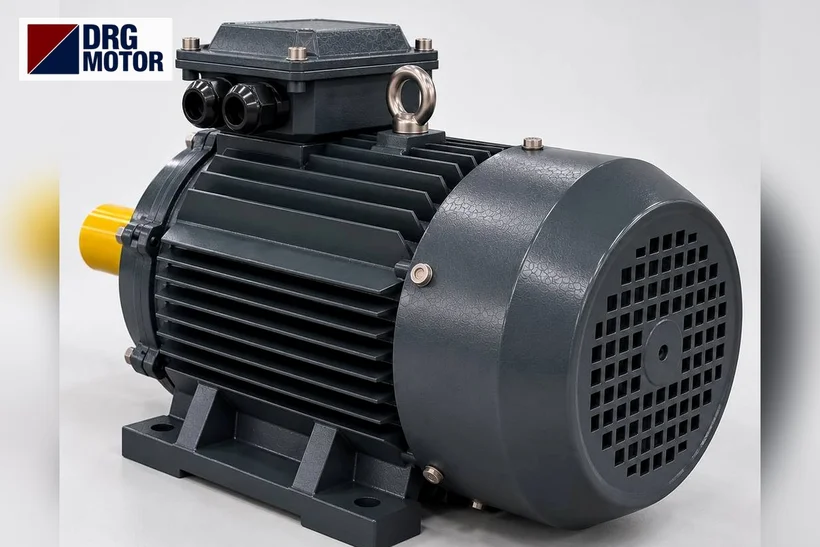
DRG Motor is a manufacturer, supplier and seller of electric motors. It is based in İzmir and ships quickly across all of Türkiye, that province included. Once you have decoded the plate, you can find the right model by power and speed in the online electric motor shop and see the same products together in the three-phase asynchronous electric motors category.
Why start with the nameplate?
The situation we meet most often: an old electric motor comes off a machine, someone says "I need the same one", yet nobody reads the plate. But even within one frame size there are different powers and speeds. The nameplate removes the guesswork. When you order, just photograph it; every point below is already on that photo.
The power line: kW and HP
The kW figure is the mechanical power the electric motor can deliver at the shaft, not the power it draws from the grid. Most plates also show the HP equivalent. The rough conversion is simple: 1 HP is about 0.746 kW, so a 4 kW electric motor is roughly 5.5 HP. Match your machine's requirement to the kW on the plate; oversizing "to be safe" and undersizing for budget both cause trouble.
Voltage and connection: 230/400 V, 400/690 V and star-delta
Voltage is printed as two values because a three-phase winding can be wired two ways. Small ratings usually show 230/400 V, larger ones 400/690 V. The first number is the delta (Δ) connection, the second is star (Y).
What matters in practice: on your 400 V supply, a motor marked 230/400 V is wired in star (Y), while a motor marked 400/690 V runs on 400 V in delta (Δ). The same detail drives star-delta starting. Before changing any connection, switch off the supply, verify it is de-energised and have the work done by a qualified electrician.
Current (A) and power factor (cosφ)
The current on the plate is what the motor draws at rated load, usually listed for each voltage (a value for 400 V, a lower one for 690 V). This is your first reference for cable size and for the thermal relay range; set the exact value according to the motor plate and the panel documentation. For a quick check, the motor current chart helps.
Next to it, cosφ (power factor) tells how much of the drawn current turns into real work; on three-phase asynchronous electric motors it is typically written in the 0.7–0.85 range at rated load. It is a meaningful line for anyone sizing compensation and cables.
Speed, frequency and number of poles
Speed is given in rpm and is tied directly to the pole count. On a 50 Hz supply the synchronous speed is 120·f/poles: 2 poles ≈ 3000, 4 poles ≈ 1500, 6 poles ≈ 1000 rpm. The plate value is a little below this (for example 1455 rpm) because an asynchronous electric motor turns slightly behind synchronous speed; that gap is called slip. The Hz line states the frequency the motor is wound for; the Turkish grid is 50 Hz.
Click to see current electric motor prices and order nowSEE PRICES →
Protection (IP) and insulation class
The code starting with IP describes protection against dust and water. DRG's standard three-phase electric motors are IP55: dust-protected and resistant to water jets from any direction. The first digit is for solids/dust, the second for water. The insulation class states the temperature the winding can withstand; DRG motors use class F. This is a thermal class, not to be confused with efficiency; if you install in a hot ambient, say so in advance.
Mounting type (IM) and frame size
The IM code on the plate gives the mounting arrangement. The common ones are foot-mounted B3, flange B5, small face flange B14 and foot-plus-flange B35. The wrong mounting type means the motor will not fit your machine even when power and speed are right; it is the most frequently skipped line.
The number in the model code (for example 112, 132, 160) is the frame size — the shaft centre height above the feet in millimetres. A 112 frame means the shaft centre sits 112 mm above the base. This figure is critical for aligning couplings and pulleys.
Example: reading a DRG electric motor plate line by line
Below we gathered the lines you will see on the nameplate of the DRG-112M-4 (4 kW, 1500 rpm) aluminium three-phase electric motor and what each one means. Open its product page and you will find the same values there.
| Plate field | Example value | Meaning |
|---|---|---|
| Power | 4 kW (5.5 HP) | Mechanical power delivered at the shaft |
| Voltage | 400/690 V (Δ/Y) | Two values for delta/star connection |
| Current (400 V) | 7.95 A | Current drawn at rated load |
| Speed | 1500 rpm (plate shows slightly less) | 4 poles, 50 Hz synchronous speed ≈ 1500 |
| Frequency | 50 Hz | Grid frequency it is wound for |
| Protection | IP55 | Dust-protected, resists water jets |
| Insulation | Class F | Thermal class of the winding |
| Frame / Shaft | 112M / 28x60 mm | Frame 112 mm, shaft diameter×length |
Which DRG model does your plate point to?
Once you know the power and speed, here are frequently requested DRG aluminium models in the 1500 rpm class with their 400 V currents. Each code links to its product page; for a wider choice use the electric motor calculator and the online electric motor shop.
| Model | Power | Speed | Current (400 V) |
|---|---|---|---|
| DRG-112M-4-AL | 4 kW (5.5 HP) | 1500 rpm | 7.95 A |
| DRG-132S-4-AL | 5.5 kW (7.5 HP) | 1500 rpm | 10.7 A |
| DRG-112M-4K-AL | 5.5 kW (7.5 HP) | 1500 rpm | 10.7 A |
| DRG-132M-4-AL | 7.5 kW (10 HP) | 1500 rpm | 14.3 A |
| DRG-160M-4-AL | 11 kW (15 HP) | 1500 rpm | 20.4 A |
| DRG-132M-4K-AL | 11 kW (15 HP) | 1500 rpm | 20.4 A |
Frequently asked questions
What does 230/400 V on the plate mean?
The two voltages show the two connection modes of the winding: 230 V in delta (Δ), 400 V in star (Y). On a 400 V supply this motor is wired in star.
Why does the plate read 1455 rather than 1500 rpm?
An asynchronous electric motor turns slightly behind the synchronous speed (1500 rpm). This small difference is slip and is normal; the plate shows the actual loaded speed.
Are IP55 and class F the same thing?
No. IP55 is the external protection rating (dust and water); class F is the thermal insulation class of the winding. They are separate lines.
I cannot read the plate — can you still find the right model?
Usually yes. Send whatever is legible together with the machine and current dimensions, and we will confirm the suitable DRG model together.
To see the current price of the electric motor that matches your nameplate power and speed, visit the shop.SEE PRICES
Send a photo of your current motor nameplate and we will find the suitable DRG model together.Send on WhatsApp
Electric Motors Related to This Topic — Models and Current Prices
Suitability is not decided by power alone: compare the speed, voltage, mounting, shaft and fixing dimensions of your machine with the product data; if unsure, send us the nameplate of your current motor.
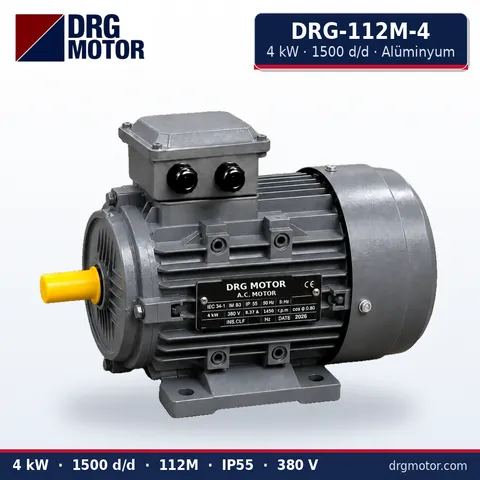
4 kW Three-Phase Motor 1500 rpm – DRG-112M-4 Aluminium
- 4 kW · 1500 rpm (4 poles)
- Aluminium frame · IEC 112M
- Shaft: 28 × 60 mm
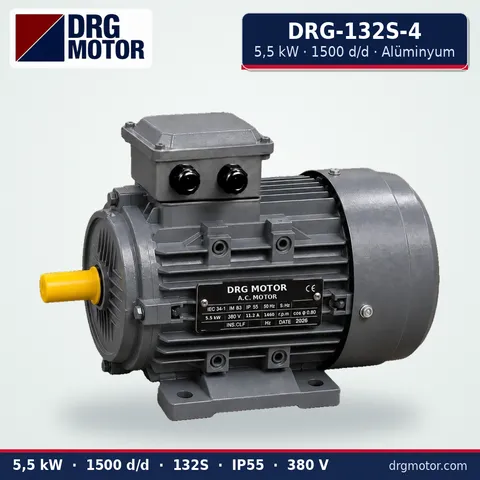
5.5 kW Three-Phase Motor 1500 rpm – DRG-132S-4 Aluminium
- 5.5 kW · 1500 rpm (4 poles)
- Aluminium frame · IEC 132S
- Shaft: 38 × 80 mm
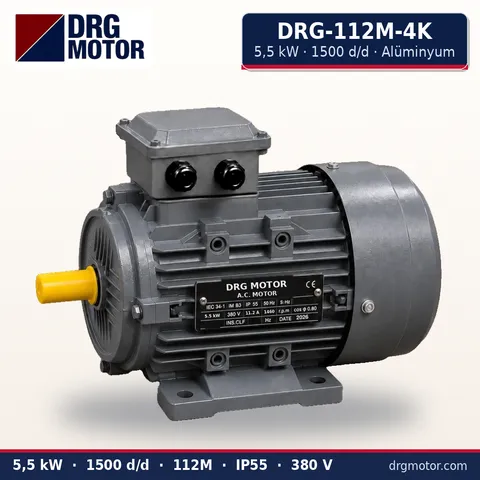
5.5 kW Compact Three-Phase Motor 1500 rpm – DRG-112M-4K Aluminium
- 5.5 kW · 1500 rpm (4 poles)
- Aluminium frame · IEC 112M
- Shaft: 28 × 60 mm
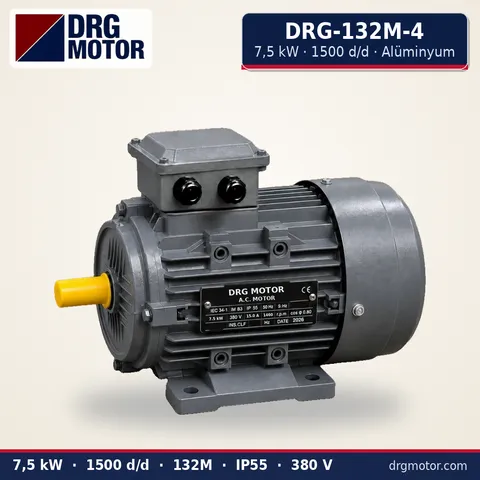
7.5 kW Three-Phase Motor 1500 rpm – DRG-132M-4 Aluminium
- 7.5 kW · 1500 rpm (4 poles)
- Aluminium frame · IEC 132M
- Shaft: 38 × 80 mm
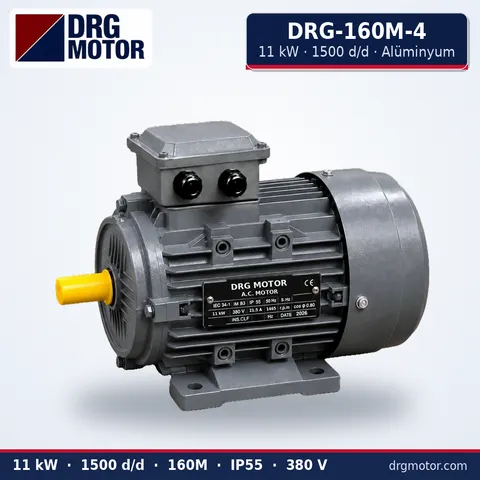
11 kW Three-Phase Motor 1500 rpm – DRG-160M-4 Aluminium
- 11 kW · 1500 rpm (4 poles)
- Aluminium frame · IEC 160M
- Shaft: 42 × 110 mm
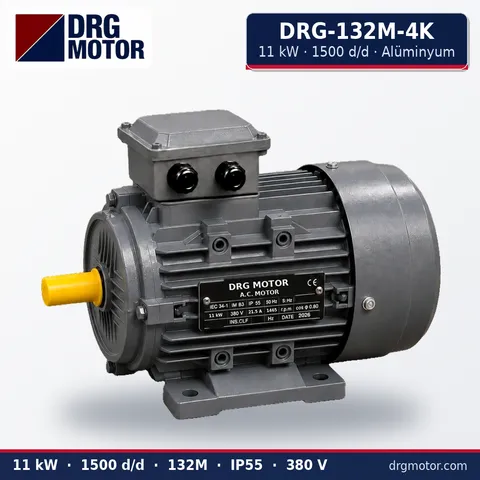
11 kW Compact Three-Phase Motor 1500 rpm – DRG-132M-4K Aluminium
- 11 kW · 1500 rpm (4 poles)
- Aluminium frame · IEC 132M
- Shaft: 38 × 80 mm