English
 Le français
 Türkçe




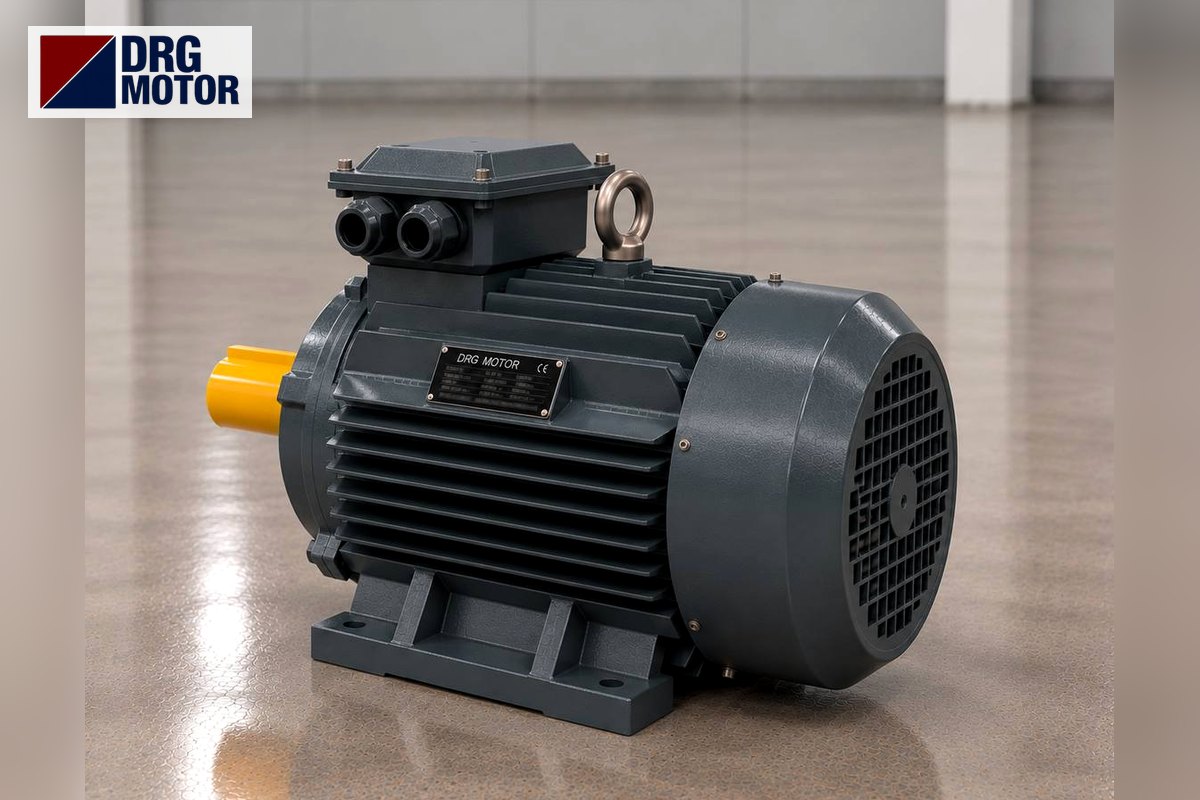

If one of the three phases is lost while a three-phase motor is running (single phasing), the motor does not stop at once; instead the current drawn through the two remaining phases rises sharply, the windings overheat and, without protection, the motor burns out within minutes. If a phase is missing at start-up, the motor cannot turn at all and only hums while staying locked.
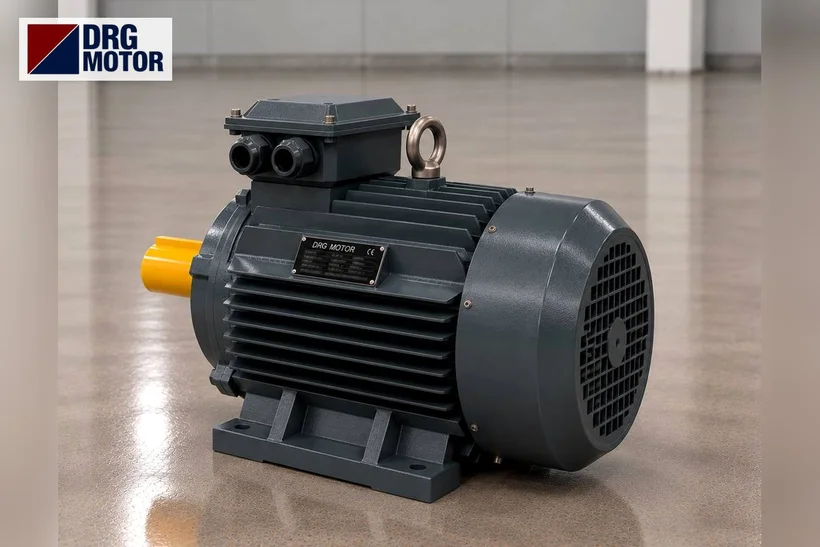
DRG Motor is a manufacturer, supplier and seller of electric motors. To pick a suitable replacement for a motor whose winding was damaged by phase loss, browse the online motor shop or the three-phase asynchronous electric motors category. This article explains what phase loss does inside the motor.
What happens inside the motor during phase loss?
A three-phase asynchronous motor runs thanks to the rotating magnetic field created by three phases arriving 120° apart. This field drags the rotor. When one phase is lost, the rotating field collapses into a weak, pulsating field along a single axis. If the motor is already turning, its inertia keeps it running, but the same mechanical load must now be carried by two phases.
Because the power demand stays, the current in the two remaining phases rises noticeably; under full load it can climb to roughly 1.7 times the rated value. Since heat is produced in proportion to the square of the current, the winding temperature reaches a dangerous level within minutes.
A phase lost while running: overcurrent and overheating
The most common case is a phase dropping out while the motor turns under load (a blown fuse, a loose terminal, a broken conductor, a faulty contactor contact). The motor slows a little and keeps trying to turn while two phases are overloaded. Typical symptoms are:
- The frame heats up quickly, with a smell of paint and then of burning insulation.
- Speed drops, the motor strains and gives a heavy, muffled hum.
- As the current in the remaining phases rises, a fuse or the thermal relay may trip.
If protection is set correctly, the thermal relay stops the motor at this point. Without protection, or when the load current stays just below the threshold, heat keeps building and the winding insulation breaks down.
A phase missing at start-up: the motor cannot start and hums
If a phase is missing while the motor is stationary, the situation is harsher. No rotating field forms, so there is no torque to start the rotor. The motor only gives a vibrating hum, the shaft does not turn, and it draws a current close to the locked-rotor value. This current is several times the rated value and, because it stays constant, burns the winding much faster. If a motor hums without turning when energised, the first suspect is phase loss, and power must be cut immediately.
Click to see current electric motor prices and order nowSEE PRICES →
The lasting damage phase loss causes
The table below summarises what phase loss does at different moments.
| Situation | What is seen in the motor | Likely result |
|---|---|---|
| Phase lost while running | Current rises in two phases, overheating, muffled hum | Winding burns if protection does not trip |
| Phase missing at start-up | Shaft does not turn, high locked-rotor current | Winding burns very quickly |
| Phase loss goes unnoticed | Heat builds up, insulation slowly degrades | Permanent winding damage, rewinding |
The damage usually concentrates in the winding group tied to the affected phase; when the motor is opened, one phase is clearly darkened or burnt. This is why phase loss is one of the most common causes of winding burnout in three-phase motors.
How much current at each power? Example DRG models
To gauge how hard the remaining phases are pushed during phase loss, you need the motor's rated current. Below are the 400 V rated currents of a few 1500 rpm (4-pole) DRG models; remember that during phase loss the current in the two remaining phases can rise to about 1.7 times this value.
| Model | Power | Rated current (400 V) |
|---|---|---|
| DRG-112M-4 (aluminium) | 4 kW | 7.95 A |
| DRG-132S-4 (aluminium) | 5.5 kW | 10.7 A |
| DRG-132M-4 (aluminium) | 7.5 kW | 14.3 A |
| DRG-160M-4 (aluminium) | 11 kW | 20.4 A |
For example, on a 7.5 kW model the rated current is about 14.3 A, while during phase loss the remaining phases may be pushed to around 24 A. Use the electric motor calculator and the motor current chart to check the correct power and current.
The solution against phase loss: a phase protection relay
The most effective way to stop phase loss from burning the motor is a phase protection (phase failure/sequence) relay that continuously monitors the three supply phases. When a phase drops out or the imbalance threshold is exceeded, the relay opens the contactor and takes the motor offline within seconds, so the winding has no time to overheat. A thermal overload relay provides a second line of defence, but because it works on heat it cannot always catch a fast phase loss on its own. Using both together is recommended.
Set the threshold and current values of the protection devices according to the rated current on the motor nameplate and the device documentation, not by guesswork. Loose terminals are also a frequent cause of phase loss, so periodic tightness checks help.
Safety: before any measurement or check
If you suspect phase loss, before measuring at the panel or motor terminals, cut the power, verify the absence of voltage with a suitable device, and let only qualified electrical personnel carry out the work. Do not restart a burnt or overheated motor before measurements are complete. For cable size and protection selection, the motor cable size calculator is a useful guide.
Send a photo of your current motor nameplate and we will find the suitable DRG model together.Send on WhatsApp
If you need to replace a motor whose winding was damaged by phase loss, you can compare power and speed options and current prices through the shop.
See suitable three-phase asynchronous models and current prices in the shop for a motor damaged by phase lossSEE PRICES
Frequently asked questions
Can a three-phase motor run on a single phase?
If a phase drops while running, the motor may keep turning briefly, but this is not real operation: current rises, it overheats and, without protection, it burns out. If a phase is missing at start-up it cannot turn at all and only hums.
Why does the motor hum during phase loss?
Because the rotating magnetic field collapses, there is no proper torque to turn the rotor; the single-direction pulsating current through the windings creates vibration and a muffled hum. If the shaft is not turning, this sound is a strong sign of phase loss.
Does phase loss burn the motor immediately?
Not always; the time depends on load and protection. With a phase missing at start-up, the high current makes burnout very fast. Under light load and with protection present, the relay can stop the motor and prevent damage.
What is the best protection against phase loss?
The most suitable solution is a phase protection relay that monitors the phases together with a thermal overload relay set to the rated current. Regular terminal tightness checks also reduce the risk of phase loss.
Electric Motors Related to This Topic — Models and Current Prices
Suitability is not decided by power alone: compare the speed, voltage, mounting, shaft and fixing dimensions of your machine with the product data; if unsure, send us the nameplate of your current motor.

4 kW Three-Phase Motor 1500 rpm – DRG-112M-4 Aluminium
- 4 kW · 1500 rpm (4 poles)
- Aluminium frame · IEC 112M
- Shaft: 28 × 60 mm
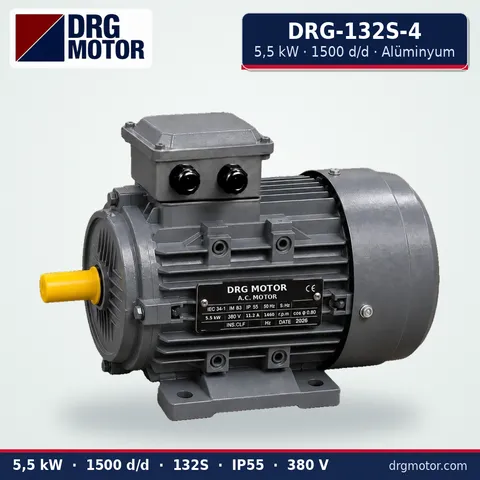
5.5 kW Three-Phase Motor 1500 rpm – DRG-132S-4 Aluminium
- 5.5 kW · 1500 rpm (4 poles)
- Aluminium frame · IEC 132S
- Shaft: 38 × 80 mm
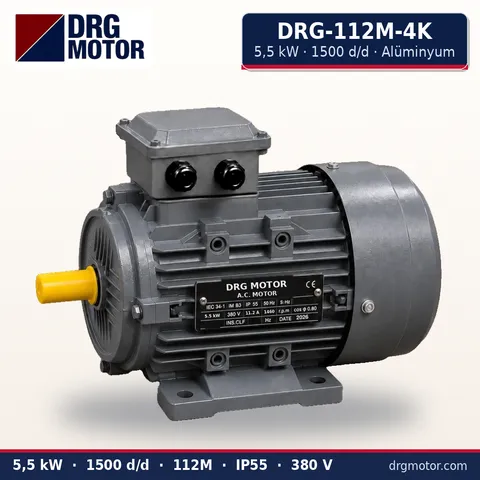
5.5 kW Compact Three-Phase Motor 1500 rpm – DRG-112M-4K Aluminium
- 5.5 kW · 1500 rpm (4 poles)
- Aluminium frame · IEC 112M
- Shaft: 28 × 60 mm
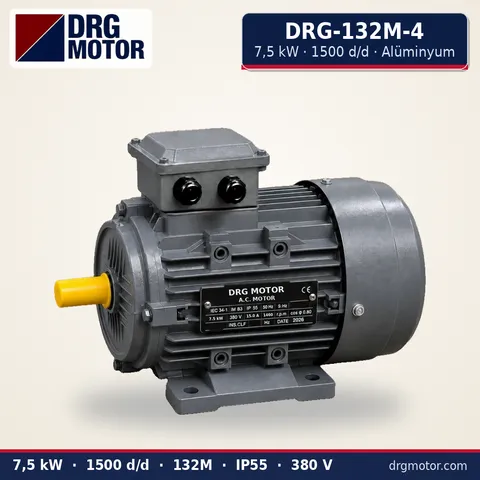
7.5 kW Three-Phase Motor 1500 rpm – DRG-132M-4 Aluminium
- 7.5 kW · 1500 rpm (4 poles)
- Aluminium frame · IEC 132M
- Shaft: 38 × 80 mm
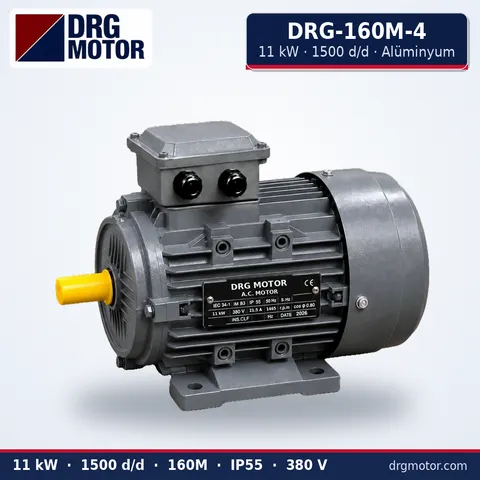
11 kW Three-Phase Motor 1500 rpm – DRG-160M-4 Aluminium
- 11 kW · 1500 rpm (4 poles)
- Aluminium frame · IEC 160M
- Shaft: 42 × 110 mm
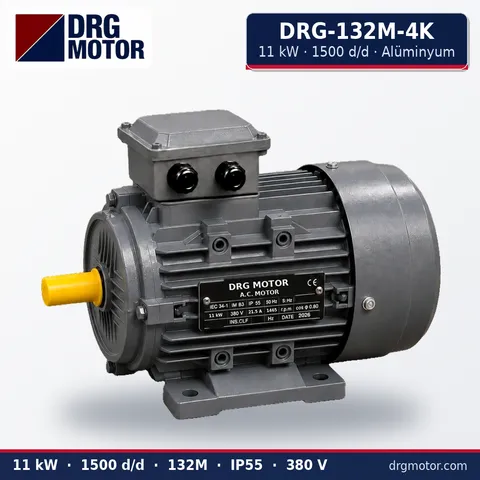
11 kW Compact Three-Phase Motor 1500 rpm – DRG-132M-4K Aluminium
- 11 kW · 1500 rpm (4 poles)
- Aluminium frame · IEC 132M
- Shaft: 38 × 80 mm