English
 Le français
 Türkçe




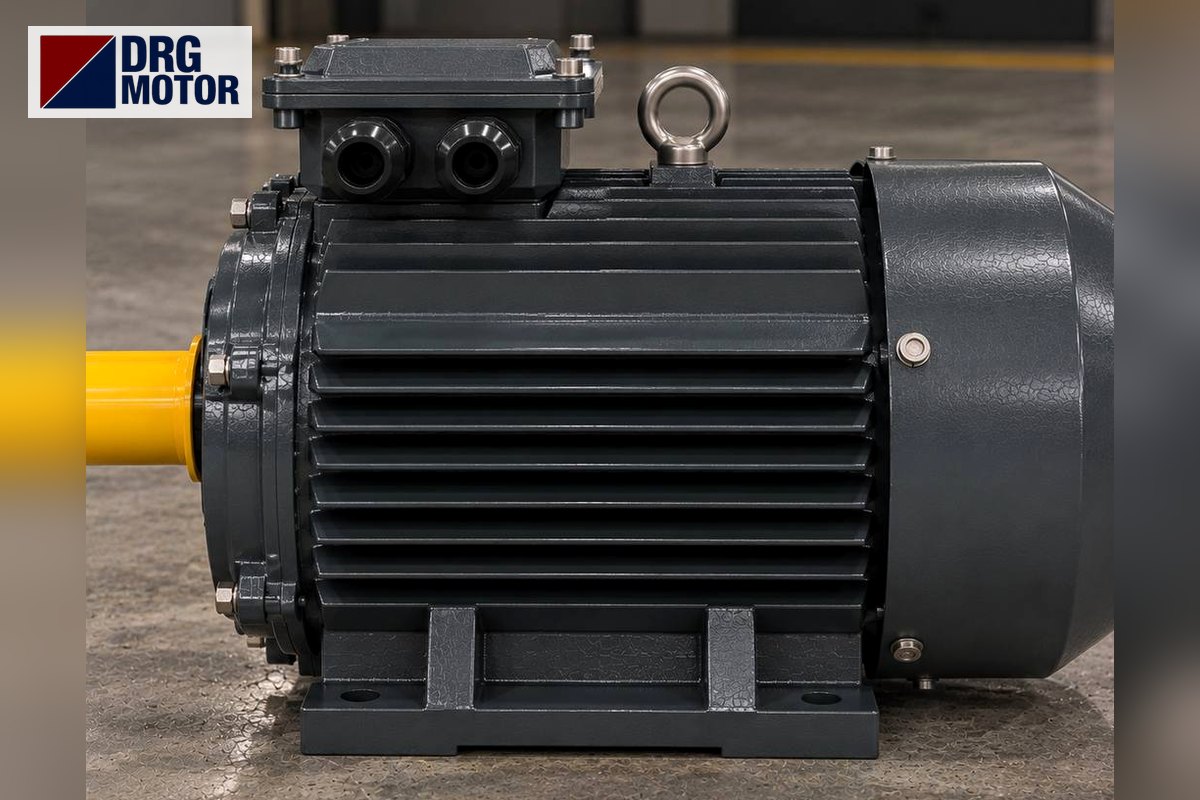

What a three-phase electric motor "uses" is not the same number as the rated power on its nameplate. The kW on the label is the mechanical power delivered at the shaft; the electrical power drawn from the grid is a little higher, because of the losses inside the motor. The consumption that shows on the bill (kWh) is that drawn power multiplied by the running hours and the load.
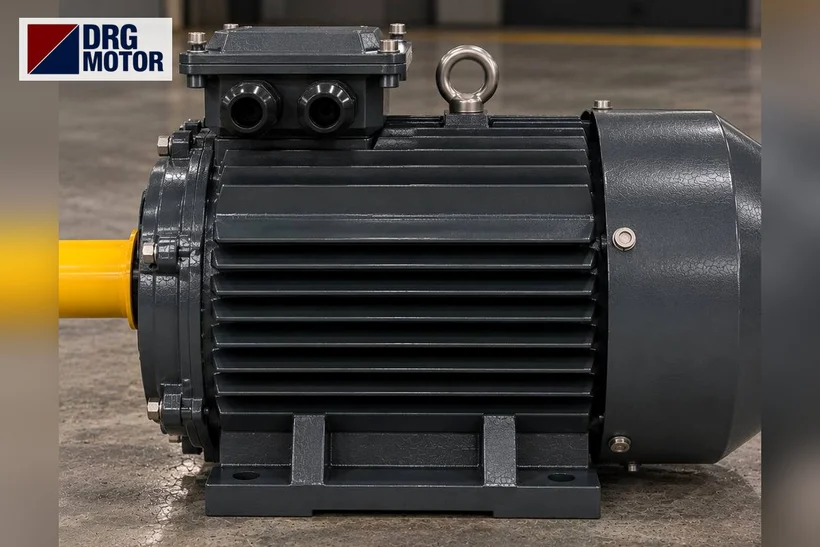
DRG Motor is a manufacturer, supplier and seller of electric motors; it is based in İzmir and ships quickly across Turkey. Below we explain, in plain terms, how power, drawn power and consumption relate. You can browse models by power and speed in the online electric motor shop and see the same models grouped in the three-phase asynchronous electric motors category.
Why rated power and drawn power differ
The kW on the nameplate is the mechanical power the shaft can deliver — the part that turns a pump, conveyor or fan into useful work. While producing that mechanical power the motor loses a little in its windings, bearings and magnetic circuit, so the electrical power it pulls from the grid is slightly higher than the shaft figure.
In practice: rated power is "the work you get", drawn power is "the electricity you pay to do it". The gap comes from losses and varies with motor type, load and operating point, so it is better to judge consumption from real conditions than from a single fixed ratio.
What the nameplate kW tells you
Three-phase power ratings follow standard steps. Common values in the DRG range are 4, 5.5, 7.5 and 11 kW. A 4 kW DRG-112M-4, a 5.5 kW DRG-132S-4 or an 11 kW DRG-160M-4 each suit a different job size. That kW is the limit of what the motor can do; it does not mean it draws that much at every moment.
Click to see current electric motor prices and order nowSEE PRICES →
From watts to kWh: how consumption is worked out
The logic is simple: multiply the running power (kW) by the hours, and you get kWh. The key is to use the power the motor actually draws for the job, not the rated figure. For a rough idea the rated value works; a 4 kW motor at full load does roughly 4 kWh of work per hour, with the draw a touch above that once losses are added.
But most machines never run at full load. For real consumption you also need the load factor. For a concrete number, enter your application in the electric motor calculator, and check the current side with the motor current chart.
| Model | Rated power | Speed |
|---|---|---|
| DRG-112M-4 | 4 kW | 1500 rpm |
| DRG-132S-4 | 5.5 kW | 1500 rpm |
| DRG-132M-4 | 7.5 kW | 1500 rpm |
| DRG-160M-4 | 11 kW | 1500 rpm |
Load factor: does a motor always run at full power?
This is the most overlooked point on site. A motor rarely draws its full rated power. A half-full conveyor, a throttled valve, a lightly loaded fan — all run the motor below its rated power. As the load falls, so does the drawn power, and so does the kWh consumption. That is why "an 11 kW motor uses 11 kWh per hour" is usually wrong; that figure only holds at continuous full load.
The opposite is also true: push a motor at its limit all the time and both consumption and heating rise. The right load band is the easiest zone for both energy and service life.
Does speed (pole count) affect consumption?
The same kW exists at different speeds. Two poles mean about 3000 rpm, four poles about 1500 rpm, six poles about 1000 rpm. If the power is equal, the work is similar in size; but if the speed does not match the load, losses grow. Fitting a high-speed motor to a job that needs low speed and then braking it, for example, simply wastes energy.
So the way to lower consumption is to pick the right speed from the start. To compare the same 4 kW at different speeds, see the models below.
| Model | Power | Speed | Poles |
|---|---|---|---|
| DRG-112M-2 | 4 kW | 3000 rpm | 2 |
| DRG-112M-4 | 4 kW | 1500 rpm | 4 |
| DRG-132M1-6 | 4 kW | 1000 rpm | 6 |
Right sizing is the biggest saving
What really sets consumption is how well you size the motor. An oversized electric motor gives headroom but wanders into an inefficient zone at light load; an undersized one is always straining. Neither is ideal for energy. Work out the real power of the job and pick the nearest standard value.
If you need a non-standard power (say 10 kW), move to the nearest standard, 11 kW, and plan the load around it.
Other real factors that affect consumption
Supply voltage, running hours, ambient temperature and the state of the mechanical transmission (coupling, belt, gearbox input) all shift the picture. A loose belt or a dry bearing makes the motor work harder and indirectly raises consumption. So a consumption problem should be judged across the whole drive line, not just the motor.
Send a photo of your current motor nameplate and we will find the suitable DRG model together.Send on WhatsApp
In short: load and time set the usage
You cannot state what a three-phase electric motor will use with a single number. The nameplate kW shows the ceiling; real consumption depends on load, time and how well the motor was chosen. Share your current motor's nameplate at the ordering stage and we will settle the right power and speed for your application together.
To see three-phase electric motors by power class and current pricesSEE PRICES
Frequently asked questions
Does a three-phase motor use power when idle?
Yes. Even turning with no load it draws some power to set up its magnetic field and cover its own losses. This is well below the rated power, but it is not zero.
If the label says 4 kW, does it use 4 kWh per hour?
Only if it runs at full load continuously will it come close; the draw is slightly above that with losses. At low load the consumption drops. Use the load factor and the calculator for a real figure.
Does the bill reflect rated power or drawn power?
The drawn electrical power. Rated power is what the shaft delivers; the bill is built on the kWh pulled from the grid.
At the same power, which speed uses less?
What matters is the match between job and speed. Choosing the pole count the load wants uses less energy than trying to correct the wrong speed afterwards.
Electric Motors Related to This Topic — Models and Current Prices
Suitability is not decided by power alone: compare the speed, voltage, mounting, shaft and fixing dimensions of your machine with the product data; if unsure, send us the nameplate of your current motor.

4 kW Three-Phase Motor 1500 rpm – DRG-112M-4 Aluminium
- 4 kW · 1500 rpm (4 poles)
- Aluminium frame · IEC 112M
- Shaft: 28 × 60 mm
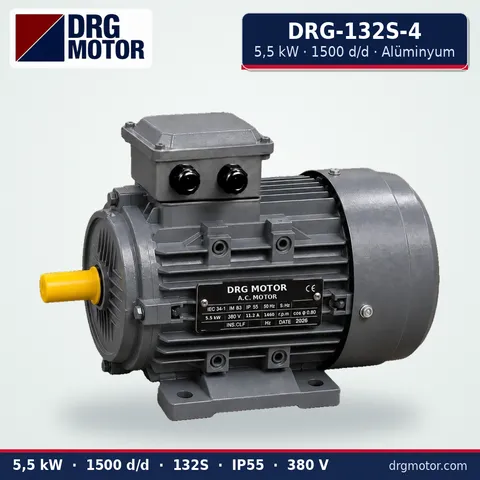
5.5 kW Three-Phase Motor 1500 rpm – DRG-132S-4 Aluminium
- 5.5 kW · 1500 rpm (4 poles)
- Aluminium frame · IEC 132S
- Shaft: 38 × 80 mm
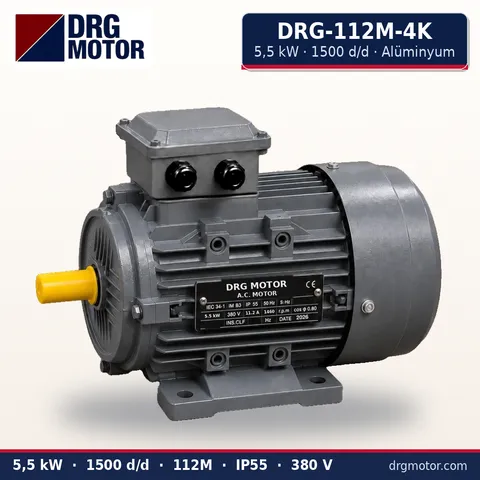
5.5 kW Compact Three-Phase Motor 1500 rpm – DRG-112M-4K Aluminium
- 5.5 kW · 1500 rpm (4 poles)
- Aluminium frame · IEC 112M
- Shaft: 28 × 60 mm
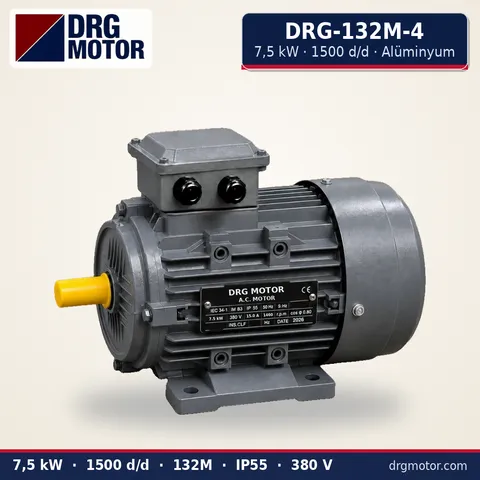
7.5 kW Three-Phase Motor 1500 rpm – DRG-132M-4 Aluminium
- 7.5 kW · 1500 rpm (4 poles)
- Aluminium frame · IEC 132M
- Shaft: 38 × 80 mm
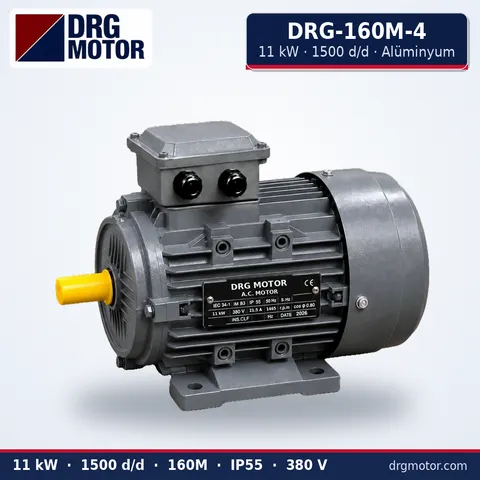
11 kW Three-Phase Motor 1500 rpm – DRG-160M-4 Aluminium
- 11 kW · 1500 rpm (4 poles)
- Aluminium frame · IEC 160M
- Shaft: 42 × 110 mm
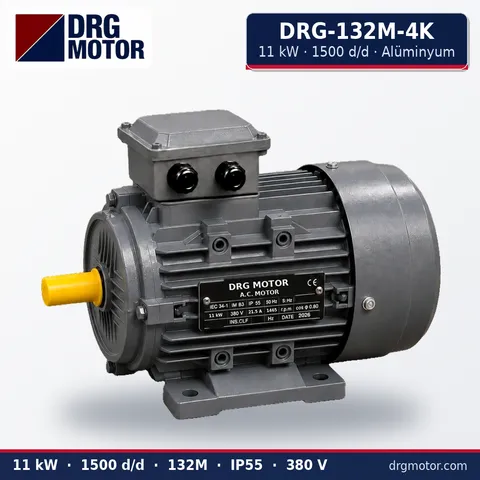
11 kW Compact Three-Phase Motor 1500 rpm – DRG-132M-4K Aluminium
- 11 kW · 1500 rpm (4 poles)
- Aluminium frame · IEC 132M
- Shaft: 38 × 80 mm