English
 Le français
 Türkçe




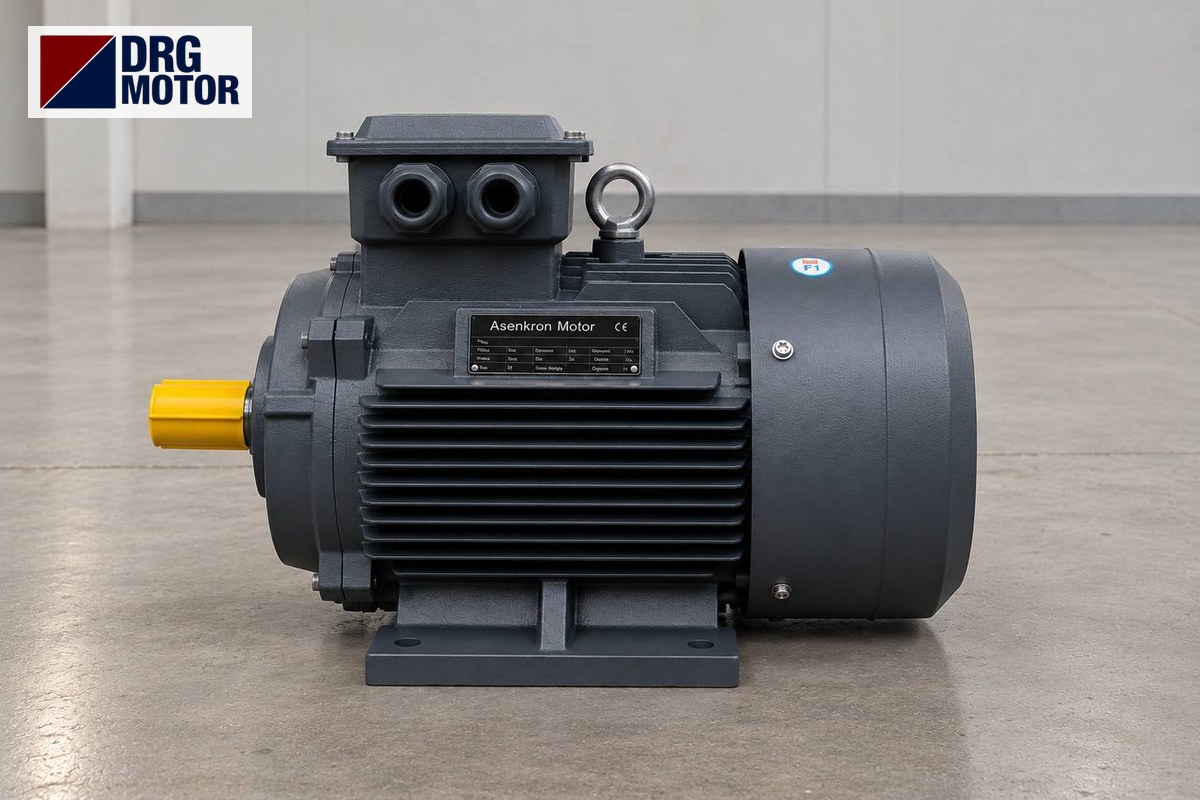

On sheet metal coil uncoilers and recoilers, the motor is sized for the torque required at the largest coil diameter, because at constant line speed and constant tension the mandrel speeds up as the coil shrinks, while torque falls in proportion to diameter. With example assumptions (3,000 N tension, 30 m/min line speed, 1.5 m outer and 0.508 m inner diameter), tension power is only 1.5 kW, yet the torque demand with a full coil reaches about 39.1 Nm at the motor shaft, and the 7.5 kW 4-pole DRG-132M-4 (1460 rpm, 49.1 Nm, 14.3 A at 400 V) is a suitable match. The exact power per machine depends on sheet thickness, width and required tension; the machine builder's data takes priority.
This article answers four questions when choosing an uncoiler motor: how torque and speed change with diameter, how tension is controlled, why a frequency inverter and an encoder are needed, and where the energy goes when the uncoiler regenerates. The inverter, encoder and braking resistor must be connected by a qualified electrician. You can find the right motor among the 120 models on our Buy Electric Motors Online page using the power and speed filters.
How Torque and Speed Change as the Coil Diameter Changes
When a line runs at constant speed, the strip must move at the same linear speed at every point. Since mandrel speed is n = v · 60 / (π · D), halving the coil diameter doubles mandrel speed. With constant tension, mandrel torque is T = F · D / 2; as the diameter shrinks, torque falls in the same proportion. Their product, the tension power P = F · v, is independent of diameter.
This is why an uncoiler or recoiler is a constant-power load for the motor: low speed and high torque at large diameter, high speed and low torque at small diameter. The ratio of outer to inner diameter (3.0 in the example) sets both the torque range and the speed range of the motor. Choosing the motor by power is therefore misleading; the decisive values are the torque at the largest diameter and the speed at the smallest.
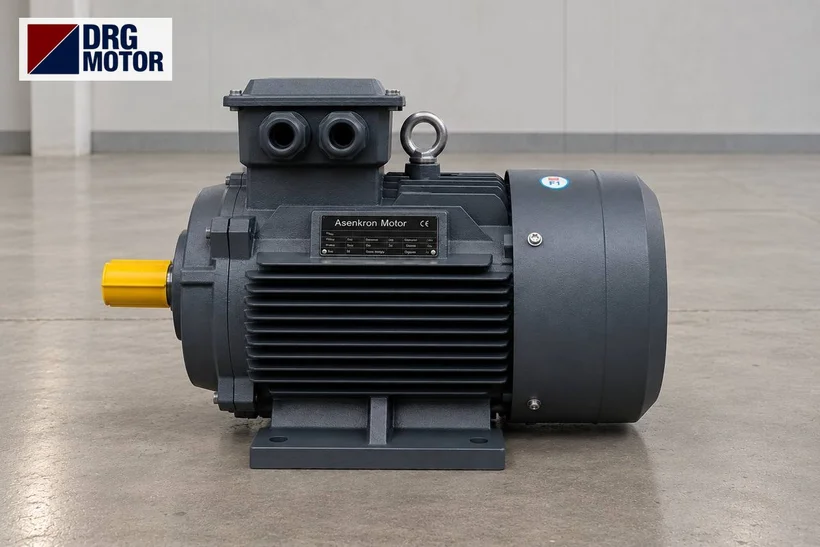
Worked Example: Small Tension Power, Large Torque Demand
Assumptions: tension 3,000 N, line speed 30 m/min (0.5 m/s), coil outer diameter 1.5 m, inner diameter (mandrel) 0.508 m, gearbox ratio 75, torque × 1.1 for gearbox and bearing losses. The gearbox ratio is chosen so that motor rated speed is not exceeded at the smallest diameter: 1460 / 18.8 ≈ 77.7, rounded to 75.
| Coil diameter | Mandrel speed | Motor speed / frequency | Motor torque |
|---|---|---|---|
| 1.5 m | 6.4 rpm | 477 rpm / 16.4 Hz | 33.0 Nm |
| 1.0 m | 9.5 rpm | 716 rpm / 24.5 Hz | 22.0 Nm |
| 0.508 m | 18.8 rpm | 1410 rpm / 48.3 Hz | 11.2 Nm |
Tension power is 3,000 × 0.5 = 1.5 kW; choosing a 2.2 kW motor on that basis would be a mistake. With a full coil the motor must deliver 33.0 Nm, and it does so at around 16.4 Hz, about one third of rated speed. The coil inertia must also be overcome while the line accelerates. For a 10,000 kg coil, inertia J = m · (Do² + Di²) / 8 ≈ 3,135 kg·m² and mandrel angular speed is 0.67 rad/s; accelerating in 5 seconds requires 418 Nm at the mandrel, about 6.1 Nm extra at the motor shaft. Total: 33.0 + 6.1 ≈ 39.1 Nm.
The 5.5 kW 4-pole DRG-132S-4, with 36 Nm rated torque, falls short of this value and relies on the inverter's short-time overload margin during acceleration. The 7.5 kW DRG-132M-4, with 49.1 Nm, leaves headroom. To try the values with your own machine, use the Gearbox Output Speed and Torque Calculator and the VFD Frequency, Torque and Power Calculator.
Tension Control: Dancer Arm, Load Cell and Diameter Calculation
If tension is not held constant, the strip slackens and folds on the uncoiler, while on the recoiler the result is loose winding or strip breakage. There are three common ways to control tension:
- Dancer arm: A weighted or pneumatic arm measures strip sag; the arm position is sent to the inverter as a speed correction.
- Load cell: The force on a deflector roll is measured directly and the inverter's torque reference is adjusted to this measurement.
- Open-loop torque control by diameter calculation: The instantaneous diameter D = v · 60 / (π · n) is calculated from line speed and mandrel speed, and the torque reference is given as T = F · D / 2 / ratio. No extra sensor is needed, but friction and inertia compensation must be tuned.
Whichever method is chosen, the requirement on the motor side is the same: the motor must be able to run on a torque command rather than a speed command and deliver stable torque at low speed. This brings us to the choice of inverter and encoder.
Inverter and Encoder: Stable Torque at Low Speed
On tension-controlled uncoilers and recoilers, V/f control is not enough; a vector-control inverter capable of torque control is required. Open-loop (sensorless) vector control works on lines of moderate precision. On lines requiring very low speeds, holding tension at standstill or precise winding, an encoder is fitted to the motor shaft and closed-loop vector control is used; the encoder reports rotor position and speed to the inverter, so torque stays under control even at zero speed.
Fitting an encoder requires a rear shaft extension or an adapter on the fan cover; this is a mounting detail to discuss before ordering. When choosing the inverter, torque control mode, encoder input card and braking chopper are assessed together. On the motor side 4 poles are preferred: at the same power it delivers roughly twice the torque of a 2-pole motor and keeps the gearbox ratio reasonable.
Running above 50 Hz (field weakening) allows a smaller gearbox ratio, but in this region available torque falls in inverse proportion to frequency and breakdown torque falls even faster. On lines with a high diameter ratio this approach only helps over a limited range; the main design should stay below 50 Hz.
Heating at Low Speed: When Is Forced Cooling Necessary?
A standard three-phase motor is cooled by a fan on its own shaft. In the example, with a full coil the motor runs at 16.4 Hz, i.e. at about one third of fan speed, while delivering torque close to its rated value. Cooling air decreases but current does not, so winding temperature rises. When large coils are processed for long periods, this leads to overload trips and shorter winding life.
The solution is a separately powered (forced) fan unit that supplies constant air regardless of motor speed. A forced fan unit lengthens the motor, so it must be planned together with the space on the machine and the encoder mounting. Alternatively, choosing the next power size up runs the motor at lower current for the same torque and reduces heating. For a detailed look at insulation and cooling on inverter-fed motors, see Insulation and Forced Cooling for Motors Running on a VFD.
The Uncoiler Acts as a Generator: Braking Resistor and Energy Recovery
The recoiler motor pulls the strip, so it works as a motor. The uncoiler creates tension by holding the strip back: while the mandrel is turned by the pull of the strip, the motor applies torque opposite to its direction of rotation. In this state the motor works as a generator and energy equal to the tension power (about 1.5 kW in the example, slightly less after losses) flows back into the inverter's DC bus.
If this energy is not dissipated, DC bus voltage rises and the inverter trips on overvoltage. There are three solutions: a braking chopper and braking resistor (energy is turned into heat), linking the uncoiler and recoiler inverters on a common DC bus (the recoiler uses what the uncoiler generates), or a regenerative unit that feeds energy back to the grid. The key point when selecting a braking resistor: on an uncoiler, braking is not a short pulse but a load lasting the whole coil, so the resistor's continuous power rating must be chosen from the tension power. For details of braking resistor sizing see Dynamic Braking and Braking Resistor in Frequency Inverters.
Uncoiler Motor Selection Table and Checklist
The table below shows 4-pole cast iron DRG models in the power range commonly found on uncoilers and recoilers in light and medium sheet lines. Rated torques are 26.3 Nm for 4 kW, 36 Nm for 5.5 kW and 49.1 Nm for 7.5 kW; compare these values with your torque demand at the largest diameter.
| Model | Power / speed | Frame | Current 400 V |
|---|---|---|---|
| DRG-112M-4 | 4 kW / 1450 rpm | 112M · cast iron | 7.95 A |
| DRG-132S-4 | 5.5 kW / 1460 rpm | 132S · cast iron | 10.7 A |
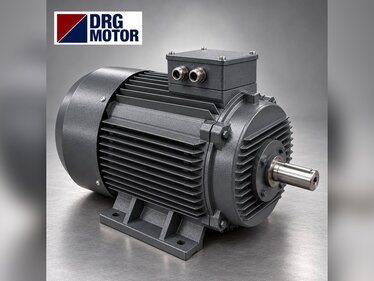
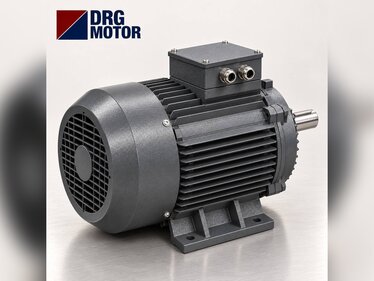
| DRG-132M-4 | 7.5 kW / 1460 rpm | 132M · cast iron | 14.3 A |
| DRG-160M-4 | 11 kW / 1465 rpm | 160M · cast iron | 20.4 A |
| DRG-160L-4 | 15 kW / 1465 rpm | 160L · cast iron | 27.3 A |
Technical data of the model selected in the example calculation:
- Power: 7.5 kW
- Rated speed: 1460 rpm
- Rated torque: 49.1 Nm
- Current 400 V: 14.3 A
- cos φ: 0.84
- Ts/Tn: 2
- Tmax/Tn: 2.3
- Is/In: 7.5
- Shaft D×E: 38 × 80 mm
- IEC frame: 132M · cast iron
Clarify the following before ordering a motor and drive:
- Sheet thickness and width, required tension force (N)
- Maximum line speed (m/min), coil outer and inner diameter, heaviest coil mass
- Gearbox ratio: motor speed must not exceed rated speed at the smallest diameter
- Motor torque: tension torque at the largest diameter + acceleration torque
- Inverter: vector control, torque mode; encoder card if needed
- Forced fan unit if long running at low frequency is expected
- Continuous power rating of the uncoiler braking resistor, or a common DC bus
- Shaft D × E, mounting (B3 foot or B5 flange to the gearbox) and encoder adapter
Motors in This Power Range
- DRG-132S-4 – 5.5 kW – 1460 rpm – 132S cast iron
- DRG-132M-4 – 7.5 kW – 1460 rpm – 132M cast iron
- DRG-160M-4 – 11 kW – 1465 rpm – 160M cast iron
- DRG-160L-4 – 15 kW – 1465 rpm – 160L cast iron
Click to see current prices and order these motors nowSEE PRICES →
Frequently Asked Questions
What size motor does a coil uncoiler need?
It is selected by the torque at the largest coil diameter, not by tension power. In the example tension power is 1.5 kW, while about 39.1 Nm is needed at the motor shaft with a full coil; this corresponds to a 7.5 kW 4-pole motor (49.1 Nm).
Why is a frequency inverter used on an uncoiler?
As the coil diameter changes, mandrel speed and required torque change continuously. A vector-control inverter sets torque by command, so tension stays constant whatever the diameter.
Does an uncoiler need a braking resistor?
Yes. While the uncoiler applies tension, the motor works as a generator and energy returns to the inverter. Either a braking resistor sized for this energy or a common DC bus with the recoiler must be used.
How many amps does a 7.5 kW 4-pole motor draw?
At full load the DRG-132M-4 draws 14.3 A at 400 V and 15 A at 380 V. When fed by an inverter, the current drawn from the supply varies with the instantaneous power of the load.
Send us your line's tension, speed and coil dimensions and we will identify the right DRG model together; for current prices see Buy Electric Motors Online. Phone: +90 (542) 666 11 11 · E-mail: [email protected] · Contact