English
 Le français
 Türkçe




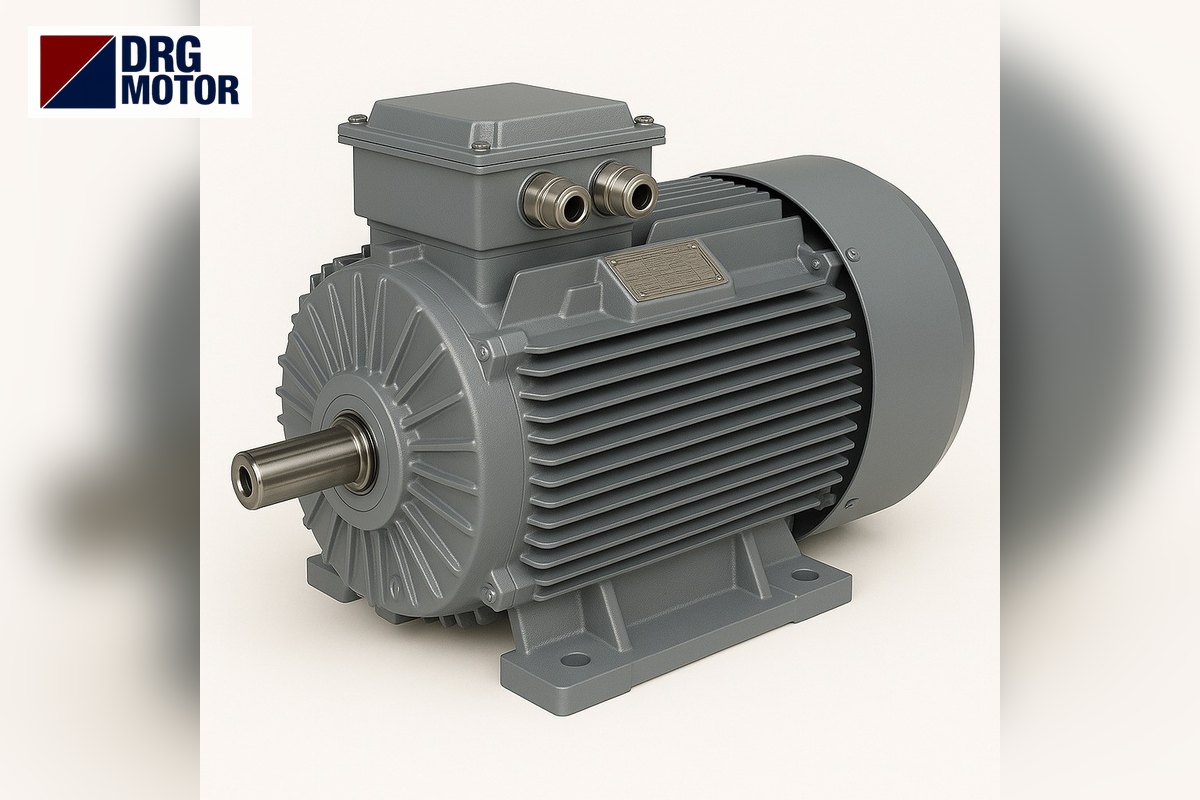

On a rebar cutting machine the motor does not push the blade directly; it first spins a heavy flywheel, and the energy stored in that flywheel absorbs the shock of each cut. When choosing a replacement motor, three things decide the result: the kW and speed (rpm) on the old motor's nameplate, and the mounting dimensions on the machine (shaft diameter, foot holes or flange). A three-phase induction motor that matches all three fits in without changing the machine's cutting capacity.
This article covers the mechanical (flywheel and eccentric) guillotine type that shears reinforcing bar; on machines that cut with a hydraulic cylinder the motor drives a hydraulic pump and the selection logic is different. Once you know the right power and speed, you can compare models by power, speed and housing in the DRG online motor store.
Flywheel, Clutch and Blade: Where Does the Motor Sit in the Chain?
In a typical mechanical rebar cutter, power flows like this: motor pulley → V-belt → flywheel → gear stage → clutch engaged by pedal or lever → eccentric shaft → moving blade. While the pedal is not pressed, the motor only turns the flywheel and gears idle; its current draw is low.
When the clutch engages, the eccentric shaft makes one turn and the moving blade passes the fixed blade, shearing the bar. The force needed in that short moment is far above the motor's instantaneous torque; the flywheel supplies the difference and its speed drops somewhat. After the cut, the motor runs loaded for a few seconds to bring the flywheel back to rated speed.
The result: motor power determines less whether the thickest bar can be cut and more how quickly the flywheel recovers between consecutive cuts. On a machine cutting heavy bar in series, a weak motor enters the next cut before the flywheel has recovered; speed drops a little more each time until the blade stalls in the bar.
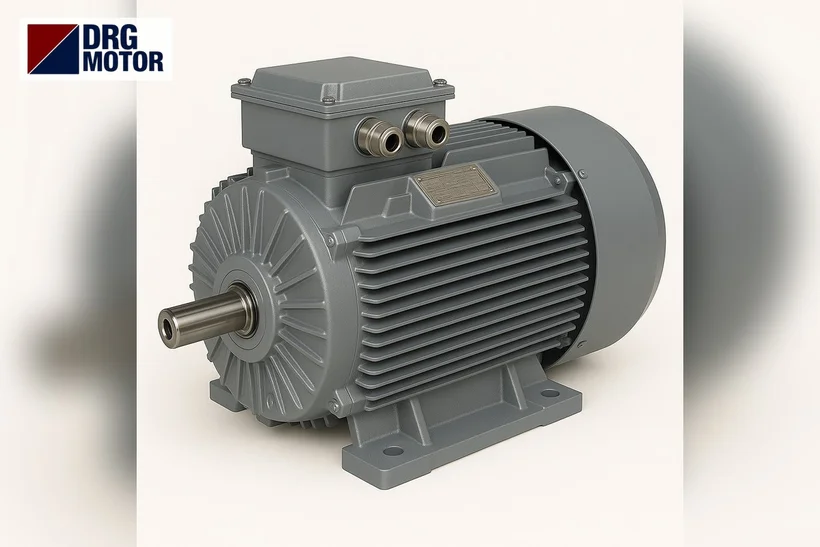
Values to Read from the Nameplate When Buying a Replacement
When a motor burns out, the most reliable source is the old motor's label. If it is unreadable, use the machine builder's catalogue or the machine plate; estimating an exact power from cutting diameter is not sound. As a general frame only, small workshop types use motors of a few kW, while heavy site machines cutting thick bar use larger ratings.
Note the following from the label:
- Power (kW or HP): convert HP to kW; the new motor should be the same or one step higher.
- Speed: around 1400–1460 rpm is a 4-pole motor (1500 synchronous); around 2850–2950 rpm is 2-pole (3000 synchronous).
- Voltage and connection: 230/400 V or 400/690 V; whether the terminal links are star or delta.
- IEC frame number: such as 100L, 112M, 132S; shaft height and shaft diameter follow from this number.
Click to see current electric motor prices and order nowSEE PRICES →
Why Changing Motor Speed Changes Flywheel Speed
With a fixed belt ratio, any change in motor speed changes flywheel speed in the same proportion. Formula: flywheel speed = motor speed × motor pulley diameter / flywheel diameter. Since flywheel energy rises with the square of speed, even a small speed difference changes how the machine behaves.
Example (assumption): motor pulley 100 mm, flywheel 500 mm. The values below are example figures calculated from the pulley ratio; do not use them without measuring your machine's actual pulley diameters.
| Motor (example) | Rated speed | Flywheel speed (ex.) | Assessment |
|---|---|---|---|
| DRG-100L2-4 (3 kW, 4-pole) | 1450 rpm | 290 rpm | Correct if old motor is 4-pole |
| DRG-100L-2 (3 kW, 2-pole) | 2895 rpm | 579 rpm | Flywheel runs twice as fast; avoid |
| DRG-132S-6 (3 kW, 6-pole) | 968 rpm | 193.6 rpm | Less stored energy, harder cuts |
Three 3 kW motors give completely different results on the same machine. With a 2-pole motor the flywheel spins twice as fast and stored energy rises roughly fourfold; blade speed and gear loading go beyond the limits the builder intended. With a 6-pole motor the flywheel slows down and may not store enough energy to cut the same bar. Matching speed by changing the pulley is possible, but check belt speed and pulley diameter with the pulley and belt calculator first.
Starting: Getting a Heavy Flywheel Moving
On a flywheel machine the hardest moment for the motor is not the cut but the first start. Flywheel inertia makes run-up long, and the motor draws high current the whole time. According to DRG data, the DRG-112M-4 has a rated current of 7.95 A at 400 V and a starting current ratio (Is/In) of 7.8, so roughly 62 A is drawn at start. If the overload relay is not set for this run-up time, the machine may trip every morning at switch-on.
The voltage class also decides the starting method. DRG motors up to 3 kW are 230/400 V; on a 400 V supply they are star-connected and not suitable for star-delta starting. From 4 kW upwards they are 400/690 V; they run in delta at 400 V and suit star-delta starting. If the old machine has a star-delta switch, the new motor must also be in the 400/690 V class.
Site Conditions and Housing Choice
Rebar cutters usually work on open sites amid dust, rain and rust scale, and take knocks during transport. DRG motors are IP55, cooled by a shaft-mounted fan (IC411) and suitable for −15…+40 °C ambient. If the fan cowl clogs with steel chips the motor overheats; cleaning it regularly is not just maintenance but the shortest way to prevent burnout.
There are two housing options: aluminium housings are light, an advantage on small portable machines; cast iron housings resist shock and vibration better and are preferred on heavy site machines. All standard foot-mounted (B3) motors are also grouped on the general purpose industrial motors page.
Faults Seen with the Wrong Motor on a Cutter
- One power step too low: the flywheel cannot recover between cuts, the blade stalls in the bar, the motor heats and the overload trips.
- Different pole number: flywheel speed changes; with 2-pole the gears and clutch are overloaded, with 6-pole cutting power falls.
- Different shaft diameter: the pulley does not fit; a pulley adapted with a bush or weld runs out of true and wears belts and bearings early.
- Wrong connection: a 400/690 V motor star-connected on a 400 V supply delivers about one third of its power and stalls in the cut.
A final check before swapping the motor:
- Photo of the old motor's label (kW, rpm, V, frame no.)
- Shaft diameter and length, key width
- Foot hole spacing (A and B) and shaft height (H)
- Pulley diameter and belt type; belt tensioning allowance
- Switch type: direct-on-line or star-delta
DRG Motors Suited to Rebar Cutting Machines
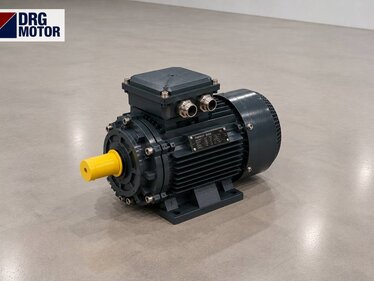
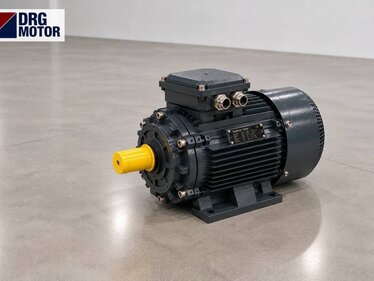
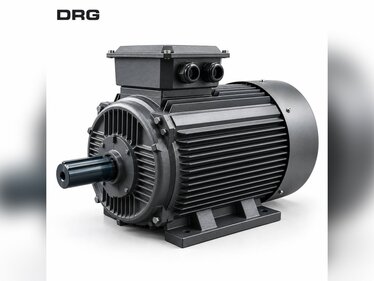
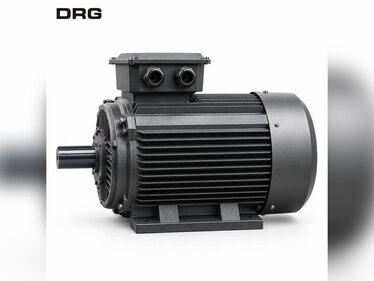
These are cast iron models from the 4-pole, foot-mounted class most common on flywheel cutters, chosen for their resistance to shock and vibration; the power step follows the old motor's nameplate.
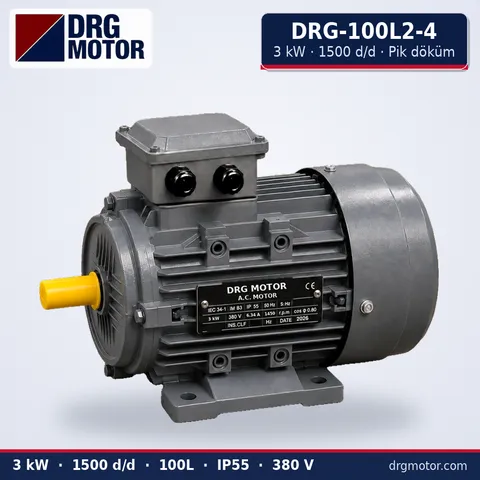
3 kW Three-Phase Motor 1500 rpm – DRG-100L2-4 Cast Iron
- 3 kW · 1500 rpm (4 poles)
- Cast iron frame · IEC 100L
- Mounting: B3 · B5 · B14 · B35
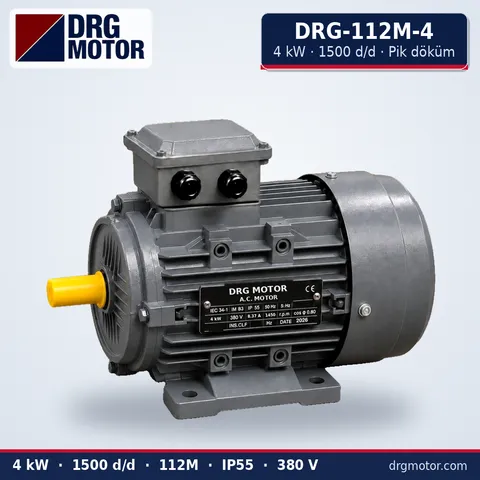
4 kW Three-Phase Motor 1500 rpm – DRG-112M-4 Cast Iron
- 4 kW · 1500 rpm (4 poles)
- Cast iron frame · IEC 112M
- Mounting: B3 · B5 · B14 · B35
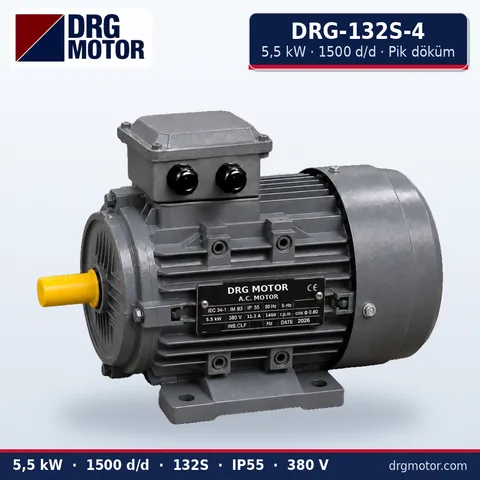
5.5 kW Three-Phase Motor 1500 rpm – DRG-132S-4 Cast Iron
- 5.5 kW · 1500 rpm (4 poles)
- Cast iron frame · IEC 132S
- Mounting: B3 · B5 · B14 · B35
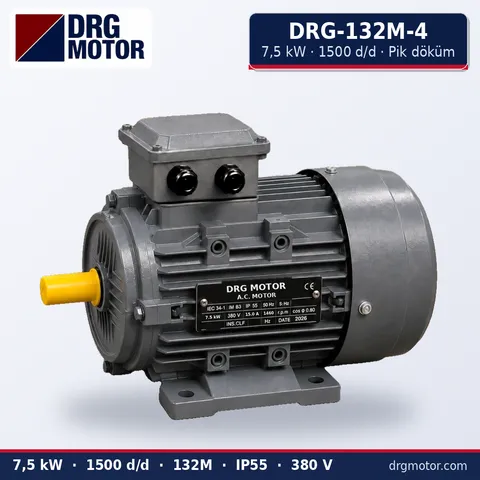
7.5 kW Three-Phase Motor 1500 rpm – DRG-132M-4 Cast Iron
- 7.5 kW · 1500 rpm (4 poles)
- Cast iron frame · IEC 132M
- Mounting: B3 · B5 · B14 · B35
Click to see current prices and order these motors nowSEE PRICES →
Rebar Cutter Motor: Frequently Asked Questions
What determines the price of a rebar cutting machine motor?
The technical factors are motor power, pole number, housing material (aluminium or cast iron) and mounting type. At the same power, a cast iron housing is heavier and more robust. Current prices are shown per model in the online store.
Can a 2-pole (3000 rpm) motor be fitted to a rebar cutter?
Not if the machine was designed for a 4-pole motor. With the same pulley ratio the flywheel turns twice as fast; blade, gears and clutch run outside the speed the builder calculated.
Why does the new motor trip the overload at start?
Flywheel inertia lengthens run-up. The overload relay should be set to the motor's rated current and chosen in a trip class suited to the run-up time. Also check that a 400/690 V motor is delta-connected on 400 V.
Does a bigger motor increase cutting capacity?
No. The thickest bar that can be cut is limited by the blade, eccentric and frame strength. A motor one step larger only lets the flywheel recover faster; do not exceed the capacity on the machine plate.
To identify the right replacement together, send a photo of the old motor's label, its power, speed, mounting (foot or flange), shaft size and machine type via WhatsApp, or add models to the quote list and request a quotation. DRG Motor is an electric motor manufacturer, supplier and seller; phone +90 (542) 666 11 11, e-mail info@drgmotor.com, other channels on the contact page. You can browse all models on the DRG electric motor online sales page.