English
 Le français
 Türkçe




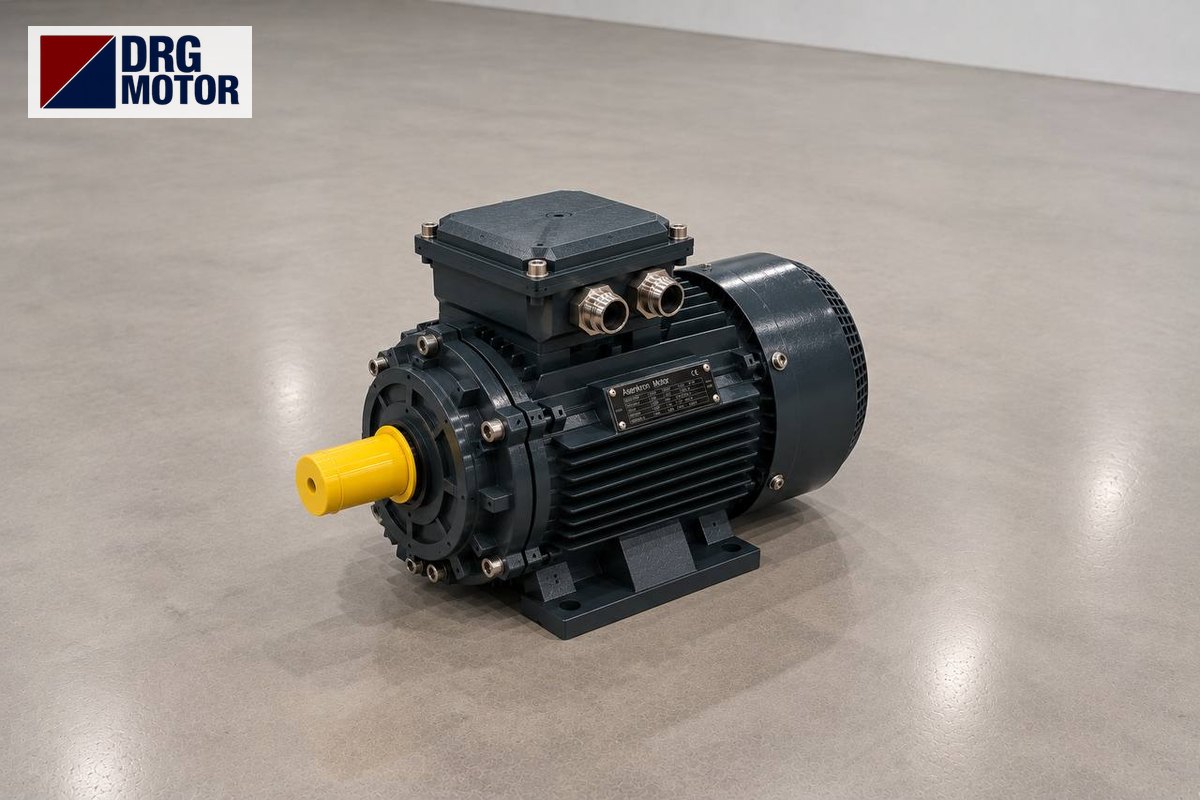

On a rebar bending machine the motor drives a bending table that turns only a few revolutions per minute, through a large reduction; the high torque at the table is produced not by the motor but by the worm and gear stages in between. When choosing a motor for this machine, two things matter more than power: motor speed (usually 4-pole, about 1450 rpm) and whether it can withstand hundreds of forward-reverse changes a day.
If the power and speed on the nameplate are known, you can filter DRG three-phase induction motors by power and housing in the online store. An important distinction: DRG does not sell gearboxes; the machine's gear unit stays in place and DRG supplies the motor that fits its input.
The Drive Chain from Motor to Bending Pin
In a typical rebar bender, the motor connects to a worm gearbox either by belt and pulley or directly by flange. The worm slowly turns a large wheel; on most machines an open gear stage follows and drives the table's centre shaft. The bar held between the centre pin and the bending pin wraps around the centre pin as the table rotates.
The bending angle is usually set by adjustable cams on the table edge or by an angle disc. When a cam hits the limit switch the motor stops, then runs in reverse to return the table to its starting position. So for every bend the motor starts at least twice: once forward, once back.
Table Speed and Torque: An Example Calculation
Table torque equals motor torque multiplied by the total ratio and the gear train efficiency. Worm gearboxes have low efficiency, so this must be included.
Example (assumption): belt ratio 1:2, worm ratio 1:40, open gear 1:2, giving a total ratio of 160. Overall gear train efficiency is taken as 0.55.
- DRG-100L2-4 (3 kW, 1450 rpm, rated torque 19.8 N·m): table speed 1450 / 160 ≈ 9.06 rpm; table torque 19.8 × 160 × 0.55 ≈ 1742 N·m.
- DRG-112M-4 (4 kW, 1450 rpm, rated torque 26.3 N·m): same table speed; table torque 26.3 × 160 × 0.55 ≈ 2314 N·m.
These figures only illustrate the logic; your machine's real ratios and the bar diameter it can bend are set by the builder's catalogue or the machine plate. To test your own ratios, use the gearbox output speed and torque calculator.
The calculation makes one point clear: if motor speed changes, table speed changes in the same proportion. Replace a 4-pole motor with a 2-pole one (about 2900 rpm) and the table turns twice as fast with half the torque; the table struggles to stop where the cam releases it and the bend angle drifts. With a 6-pole motor the table slows and torque rises, possibly beyond what the worm gear can take.
Click to see current electric motor prices and order nowSEE PRICES →
How Forward-Reverse Cycling Wears the Motor
A bender motor does not run long at steady load; it makes short, frequent cycles. Each start draws several times rated current. According to DRG data, the DRG-100L2-4 has a rated current of 6.02 A at 400 V and an Is/In ratio of 7.6; for the DRG-112M-4 these are 7.95 A and 7.8. That starting current builds up as heat in the winding, and the more frequent the starts, the less time the motor has to cool.
Three habits increase heating:
- Reversing before standstill: if the motor is commanded in reverse before it stops, the winding takes a current surge heavier than a normal start. A short delay between the forward and reverse contactors in the control circuit matters for this reason.
- Bending at the capacity limit: constantly bending the thickest bar the machine allows means every cycle begins with a loaded start.
- Dirty fan cowl: site dust and rust block the shaft fan's airflow; on an IC411 motor, cooling depends entirely on that fan.
So if the old motor often overheated and tripped, choosing the new one a step higher can make sense. But a larger motor can deliver more torque to the worm gear; check the permitted input against the builder's data.
Connecting to the Worm Gearbox: Foot or Flange?
If the motor drives the gearbox by belt, a foot-mounted (B3) motor is used; on replacement the foot hole spacing, shaft height and shaft diameter must match. If the motor sits directly on the worm gearbox input by flange, a B5 (large flange) motor is needed and four dimensions must match exactly: pitch circle diameter (M), spigot diameter (N), flange outer diameter (P) and shaft diameter × length (D×E). For small-flange (B14) connections, dimensions are confirmed at order.
B5 flange dimensions from the DRG catalogue for frames common on benders:
| Frame | Flange M / N / P (mm) | Shaft D×E (mm) | Example DRG model |
|---|---|---|---|
| 100L | 215 / 180 / 250 | 28 × 60 | DRG-100L2-4 (3 kW) |
| 112M | 215 / 180 / 250 | 28 × 60 | DRG-112M-4 (4 kW) |
| 132S | 265 / 230 / 300 | 38 × 80 | DRG-132S-4 (5.5 kW) |
The identical flange and shaft dimensions of 100L and 112M are a practical advantage: a 3 kW and a 4 kW motor fit the same worm gear input. Moving to 132S, the flange grows and the shaft becomes 38 mm; this motor cannot be fitted without changing the gearbox input bush. Motors that connect to gearbox inputs are also listed on the electric motors for worm gearboxes page.
What Gets Overlooked on the Control Side
Direction is reversed by swapping two phases with contactors; the motor itself has no separate setting. If, at the first test after connecting the new motor, the table turns opposite to the cam direction, swapping two phase wires is enough.
Watch the voltage class too. DRG motors up to 3 kW are 230/400 V and star-connected on a 400 V supply. From 4 kW they are 400/690 V and delta-connected at 400 V. Someone replacing an old 3 kW motor with a 4 kW one and leaving the terminal links in star will get only part of the motor's power; the table stalls on thick bar.
Some machines use a brake motor to stop the table exactly at the angle. DRG does not offer brake motors; if your machine was designed around a brake motor, this duty cannot be met by a standard IEC motor, while machines with a separate braking device can use a standard motor.
Clarify the following before ordering:
- Motor label: kW, rpm, voltage, frame number
- Connection: belt-driven (B3) or flanged to the worm gearbox (B5/B14)
- If flanged: M, N, P dimensions and shaft diameter × length
- Whether the old motor had a brake
- Control: forward-reverse contactors and overload relay setting
DRG Motors Suited to Rebar Bending Machines
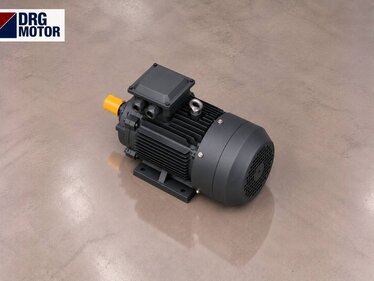
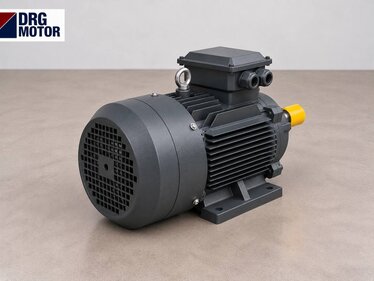
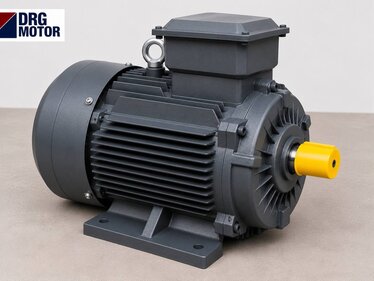
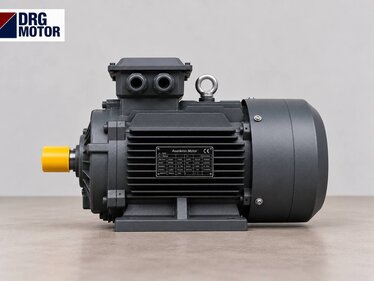
Chosen at the 4-pole speed a worm gear input expects, with light aluminium housings in frames that can be foot- or flange-mounted; the power step follows the old motor's nameplate.
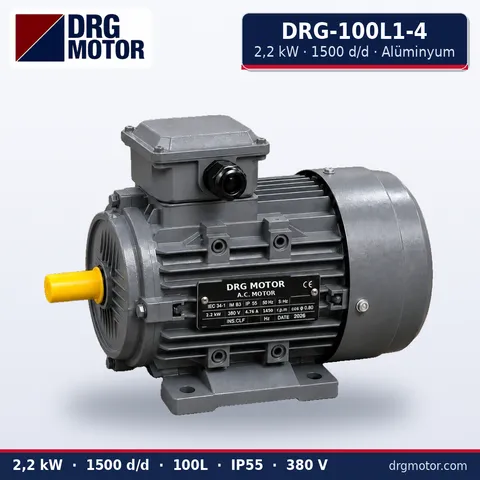
2.2 kW Three-Phase Motor 1500 rpm – DRG-100L1-4 Aluminium
- 2.2 kW · 1500 rpm (4 poles)
- Aluminium frame · IEC 100L
- Mounting: B3 · B5 · B14 · B35
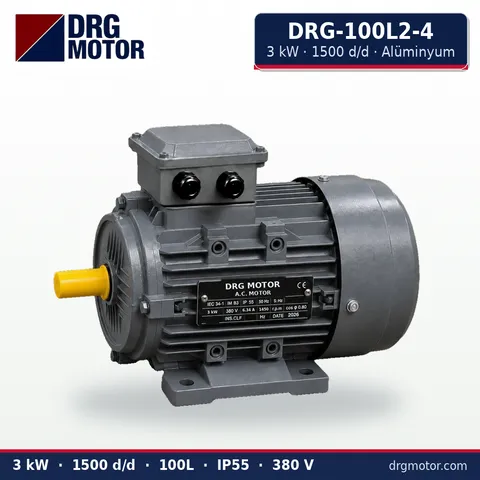
3 kW Three-Phase Motor 1500 rpm – DRG-100L2-4 Aluminium
- 3 kW · 1500 rpm (4 poles)
- Aluminium frame · IEC 100L
- Mounting: B3 · B5 · B14 · B35
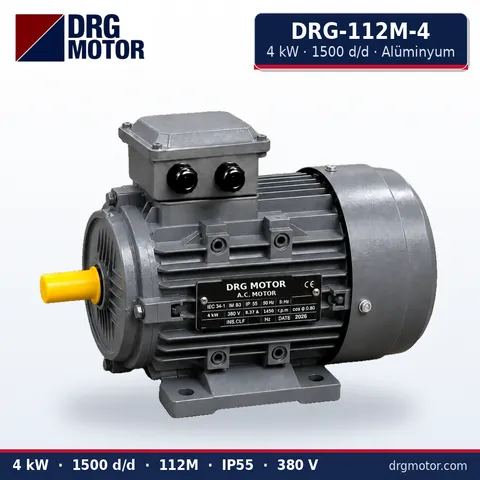
4 kW Three-Phase Motor 1500 rpm – DRG-112M-4 Aluminium
- 4 kW · 1500 rpm (4 poles)
- Aluminium frame · IEC 112M
- Mounting: B3 · B5 · B14 · B35
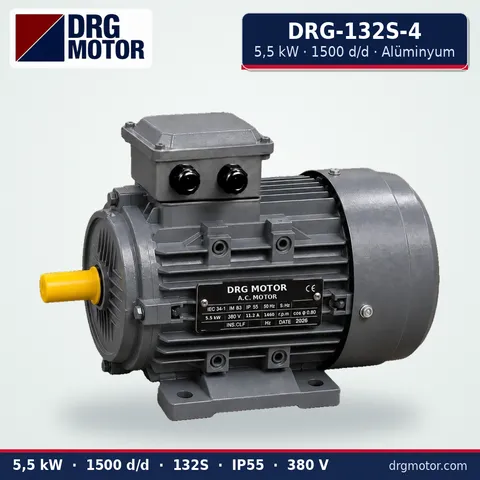
5.5 kW Three-Phase Motor 1500 rpm – DRG-132S-4 Aluminium
- 5.5 kW · 1500 rpm (4 poles)
- Aluminium frame · IEC 132S
- Mounting: B3 · B5 · B14 · B35
Click to see current prices and order these motors nowSEE PRICES →
Rebar Bender Motor: Common Questions
How many kW should a rebar bending machine motor be?
The exact value is on the builder's plate or in the catalogue. Small workshop types use motors of a few kW; heavy machines bending thick bar need more. The new motor is chosen at the same power as the old one or one step higher.
Why does the rebar bender motor overheat?
Frequent forward-reverse starts, reversing before standstill, bending at the capacity limit and a clogged fan cowl are the most common causes. Also check that the overload relay is set to the motor's rated current.
Can a motor of different power be fitted to the worm gearbox?
If flange and shaft dimensions match, it fits physically; 100L and 112M frames, for example, share the same B5 flange. But a stronger motor delivers more torque to the gears; confirm the gearbox input power limit with the builder.
Can a 3000 rpm motor be fitted to a rebar bender?
Not if the machine was designed for a 4-pole motor. The table speeds up twofold, torque halves and the cams cannot stop the table at the right angle.
To identify the right motor, send a photo of the old motor's label, its power, speed, mounting (foot or flange), shaft and flange dimensions and machine details to our WhatsApp line, or add your chosen models to the quote list. DRG Motor is an electric motor manufacturer, supplier and seller; phone +90 (542) 666 11 11, e-mail info@drgmotor.com, address and other details on the contact page. All models are on the buy electric motors online page.