English
 Le français
 Türkçe




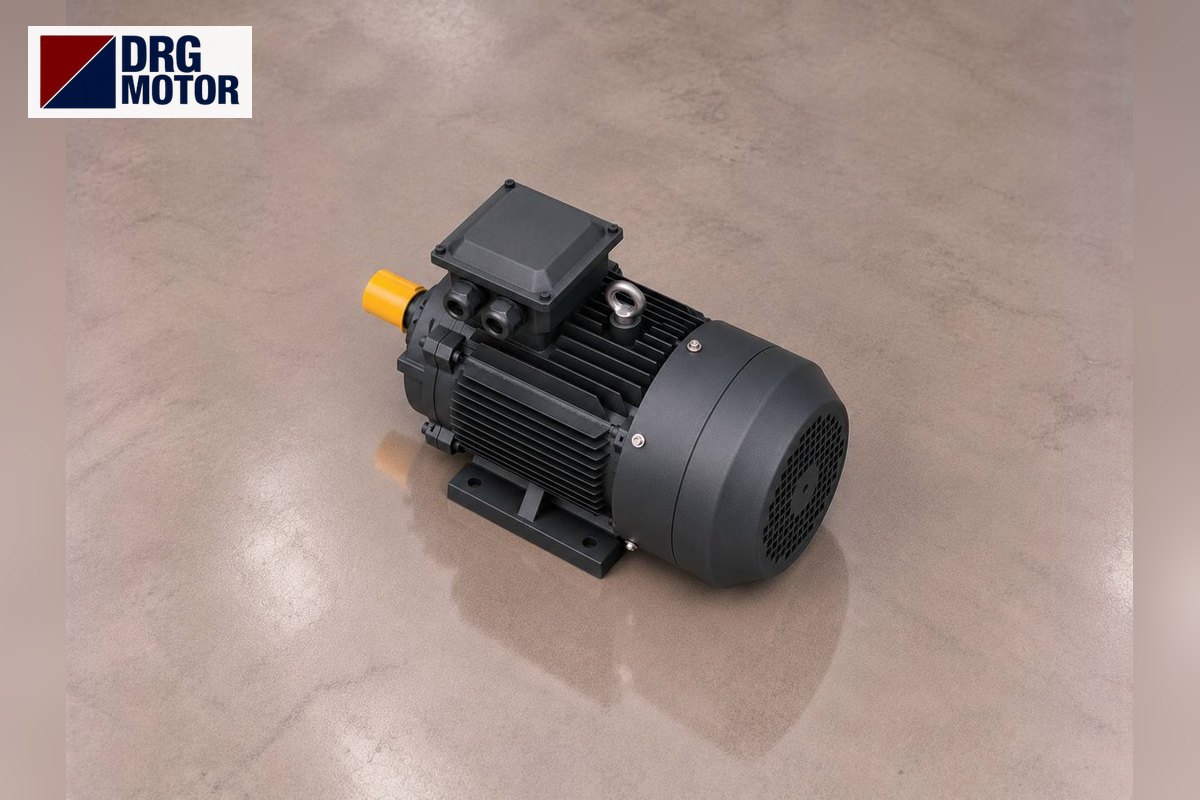

If you need to replace a GAMAK 22 kW electric motor that drives a pump or a fan, the equipment it turns determines the choice as much as the motor itself. On a pump, a small difference in speed changes flow and head; on a fan, it changes air volume and run-up time. This article covers the checks specific to pump and fan applications together with the motor's frame and shaft dimensions, and lists the data you should send to DRG MOTOR.
Frame and speed of the existing motor
Two types stand out in the GAMAK catalogue for 22 kW: the four-pole AGM3EL/GM3EL 180 L 4b (180L frame) and the two-pole 180 M 2a (180M frame). Both have a 48×110 mm shaft. The catalogue lists pumps and fans among the motors' fields of application, but it does not give a pump- or fan-specific selection table. The choice therefore relies on the type code and rated speed on your nameplate and on the data of the driven equipment. If the plate shows a speed of around 2950, the motor is two-pole; around 1470, it is four-pole. This distinction is critical for pumps and fans.
Checks for pump drives
Speed and duty point. A centrifugal pump's flow changes with speed, its head with the square of speed and its power demand roughly with the cube of speed. Fitting a four-pole motor to a two-pole pump roughly halves the flow; the reverse can overload both motor and pump. Even within the same speed class, a difference in rated speed shifts the pump's duty point slightly. That is why the speed and power on the pump plate are at least as important as the motor plate.
Connection type. On base-mounted pumps with a coupling, the shaft diameter, key, coupling hub and shaft height are compared. Where the motor is flange-mounted directly on the pump casing, flange size and spigot diameter are decisive; the DRG catalogue gives for 180M and 180L frames a B5 flange outer diameter of 350 mm, a hole circle of 300 mm and a spigot diameter of 250 mm. Designs in which the pump maker requires a motor-specific shaft or flange need a separate review.
Direction of rotation. The pump's direction of rotation is shown by an arrow on its casing. After the new motor is connected, direction should be checked with a short trial run; the connection must be made by competent technical staff.
Checks for fan drives
Pulley ratio or direct drive. On belt-driven fans, fan speed is set by motor speed and pulley diameters. If motor speed changes, the fan turns at a different speed with the same pulleys, and air volume and power demand change too. Note the pulley diameters, belt type and number of belts. On direct-drive fans, motor speed equals fan speed, so even the rated speed difference is taken into account.
Inertia and run-up time. Large fan impellers are heavy; while the motor accelerates this mass, run-up takes longer and the motor draws high current during that time. Measure or estimate the existing motor's run-up time. Long run-ups should be assessed together with the starting arrangement and protection settings. For example, DRG-180L-4 has a starting torque ratio of 2.0 and a starting current ratio of 7.8; suitability is reviewed together with the fan data.
Environment. For fans carrying dusty, hot or humid air, the environment around the motor should be stated separately. DRG models are specified for IP55, −15…+40 °C ambient and altitudes up to 1000 m; arrangements where the motor sits in the hot air stream must be stated.
Send DRG MOTOR photos of the motor nameplate and the pump or fan plate together with the connection dimensions, so that the assessment is based on data from both the motor and the driven equipment.
Drives and throttling. On pumps and fans, flow is often adjusted with a valve, damper or drive. If the motor runs on a drive, send the operating frequency range, how long it stays at low speed and the drive settings. Compatibility between the new motor and the drive should be assessed by competent technical staff. On a pump running against a throttled valve, the measured current shows more clearly how heavily the motor is actually loaded.
DRG options that can be assessed
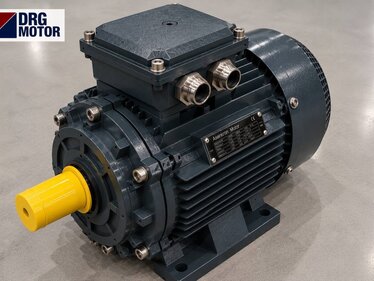
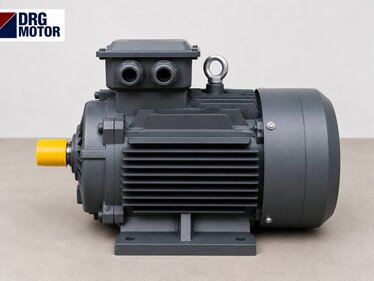
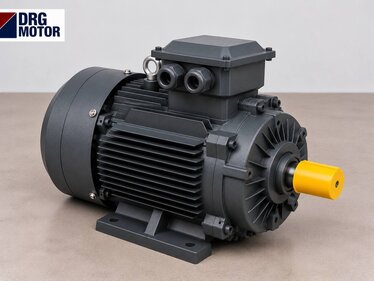
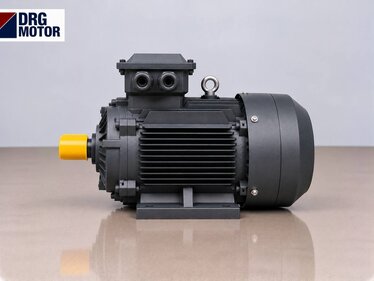
DRG Motor is a manufacturer, supplier and seller of electric motors. Some cast iron three-phase asynchronous motors on the online electric motor sales page that can be assessed for 22 kW are:
- DRG-180L-4: 22 kW, rated 1470 rpm, 180L, 48×110 mm shaft, 39.7 A at 400 V.
- DRG-180M-2: 22 kW, rated 2955 rpm, 180M, 48×110 mm shaft, 38.5 A at 400 V.
- DRG-200L2-6: 22 kW, rated 980 rpm, 200L, 55×110 mm shaft, 42.5 A at 400 V.
The list clearly shows that the same kW value is not enough for a replacement: all three models are 22 kW, but the six-pole DRG-200L2-6 has a different frame and shaft, and its speed would fundamentally change a pump's flow. Which one can be assessed is decided by the speed and connection dimensions the pump or fan requires. For pump applications see the pump motors page, and for dimension comparison the technical drawings page.
Pump and fan motor replacement questions
The motor on my pump is two-pole; what happens if I fit a four-pole motor?
Speed drops by about half, and flow and head fall accordingly. If your pump system was not designed for that duty point, the expected performance will not be achieved. Changing the speed class requires the pump to be assessed.
My fan motor takes a long time to start; will this change with a new motor?
Run-up time depends on fan inertia, the motor's starting torque and the starting arrangement. Nothing definite can be said without the fan data and the current run-up time. Once this information is provided, an assessment can be made.
Can the motor of a close-coupled pump be replaced?
Where the pump maker uses a motor-specific shaft or flange, replacement with a standard IEC motor may not be suitable. Shaft, flange and spigot dimensions should be measured on site and checked.
Is the pump plate needed, or is the motor plate enough?
The pump or fan plate gives the speed and power the equipment requires. The motor plate alone may not reveal the equipment's real need; sending both is recommended.
What to send to DRG MOTOR
- Motor nameplate photo and full type code
- Pump or fan plate photo (flow, head or air volume, speed, power)
- kW, rated speed, voltage, frequency and current on the plate
- Connection type: coupled on a base, close-coupled flange, belt and pulley (pulley diameters)
- Shaft diameter × length, key; for flange motors, flange outer diameter, hole circle and spigot diameter
- Direction of rotation, run-up time, and whether a drive or valve/damper is used for control
- Ambient conditions (dust, humidity, hot air) and daily operating hours
You can send the details via WhatsApp, info@drgmotor.com or the contact page, or call +90 (542) 666 11 11. If you add the models you want to review to the quote list and share them with the pump or fan data, the option is assessed according to your equipment's needs.
Technical Sources
- GAMAK — Technical Catalogue (Turkish edition) — 3-phase standard asynchronous motors: fields of application (pumps, fans) — printed page 68.
- GAMAK — Technical Catalogue (Turkish edition) — 3-phase standard asynchronous motors: aluminium frame IE3 tables (AGM3EL 180 M 2a, 180 L 4b) — printed pages 69–70.
- GAMAK — Technical Catalogue (Turkish edition) — 3-phase standard asynchronous motors: cast iron frame IE3 tables (GM3EL 180 M 2a, 180 L 4b) — printed pages 76–77.
- GAMAK — Technical Catalogue (Turkish edition) — Motor dimensions: foot-mounted motor (IEC 60072-1) B3 dimension tables, aluminium and cast iron frame (180 M and 180 L, shaft 48×110) — printed pages 88–89.