English
 Le français
 Türkçe




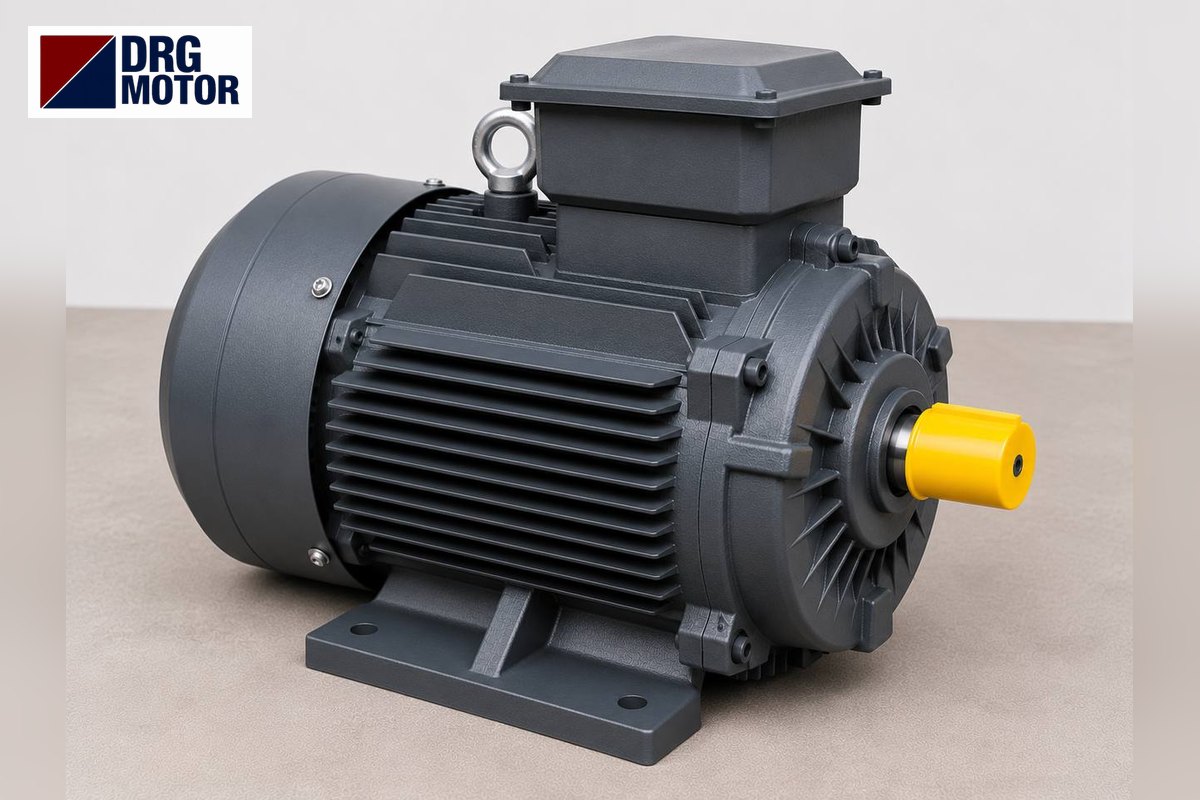

If you are about to remove a GAMAK 11 kW electric motor, three questions must be considered at the same time: how the new motor will connect to the machine, whether it can bring the machine up to speed under load, and whether it will sit in the same place. This article takes them in order: what to measure on the coupling side, how to describe the starting load, and how to compare foot and flange dimensions.
Identify the motor first: frame and shaft. The GAMAK catalogue shows the 160M frame for 11 kW: the four-pole AGM3EL/GM3EL 160 M 4a and the two-pole 160 M 2a. Both types have a 42×110 mm shaft. If you see 160 and M in the type code on your plate, your motor is most likely in this frame; for a firm answer, still measure the shaft with a caliper and note the key width. Although aluminium (AGM) and cast iron (GM) frames may share connection dimensions, frame weight and foot design differ; the catalogue states that the aluminium frame has bolt-on feet, while the cast iron frame has feet cast with the housing.
What to check on the coupling side
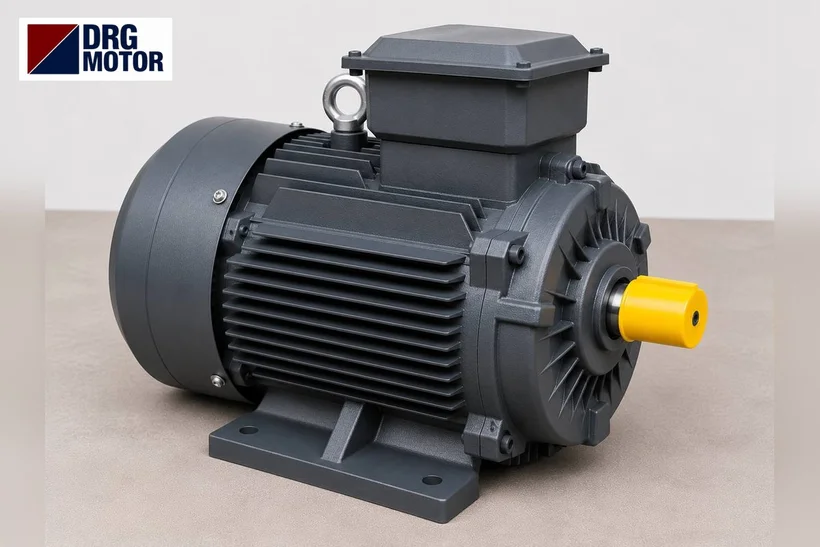
On motors connected directly by a coupling, the new motor's shaft must fit the existing coupling hub. If the new shaft and key (42 mm shaft, 12 mm key on DRG-160M-4) do not match the hub bore and keyway, the coupling has to be replaced or re-machined, which widens the scope of the job. The checklist is short:
- Shaft diameter, shaft length and key width (measured on the old motor)
- Coupling type (elastic element, rubber block, chain, etc.) and hub engagement length
- Shaft height: on a foot motor, the distance from the base to the shaft axis; H 160 mm on DRG-160M-4
- Distance between motor and machine and whether shims are used for alignment
The operation section of the GAMAK catalogue mentions the use of a flexible coupling; when replacing the motor, the condition of the existing coupling should also be reviewed. A worn elastic element or poor alignment increases bearing and shaft load and may also explain why the old motor wore out. Alignment has to be redone with the new motor.
Describe the starting load accurately
The same 11 kW motor can run easily on a fan that starts unloaded and struggle on a loaded conveyor or a mixer full of material. So state the machine's condition at start-up in your request: does it start empty, half full or fully loaded, how many seconds does the start take, and how many times a day is it repeated?
A motor's starting capability is expressed by the ratios in its nameplate or catalogue data. For example, DRG-160M-4 has a starting torque of 2.2 times rated torque and a starting current of 7.7 times rated current; rated torque is 71.7 Nm. The GAMAK catalogue also contains starting current and torque ratios and information on star-delta starting. If the existing panel has a star-delta starter, soft starter or drive, the relationship between that arrangement and the new motor's rated voltage (400/690 V for DRG-160M-4) should be assessed by competent technical staff; the starting method also affects starting torque.
Send DRG MOTOR your nameplate photo, your shaft and coupling dimensions and a description of how the machine starts, so that the options worth considering are reviewed together with this data.
Comparing foot and flange mounting
On a foot-mounted (B3) motor, the decisive dimensions are the foot hole spacing (A, B), the distance from the shaft shoulder to the first foot hole (C), shaft height (H) and hole diameter. On DRG-160M-4, A is 254 mm, B 210 mm, C 108 mm, holes 4–Φ14.5 and overall length L 608 mm. For a flange (B5) connection, the DRG catalogue gives for the 160M frame a flange outer diameter P of 350 mm, hole circle M of 300 mm, spigot diameter N of 250 mm, hole diameter S of 18.5 mm and spigot depth T of 5 mm. On B35, foot and flange are checked together. If you have a B14 flange motor, dimensions are confirmed with the order.
The same power can also correspond to a different frame. DRG-132M-4K is a compact 11 kW model with a rated nameplate speed of 1465 rpm, but its frame is 132M and its shaft 38×80 mm. If it is considered in place of a 160M motor, the coupling hub, foot holes and shaft height change. In other words, even when kW and speed class match, connection dimensions may differ. For dimension comparison you can use the drawings on the technical drawings page.
Options that can be assessed
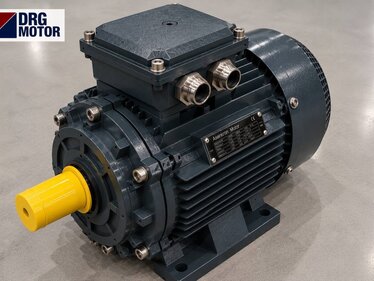
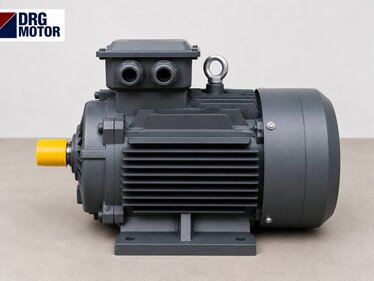
DRG Motor is a manufacturer, supplier and seller of electric motors. Some models among the three-phase asynchronous motors in the online motor shop that can be assessed for 11 kW:
- DRG-160M-4 (cast iron): 11 kW, rated 1465 rpm, 160M, 42×110 mm shaft, 20.4 A at 400 V.
- DRG-132M-4K (aluminium, compact): 11 kW, rated 1465 rpm, 132M, 38×80 mm shaft.
- DRG-160M1-2 (cast iron): 11 kW, rated 2945 rpm, 160M, 42×110 mm shaft, starting torque ratio 2.0.
Which one may be suitable is assessed together with your shaft, coupling, mounting and starting data; the list does not indicate definite suitability. For general applications you can also look at the general purpose electric motors page.
FAQ
Can I reuse the existing coupling on the new motor?
It can be reused if the shaft diameter, key and hub engagement length match and the coupling elements are not worn. If the shaft size differs, the hub has to be replaced or machined. Checking the coupling while it is dismantled is the easiest way.
My machine starts loaded; should I choose more than 11 kW?
Not automatically. First you need to know whether the existing motor struggles at start-up, how long the start takes and what current is measured. Increasing power can also change the frame and shaft size; the decision should be based on load data.
What should be watched in a system running with star-delta starting?
Nameplate voltage and connection data should be reviewed together with the panel arrangement. Whether the connection or protection arrangement needs any change must be decided by competent technical staff; this article does not give connection instructions.
How do I compare dimensions for my flange motor?
Measure and write down the flange outer diameter, hole circle, spigot diameter, number and diameter of holes, and the shaft size. These values are then checked against DRG drawings.
Information to send
- Nameplate photo and type code (including frame and pole information)
- kW, rated speed, voltage, frequency and nameplate current
- Shaft diameter × length, key width, coupling type and hub size
- Mounting; A, B, C and H for foot motors, P, M, N and hole data for flange motors
- Type of machine and starting condition (empty/loaded, start time, starts per day)
- Starting method in the panel (direct, star-delta, soft starter, drive)
- Ambient conditions and failure history
You can send the details via WhatsApp, to info@drgmotor.com or through the contact form, or reach us on +90 (542) 666 11 11. If you add the models you are interested in to the quote list and send them with your measurements, the review is made according to your machine's conditions.
Technical Sources
- GAMAK — Technical Catalogue (Turkish edition) — 3-phase standard asynchronous motors: removable feet (aluminium) and cast-on feet (cast iron) — printed page 68.
- GAMAK — Technical Catalogue (Turkish edition) — 3-phase standard asynchronous motors: aluminium frame IE3 tables (AGM3EL 160 M 2a, 160 M 4a; starting current and torque ratios, direct and Y/∆) — printed pages 69–70.
- GAMAK — Technical Catalogue (Turkish edition) — 3-phase standard asynchronous motors: cast iron frame IE3 tables (GM3EL 160 M 2a, 160 M 4a; starting current and torque ratios) — printed pages 76–77.
- GAMAK — Technical Catalogue (Turkish edition) — Electrical design: starting methods (direct, star-delta, soft start) — printed page 39.
- GAMAK — Technical Catalogue (Turkish edition) — Motor dimensions: foot-mounted motor (IEC 60072-1) B3 dimension tables, aluminium and cast iron frame (160 M, shaft 42×110) — printed pages 88–89.
- GAMAK — Technical Catalogue (Turkish edition) — General information: shaft couplings and pulleys (use of flexible couplings) — printed page 167.