English
 Le français
 Türkçe




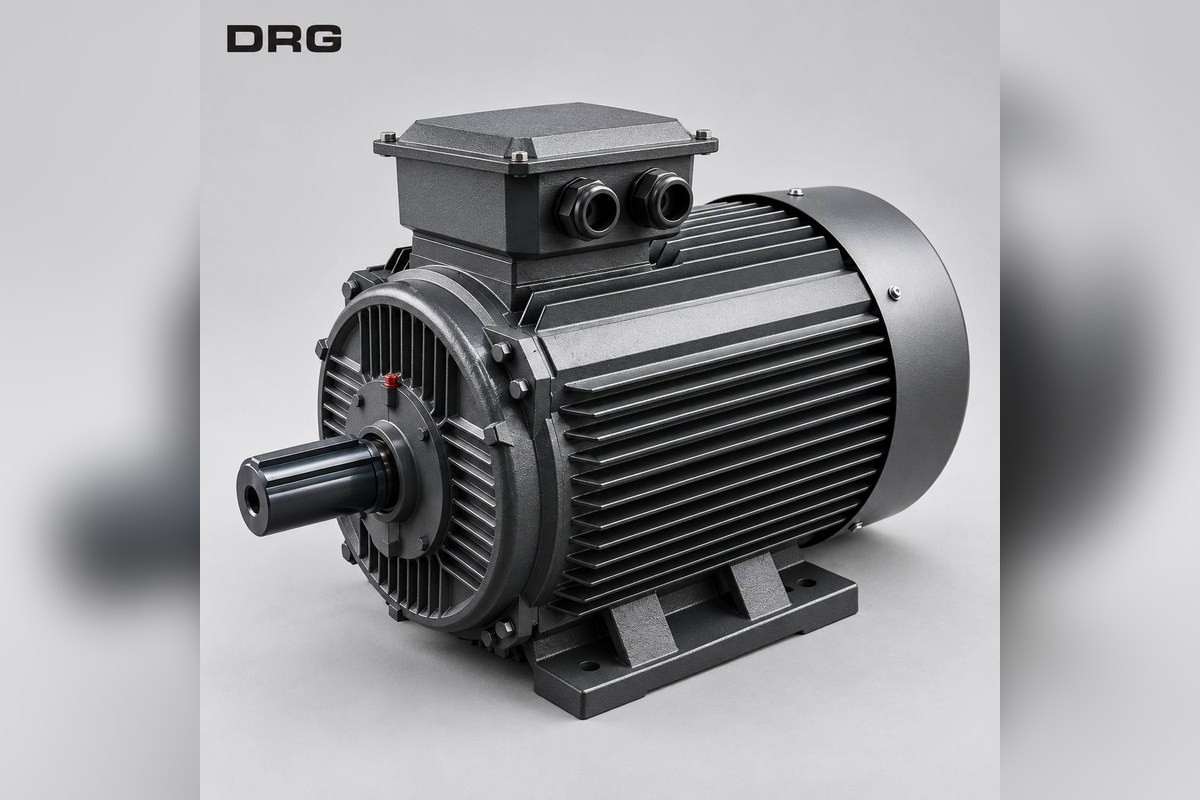

On an industrial buffing and polishing machine, the motor is chosen by the peripheral speed of the felt or cloth wheel and by the load the two wheels put on the shaft: a double-ended metal polishing bench with 350 mm wheels reaches 26.6 m/s with a 4-pole motor of about 1450 rpm and, with both stations working, needs a motor in the 3 kW class; for example the DRG-100L2-4 draws 6.02 A at 400 V and gives 19.8 Nm rated torque. With 400 mm wheels and heavy pressure, the 4 kW DRG-112M-4 (7.95 A) stays on the safe side. The power on the machine builder's nameplate always comes first; the calculations here are a check for benches whose plate is lost or which are being rebuilt.
What sets a polishing motor apart from a sander or grinder motor is the type of load: the wheels sit at both ends of the shaft, away from the frame, and as the operator presses the part against the wheel, bending load acts on the shaft and bearings. Shaft size, shaft extension length and bearing are therefore part of the choice as much as power. Terminal wiring, rotation check and overload setting must be done by a qualified electrician; a wheel running the wrong way or with a loose nut is a serious injury risk for the operator. Suitable models by power and speed are listed on the Buy Electric Motors Online page.
The 3 most common mistakes with a polishing motor
- Fitting a larger wheel at the same speed: at 1450 rpm a 250 mm wheel gives 19 m/s and a 400 mm wheel 30.4 m/s. If the maximum speed marked on felt and cloth wheels is exceeded the wheel can burst; a larger wheel also draws more power from the motor.
- Adding a long extension to a single-shaft motor: the shaft end of a standard motor (e.g. 28 × 60 mm on a 100L frame) is short and stout, not designed to carry a wheel far out. Welding or sleeving an extension onto it leads to vibration and bearing failure.
- Running without checking rotation: the wheel must turn downwards on the face towards the operator. On double-ended benches one nut is left-hand threaded and the other right-hand; a motor turning the wrong way loosens the nut.
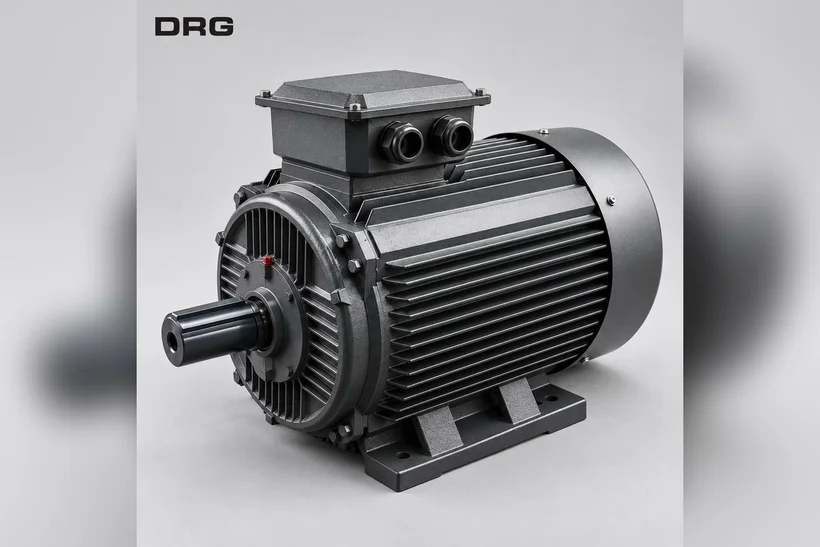
Wheel diameter and speed: peripheral speed table
In polishing, the deciding value is not motor speed but the speed at the outer edge of the wheel: v (m/s) = π × D (m) × n (rpm) / 60. D is the outer wheel diameter, n the shaft speed. The table below was calculated in Python with the rated speeds of the small 2-, 4- and 6-pole frames in the DRG range:
| Disc diameter | 2-pole · 2895 rpm | 4-pole · 1450 rpm | 6-pole · 955 rpm |
|---|---|---|---|
| 200 mm | 30.3 m/s | 15.2 m/s | 10.0 m/s |
| 250 mm | 37.9 m/s | 19.0 m/s | 12.5 m/s |
| 300 mm | 45.5 m/s | 22.8 m/s | 15.0 m/s |
| 350 mm | 53.1 m/s | 26.6 m/s | 17.5 m/s |
| 400 mm | 60.6 m/s | 30.4 m/s | 20.0 m/s |
For metal polishing most workshops use 250–400 mm wheels with a 4-pole motor and work in the 19–30 m/s range of the table. A 2-pole motor doubles the speed on the same wheels; up to 45.5 m/s on a 300 mm wheel is above the permitted limit of many felt and cloth wheels. For soft metals and plastics, a 6-pole motor or a pulley-reduced speed is preferred to limit heating. When fitting a new wheel, compare the maximum speed on its label with the motor's rated speed; on a belt-driven machine you can find the spindle speed with the pulley and belt calculator.
Click to see current electric motor prices and order nowSEE PRICES →
How many kW are needed? Power from contact force
The power drawn by polishing is the tangential friction force between wheel and part multiplied by peripheral speed: P (kW) = Ft (N) × v (m/s) / 1000. On a double-ended machine two operators may work at the same time, so both wheels are counted. Below, a tangential force of 40 N per wheel is assumed at 1450 rpm, with a 1.25 margin for a compound-loaded wheel and heavy pressure. The force is an assumption; the real value depends on compound type, wheel hardness and pressure:
| Disc diameter · speed | Two-disc shaft power | With 1.25 margin | Motor to choose |
|---|---|---|---|
| 250 mm · 19.0 m/s | 1.52 kW | 1.90 kW | DRG-100L1-4 · 2.2 kW |
| 300 mm · 22.8 m/s | 1.82 kW | 2.28 kW | DRG-100L2-4 · 3 kW |
| 350 mm · 26.6 m/s | 2.13 kW | 2.66 kW | DRG-100L2-4 · 3 kW |
| 400 mm · 30.4 m/s | 2.43 kW | 3.04 kW | DRG-112M-4 · 4 kW |
The practical result: a 250 mm double-ended bench works with 2.2 kW, a 300–350 mm bench with 3 kW and a 400 mm bench with 4 kW. The quickest way to confirm this on an existing machine is to measure the motor current with a clamp meter while both stations are working. If the current often exceeds the rated value the power is short; if it stays below half the rated value the motor is oversized. You can also see rated currents by power and voltage on the motor current chart page.
Long shaft and shaft load: can the motor carry the wheel?
A double-ended polishing bench is built in one of two ways, and the motor choice depends on which:
Wheel directly on the motor shaft
Mounting wheels directly on both ends of the motor shaft needs a motor with a shaft extension at each end, long and bearing-supported accordingly. The standard DRG models in the store have a single shaft extension, with shaft dimensions from the IEC catalogue (90L: 24 × 50 mm, 100L and 112M: 28 × 60 mm, 132S: 38 × 80 mm). A double-shaft special design is outside the catalogue; if you need one, call us with the dimensions. The further the wheel is from the shaft shoulder, the larger the bending moment the same contact force puts on the bearing: moving the wheel twice as far doubles the moment.
Separately supported polishing spindle with belt
This is the most common layout in workshops and the one that makes motor replacement easiest: the wheels sit on a long spindle running in its own bearings, and the motor drives this spindle by belt. The spindle bearings carry the wheel load; the motor bearing only sees the belt pull. If the motor fails, a standard foot-mounted motor is fitted and the wheel speed is set by the pulley ratio. A rough value of the belt force is F = 2 × T / d (T motor torque, d motor pulley diameter); with a V-belt, pre-tension produces a radial load of roughly twice this:
| Motor | Torque Tn | Pulley 100 mm | Pulley 80 mm |
|---|---|---|---|
| DRG-100L1-4 · 2.2 kW | 14.5 Nm | 290 N | 362 N |
| DRG-100L2-4 · 3 kW | 19.8 Nm | 396 N | 495 N |
| DRG-112M-4 · 4 kW | 26.3 Nm | 526 N | 658 N |
The table shows why a small pulley increases bearing load: on the same 4 kW motor, going from a 100 mm to an 80 mm pulley raises the belt force from 526 N to 658 N. So do not choose a motor pulley smaller than necessary, and mount it close to the shaft shoulder. The bearing is 6206-ZZ-C3 on 100L and 112M frames and 6208-ZZ-C3 on 132S. We explain the general logic of motor selection for belt drives in motor selection for belt and pulley drives.
Dust, compound and run-down time
Unlike sanding dust, polishing compound and felt fibre are greasy and sticky: they cling to the fan cowl and fins, and if not cleaned the frame cannot cool. An IP55 frame protects the inside, but weekly cleaning of the outer surface prevents overheating. Place the dust extraction inlet under the wheels, keep the motor away from where the dust falls and point the terminal box gland downwards.
The inertia of a large felt wheel makes it keep spinning for a long time after the motor is switched off. If run-down time is a problem, a frequency inverter with controlled deceleration or a braking resistor can be used; details are in inverter dynamic braking and braking resistor. An inverter also lets you set the speed for the wheel diameter; but at low speed the motor's own fan slows too, and long periods at very low speed increase heating.
Which DRG motor should I buy? Model table for polishing
The models below cover the power range for benches that drive a separately supported spindle by belt and for small direct-wheel machines. The 4-pole models are the main group for metal polishing, while the 6-pole models are for soft metals and plastics where heating is a concern. The table also gives the bearing that carries the shaft load:
| Model | Power / speed | Bearing | Current 400 V |
|---|---|---|---|
| DRG-100L1-4 | 2.2 kW / 1450 rpm | 6206-ZZ-C3 | 4.52 A |
| DRG-100L2-4 | 3 kW / 1450 rpm | 6206-ZZ-C3 | 6.02 A |
| DRG-112M-4 | 4 kW / 1450 rpm | 6206-ZZ-C3 | 7.95 A |
| DRG-132S-4 | 5.5 kW / 1460 rpm | 6208-ZZ-C3 | 10.7 A |
| DRG-112M-6 | 2.2 kW / 955 rpm | 6206-ZZ-C3 | 5.09 A |
| DRG-132S-6 | 3 kW / 968 rpm | 6208-ZZ-C3 | 6.84 A |
Collect this information before replacing the motor:
- kW, speed and voltage on the old motor's nameplate; star or delta connection
- Are the wheels on the motor shaft or on a separately supported spindle
- Outer wheel diameter and the maximum speed on the wheel label
- Motor and spindle pulley diameters, belt type
- Frame size, foot hole spacing, shaft D × E and key
- History of bearing noise or heat; run-out at the shaft end
- Position of the dust extraction inlet and cleanliness of the fan cowl
- Overload relay range, contactor and stopping arrangement in the panel
As an example, the model that stands out for a double-ended, belt-driven polishing bench with 350 mm wheels:
- Power: 3 kW
- Rated speed: 1450 rpm
- Frame: 100L · cast iron
- Current 400 V: 6.02 A
- Current 380 V: 6.34 A
- cos φ: 0.82
- Rated torque: 19.8 Nm
- Starting torque: 2.3 × Tn
- Shaft D × E: 28 × 60 mm
- Bearing: 6206-ZZ-C3
- Voltage: 230/400 V (Δ/Y)
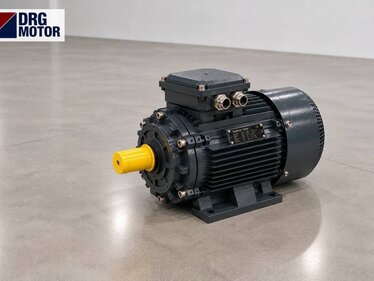
DRG Motor is a manufacturer, supplier and seller of electric motors; our motors are guaranteed for 2 years from the delivery date against material and manufacturing defects (warranty certificate). For dimension checks, see the technical drawings page.
Motors in this power range
- DRG-100L1-4 – 2.2 kW – 1450 rpm – 100L cast iron
- DRG-100L2-4 – 3 kW – 1450 rpm – 100L cast iron
- DRG-112M-4 – 4 kW – 1450 rpm – 112M cast iron
- DRG-132S-4 – 5.5 kW – 1460 rpm – 132S cast iron
- DRG-112M-6 – 2.2 kW – 955 rpm – 112M cast iron
- DRG-132S-6 – 3 kW – 968 rpm – 132S cast iron
Click to see current prices and order these motors nowSEE PRICES →
Frequently Asked Questions
What speed should a polishing motor have?
Most metal polishing benches run with a 4-pole motor of about 1450 rpm; on a 350 mm wheel this gives 26.6 m/s peripheral speed. The maximum speed on the wheel label must be higher than the motor speed.
How many kW does a double-ended polishing machine need?
Assuming 40 N tangential force per wheel and a 1.25 margin, you get 2.2 kW for 250 mm wheels, 3 kW for 300–350 mm and 4 kW for 400 mm. Confirm on your machine by measuring current under load.
How many amps does a 3 kW polishing motor draw?
The 4-pole DRG-100L2-4 draws 6.02 A at 400 V and 6.34 A at 380 V; its rated torque is 19.8 Nm. Set the overload relay to this current.
Can I mount a polishing wheel directly on the motor shaft?
It is possible for small wheels, but because a standard motor's shaft end is short, the wheel stays close to the frame and the motor is not suitable for double-ended use. On double-ended benches with large wheels, a separately supported spindle with belt drive is safer.
Send us the old motor's nameplate or dimensions and we will narrow down the right DRG model together: phone +90 (542) 666 11 11, e-mail info@drgmotor.com, contact page. For all models and current prices, see Buy Electric Motors Online.