English
 Le français
 Türkçe




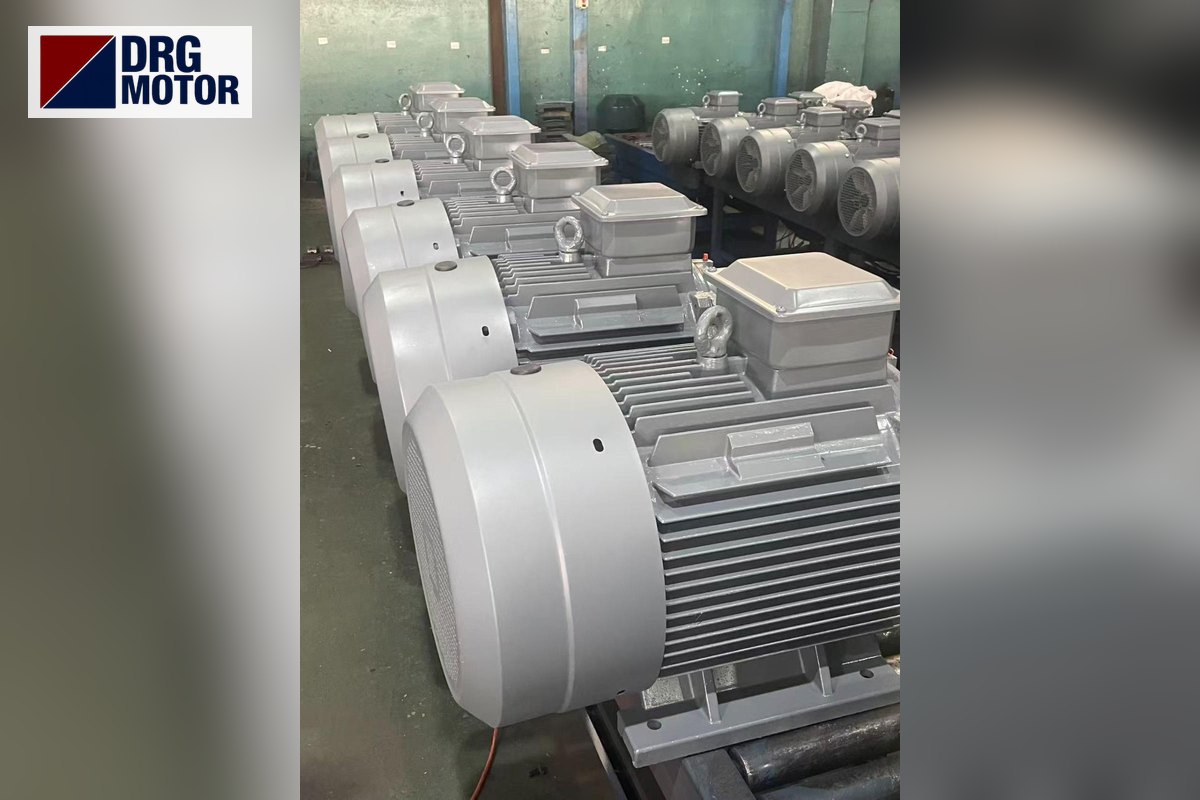

In a plastering machine, the main motor turns the mixing shaft in the hopper and the screw pump (rotor-stator) at the end of that shaft at the same time. When replacing the motor, keep the power and pole count on the nameplate unchanged; the real selection criterion is the flange and shaft size with which the motor mates to the gearbox. On many machines the motor and gearbox come as a single block; if the gearbox input has an IEC flange, the motor alone can be replaced.
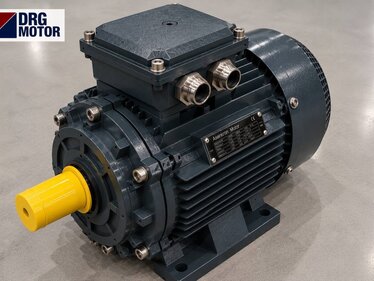
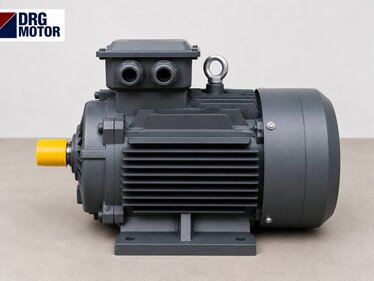
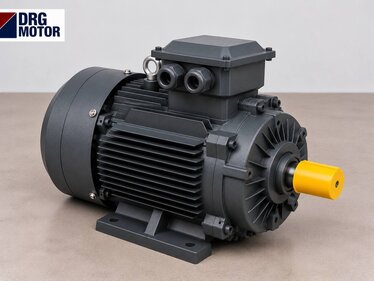
DRG Motor is a manufacturer, supplier and seller of electric motors, offering three-phase asynchronous IEC motors with aluminium and cast iron frames. Models can be filtered by power, speed and frame on the buy electric motors online page.
Below you will find, in order, the motor's job in the machine, the limits imposed by construction-site power supply, and the mounting dimensions to measure before removing the old motor.
The Mixing Shaft and Screw Pump Run From One Motor
Bagged gypsum plaster drops from the hopper into the mixing zone via a feed screw, and water is added at a set rate from the flow meter. The mixing shaft turns powder and water into mortar within seconds, and the steel rotor on the extension of the shaft rotates inside the rubber stator, pushing the mortar into the hose.
The rotor is a tight fit in the stator. So even with the machine empty, the motor overcomes friction torque; as the hopper fills and the hose gets longer, pressure load is added on top. The load is constant-torque: the torque demand does not fall when the speed drops.
The pump runs at a few hundred revolutions per minute. To achieve this, most machines use a 4-pole motor together with a gearbox. If the mortar starts to set in the hose or the hose kinks, the load rises suddenly; the motor's overload relay must then open the circuit.
Choosing Power: Nameplate Value, Hose Length and a New Stator
On site-type plastering machines, motor power is usually in the range of a few kW; the exact value is on the machine maker's nameplate and in its catalogue. Do not go below the nameplate kW: a smaller motor cannot turn the pump as the floor height increases.
Current measured on the old motor can mislead you. A worn stator grips the rotor loosely, so the current looks low; once the stator is renewed, the torque demand rises noticeably during the first hours. Select power from the nameplate, not from a measurement taken on a worn pump.
Example: the DRG-132S-4 is 5.5 kW, 1460 rpm, with a rated torque of 36.0 Nm and a starting torque ratio (Ts/Tn) of 2.0, so it delivers about 72 Nm at start-up. Assuming a gearbox ratio of 5, the pump shaft turns at 292 rpm. These figures are only a worked example; your machine's ratio is on the gearbox nameplate.
Fitting a motor one size larger will not clear a blocked hose. Excess torque strains the stator and hose couplings and makes the overload setting meaningless.
Site Supply: Generator, Extension Cable and Starting Current
On DRG motors the winding is 230/400 V up to 3 kW and 400/690 V from 4 kW upwards. On a 400 V site distribution board, motors up to 3 kW are connected in star, 4 kW and above in delta. Photograph how the terminal links on your old motor are fitted before removing it.
Starting current is decisive on generator-powered sites. For the DRG-112M-4, rated current at 400 V is 7.95 A with an Is/In ratio of 7.8, so it draws about 62 A at start-up. For the DRG-132S-4, with 10.7 A and a ratio of 7.9, the figure becomes about 84.5 A. Check from the generator maker's data whether the generator can supply this inrush without a voltage collapse.
Long extension cables run between floors cause voltage drop; the motor cannot start against a full pump and the overload trips. You can check cable length and cross-section with the motor cable size calculator.
If the phase sequence at the socket changes, the motor runs backwards; the screw pump tries to pull mortar back from the hose and the stator runs dry. Each time you connect to a new board, keep the first start short and check the direction of rotation visually.
Click to see current electric motor prices and order nowSEE PRICES →
Integrated Motor or IEC Flange Motor?
On some plastering machines the motor is part of the gearbox housing: it has no separate flange and carries a gear directly on the shaft end. This type cannot be replaced with a standard IEC motor; the gearbox must be changed to a model with an IEC input. DRG does not sell gearboxes, but supplies the motor to be connected to an IEC-input gearbox (see electric motors for gearboxes).
If the gearbox has an IEC flange, compare the B5 dimensions below with your old motor. Values are from the large flange (B5) table in the DRG catalogue.
| Model | IEC frame | Shaft D×E (mm) | B5 flange P / M / N (mm) |
|---|---|---|---|
| DRG-112M-4 (4 kW) | 112M | 28 × 60 | 250 / 215 / 180 |
| DRG-112M-4K (5.5 kW) | 112M (compact) | 28 × 60 | 250 / 215 / 180 |
| DRG-132S-4 (5.5 kW) | 132S | 38 × 80 | 300 / 265 / 230 |
| DRG-132M-4 (7.5 kW) | 132M | 38 × 80 | 300 / 265 / 230 |
P is the flange outside diameter, M the bolt circle and N the spigot diameter. The compact DRG-112M-4K delivers 5.5 kW in a 112 frame; if your old 5.5 kW motor mates to the gearbox with a 28 mm shaft and 250 mm flange, this model fits the same place. Length matters too under the machine cover: overall length is 394 mm for 112M, 438 mm for 132S and 476 mm for 132M. For small flange (B14) connections we confirm the dimensions with the order.
Gypsum Dust, Wash Water and Transport Knocks
DRG motors are IP55: protected against dust and low-pressure water splashes from any direction. When the machine is washed at the end of the day, do not aim a pressure jet at the motor frame or terminal box; leave the cable gland tight with its entry facing down.
The motor is cooled by a shaft-mounted fan (IC411). Gypsum dust sticking to the fan cover grille cuts off airflow and raises winding temperature; clean the grille regularly with a dry brush.
On machines carried from floor to floor, weight matters, which is why aluminium frame electric motors, offered up to 11 kW, are often preferred. Ambient temperature must stay within −15…+40 °C and altitude within 1000 m; heat building up under a closed cover in summer sun can exceed this limit.
Signs of the Wrong Motor and Replacement Checks
Typical faults seen on site
- With a 2-pole (3000 rpm) motor the pump speed doubles; the stator heats up and mortar flow becomes pulsating.
- With a 6-pole (1000 rpm) motor the output drops and the plastering crew waits for the machine.
- An underpowered motor trips the overload on upper floors; if the problem is hidden by raising the overload setting, the winding burns.
- Adapting a motor with a different shaft diameter using a bushing causes misalignment and bearing damage.
Checklist before removing the motor
- Photo of the motor nameplate: kW, rpm, voltage, current
- Are motor and gearbox separate or a single block?
- Flange outside diameter, bolt circle, spigot diameter and number of holes
- Shaft diameter, shaft length and key width
- Length available under the cover and terminal box orientation
- Is a generator used on site, and how long is the cable?
DRG Motors Suitable for Plastering Machines
These 4-pole (about 1450 rpm), lightweight aluminium frame models cover the usual power range of machines driving a screw pump through a gearbox. Flange (B5) or foot-and-flange (B35) construction is specified with the order.

4 kW Three-Phase Motor 1500 rpm – DRG-112M-4 Aluminium
- 4 kW · 1500 rpm (4 poles)
- Aluminium frame · IEC 112M
- Mounting: B3 · B5 · B14 · B35
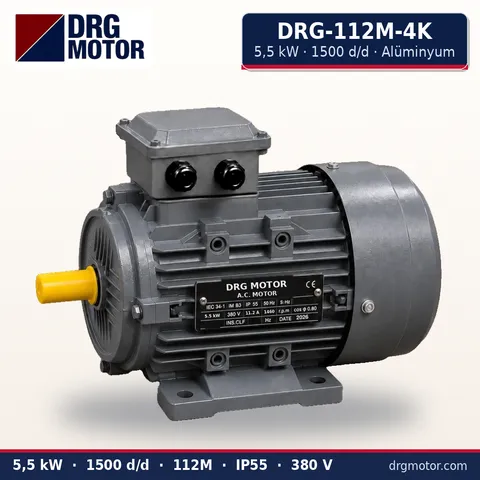
5.5 kW Compact Three-Phase Motor 1500 rpm – DRG-112M-4K Aluminium
- 5.5 kW · 1500 rpm (4 poles)
- Aluminium frame · IEC 112M
- Mounting: B3 · B5 · B14 · B35
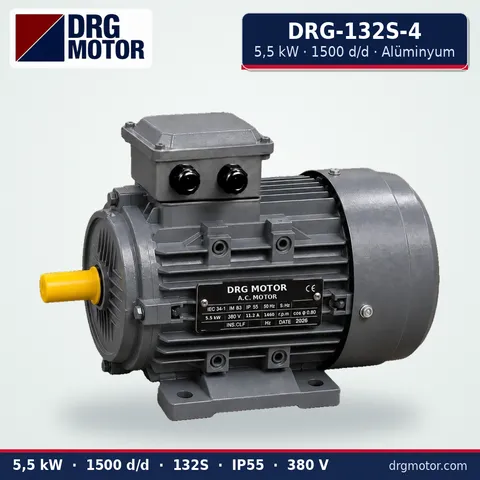
5.5 kW Three-Phase Motor 1500 rpm – DRG-132S-4 Aluminium
- 5.5 kW · 1500 rpm (4 poles)
- Aluminium frame · IEC 132S
- Mounting: B3 · B5 · B14 · B35
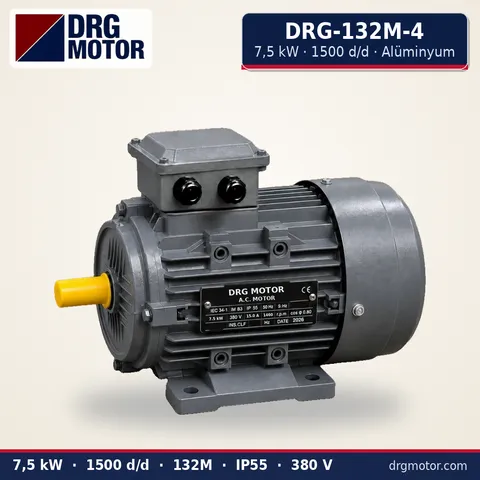
7.5 kW Three-Phase Motor 1500 rpm – DRG-132M-4 Aluminium
- 7.5 kW · 1500 rpm (4 poles)
- Aluminium frame · IEC 132M
- Mounting: B3 · B5 · B14 · B35
Click to see current prices and order these motors nowSEE PRICES →
Plastering Machine Motor: Frequently Asked Questions
Can a 3000 rpm motor be fitted to a plastering machine?
Not if the machine was designed for a 4-pole motor. With the same gearbox ratio the pump turns twice as fast; the stator overheats and mortar flow becomes irregular.
Will a plastering machine motor run on a generator?
Yes, but the generator must be able to supply the motor's starting current. For example, the 4 kW DRG-112M-4 draws about 62 A at start-up; size the generator with this value and the generator maker's data.
The motor runs backwards and the pump pulls mortar back; what should I do?
Stop the motor immediately and have a qualified electrician swap two supply phases. Running in reverse makes the stator run dry and damages it quickly.
Motor and gearbox are one piece; can I replace only the motor?
If the motor is not connected by a separate IEC flange, a standard motor cannot be fitted. In that case you switch to a gearbox with an IEC input; DRG supplies the motor to be connected to that gearbox.
For a quotation, send a photo of the motor nameplate, its power, speed, mounting type (foot or flange), shaft size and machine type via WhatsApp, or add the models to the quote list. Phone: +90 (542) 666 11 11 · Email: info@drgmotor.com · Contact page. All models can be viewed in our online store.