English
 Le français
 Türkçe




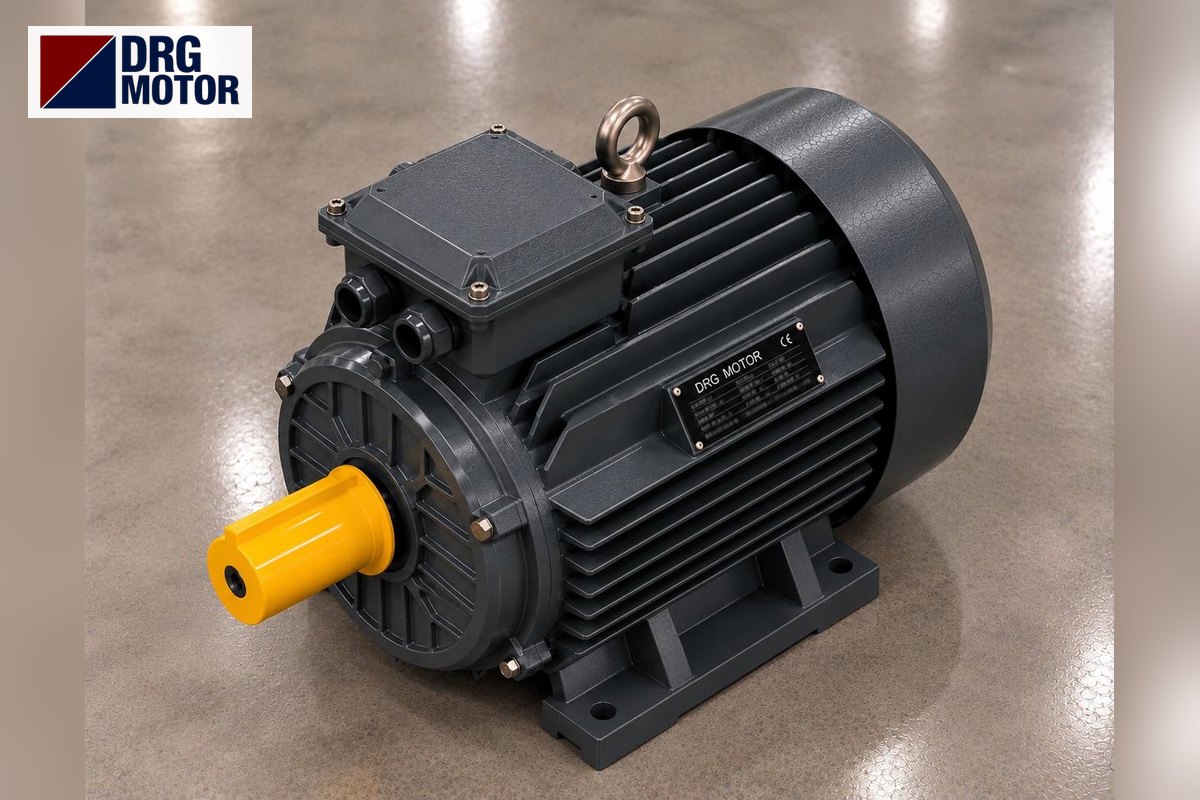

On a paper towel and toilet tissue rewinder, motor selection splits into two separate questions. The main winding head that winds the log works on most modern lines with a servo or precise vector-controlled drive because of the rapidly changing diameter and several log changes per minute; a standard IEC motor cannot do this job. The rest of the line, such as the tail sealer, accumulator belt, log saw and dust extraction fan, runs on standard three-phase induction motors with an inverter where needed. Suitable motors for this second group are in our online shop.
Below we first map the line, then explain motor selection where a standard motor really does the work.
From Jumbo Roll to Packed Roll: Which Motor Does What?
The wide jumbo roll from the paper machine is loaded on the unwind. The paper is embossed, the plies are bonded and the perforating knife cuts the sheet line. At the winding head the paper is wound into a log on a cardboard core; when the length is complete the paper is torn off, a new core enters and the full log is ejected.
The log tail is glued, the logs queue on the accumulator belt and the log saw cuts them to roll length. Paper dust is collected along the line by an extraction system.
| Line section | What the motor does | Typical control | Covered by DRG? |
|---|---|---|---|
| Jumbo roll unwind | Turns/brakes the parent roll | Vector, tension | Depends on machine |
| Embossing unit | Turns the pattern rolls | Synchronised with line | Depends on machine |
| Rewinder head | Winds, cuts, ejects the log | Servo / vector | No (servo) |
| Tail sealer | Glues the log tail | Fixed speed, inverter | Yes |
| Log accumulator belt | Carries the logs | Constant torque | Yes |
| Log saw | Turns the blade | Belt drive, inverter | Yes |
| Dust extraction fan | Pulls away paper dust | Fan load | Yes |
"Depends on machine" in the table means this: on older, slower lines the unwind and embossing unit may run on inverter-fed induction motors; on new lines they may also be tied into the servo system. On replacement, the old nameplate tells you: if it belongs to a servo motor, a standard motor cannot replace it.
Click to see current electric motor prices and order nowSEE PRICES →
Why the Main Winding Head Does Not Run on a Standard Motor
At the winding head each log is wound in a few seconds. During that time the log grows from the core to product diameter, and the speed and position of the winding rolls change constantly with diameter. At log change, core, tear-off and glue movements must be synchronised within milliseconds; otherwise roll firmness varies and the paper tears.
That response speed and position accuracy come from a servo motor and its drive. DRG's range has no servo motors. If a servo fails on the winding head, contact the machine builder or the servo supplier; an induction motor cannot do this job.
On older rewinders with mechanical cams, a single large induction motor may drive the main winding. In that case too, take power and speed only from the old motor's nameplate and keep the speed ratio of the cam and gear train.
Log Saw: Adjusting Speed as the Blade Wears
The log saw cuts the rolls with a large circular blade that both spins and moves down onto the logs. The blade is sharpened during operation and its diameter shrinks over time. As it shrinks, cutting speed falls at the same rpm and the cut face deteriorates.
Example / assumption: a 610 mm blade at 700 rpm has a peripheral speed of about 22.4 m/s from v = π·D·n/60. When the blade is down to 450 mm, the same rpm gives 16.5 m/s. To keep 22.4 m/s the blade must turn at about 951 rpm; with the same pulleys this means about 67.9 Hz on the inverter.
This is why the log saw motor is usually 4-pole, run above 50 Hz to compensate for wear. With a 1460 rpm motor and a 700 rpm blade the belt ratio is about 2.09. A 2-pole motor can also be used, but the ratio rises to 4.19 and belt slip increases on the small motor pulley.
Note on the blade motor
- Example model: DRG-132S-4
- Power / speed: 5.5 kW – 1460 rpm
- Rated torque: 36.0 Nm
- Shaft: 38 mm
- Housing: cast iron, foot or B35
The blade is heavy and the saw head accelerates on every cut; a cast iron housing carries the vibration better. Since torque falls above 50 Hz, do not choose a smaller motor than the old one.
Paper Dust: Fan Cowl, Fire and Explosion Risk
On a tissue line the decisive environmental factor is paper dust. It builds up like felt on the motor's fan grille and fins, cuts off cooling and forms a combustible layer. The IP55 housing protects the inside of the motor but does not stop build-up outside; motor surfaces should be on the shift cleaning list.
On lines with an extraction fan and cyclone, the plant risk assessment may define an explosive dust zone. Motors in that zone need a special Ex-protected motor; DRG's standard motors are not used there. Fan motors outside the zone are covered by standard 2- or 4-pole motors.
Replacement, Cabling and Order Information
Because motors are spread along the machine, cable runs are long. If an 11 kW frame 160 motor sits 40–50 metres from the panel, check the cross-section for voltage drop; our motor cable size calculator can be used for this.
Checklist before ordering
- Position of the motor on the line: unwind, saw, tail sealer, belt or fan
- Does the nameplate show servo data (encoder, drive type)?
- Power, speed, voltage; star or delta at 400 V
- Mounting (B3, B5, B35), foot hole spacing, shaft diameter
- Belt/pulley size and the inverter's maximum frequency
- Is the area around the motor classified for explosive dust?
DRG Motor is a manufacturer, supplier and seller of electric motors; it does not supply rewinders, servos, gearboxes or drives. It supplies the line's induction motors. For an overview of motors on paper converting machines see our paper and board converting machine motors page, and for the mill side where paper is made, our article on motor selection in paper and pulp plants.
DRG Motors Suited to the Auxiliary Drives of a Tissue Rewinding Line
The models are chosen for the sections where a standard motor does the work: 4- and 2-pole cast iron motors for the log saw and extraction fan, and a small 4-pole model for belts and the tail sealer.
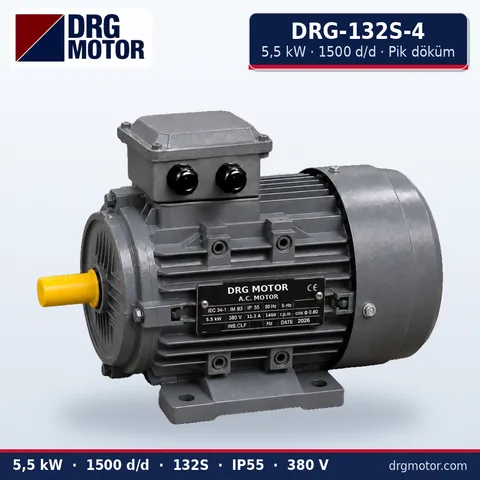
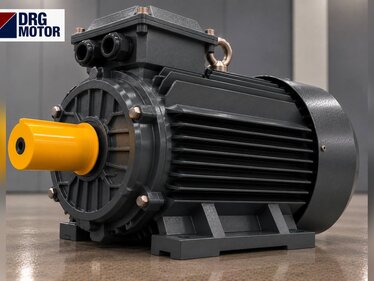
5.5 kW Three-Phase Motor 1500 rpm – DRG-132S-4 Cast Iron
- 5.5 kW · 1500 rpm (4 poles)
- Cast iron frame · IEC 132S
- Mounting: B3 · B5 · B14 · B35
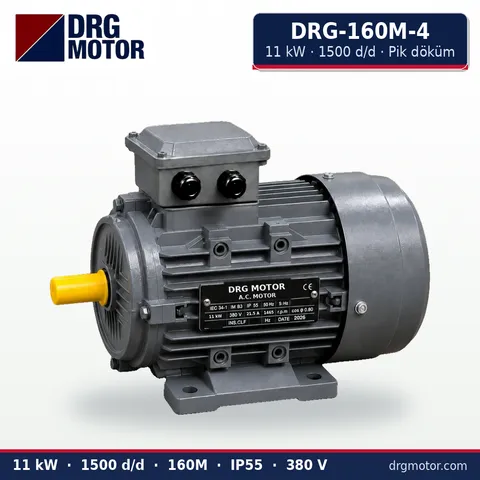
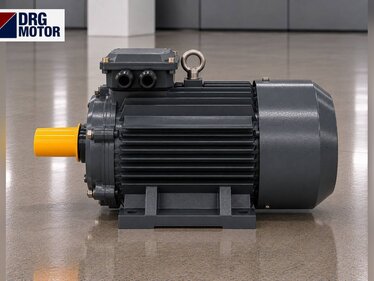
11 kW Three-Phase Motor 1500 rpm – DRG-160M-4 Cast Iron
- 11 kW · 1500 rpm (4 poles)
- Cast iron frame · IEC 160M
- Mounting: B3 · B5 · B14 · B35
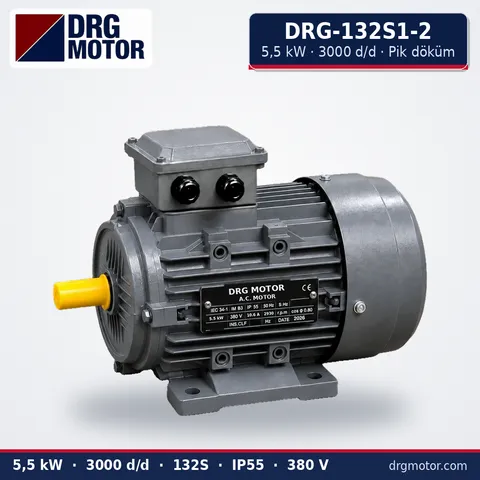
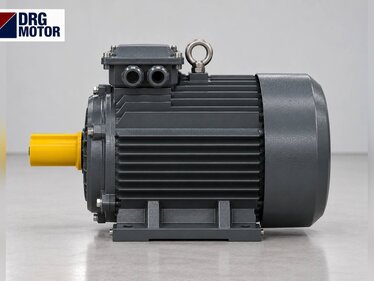
5.5 kW Three-Phase Motor 3000 rpm – DRG-132S1-2 Cast Iron
- 5.5 kW · 3000 rpm (2 poles)
- Cast iron frame · IEC 132S
- Mounting: B3 · B5 · B14 · B35
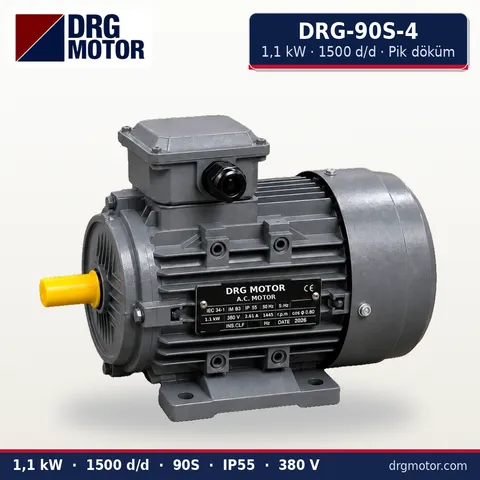
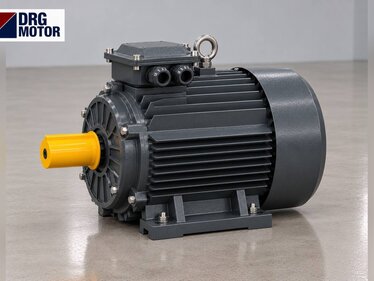
1.1 kW Three-Phase Motor 1500 rpm – DRG-90S-4 Cast Iron
- 1.1 kW · 1500 rpm (4 poles)
- Cast iron frame · IEC 90S
- Mounting: B3 · B5 · B14 · B35
Click to see current prices and order these motors nowSEE PRICES →
Paper Towel Rewinder Motor: Frequently Asked Questions
Can an induction motor replace the main motor of a toilet paper rewinder?
Not if the main winding head is servo driven; the drive and software are built around the servo motor. On older mechanical cam machines with an induction main motor, it can be replaced at the same power and speed.
What speed should a log saw motor have?
Blade diameter and the required cutting speed decide. Blade speeds of 600–1000 rpm with a 4-pole motor and belt are common; inverter frequency is raised as the blade wears.
How does paper dust affect the motor?
Dust clogs the fan cowl, the motor heats up and the build-up can ignite. Regular cleaning is required. In an explosive dust zone, a special Ex-protected motor is used instead of a standard one.
Which motors on a paper towel line can DRG cover?
The sections with standard induction motors: log saw, accumulator belt, tail sealer, dust extraction fan and older inverter-driven unwind or embossing drives.
When asking for a quote, photograph the failed motor's nameplate and note its kW and rpm, foot or flange mounting, shaft diameter and the line section it drives, then send these via WhatsApp, or add the models to the quote list. Phone +90 (542) 666 11 11 · e-mail info@drgmotor.com · contact. Other ratings are listed in our online shop.