English
 Le français
 Türkçe




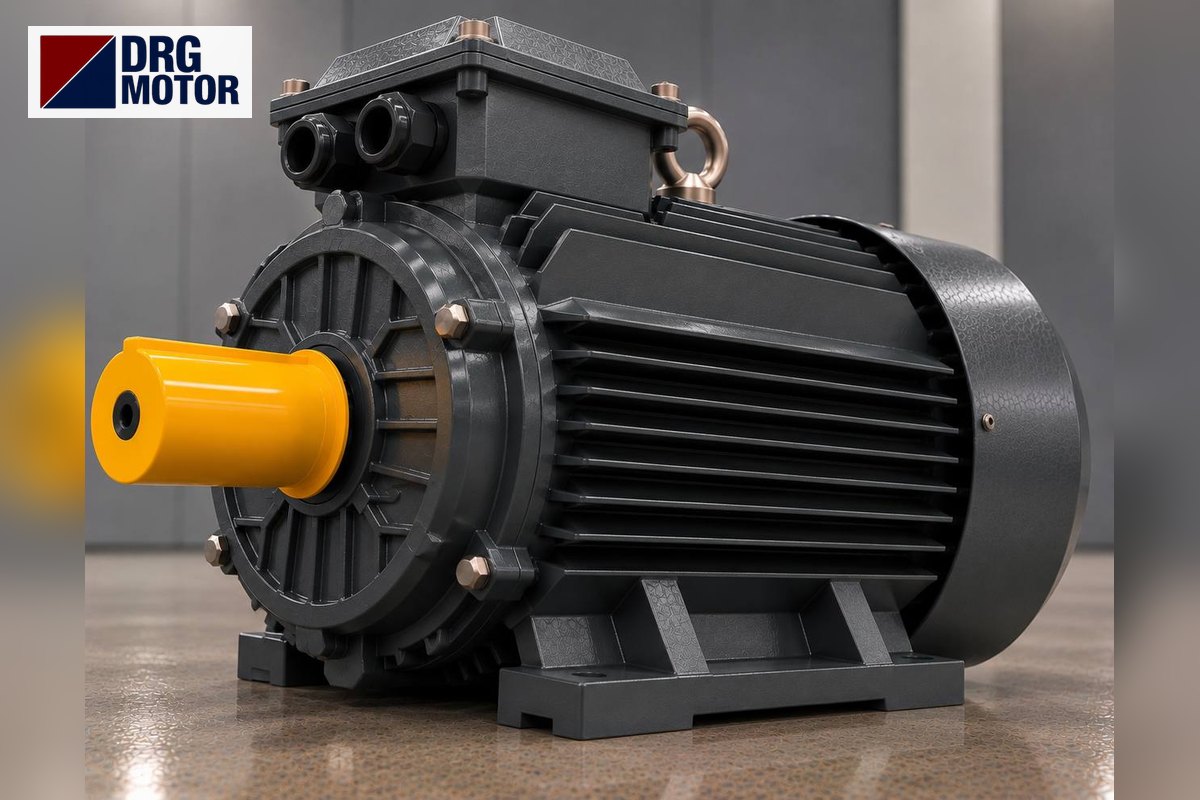

In a lime slaker, the electric motor turns the paddle shaft or screw that keeps quicklime (CaO) and water in contact. The reaction runs on its own and gives off heat; the motor's job is to keep the lime wetted, push the hot paste towards the outlet and separate coarse grit. What decides the motor is not power alone but the starting torque available at the gearbox output to move a paste-like mass.
DRG Motor is a manufacturer, supplier and seller of electric motors. The slaker body, paddle shaft and gearbox belong to the machine builder; DRG supplies the three-phase IEC asynchronous motor that connects to the gearbox input. All foot- and flange-mounted models are listed on the buy electric motors online page.
This article covers the slaking unit where lime meets water for the first time, not the agitator that keeps finished milk of lime in suspension. Crushing and grinding limestone is a very different load; see the hammer crusher motor page for that.
What Happens Inside the Slaker? Exothermic Reaction and Paste
The reaction CaO + H₂O → Ca(OH)₂ releases about 1.16 MJ of heat per kilogram. In a unit handling 1 tonne of quicklime per hour, this is a continuous heat source of roughly 320 kW. Part of the heat brings the water close to boiling, part leaves as steam through the vent and covers. The steam carries fine lime dust with it.
Depending on the water ratio, the product is either a thick paste or a fluid slurry. In a paste slaker the mass is dense and the paddles cut and knead it forward; in a slurry slaker the mix is wetter and the load smoother. In both cases the load seen by the motor can change within minutes with lime reactivity, particle size and water temperature.
Motor Load in Paste and Slurry Slakers
The difference between slaker types directly affects motor selection. The table below shows the general trend; exact power and speed are on the machine builder's nameplate and catalogue.
| Slaker type | Agitator design | Load character | Motor-side concern |
|---|---|---|---|
| Paste slaker | Twin horizontal paddle shafts | Dense, sticky, variable | High starting torque, overload set |
| Slurry slaker | Vertical or horizontal impeller | Smoother, fluid | Sealing against steam and dust |
| Ball mill slaker | Rotating drum, ball charge | High inertia, constant torque | Long run-up, starting current |
| Grit removal screw | Inclined screw, low speed | Jamming with sand and stones | Overcurrent protection on jam |
Small dosing units may use a few kW, while large paste slakers in water treatment and flue gas plants can reach tens of kW. This is only a general range; the value for your machine is on its nameplate.
Click to see current electric motor prices and order nowSEE PRICES →
Torque at the Gearbox Input: An Example
In a paste slaker the paddle shaft usually turns at a few tens of rpm. The calculation below is an example. Assumptions: 11 kW DRG-160M-4 (rated 1465 rpm, rated torque 71.7 Nm, Ts/Tn 2.2), paddle shaft speed 50 rpm, overall gearbox efficiency 0.95.
- Gear ratio: i = 1465 / 50 ≈ 29.3
- Rated torque at the shaft: 9550 · 11 / 50 · 0.95 ≈ 1996 Nm
- Torque at start: 2.2 × 71.7 ≈ 157.7 Nm at the motor shaft; about 4390 Nm reaches the paddle shaft
If paste that has cooled and hardened during a stop exceeds even this starting torque, the motor draws current without turning and the overload trips. Fitting a larger motor is often not the answer; the gearbox and paddles may not be designed for the extra load. You can test the ratio and output torque with your own values in the gearbox output speed and torque calculator.
Steam, Lime Dust and Heat: Where Should the Motor Sit?
Steam leaving the top cover and vent carries fine Ca(OH)₂ dust. When this dust meets moisture it leaves a crust that hardens on the motor fins and fan cowl. The crust blocks cooling air; IC411 motors cool by blowing air over the frame, so when the fins clog, winding temperature rises.
DRG motors come with IP55 protection and class F insulation and are rated for −15…+40 °C ambient. If the hot zone right above the slaker can exceed 40 °C, place the motor away from the steam outlet, preferably on the windward side, or drive the gearbox through a longer intermediate shaft. Adding periodic cleaning of the fan cowl and fins to the maintenance plan directly extends motor life.
Terminal box and cable glands
Alkaline dust combined with moisture can form a conductive layer. A sound terminal box gasket, tight cable glands and plugged unused entries matter for this reason. Turning the terminal box away from the steam outlet is a simple but effective measure.
Common Faults and the Effects of a Wrong Motor
The most common complaint with slaker motors is failure to restart after a power cut and frequent overload trips. The cause is usually the process rather than the motor: water stopping while lime feed continues, temperature running out of control, or sand and stones building up in the grit section. Still, these motor-side mistakes make things worse:
- Fitting a motor with fewer poles: with the same gearbox the paddle speed rises, the paste is pushed faster, wear and power demand increase.
- Undersized motor: it may run under normal load, but starting torque is not enough in hardened paste.
- Clogged fan cowl: a motor whose dust crust is not cleaned runs hot and its insulation ages early.
- Wrong terminal links: from 4 kW the DRG winding is 400/690 V; if the slaker panel supplies 400 V, the links go in the delta position.
The feed screw, grit screw and main agitator of a slaker may each have their own motor. When replacing, confirm from the nameplate which one has failed; the three usually differ in power and gear ratio.
Checklist Before Replacing the Motor
- Old motor nameplate: kW, rpm, voltage and connection
- Mounting: B3 foot, B5 flange on the gearbox, or B35
- Flange outer diameter, bolt circle and spigot diameter; shaft diameter, length and key
- Gear ratio and paddle shaft speed
- Slaker type (paste, slurry, ball mill) and hourly lime capacity
- Temperature where the motor sits and its distance from the steam outlet
- Starting method: direct, star-delta or soft starter
DRG Motors Suited to Lime Slaking Units
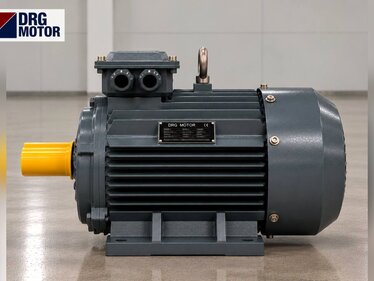
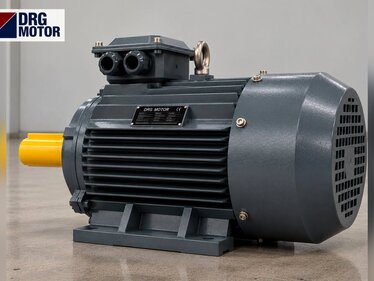
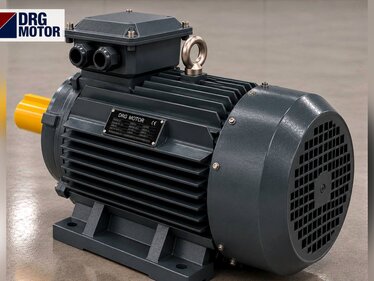
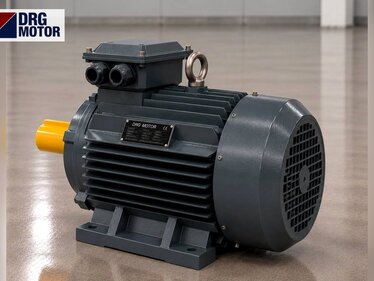
These are 4-pole motors that connect to a gearbox input; they cover the power range from small dosing slakers to medium paste units. On larger frames, cast iron offers a tougher outer surface in damp and dusty conditions.

4 kW Three-Phase Motor 1500 rpm – DRG-112M-4 Aluminium
- 4 kW · 1500 rpm (4 poles)
- Aluminium frame · IEC 112M
- Mounting: B3 · B5 · B14 · B35
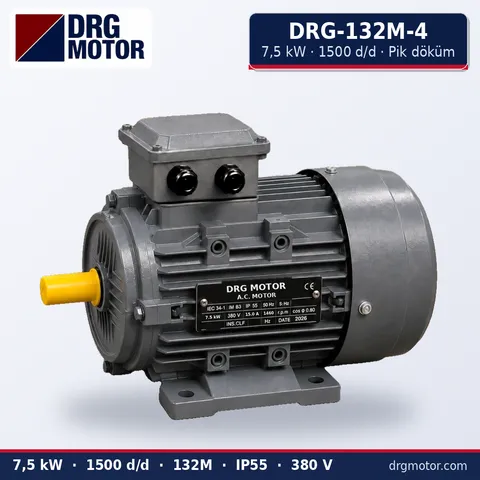
7.5 kW Three-Phase Motor 1500 rpm – DRG-132M-4 Cast Iron
- 7.5 kW · 1500 rpm (4 poles)
- Cast iron frame · IEC 132M
- Mounting: B3 · B5 · B14 · B35
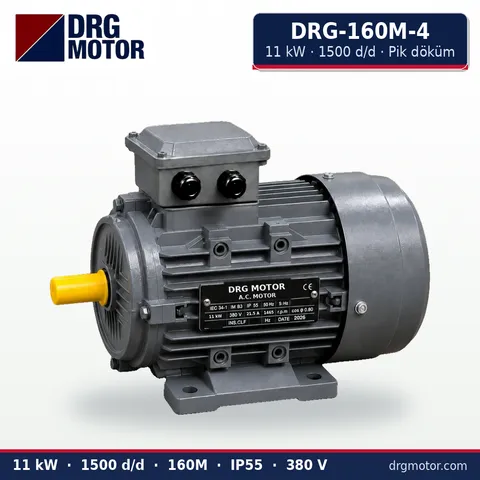
11 kW Three-Phase Motor 1500 rpm – DRG-160M-4 Cast Iron
- 11 kW · 1500 rpm (4 poles)
- Cast iron frame · IEC 160M
- Mounting: B3 · B5 · B14 · B35
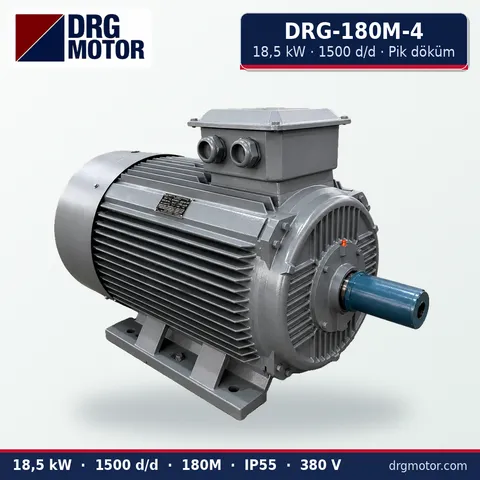
18.5 kW Three-Phase Motor 1500 rpm – DRG-180M-4 Cast Iron
- 18.5 kW · 1500 rpm (4 poles)
- Cast iron frame · IEC 180M
- Mounting: B3 · B5 · B14 · B35
Click to see current prices and order these motors nowSEE PRICES →
Lime Slaker Motor FAQ
Why does the lime slaker motor struggle at start-up?
During a stop the paste cools and hardens around the paddles. At start the motor must break this mass; if starting torque is not enough, it draws current without turning and the overload trips.
Should a slaker motor be 1500 rpm or 1000 rpm?
The gear ratio was chosen for the old motor's speed. Keep the same number of poles when replacing; a motor of different speed changes paddle speed and affects reaction time.
Is an inverter needed on a slaker?
Some plants use a drive to soften the start or to adjust paddle speed to lime quality. This is the machine builder's decision; DRG does not sell drives, it supplies the standard motor that runs on one.
Does lime dust damage the motor?
Dust alone does not enter an IP55 motor, but it forms a crust on the frame and fan cowl that spoils cooling. Regular cleaning and keeping the motor away from the steam outlet are sufficient measures.
For a quotation, send a photo of the slaker motor nameplate together with power, speed, mounting (foot or flange), shaft size and the machine type and capacity via WhatsApp, or build a quote list. Phone: +90 (542) 666 11 11 · e-mail: info@drgmotor.com · contact. For other motors that connect to gearboxes see electric motors for gearboxes, and for all models visit the online store.