English
 Le français
 Türkçe




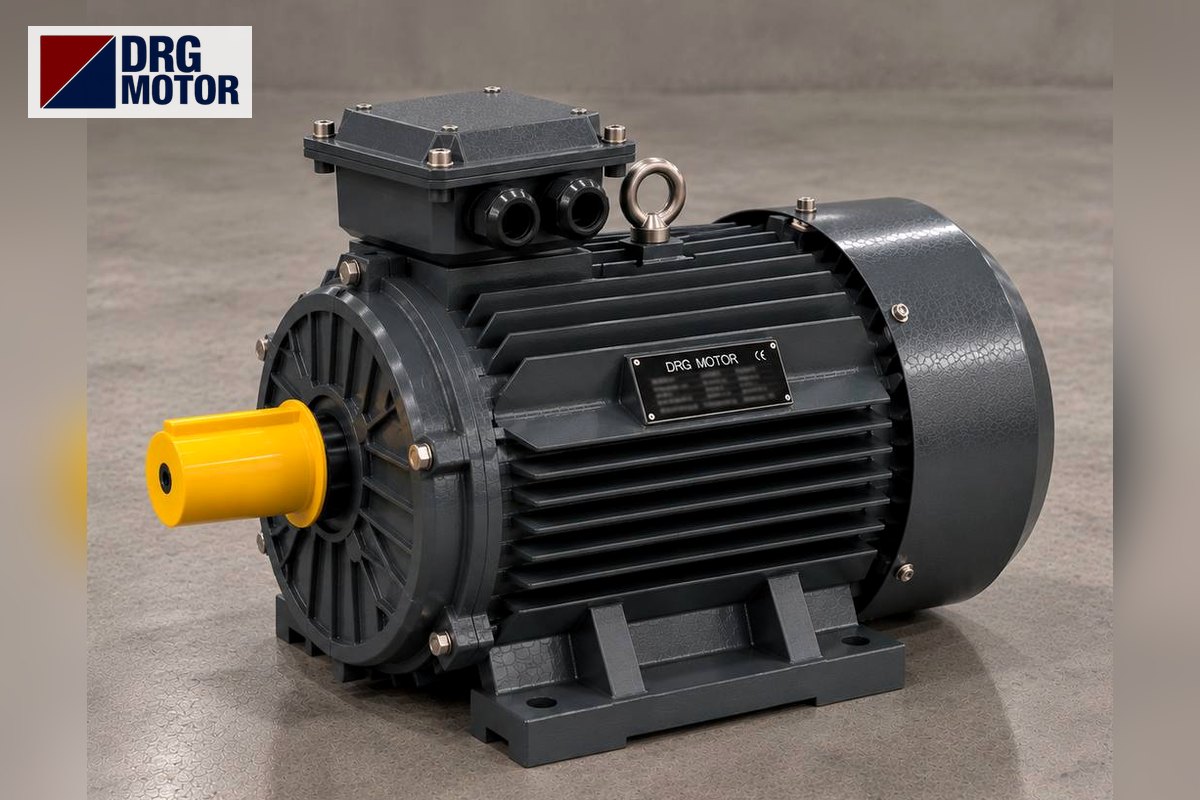

The most common reason a fan motor vibrates is an unbalanced rotating impeller: dirt stuck to the blades, a lost balance weight or a slightly bent impeller creates a force that repeats every revolution. Other sources are coupling/belt misalignment, worn bearings and loose mounting bolts. In a fan application the fix is to check blade balance and the air path first, then the drive connection and the bearings.
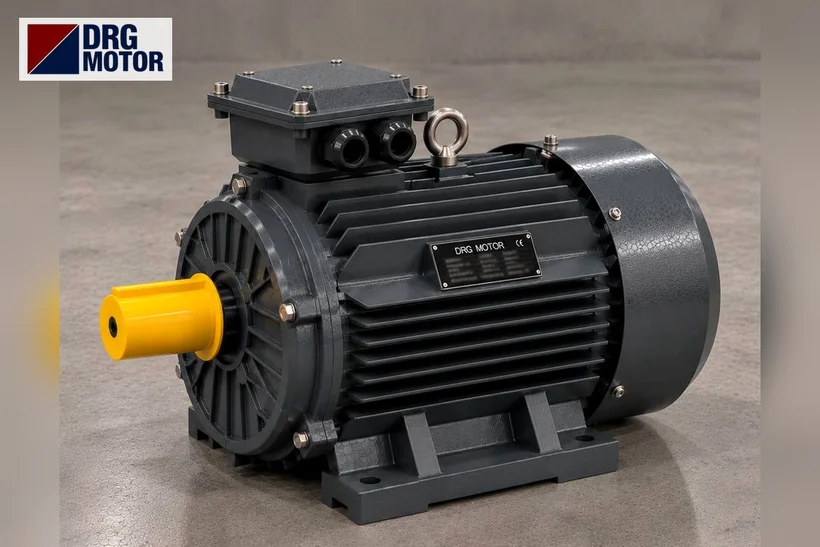
DRG Motor is a manufacturer, supplier and seller of electric motors. You can review three-phase models suited to your fan by power and speed in the online motor shop, and see the same motors together in the three-phase asynchronous electric motors category.
Why does fan vibration matter?
A fan is a rotating mass connected to the motor shaft directly or through a belt and pulley. If that mass does not run in balance, the unbalance force grows rapidly with speed, because centrifugal force is proportional to the square of the speed. A small unbalance at 3000 rpm becomes a far harsher vibration than the same value at 1000 rpm. That is why balance is far more critical on high-speed fans than on low-speed ones.
Continuous vibration is not just an annoying noise; it tires the bearings, the shaft seat and the mounting feet, and can start cracks at welds and bolt points. Finding fan vibration early and removing it at the source extends the life of both the motor and the connected duct/damper system.
Blade balance: the number-one cause of fan vibration
A fan impeller is balanced at the factory. Over time that balance is lost for several reasons:
- One-sided dirt build-up: dust, oil, soot or moisture stuck to one area of the blade makes that side heavier. This is the most common cause of unbalance in the field.
- Wear and corrosion: in air carrying abrasive dust the blade edges do not wear evenly, so one blade ends up with slightly different mass.
- Bending or impact: a blade slightly bent during maintenance or by a foreign object upsets both balance and airflow.
- Lost balance weight: on centrifugal fans, a small balance clip falling off a blade causes a sudden, clear vibration.
The first step is to clean the impeller thoroughly; most fan vibration drops noticeably once the built-up dirt is removed. If vibration remains after cleaning, check the blade visually for straightness; if there is bending or a crack, the impeller must be balanced or renewed. Precision balancing is done in a properly equipped workshop.
Vibration from airflow and operating point
Not every vibration is mechanical; sometimes the fan is stressed at the wrong operating point. A damper too far closed on the inlet or outlet, a clogged filter or a narrowed duct can push the fan into an unstable region (stall, especially on centrifugal fans). The vibration and noise then fluctuate with airflow. Making sure ducts, louvres and filters are open and clean is an easy step to take before touching the mechanical parts.
Click to see current electric motor prices and order nowSEE PRICES →
Coupling, belt/pulley and mounting
On directly coupled fans the motor shaft and the fan shaft must share the same axis. Coupling misalignment (axial, angular or parallel) produces a once-per-revolution vibration and tires the bearings fast. On belt-driven fans, pulleys out of the same plane, a worn/cracked belt or wrong belt tension are the sources: a belt too loose slips and flaps, a belt too tight overloads the bearings.
On the mounting side, loose foot bolts, a base that does not sit flat (feet not fully in contact, "soft foot") and tired vibration mounts turn even a small unbalance into large vibration. Bolting the motor to a rigid, flat base with all feet in equal contact is a basic requirement.
Vibration from bearings
A bearing with grown clearance or damaged ball/race surfaces produces vibration and a characteristic noise on its own. In continuously running applications such as fans the bearing load is high; dried grease, moisture and dust shorten bearing life. If you feel roughness, catching or radial play when you turn the shaft by hand, a bearing is the likely suspect. Because replacement needs a proper puller and press, it is best left to a qualified workshop.
Choosing the right three-phase motor for a fan
If you decide to renew the motor while fixing vibration, or you are building a new fan, power and speed selection matters. Since the power a fan draws rises steeply with speed, choosing the wrong speed causes both inefficiency and stress. For most ventilation fans a balanced choice is the 1500 rpm (4-pole) class. The table below shows aluminium-frame DRG examples from this class; each code links to its product page. The voltage on all of them is 230/400 V (Δ/Y).
| Model | Power | Nameplate speed | Rated current (400 V) |
|---|---|---|---|
| DRG-90L-4 | 1.5 kW | 1445 rpm | 3.3 A |
| DRG-100L1-4 | 2.2 kW | 1450 rpm | 4.52 A |
| DRG-100L2-4 | 3 kW | 1450 rpm | 6.02 A |
The motor power needed depends on the fan curve and operating point; replacing a fan motor with a more powerful model does not reduce vibration, as the real cause is on the blade/connection side. For power and current you can use the electric motor calculator and the motor current chart.
Because a fan motor is usually selected by pulley or impeller hub against the shaft, when replacing it compare not only power but also shaft diameter and mounting type (B3 foot, B5/B14 flange). For dimension comparison the shaft diameter, key and coupling standards article is a good guide.
Check order to reduce fan vibration
- Switch off the supply and clean the impeller; stuck dirt is the most common cause of unbalance.
- Check the blade visually for bending, cracks or a missing balance weight.
- Keep the air path (filter, damper, duct) open and clean; do not run the fan at an unstable point.
- Check coupling/belt alignment and belt tension.
- Inspect the mounting feet, base contact and vibration mounts.
- Turn the shaft by hand to assess bearing clearance and noise.
Following these steps in order usually narrows down the source of vibration without needing a special measuring instrument.
Safety note
Before any check on the fan and motor, switch off the supply, confirm it is de-energised and make sure the impeller has come to a complete stop. A rotating blade and a freely spinning impeller are a serious injury hazard. Let only qualified electrical and maintenance personnel carry out work such as electrical connection, coupling alignment and bearing replacement. Set values such as the thermal protection current not from memory but from the rated current on the motor nameplate.
Send a photo of your current motor nameplate and we will find the suitable DRG model together.Send on WhatsApp
Click to see current prices of three-phase motors in the right power and speed for your fanSEE PRICES
Frequently asked questions
My fan motor vibrates — what should I check first?
First switch off the supply and clean the impeller. One-sided dirt on the blades is the most common cause of unbalance in the field, and cleaning often reduces vibration noticeably. Then check the blade for bending/cracks, followed by the connection and the bearings.
Will a more powerful motor stop the vibration?
No. The source of fan vibration is usually blade balance, alignment or mounting; increasing power does not remove these causes. You need to find the source of the vibration first.
Why is vibration harsher on a high-speed fan?
The force from unbalance rises with the square of the speed. So the same unbalance on a 3000 rpm fan creates far harsher vibration than on a 1000 rpm fan; balance is more critical on high-speed fans.
Can I balance the impeller myself?
Cleaning and visual checks can be done in the field; but precision balancing is a job for a properly equipped workshop. Weight added incorrectly can increase the unbalance.
Electric Motors Related to This Topic — Models and Current Prices
Suitability is not decided by power alone: compare the speed, voltage, mounting, shaft and fixing dimensions of your machine with the product data; if unsure, send us the nameplate of your current motor.
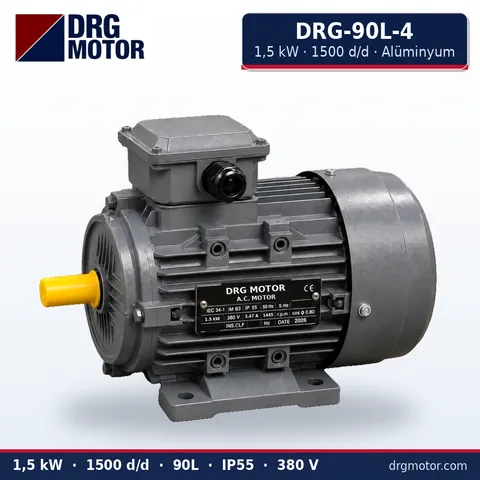
1.5 kW Three-Phase Motor 1500 rpm – DRG-90L-4 Aluminium
- 1.5 kW · 1500 rpm (4 poles)
- Aluminium frame · IEC 90L
- Shaft: 24 × 50 mm
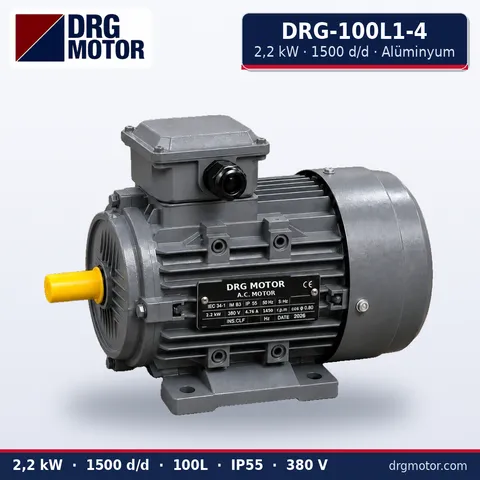
2.2 kW Three-Phase Motor 1500 rpm – DRG-100L1-4 Aluminium
- 2.2 kW · 1500 rpm (4 poles)
- Aluminium frame · IEC 100L
- Shaft: 28 × 60 mm
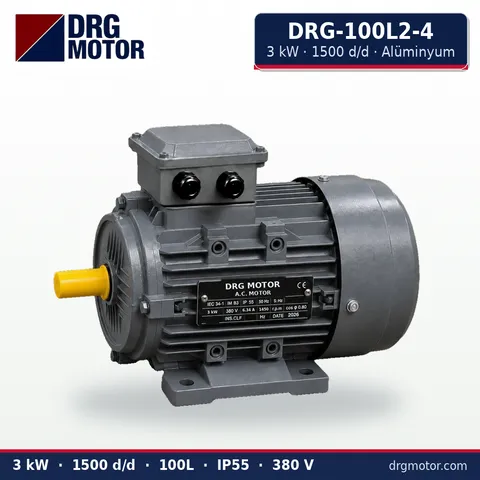
3 kW Three-Phase Motor 1500 rpm – DRG-100L2-4 Aluminium
- 3 kW · 1500 rpm (4 poles)
- Aluminium frame · IEC 100L
- Shaft: 28 × 60 mm
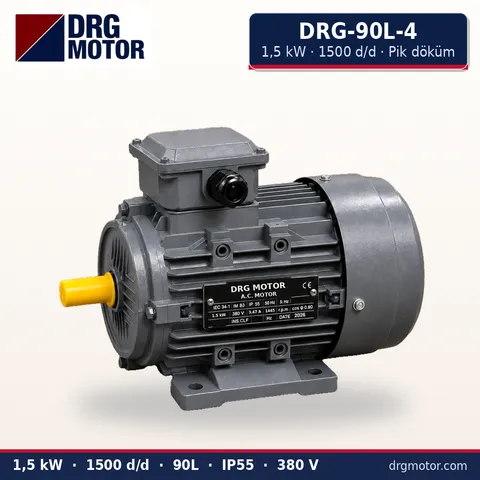
1.5 kW Three-Phase Motor 1500 rpm – DRG-90L-4 Cast Iron
- 1.5 kW · 1500 rpm (4 poles)
- Cast iron frame · IEC 90L
- Shaft: 24 × 50 mm
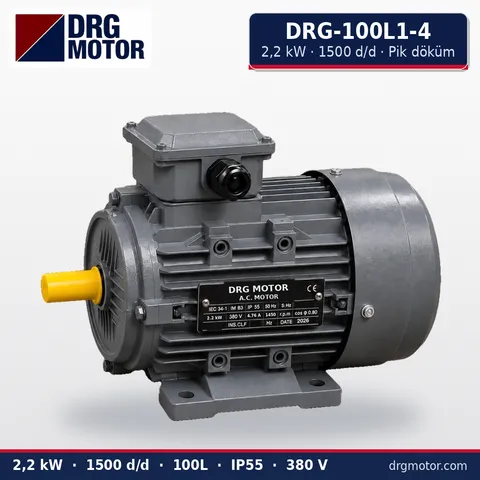
2.2 kW Three-Phase Motor 1500 rpm – DRG-100L1-4 Cast Iron
- 2.2 kW · 1500 rpm (4 poles)
- Cast iron frame · IEC 100L
- Shaft: 28 × 60 mm
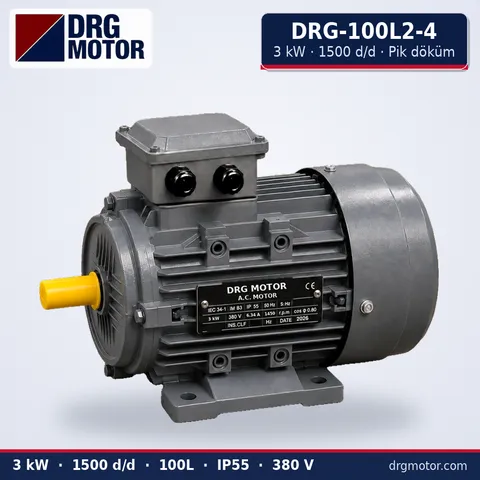
3 kW Three-Phase Motor 1500 rpm – DRG-100L2-4 Cast Iron
- 3 kW · 1500 rpm (4 poles)
- Cast iron frame · IEC 100L
- Shaft: 28 × 60 mm