English
 Le français
 Türkçe




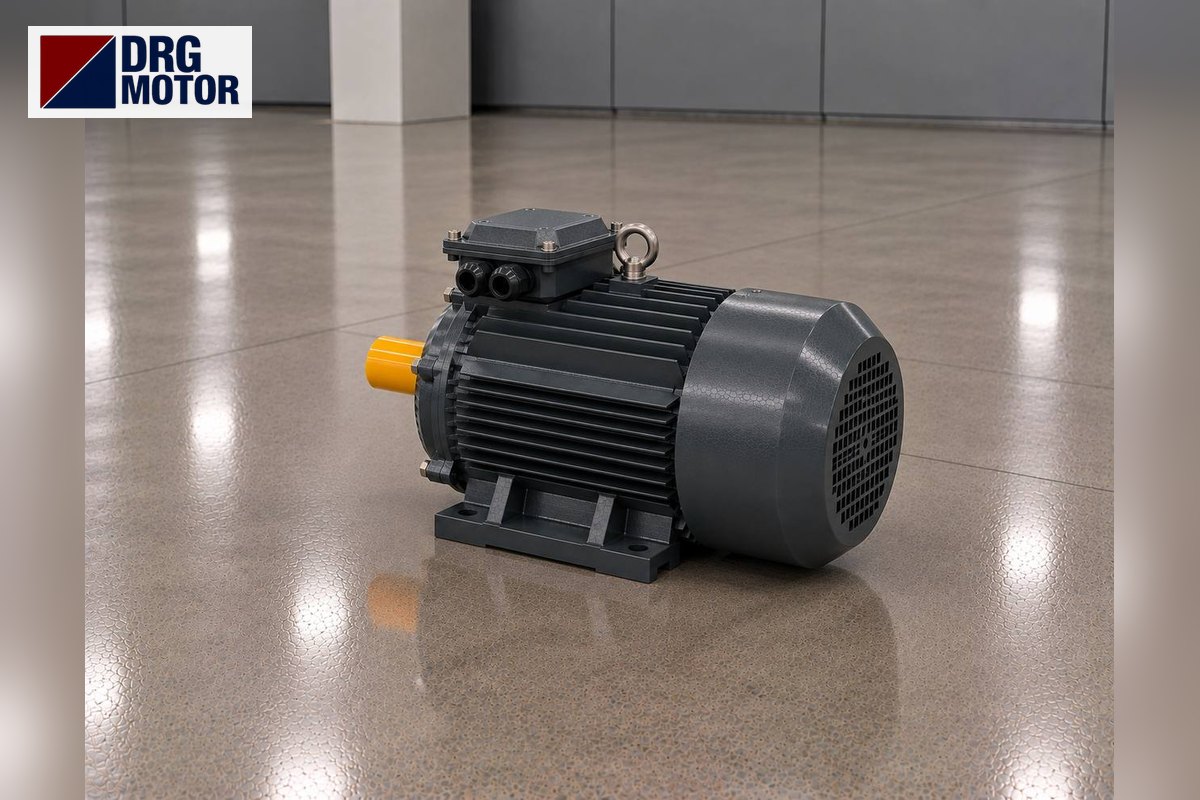

The motors on a fabric opening machine do no heavy work; they turn the rollers, the rotating detwister and the plaiter that bring fabric arriving from dyeing in wet, twisted rope form back to open width. They are mostly small 4-pole, inverter-driven three-phase motors; on narrow workshop lines they can be a fraction of a kilowatt, on wide lines a few kilowatts, and the exact value is on the machine nameplate. What decides the selection is not power but tying the motor correctly to line speed and protecting it in a wet environment.
You can see all the small 4-pole models on our buy electric motors online page. Below we explain which motor does what at each point of the opening line, how speed synchronisation is set up, and what to check when replacing.
Where the Motors Work on an Open-Width Line
On a rope opening and open-width line, the fabric is first taken from a bin or trolley by a draw roller. The rope is usually twisted about its own axis; a rotating opener (detwister) undoes this twist. The rotating head is controlled by a photocell or a mechanical sensor and turns the motor left or right according to the direction of the twist. Spiral opening rollers then spread the fabric edges outward, and the fabric is fed with an even width to the next machine, such as a squeezer, a sanforising range or a stenter.
Each unit has a different load. The draw roller is a constant-torque load that turns steadily. The detwister reverses often and makes short start–stop cycles. The spiral openers are light but must be adjusted to fabric speed.
| Unit | Duty | Load type | Control |
|---|---|---|---|
| Draw roller | Pulls fabric from the bin | Constant torque | Inverter, speed ratio |
| Detwister | Undoes the rope twist | Frequent reversal | Sensor + inverter |
| Spiral opener | Spreads the edges | Light, constant torque | Follows fabric speed |
| Plaiter / exit | Lays fabric on a trolley | Reciprocating motion | Synced to line speed |
The duties in the table describe a general line; the number and order of units on your machine may differ according to the maker's drawing. Motor power also depends on fabric type and line speed; the exact value is the motor nameplate.
Click to see current electric motor prices and order nowSEE PRICES →
Speed Synchronisation: Overfeed and Dancer
An opening line does not work alone; it follows the speed of the machine behind it. The opening unit delivers slightly more fabric than the input speed of the next machine; this is called overfeed. The extra length lets knitted fabric open without being stretched or narrowed. When the main machine changes speed, the opening unit must change in the same ratio.
There are two ways to do this. In the first, the opening unit's inverter takes an analogue speed signal from the main machine and adds a fixed ratio to it. In the second, the fabric passes over a dancer arm whose position continuously corrects the inverter speed. A dancer system adapts better to the fabric stretching and relaxing.
Example: draw roller speed and frequency
The values below are assumptions. Let the next machine run at 40 m/min with an overfeed of 3 percent: the opening unit must deliver 40 × 1.03 = 41.2 m/min. With a 160 mm draw roller, roller speed is 41.2 / (π × 0.16) ≈ 82 rpm.
With a DRG-801-4 motor (0.55 kW, 1400 rpm) and a gearbox ratio of 15, the roller turns at about 93.3 rpm at 50 Hz and fabric speed is about 46.9 m/min. For 41.2 m/min the inverter supplies about 43.9 Hz. If line speed varies between 10 and 60 m/min, frequency ranges from about 10.7 to 63.9 Hz.
Above 50 Hz the motor enters the field-weakening region and the torque it can deliver drops. Since the load on an opening unit is small, this is usually not a problem: assuming a pulling force of 120 N at the roller, roller torque is 9.6 N·m, and with a worm gearbox efficiency of 0.7 about 0.91 N·m is needed at the motor shaft. The rated torque of the DRG-801-4 is 3.75 N·m. Even so, choosing the gearbox ratio so that the motor stays near 50 Hz at top speed gives smoother running.
Reversing the Detwister
The detwister motor can change direction within seconds according to the sensor signal. On a three-phase induction motor, direction changes by swapping two phases or by the inverter's direction command. Direct reversal with contactors draws a high starting current every time; on a detwister that reverses often, the inverter's ramped reversal protects both motor and gearbox.
On this unit, motor heating depends more on the number of starts than on the load. If the number of reversals per hour is high, the inverter ramp time should be lengthened and the motor chosen one size larger. The small motors in the box have a starting current ratio Is/In between 5.2 and 6.8; with an inverter this current peak does not occur.
Wet Fabric, Water and Motor Protection
Fabric coming out of dyeing is soaking wet; water drips from the rollers, the bin and the opener head. Motors usually sit low on the machine frame or beside the gearbox, at a point where water splashes. The IP55 housing of DRG motors protects against splashing water, but water running continuously over the motor or the motor standing in water is outside that protection.
When replacing, check the following: the cable entry of the terminal box should face downward and the cable gland should be tight and of the correct size. If water drips onto the motor, a simple drip shield should be fitted. During line cleaning, pressurised water should not be aimed directly at the motor. In an environment with dye chemicals and bleaching agents, the paint and housing surface should be checked regularly.
Small Motors Fitted to Worm Gearboxes
On opening units most motors are fitted to a worm or helical gearbox with a B5 flange. DRG does not sell gearboxes; it supplies the motor that fits the gearbox. The catalogue B5 dimensions for frame 80 motors are:
- Frame: 80, aluminium, IP55, class F insulation
- B5 flange: M = 165 mm, N = 130 mm, P = 200 mm, S = 12 mm
- Shaft (D × E): 19 × 40 mm, key 6 mm
- Voltage: 230/400 V (Δ/Y)
Moving from frame 71 to frame 80 changes the flange size and shaft diameter (frame 71 has a 14 × 30 mm shaft); the gearbox input adapter must be chosen accordingly. You can find this dimensional matching, common on small gearboxes, in detail on our electric motors for worm gearboxes page.
Before Replacing an Opening Unit Motor
- Which unit the motor drives: draw roller, detwister, spiral opener or plaiter.
- Old motor nameplate: kW, rpm, voltage and connection (Δ/Y).
- Gearbox type and ratio, input flange (M, N, P) and shaft bore diameter.
- Line speed range (m/min) and overfeed setting.
- Inverter frequency range; on the detwister, how often it reverses.
- Motor position: does water drip on it, which way does the cable entry face?
DRG Motors Suited to Fabric Opening Units
Small 4-pole aluminium-housing models from 0.25 to 1.1 kW for draw rollers, detwisters and spiral openers; they fit a gearbox with a B5 flange and can be inverter-driven.
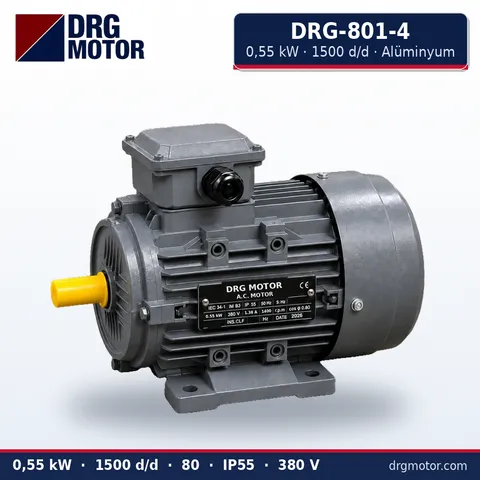
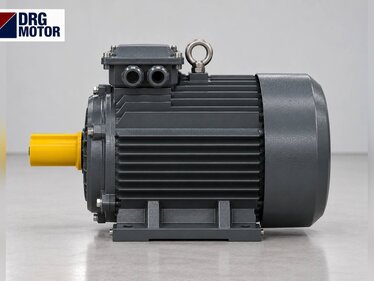
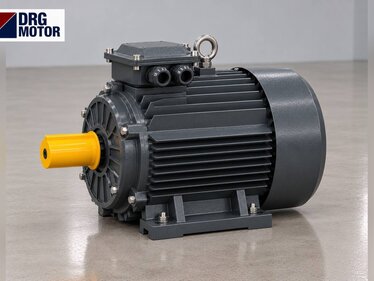
0.55 kW Three-Phase Motor 1500 rpm – DRG-801-4 Aluminium
- 0.55 kW · 1500 rpm (4 poles)
- Aluminium frame · IEC 80
- Mounting: B3 · B5 · B14 · B35
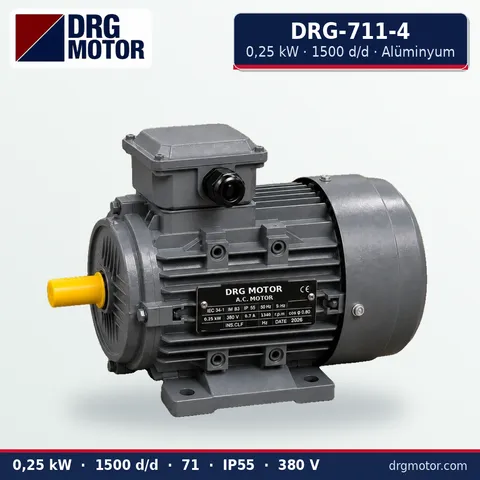
0.25 kW Three-Phase Motor 1500 rpm – DRG-711-4 Aluminium
- 0.25 kW · 1500 rpm (4 poles)
- Aluminium frame · IEC 71
- Mounting: B3 · B5 · B14 · B35
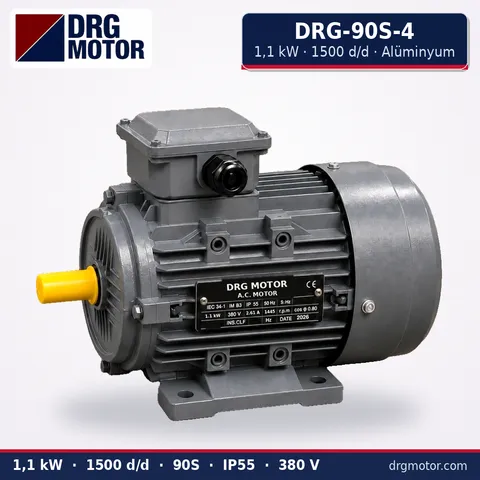
1.1 kW Three-Phase Motor 1500 rpm – DRG-90S-4 Aluminium
- 1.1 kW · 1500 rpm (4 poles)
- Aluminium frame · IEC 90S
- Mounting: B3 · B5 · B14 · B35
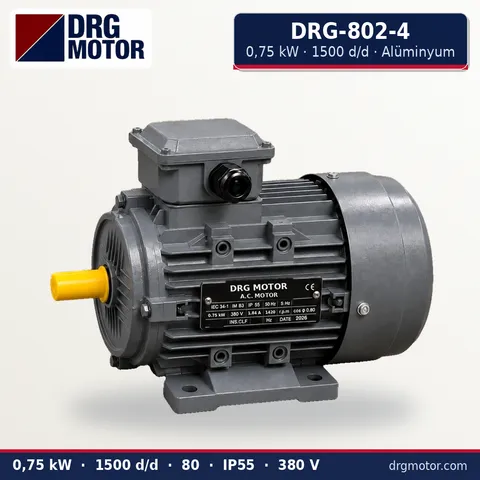
0.75 kW Three-Phase Motor 1500 rpm – DRG-802-4 Aluminium
- 0.75 kW · 1500 rpm (4 poles)
- Aluminium frame · IEC 80
- Mounting: B3 · B5 · B14 · B35
Click to see current prices and order these motors nowSEE PRICES →
Fabric Opening Machine Motor: Frequently Asked Questions
How do I match the opening machine to the stenter speed?
Connect the stenter's speed signal to the opening unit's inverter and add the overfeed ratio on top, or put a dancer in between. This is a matter of inverter setup, not of the motor; the motor only needs to deliver its torque over the required frequency range.
Why does the detwister motor burn out often?
Usually because of many direct contactor reversals per hour or water running over the motor. Ramped reversal with an inverter and the sealing of the terminal box are the first two points to check.
Can a 6-pole motor be used on this machine?
Yes; it turns slower for the same power and the gearbox ratio gets smaller. When replacing, either the gearbox ratio changes or the inverter frequency is reset so that roller speed stays the same. Flange and shaft dimensions must also be checked again.
To choose the right motor together, send a photo of the old motor's nameplate, its power, speed, mounting (foot/flange), shaft size and gearbox details to our WhatsApp line, or build a quote list. You can reach us by phone on +90 (542) 666 11 11, at info@drgmotor.com or through the contact form. DRG Motor is a manufacturer, supplier and seller of electric motors; all options, including the small ratings, are on our store page.