English
 Le français
 Türkçe




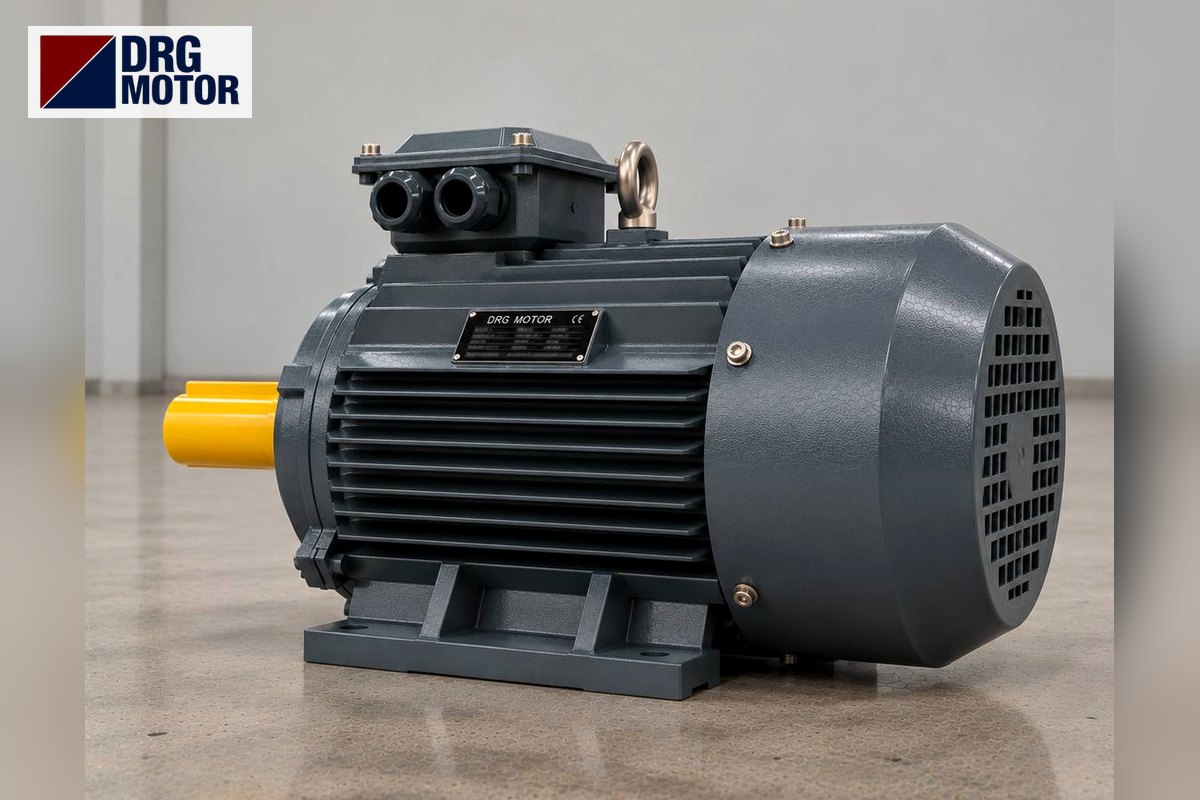

A motor winding burns out when the heat produced by the current it draws exceeds the limit the wire insulation can withstand. The most common causes are overload, phase loss, low or unbalanced voltage, moisture and very frequent start-stop. The symptoms are usually a sharp burnt smell, unequal winding resistances between phases, and a drop in the insulation resistance between winding and frame (earth leakage). This article explains why windings burn in three-phase asynchronous motors, how to recognise it, and how to decide between rewinding and a new motor.
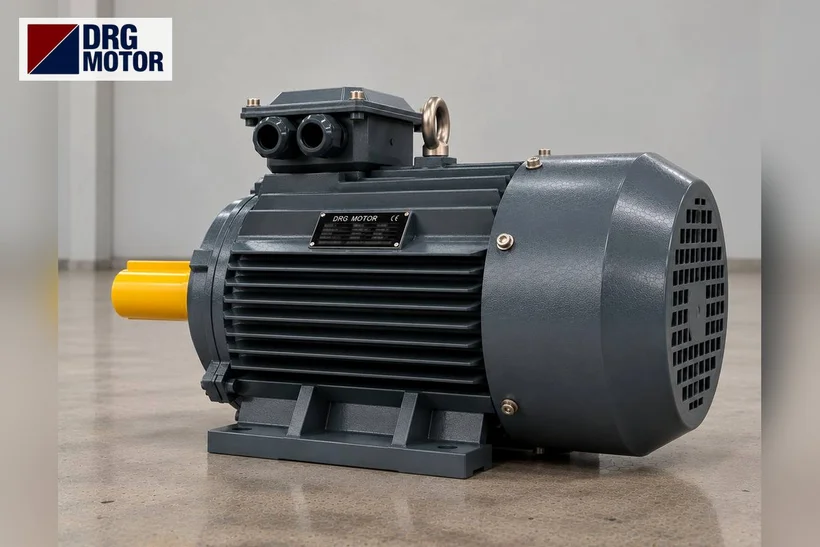
DRG Motor is a manufacturer, supplier and seller of electric motors. You can review suitable three-phase models by power and speed in the online motor shop, and see the same motors together in the three-phase asynchronous electric motors category.
What does a burnt winding mean?
The windings in an asynchronous motor stator are wound from copper wire insulated with enamel (varnish). This insulation withstands heat up to a certain temperature; once that limit is exceeded, the varnish chars, carbonises and loses its insulating property. After that, electrical contact forms between adjacent turns (a turn-to-turn short) or between the winding and the frame (earth leakage). What people call a "burnt-out motor" is usually exactly this: not a mechanical break but the thermal breakdown of the winding insulation.
The key distinction is this: a healthy motor warms up under load but does not exceed the insulation limit. Burning happens when that limit is crossed, briefly or for a long time. So the answer to "why did it burn?" almost always lies in an external condition that overheated the winding.
What symptoms appear when a winding burns?
A burnt or nearly-burnt winding usually shows more than one symptom. The table below summarises the signs most often seen in the field and their possible meaning; a firm diagnosis needs measurement.
| Symptom | Possible meaning |
|---|---|
| Sharp burnt / varnish smell | The winding insulation has overheated and charred |
| Unequal winding resistance between phases | Turn-to-turn short, one winding damaged |
| Low insulation resistance between winding and frame | Earth leakage, insulation breakdown |
| Fuse / protection trips as soon as it starts | Short in the winding or a solid earth contact |
| Labouring rotation, loss of power and torque | Phase loss or a partly damaged winding |
Even one of these signs calls for stopping the motor without forcing it. In particular, a sharp burnt smell and protection tripping on every start point to advanced winding damage.
Why does an electric motor winding burn?
Behind a burnt winding there is almost always a current or environmental condition that pushes the winding above its insulation limit. The most common causes and their first signs are summarised below.
| Cause of burning | What happens in the winding | First sign |
|---|---|---|
| Overload | Current above the rated value heats the wire, the insulation chars | Running current above the nameplate value |
| Phase loss (single-phasing) | The two remaining phases overload and those windings heat quickly | Labouring, humming motor that stalls with a smell |
| Low or unbalanced voltage | Current rises for the same power, one phase heats more than the others | Voltage difference between phases, weak torque |
| Moisture and condensation | Insulation resistance drops, earth leakage and tracking begin | Residual-current device tripping after a long stop |
| Frequent start-stop | The high current of each start builds up, the winding cannot cool | Many switch-ons per minute |
Click to see current electric motor prices and order nowSEE PRICES →
Phase loss and voltage problems
If one of the phases of a three-phase motor is broken, or only one fuse blows, the motor is left "single-phasing". The two remaining phases then try to carry the load of the missing phase as well, and the current through those windings rises quickly to a dangerous level. The motor often keeps turning but hums, labours and soon burns those windings. Similarly, a voltage difference between phases (imbalance) heats one winding more than the others. To assess the supply voltage and cabling, use the motor current chart and the motor cable size calculator.
Moisture, condensation and earth leakage
Motors that stand idle for a long time in cold, damp places can form condensation on the winding surface. Moisture lowers the insulation resistance; first a small earth leakage, then surface tracking, and finally insulation breakdown follow. In dusty or conductive-dirty environments this process is faster. This is why DRG three-phase motors have IP55 protection and, with proper mounting, are protected against dust and water ingress; even so, long idle periods and very damp places are a risk for the winding. Energising a damp motor without measuring and drying it can break down the weakened insulation instantly.
Overload and frequent start-stop
When the motor is asked for more than its rated power the current rises, and heat builds up in the winding in proportion to the square of the current. A motor chosen too small from the start, a jamming load or a seized transmission keeps the winding permanently near its limit. Frequent start-stop is a separate risk: at every start the motor draws several times its rated current, and a motor that switches on many times a minute never gets time to cool. Together these two causes can, over time, burn a motor that appears to run "without any problem".
What to do with a motor that has a burnt winding?
Safety first. If there is a burnt smell, smoke or protection tripping, do not try to run the motor; switch off the power and confirm it is de-energised. Measurements of winding resistance, insulation resistance and earth leakage, and checking the terminal connections, must be carried out by qualified electrical personnel. Do not memorise a general figure for the valid insulation-resistance threshold or the overload current setting; evaluate them according to the motor nameplate and the measuring device documentation. The diagnosis should reveal not only that the winding burned, but also the root cause that burned it (phase loss, overload, moisture, voltage); otherwise the same problem will recur.
Rewind or a new motor?
A burnt winding can be repaired by rewinding; this is a common route, especially for large and special motors. The decision depends on the application and the motor, and there is no single right answer. In general, rewinding can make sense when the motor is high-power, of special dimensions or hard to find, and the root cause has been removed. On the other hand, when the motor is small or medium power, a standard IEC frame, has been rewound several times, or the root cause of the fault is unclear, a standard new motor with the correct power and speed is often a more predictable solution. When choosing a new motor, it is healthiest to establish the real power and speed demand of the application and pick a model that matches it with a small margin. You can review suitable models by power and speed in the online motor shop.
1500 rpm three-phase DRG models
The table below lists the 4-pole (1500 rpm class) aluminium-frame DRG models commonly used in the medium-power range. The model codes link straight to the product page; the voltage on all of them is 400/690 V (Δ/Y). The rated current is given so you can compare it with the running current you measure.
| Model | Power | Rated speed | Rated current (400 V) |
|---|---|---|---|
| DRG-112M-4-AL | 4 kW | 1450 rpm | 7.95 A |
| DRG-132S-4-AL | 5.5 kW | 1460 rpm | 10.7 A |
| DRG-112M-4K-AL | 5.5 kW | 1460 rpm | 10.7 A |
| DRG-132M-4-AL | 7.5 kW | 1460 rpm | 14.3 A |
| DRG-160M-4-AL | 11 kW | 1465 rpm | 20.4 A |
| DRG-132M-4K-AL | 11 kW | 1465 rpm | 20.4 A |
See current prices to choose a correctly sized three-phase model to replace a motor with a burnt windingSEE PRICES
Send a photo of your current motor nameplate and we will find the suitable DRG model together.Send on WhatsApp
Frequently asked questions
There is a burnt smell but the motor still turns; can I keep running it?
No. A burnt smell is a sign that the winding insulation has started to char; the damage progresses even if the motor still turns. Stop the motor, switch off the power and have qualified personnel take measurements.
Does single-phasing really burn the winding?
Yes. In phase loss the two remaining phases overload and the current through those windings quickly reaches a dangerous level. A phase-protection relay reduces this risk, but the root cause (a broken phase, a blown fuse) must still be removed.
Is it more sensible to rewind a burnt motor or buy a new one?
That depends on the motor's power and type and on whether the root cause has been removed. Rewinding is often preferred for large and special motors; for small or medium-power standard IEC motors, a new motor with the correct power and speed is usually more predictable.
Can I run a motor that has stood idle for a long time straight away?
A motor left for a long time in a damp place may have a reduced insulation resistance. Having the insulation resistance measured by qualified personnel before energising, and drying the motor if needed, prevents the weakened insulation from breaking down.
Electric Motors Related to This Topic — Models and Current Prices
Suitability is not decided by power alone: compare the speed, voltage, mounting, shaft and fixing dimensions of your machine with the product data; if unsure, send us the nameplate of your current motor.
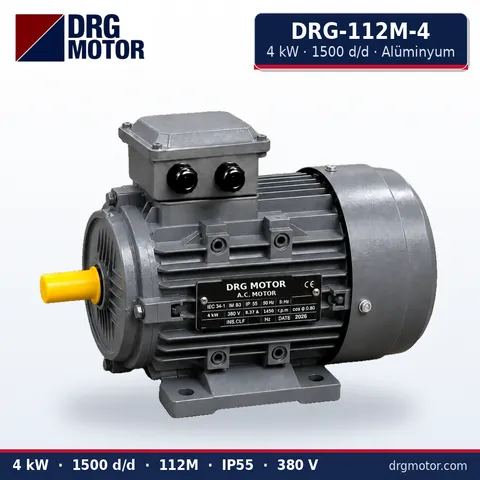
4 kW Three-Phase Motor 1500 rpm – DRG-112M-4 Aluminium
- 4 kW · 1500 rpm (4 poles)
- Aluminium frame · IEC 112M
- Shaft: 28 × 60 mm
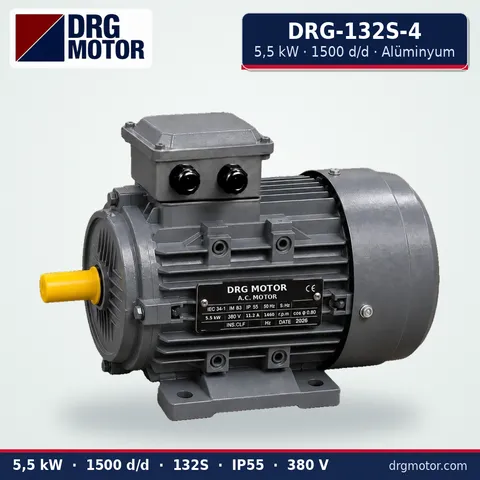
5.5 kW Three-Phase Motor 1500 rpm – DRG-132S-4 Aluminium
- 5.5 kW · 1500 rpm (4 poles)
- Aluminium frame · IEC 132S
- Shaft: 38 × 80 mm
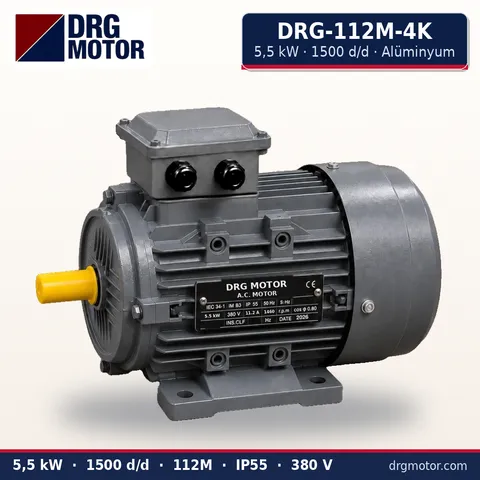
5.5 kW Compact Three-Phase Motor 1500 rpm – DRG-112M-4K Aluminium
- 5.5 kW · 1500 rpm (4 poles)
- Aluminium frame · IEC 112M
- Shaft: 28 × 60 mm
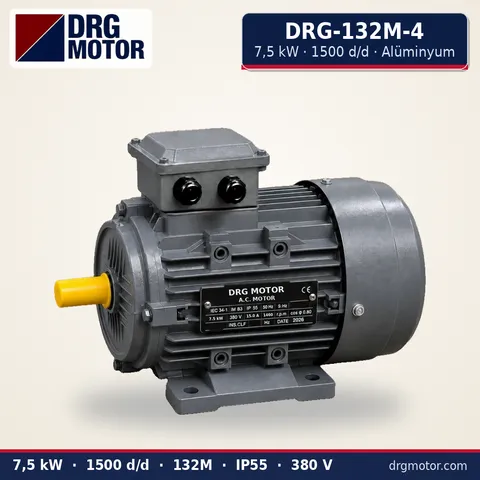
7.5 kW Three-Phase Motor 1500 rpm – DRG-132M-4 Aluminium
- 7.5 kW · 1500 rpm (4 poles)
- Aluminium frame · IEC 132M
- Shaft: 38 × 80 mm
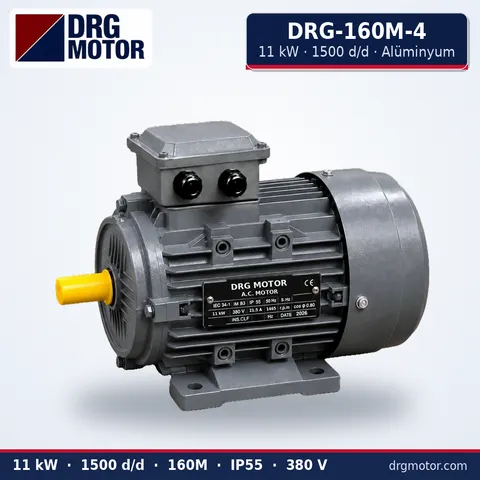
11 kW Three-Phase Motor 1500 rpm – DRG-160M-4 Aluminium
- 11 kW · 1500 rpm (4 poles)
- Aluminium frame · IEC 160M
- Shaft: 42 × 110 mm
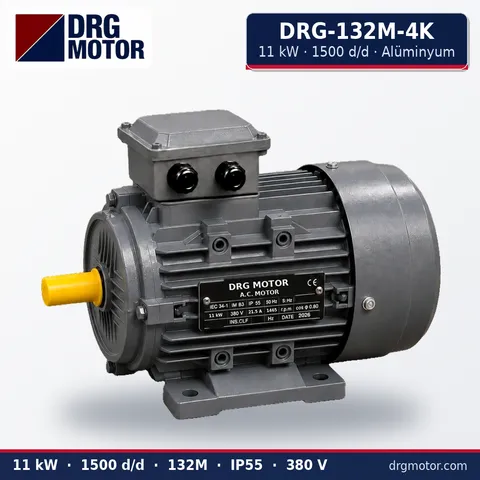
11 kW Compact Three-Phase Motor 1500 rpm – DRG-132M-4K Aluminium
- 11 kW · 1500 rpm (4 poles)
- Aluminium frame · IEC 132M
- Shaft: 38 × 80 mm