English
 Le français
 Türkçe




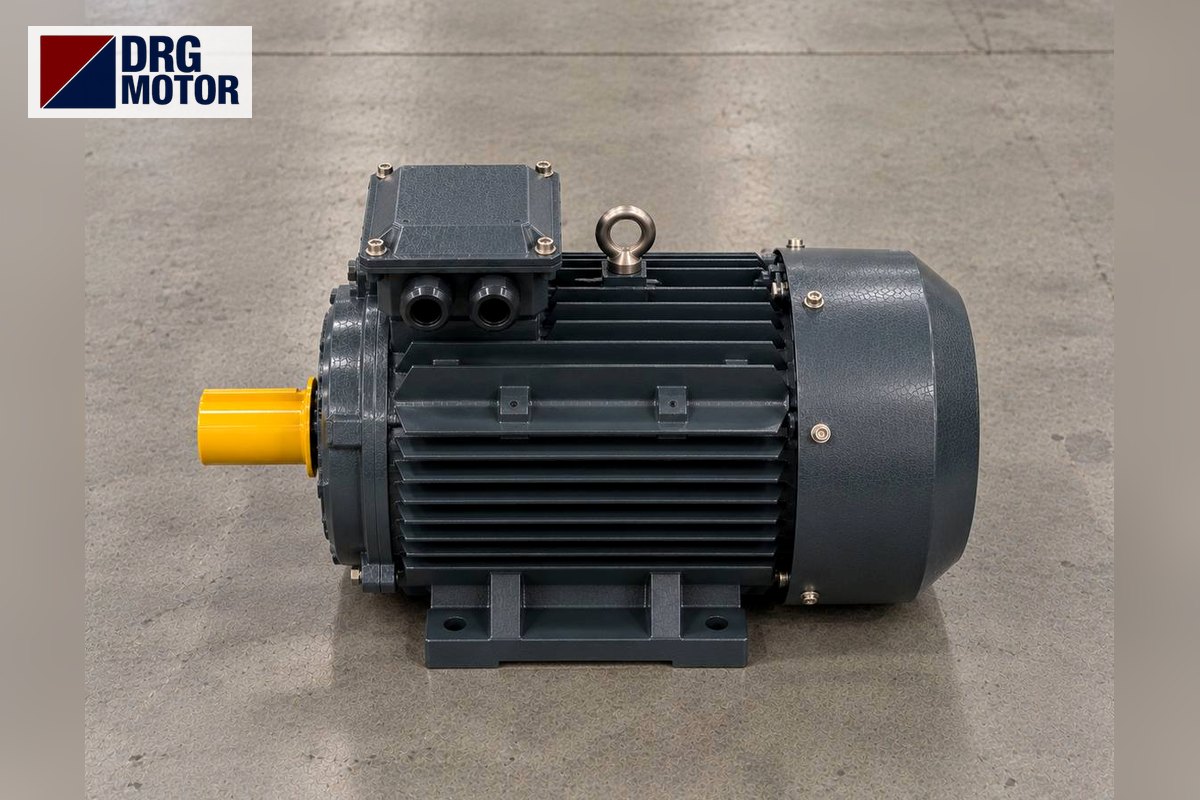

When an electric motor is fed below its rated voltage, it draws more current from the supply to deliver the same mechanical load; this causes extra heating in the windings, a drop in torque and harder starting under heavy loads. In short, low voltage is a hidden stress that strains the motor and shortens its life.
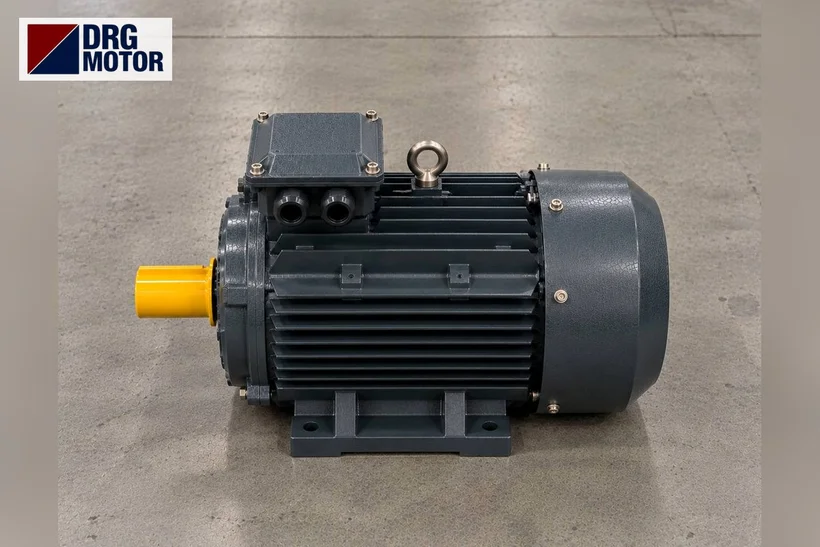
DRG Motor is a manufacturer, supplier and seller of electric motors. You can compare three-phase models in the power and speed you need in the online motor shop and see the whole range in the three-phase asynchronous electric motors category. This article explains what low voltage changes in a motor, why it happens and how to prevent it.
What changes in the motor when voltage drops?
An induction motor produces mechanical power at the shaft from the electrical power it takes from the supply. When the supply voltage falls, the work the motor must do does not change; but since power is roughly the product of voltage and current, lower voltage means higher current to deliver the same power. This simple relationship is the root of the heating: as current rises, the heat loss in the windings grows noticeably.
The second major effect is on torque. The torque an induction motor produces is proportional to the square of the supply voltage. So if voltage drops by 10%, the maximum torque falls by about 19% (0.90 × 0.90 ≈ 0.81). On light loads this often goes unnoticed; but under a heavy load the motor struggles, its speed drops slightly and the slip increases.
Why does current rise at low voltage?
The rated current on a motor nameplate is the current it draws at rated voltage and full load. When the voltage falls below that value, the current drawn can climb above the rated figure depending on the load. The table below lists the rated current at 400 V of a few common 4-pole (1500 rpm) DRG models; in service, when voltage drops below this, these figures remain the reference.
| Model | Power / Speed | Rated current (400 V) | Rated torque |
|---|---|---|---|
| DRG-132S-4-AL | 5.5 kW / 1500 rpm | 10.7 A | 36.0 Nm |
| DRG-112M-4K-AL | 5.5 kW / 1500 rpm | 10.7 A | 36.0 Nm |
| DRG-132M-4-AL | 7.5 kW / 1500 rpm | 14.3 A | 49.1 Nm |
| DRG-160M-4-AL | 11.0 kW / 1500 rpm | 20.4 A | 71.7 Nm |
For example the 7.5 kW DRG-132M-4 draws about 14.3 A at 400 V. If the supply voltage stays low at full load, the motor draws above this current to do the same job; a correctly set protection relay then trips the circuit. Users who need a cast iron housing can find the same power in options such as the 5.5 kW cast iron model. To compare the motor's actual current with the rated value, use the motor current chart.
Click to see current electric motor prices and order nowSEE PRICES →
Main causes of low voltage
A low voltage measured at the motor terminals usually points to a problem in the supply line rather than the motor. The most common causes are:
- Long, thin supply cable: as the cable gets longer and its cross-section smaller, the voltage drop along it grows. If the motor is far from the panel, even with 400 V at the panel output, a lower value may appear at the motor terminals.
- Weak or overloaded grid: in installations far from the transformer where many loads share the same line, the voltage temporarily sags, especially while large motors start.
- Loose or oxidised connections: a loose joint at a terminal block, contactor tip or splice creates a local resistance; voltage drops there, and heating and arcing risk rise.
- Phase imbalance: one of the three phases being lower than the others causes both current imbalance and extra heating in the motor.
Effect on starting and continuous running
Low voltage is felt most at the moment of starting. Because torque is proportional to the square of the voltage, a low voltage also reduces the starting torque. A motor with a heavy load (a full conveyor, a loaded compressor) starts slowly and in some cases may not reach full speed. During this time the high current it draws heats the windings quickly.
A long starting time and sustained high current wear the insulation over time and cause earlier-than-expected failures. A single small voltage fluctuation is usually harmless; the real risk is in installations where voltage stays low permanently.
Tolerance, prevention and safe checking
Standard three-phase asynchronous motors are designed to run within a certain voltage tolerance; the generally accepted range is about ±10% of the rated value. For a 400 V motor this is roughly 360–440 V. If there is a permanent drop outside this band, the cause should be fixed first. Practical measures:
- Re-assess the supply cable cross-section for distance and current; increase it if needed. The motor cable size calculator helps you find a suitable cross-section.
- Check terminal and contactor connections and, after switching off the supply, tighten any that are loose.
- Measure the voltage of the three phases separately to see whether there is imbalance.
- On a new installation, size the power and current correctly from the start with the electric motor calculator.
Before any measurement or wiring, switch off the supply, confirm it is de-energised and let only qualified electrical personnel do the work. Set protection values such as the thermal current from the rated current on the motor nameplate and the device documentation, never from memory.
Send a photo of your current motor nameplate and we will find the suitable DRG model together.Send on WhatsApp
Once the voltage drop on your line is fixed, you can choose the motor in the power and speed best suited to your application through the shop.
Browse the right power and speed three-phase asynchronous motor models and current prices in the shopSEE PRICES
Frequently asked questions
Does low voltage burn out a motor?
Not directly or instantly; but while voltage stays low the motor draws excess current and overheats. If the protection is not set correctly, this heating degrades the insulation over time and can lead to winding failure.
How much voltage drop becomes a problem?
Short, small fluctuations are normal. Permanent drops outside roughly the ±10% band of the rated value, especially under full load, are problematic; the line should then be reviewed.
Why does a motor draw more current at low voltage?
Because it must still deliver the same mechanical power. Since power is roughly the product of voltage and current, when voltage falls the current rises to meet the same power.
Why does the voltage drop during starting?
An induction motor draws several times its rated current at start. On weak or long lines this high current creates a temporary voltage drop along the line; as the motor reaches speed the voltage returns to normal.
Electric Motors Related to This Topic — Models and Current Prices
Suitability is not decided by power alone: compare the speed, voltage, mounting, shaft and fixing dimensions of your machine with the product data; if unsure, send us the nameplate of your current motor.
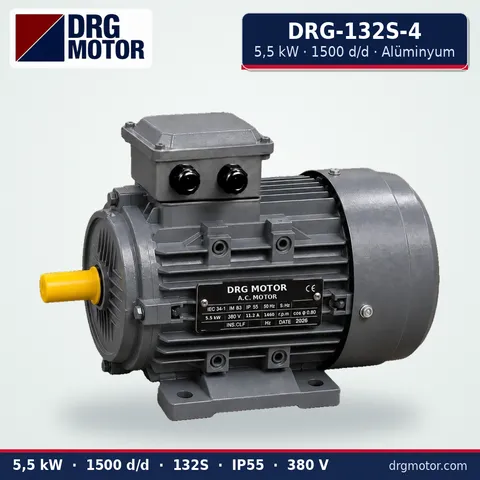
5.5 kW Three-Phase Motor 1500 rpm – DRG-132S-4 Aluminium
- 5.5 kW · 1500 rpm (4 poles)
- Aluminium frame · IEC 132S
- Shaft: 38 × 80 mm
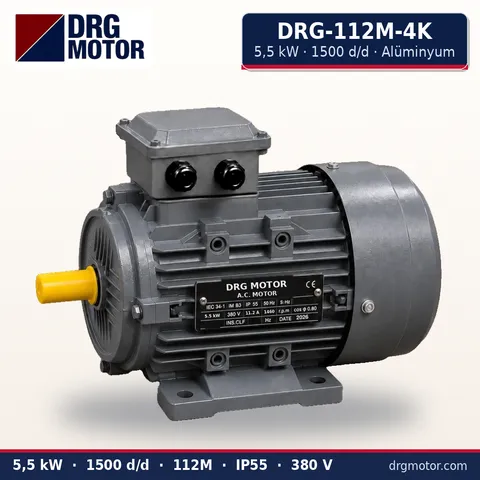
5.5 kW Compact Three-Phase Motor 1500 rpm – DRG-112M-4K Aluminium
- 5.5 kW · 1500 rpm (4 poles)
- Aluminium frame · IEC 112M
- Shaft: 28 × 60 mm
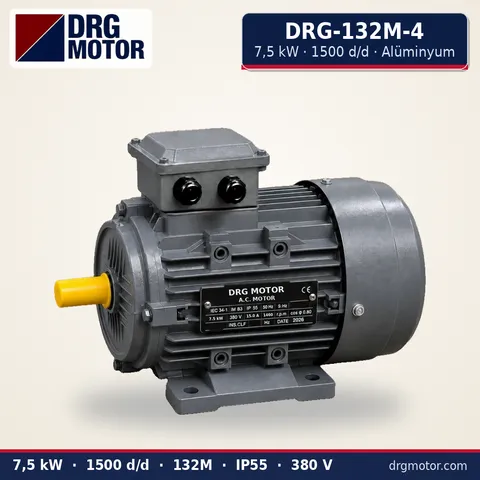
7.5 kW Three-Phase Motor 1500 rpm – DRG-132M-4 Aluminium
- 7.5 kW · 1500 rpm (4 poles)
- Aluminium frame · IEC 132M
- Shaft: 38 × 80 mm
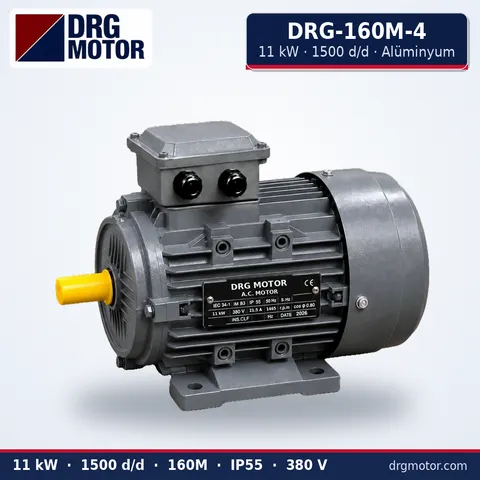
11 kW Three-Phase Motor 1500 rpm – DRG-160M-4 Aluminium
- 11 kW · 1500 rpm (4 poles)
- Aluminium frame · IEC 160M
- Shaft: 42 × 110 mm
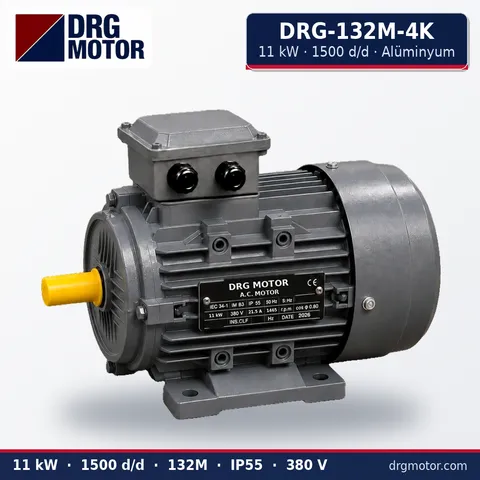
11 kW Compact Three-Phase Motor 1500 rpm – DRG-132M-4K Aluminium
- 11 kW · 1500 rpm (4 poles)
- Aluminium frame · IEC 132M
- Shaft: 38 × 80 mm
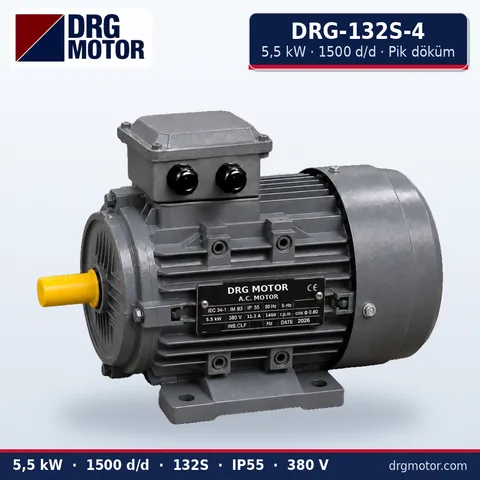
5.5 kW Three-Phase Motor 1500 rpm – DRG-132S-4 Cast Iron
- 5.5 kW · 1500 rpm (4 poles)
- Cast iron frame · IEC 132S
- Shaft: 38 × 80 mm