English
 Le français
 Türkçe




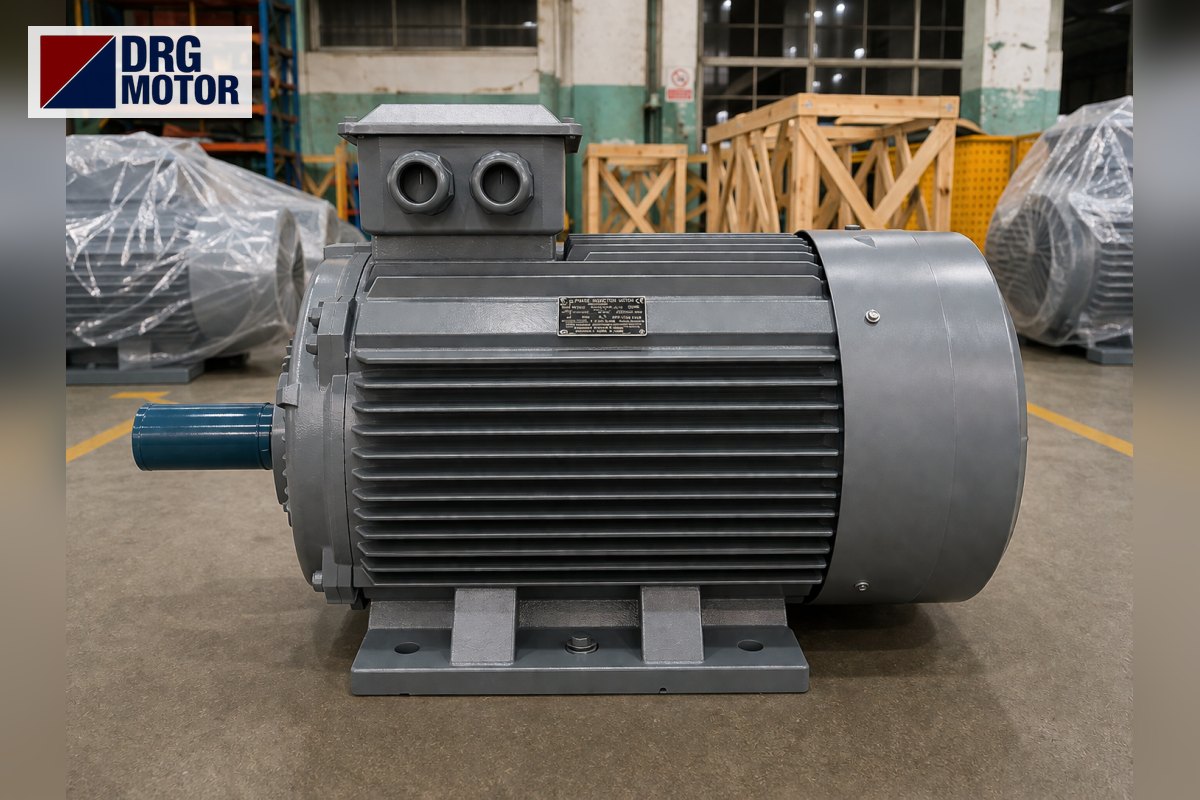

In an electric concrete saw (joint cutter or floor saw), the motor turns the spindle carrying the diamond blade through a belt and pulleys. Two things decide the motor choice: a spindle speed that never exceeds the maximum speed printed on the blade, and enough power so the motor does not stall when the blade binds at full cutting depth. That is why the pulley ratio and blade diameter come first, and the kW rating second.
These machines usually run a 2-pole motor, i.e. the 3000 rpm class, because the blade rim needs a high cutting speed and a 2-pole motor reaches it with a small pulley ratio. Three-phase 2-pole models that fit a saw are sorted by kW on the buy electric motors online page.
DRG Motor is a manufacturer, supplier and seller of electric motors; it supplies the standard IEC induction motor fitted to the machine, not the machine itself. Petrol and diesel saws are driven by a combustion engine; converting them to electric drive is a separate matter, covered briefly in the FAQ below.
How Does Power Travel from the Motor Shaft to the Blade?
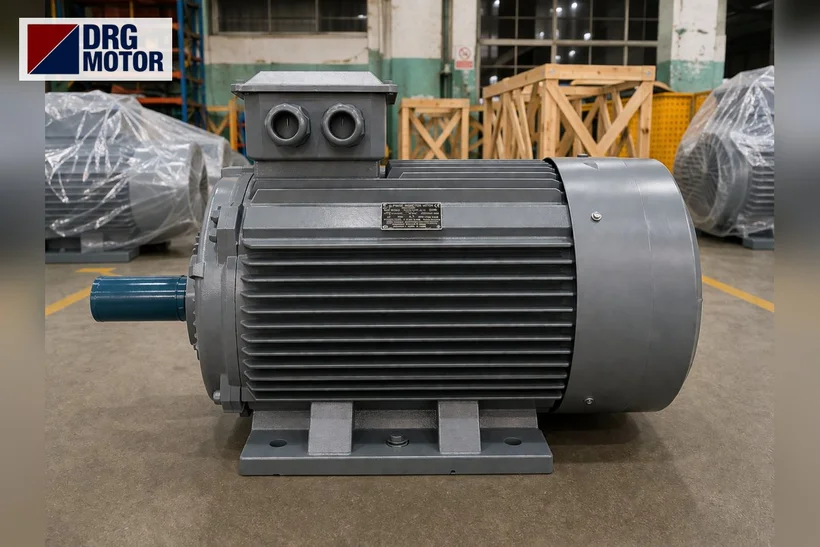
On a walk-behind floor saw, the motor is foot-mounted (B3) on a sliding base plate on top of the wheeled chassis. The pulley on the motor shaft drives the blade-spindle pulley through one or more V-belts. The spindle runs in a housing with two bearings, and the diamond blade is clamped between two flanges at its end.
Cutting depth is set with a handwheel or a small lifting mechanism: the operator lowers the blade slowly into the concrete, then pushes the machine along the cutting line. Water is sprayed onto the front and sides of the blade; it cools the blade and flushes the concrete slurry out of the kerf. From the moment the blade enters the concrete, the motor load varies with the operator’s pushing speed.
The sliding base lets the motor move back and forth to set belt tension. When replacing the motor, the foot-hole spacing must match this base, and the shaft height must keep both pulleys in line.
Blade Diameter, Pulley Ratio and Peripheral Speed
A diamond blade’s cutting performance depends on how many metres per second its rim travels: v = π·D·n/60. Every blade carries the maximum permitted speed (or peripheral speed) for that blade. That limit belongs to the blade maker; the spindle speed on the machine must never exceed it.
Example (assumption): on a 2-pole motor running at 2930 rpm, let the motor pulley be 100 mm and the spindle pulley 130 mm. Spindle speed n2 = n1·d1/d2 = 2930·100/130 ≈ 2254 rpm. The table shows the peripheral speed this spindle speed gives with different blade diameters.
| Blade diameter | Spindle speed | Peripheral speed | Comment |
|---|---|---|---|
| 350 mm | 2254 rpm | 41.3 m/s | Small blade, low speed |
| 450 mm | 2254 rpm | 53.1 m/s | Reference for the example |
| 600 mm | 2254 rpm | 70.8 m/s | Always check the blade limit |
| 600 mm | 1694 rpm (173 mm pulley) | 53.2 m/s | New ratio restores the speed |
The conclusion is clear: fitting a larger blade with the same pulleys raises peripheral speed quickly. Moving to a 600 mm blade, a 173 mm spindle pulley brings the speed back to the level of the 450 mm blade. You can check pulley diameters with the pulley and belt calculator; the final word is still the limit printed on the blade.
If a 4-pole (1460 rpm) motor is fitted to the same machine, reaching the same 2254 rpm spindle speed requires a motor pulley larger than the spindle pulley (about 201 mm for a 130 mm spindle pulley). This strains the belt wrap angle and the space on the chassis, which is why 2-pole motors are preferred on these machines.
Click to see current electric motor prices and order nowSEE PRICES →
What Sets the Cutting Load: Aggregate, Rebar, Depth
With the blade at constant speed, the power drawn depends on cutting depth, the hardness of the aggregate in the concrete, whether rebar is hit, and feed speed. Opening joints in freshly placed screed and cutting deep into aged industrial flooring with coarse aggregate demand very different torque from the same motor.
The load fluctuates: when the blade meets a hard stone or a bar, torque rises briefly and then drops. The motor’s breakdown torque covers these short peaks; but when the operator pushes too fast, the load stays high for long and the overload relay trips. The fix is usually not a bigger motor but matching feed speed to cutting depth.
Power varies by machine class: a few kW on small hand-pushed types, tens of kW on large self-propelled floor saws. The exact value is on the machine maker’s nameplate and catalogue; do not go below it when choosing a replacement motor.
Protecting the Motor from Water and Slurry in Wet Cutting
Wet cutting means a constant mist of water and concrete slurry around the motor. DRG motors are rated IP55: protected against dust and water jets from any direction, but not suited to direct pressure washing or immersion. Keep the motor away from the spray nozzles, ideally behind a splash guard.
The motor cools itself with a shaft-mounted fan (IC411). If the fan cowl grille clogs with slurry, cooling air drops and the winding heats up. At the end of the job, clean the fan cowl and housing fins with a dry brush, and keep the terminal box cover and cable gland tight. Outdoors, the operating range is −15…+40 °C.
Running on a Generator and Starting Current
Concrete cutting is often done where there is no mains supply, on a generator. What matters here is not the rated current but the starting current. Example: the DRG-132S2-2 (7.5 kW) draws 13.7 A at 400 V with a starting current ratio Is/In = 7.9; with direct-on-line starting, the inrush reaches about 108 A.
From 4 kW upwards the DRG winding is 400/690 V, so they run in delta on a 400 V supply and are suitable for star-delta starting. In star, starting current falls to roughly one third (about 36 A in this example). If the blade is raised out of the concrete before starting, the lower torque in star is sufficient. The generator must be sized to carry this starting current without a voltage collapse.
DRG does not offer single-phase motors. If only single phase is available on site, this machine needs a three-phase generator or a three-phase supply.
What to Measure Before Removing the Old Motor
A replacement motor should sit in place without changing the base or pulleys. The mounting dimensions of the models below are catalogue values:
| Model | Power / speed | Shaft D×E | Foot holes A×B |
|---|---|---|---|
| DRG-112M-2 | 4 kW / 2905 rpm | 28×60 mm | 190×140 mm (H 112) |
| DRG-132S1-2 | 5.5 kW / 2930 rpm | 38×80 mm | 216×140 mm (H 132) |
| DRG-132S2-2 | 7.5 kW / 2930 rpm | 38×80 mm | 216×140 mm (H 132) |
| DRG-160M1-2 | 11 kW / 2945 rpm | 42×110 mm | 254×210 mm (H 160) |
- kW, speed and voltage on the old motor’s nameplate (230/400 V or 400/690 V)
- Foot-hole spacing A×B and shaft height H; whether the slots in the sliding base fit this dimension
- Shaft diameter and length (D×E), key width; whether the existing pulley hub fits the new shaft
- Motor and spindle pulley diameters, belt type and number of belts
- Diameter of the fitted blade and the maximum speed printed on it
- Blade rotation arrow: if direction is wrong, swap two phases
- Cable entry size and a gland suitable for wet conditions
If the existing motor’s kW is unknown, cutting depth, blade diameter and concrete type are not enough; go by the machine nameplate or the maker’s catalogue. For other stone and marble cutting applications, see the marble machine electric motors page.
DRG Motors Suited to Concrete Saws
These 2-pole, foot-mounted (B3) models suit belt-driven blade spindles; a light aluminium housing works on small machines, a cast iron housing on heavy floor saw chassis.
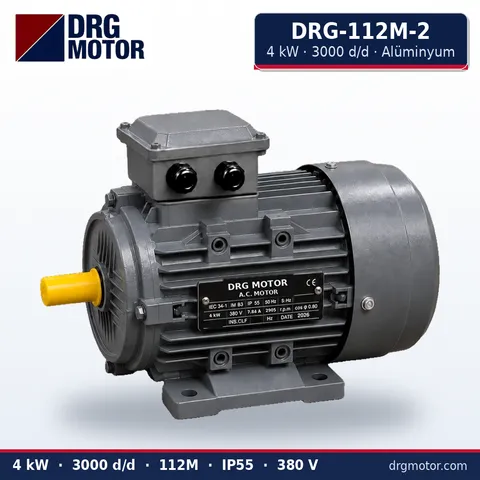
4 kW Three-Phase Motor 3000 rpm – DRG-112M-2 Aluminium
- 4 kW · 3000 rpm (2 poles)
- Aluminium frame · IEC 112M
- Mounting: B3 · B5 · B14 · B35
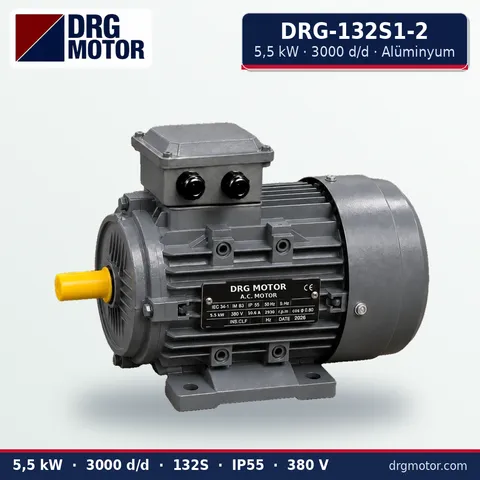
5.5 kW Three-Phase Motor 3000 rpm – DRG-132S1-2 Aluminium
- 5.5 kW · 3000 rpm (2 poles)
- Aluminium frame · IEC 132S
- Mounting: B3 · B5 · B14 · B35
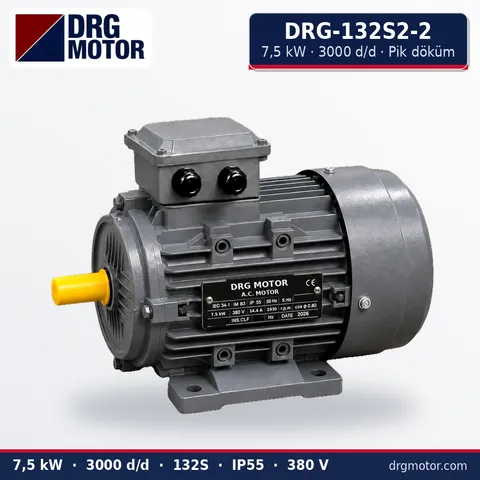
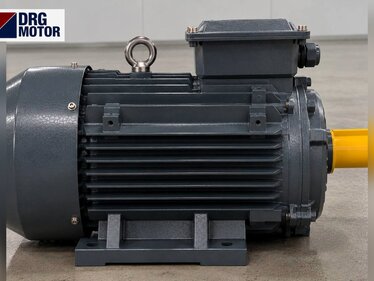
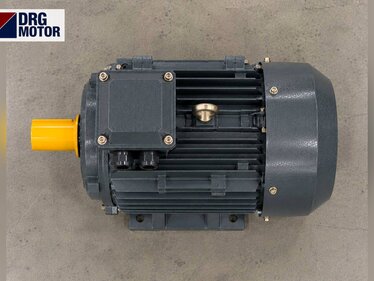
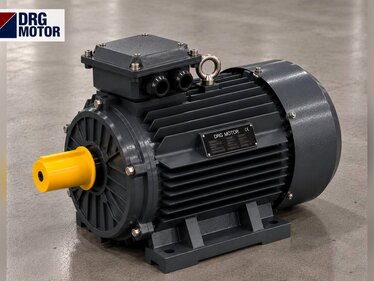
7.5 kW Three-Phase Motor 3000 rpm – DRG-132S2-2 Cast Iron
- 7.5 kW · 3000 rpm (2 poles)
- Cast iron frame · IEC 132S
- Mounting: B3 · B5 · B14 · B35
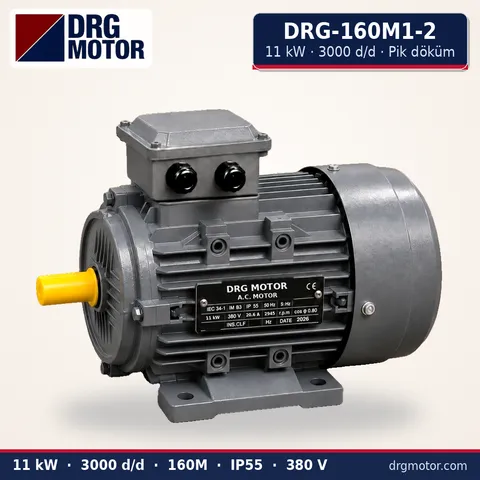
11 kW Three-Phase Motor 3000 rpm – DRG-160M1-2 Cast Iron
- 11 kW · 3000 rpm (2 poles)
- Cast iron frame · IEC 160M
- Mounting: B3 · B5 · B14 · B35
Click to see current prices and order these motors nowSEE PRICES →
Concrete Saw Motor FAQ
Can a 1500 rpm motor be used on a concrete saw?
It can, but the pulleys must be recalculated: for the same blade speed, the motor pulley must be larger than the spindle pulley. Left with the old pulleys, the blade turns at half speed, cutting slows and the blade glazes. If the chassis space and belt line do not allow it, staying with a 2-pole motor is the right call.
Do I need to change the motor when fitting a larger blade?
Check speed first: with a larger blade, the same spindle speed gives a higher peripheral speed and may exceed the blade limit; usually the spindle pulley needs to be enlarged. Since deeper cuts need more torque, ask the maker about motor power if the nameplate rating was not intended for this blade.
Does an electric joint cutter run on a generator?
Yes; the generator must be three-phase and large enough to carry the motor’s starting current. From 4 kW upwards, star-delta starting and starting with the blade lifted out of the concrete noticeably reduce the load on the generator.
Can I convert a petrol concrete saw to electric?
This is done where exhaust fumes are unacceptable indoors. The engine’s rated power is the value at its top speed and does not map directly onto electric motor power; spindle speed, pulley ratio and the mounting point on the chassis must be recalculated. Plan the conversion with a manufacturer who knows the machine; DRG supplies the suitable three-phase motor.
For a replacement, send a nameplate photo of the old motor, the blade diameter, both pulley diameters, whether the motor is foot- or flange-mounted and the shaft size to our WhatsApp line; or submit your chosen models through the quote list. You can reach us on +90 (542) 666 11 11, at info@drgmotor.com or via the contact page. All 2-pole models are listed in the DRG online store.