English
 Le français
 Türkçe




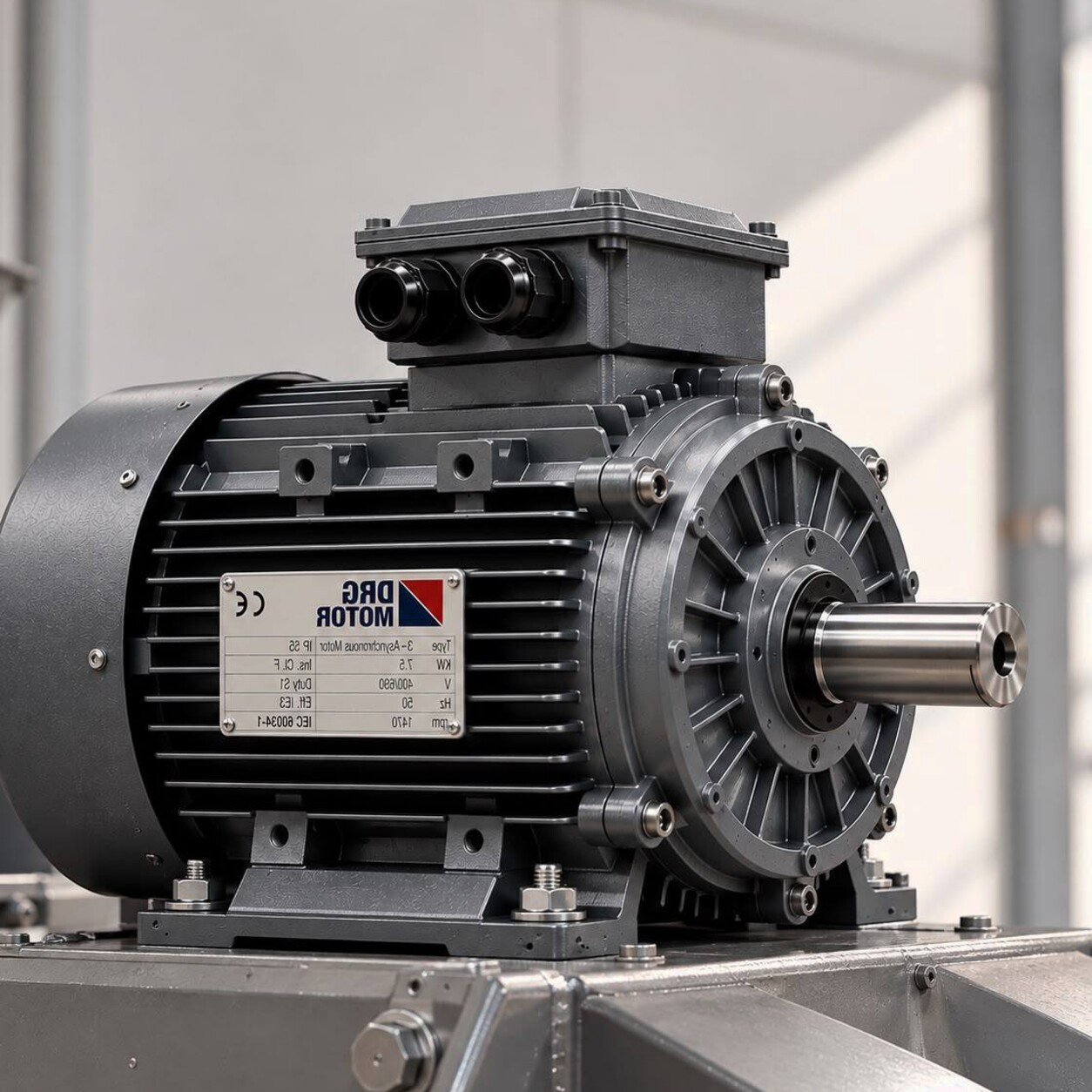

The power goes off at the batching plant; the mixer drum is full of two cubic metres of fresh concrete and the lid is closed. Power returns twenty minutes later, the operator presses start, and the motor hums but the shaft does not turn. A few seconds later the overload relay trips. This moment is the real test for a concrete mixer motor: if a motor that starts easily with an empty mixer cannot move from standstill with a full one, something is missing in the selection or in the starting method. Below, separating the batching plant mixer from the small site mixer, we go step by step through the load and operating conditions that determine motor selection.
Two Separate Worlds: Plant Mixer and Site Mixer
The phrase "concrete mixer" describes two very different machines. The stationary mixer in a ready-mix or precast plant mixes tonnes of aggregate within a few minutes for each batch. The small drum mixer on a building site is fed with a worker's shovel and used intermittently during the day. Scale, starting method and protection needs therefore change completely in motor selection.
Twin-shaft mixer
Two horizontal shafts, with arms and paddles, push the concrete towards each other. Each shaft usually turns with its own motor and gearbox; the shafts can be linked by gears or a cardan connection to keep both sides synchronised. As mixer volume grows, power moves from one motor to two motors and to larger frames. In this type the motor is mostly 4-pole (about 1500 rpm), and the gearbox has a ratio that turns the shaft at a few tens of revolutions per minute.
Planetary mixer
In this vertical-axis mixer, the mixing arms rotate both around their own axes and around the centre of the pan. It is preferred for precast, coloured concrete and mortar, where homogeneity matters. The motor sits on top, in a vertical position, and is flange-mounted on the gearbox; therefore the mounting arrangement (mostly V1 or top flange-mounted) must be stated clearly in the order.
Site drum mixer
The rotating drum turns as the motor is slowed down via a belt and pulley and a pinion and ring gear. Power is in the range of a few kW; single-phase and three-phase models exist. Here the motor's worst enemies are the open air, cement dust and rain.
Starting with a Full Mixer: Why Torque Is Decisive
Even though the power drawn by the mixer fluctuates while mixing, once the motor starts turning the job is relatively easy. The hard part is setting a stopped mixer with settled concrete inside in motion. Aggregate particles in the concrete interlock; the paddles cannot turn without breaking up this mass. That is why, in a mixer motor, the motor's starting torque and how much the starting method reduces this torque matter as much as rated power.
Restarting the mixer without emptying it after a power cut, an emergency stop or a fault during a batch is a frequent situation in the field. Selection should be based not on an "empty start" but on the "worst day" scenario, that is, starting with a full mixer.
Gearbox Ratio and Shaft Torque: Worked Example
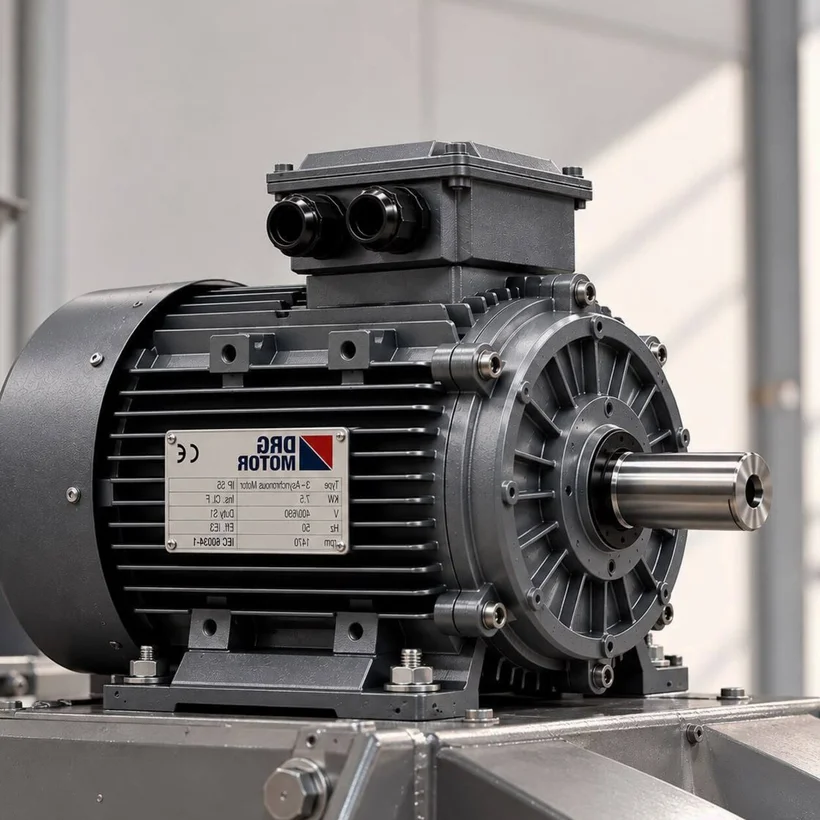
In a twin-shaft mixer, let each shaft be driven by a 37 kW 4-pole motor. The rated torque of the 37 kW 1500 rpm cast iron motor in the store list is 237.9 Nm; from this, motor speed n = 9550 × 37 / 237.9 ≈ 1485 rpm.
If the mixing shaft is to turn at 26 rpm, the gearbox ratio is i = 1485 / 26 ≈ 57.1. Neglecting gearbox losses, shaft torque is approximately M_shaft = 237.9 × 57.1 ≈ 13,590 Nm. The formula 9550 × 37 / 26 ≈ 13,590 Nm gives the same result. When selecting the gearbox, this value is multiplied by the service factor given by the mixer manufacturer and compared with the permissible output torque in the gearbox catalogue.
The logic is the same for a site mixer. The rated torque of a 2.2 kW 4-pole motor is 14.5 Nm; its speed is 9550 × 2.2 / 14.5 ≈ 1449 rpm. With an 80 mm motor pulley and a 240 mm intermediate pulley, the belt stage is 1:3 and the intermediate shaft turns at 1449 / 3 ≈ 483 rpm. When the 12-tooth pinion on the intermediate shaft drives the 232-tooth ring gear on the drum, the drum turns at 483 × 12 / 232 ≈ 25.0 rpm. The overall ratio is about 58.
To try these speed and torque calculations with different values, you can use the electric motor calculators page.
Starting Method: Why Is Star-Delta Risky Here?
Star-delta starting is a common method for relieving the supply network; however, in the star position the motor's starting torque also falls to one third. On machines that start unloaded this is not a problem, but on a full mixer it can be.
Example assumption: suppose 1.6 times rated torque is needed to move the full mixer, and the motor catalogue gives a starting torque / rated torque ratio of 2.3. With direct-on-line starting the motor delivers 2.3 × Mn and the mixer turns. In star, only 2.3 / 3 ≈ 0.77 × Mn remains; this is less than half of the required 1.6 × Mn, and the motor stays in a locked-rotor condition. The "hums but does not turn" picture from the introduction is exactly this.
For this reason, large plant mixers usually follow one of these routes: direct-on-line starting with a high starting torque motor (if the supply capacity allows), a soft starter with adjustable ramp and current limit, or a frequency inverter. A soft starter also reduces torque by lowering the voltage; its settings must be tested on site for the full-mixer scenario. Since a frequency inverter can deliver high torque at low speed, it is the most flexible option for a full start, but the ventilation of the inverter panel in a dusty environment must be considered separately.
Dust, Cement, Moisture and Open Air
At a batching plant, what wears the motor most is not the load but the environment. Cement dust sticks to the grille of the motor's fan cover, hardens when it combines with moisture and cuts off the cooling air. Washing water and rain can seep in through the terminal box gasket or the cable gland. The temperature difference between night and day causes condensation inside the motor.
Practical measures are: a motor with at least IP55 protection, positioning the terminal box so that it does not face the rain, choosing cable glands of the right size for the cable, checking that the condensation drain holes under the motor are open, and placing a canopy or cover that does not block ventilation over motors in the open air. A cast iron frame is often preferred on plant mixers for its resistance to impact and vibration; on a site mixer, a light aluminium frame makes transport easier.
Spraying pressurised water directly onto the motor during washing is not recommended, even for an IP55 motor. While the mixer is washed, the motor and gearbox should be protected with a cover.
Thermal Protection and Winding Temperature Sensors
Protection of a mixer motor should be thought of in two layers. The first is the overload relay or motor protection circuit breaker that monitors motor current; it is set to the rated current on the motor nameplate. For example, the store list gives a 400 V rated current of 66.1 A for the 37 kW 4-pole cast iron motor. Setting the overload above the nameplate current "so it won't trip" is one of the most frequent causes of motor burnout during full-start attempts.
The second is the PTC thermistor or thermostat embedded in the winding. When the fan cover is blocked with cement, the current looks normal but the motor heats up; the overload relay does not notice this, but the sensor in the winding does. On plant mixers, it is a good habit to request PTC when ordering the motor and to connect it to the thermistor relay in the control panel.
Another frequent mistake is trying to free a stalled mixer with repeated start-stop attempts. Each failed start draws locked-rotor current and the winding heats up quickly. If the mixer still does not turn after two attempts, the concrete should be partly discharged and the motor left to cool.
Load and Operating Condition Table
The table below summarises the conditions that affect motor selection by mixer type. Power values should be taken from the machine manufacturer's plate; the table is intended to show what to watch for.
| Mixer type | Load character | Starting condition | Environment | Motor-side points |
|---|---|---|---|---|
| Twin-shaft plant mixer | Heavy, fluctuating per batch | High chance of full-mixer start | Cement dust, washing water | Direct-on-line or inverter, PTC, IP55, cast iron frame |
| Planetary mixer | Medium-heavy, homogeneous mix | Partly full start | Indoor plant, dust | Vertical mounting (V1/flanged), gearbox flange fit |
| Site drum mixer | Light-medium, intermittent | Usually empty or lightly loaded | Open air, rain, dust | IP55, terminal box orientation, canopy, belt tension |
| Mortar/screed mixer | Dense and viscous material | Full starts frequent | Building site, moisture | Starting torque, overload setting, condensation drain |
Selection and Replacement Checklist
- Clarify the mixer type and volume; write down the motor power and speed from the machine plate.
- Assess the likelihood of starting with a full mixer; if star-delta is used, calculate the torque remaining in star.
- Measure the gearbox input flange, shaft diameter and key size; determine the mounting arrangement (B3, B5, B35, V1).
- Describe the environment: open air or indoor plant? Is washing carried out?
- Decide whether to request a PTC thermistor in the motor order.
- Set the overload relay to the new motor's nameplate current.
- At first start, check the direction of rotation and, on twin-shaft mixers, the counter-rotation of the shafts.
- Add cleaning of the fan cover and frame fins to the weekly maintenance list.
Some 4-pole cast iron motors frequently used on mixers, with current list prices:
| Model | Power | Speed | IEC frame | Excl. VAT | Incl. VAT |
|---|---|---|---|---|---|
| DRG-100L1-4 | 2.2 kW | 1500 rpm | 100L | 8,500.80 TRY | 10,200.96 TRY |
| DRG-112M-4 | 4 kW | 1500 rpm | 112M | 11,482.90 TRY | 13,779.48 TRY |
| DRG-180M-4 | 18.5 kW | 1500 rpm | 180M | 39,429.50 TRY | 47,315.40 TRY |
| DRG-225S-4 | 37 kW | 1500 rpm | 225S | 68,937.00 TRY | 82,724.40 TRY |
| DRG-225M-4 | 45 kW | 1500 rpm | 225M | 76,219.00 TRY | 91,462.80 TRY |
| DRG-250M-4 | 55 kW | 1500 rpm | 250M | 93,247.00 TRY | 111,896.40 TRY |
Prices are taken from the DRG Motor online store list dated 24.09.2026; a 3% discount applies to bank transfer/EFT payments, shipping is not included in the price and is paid by the buyer.
For other powers and aluminium frame options, see the buy electric motors online page. If you are planning the plant's belt and silo motors in the same order, the article on concrete plant mixer, belt and silo motors may be useful.
Frequently Asked Questions
Should I choose a 1000 rpm or a 1500 rpm motor for a concrete mixer?
Most mixers use a 1500 rpm motor with a gearbox of suitable ratio; a 1500 rpm motor has a smaller and lighter frame for the same power. A 1000 rpm motor comes into question when the shaft speed must be lowered without changing the existing gearbox ratio. If the motor on an existing machine is being replaced, keep the old motor's speed.
The mixer motor won't start with a full mixer. Should I buy a bigger motor?
Look at the starting method first. The problem is often that torque falls to one third in the star position. Direct-on-line starting, a properly set soft starter or a frequency inverter can solve the problem with the same motor. A bigger motor also changes gearbox and coupling compatibility.
Is an aluminium frame enough for a site mixer?
At small powers, an aluminium frame is light and an advantage on machines that are moved around. On stationary machines with high impact and vibration, a cast iron frame is the more durable choice. In both cases, IP55 protection and the position of the terminal box relative to rain are important.
Does a mixer motor need a PTC thermistor?
It is not mandatory but is recommended in a dusty plant environment. When the fan cover is clogged, the winding can heat up while current stays normal; it is the sensor inside the winding, not the overload relay, that detects this. The PTC must be connected to the thermistor relay in the panel.
Send us your mixer's plate, the gearbox flange dimensions and the starting method, and we will choose the suitable motor together: +90 (542) 666 11 11, [email protected] or our contact page.