English
 Le français
 Türkçe




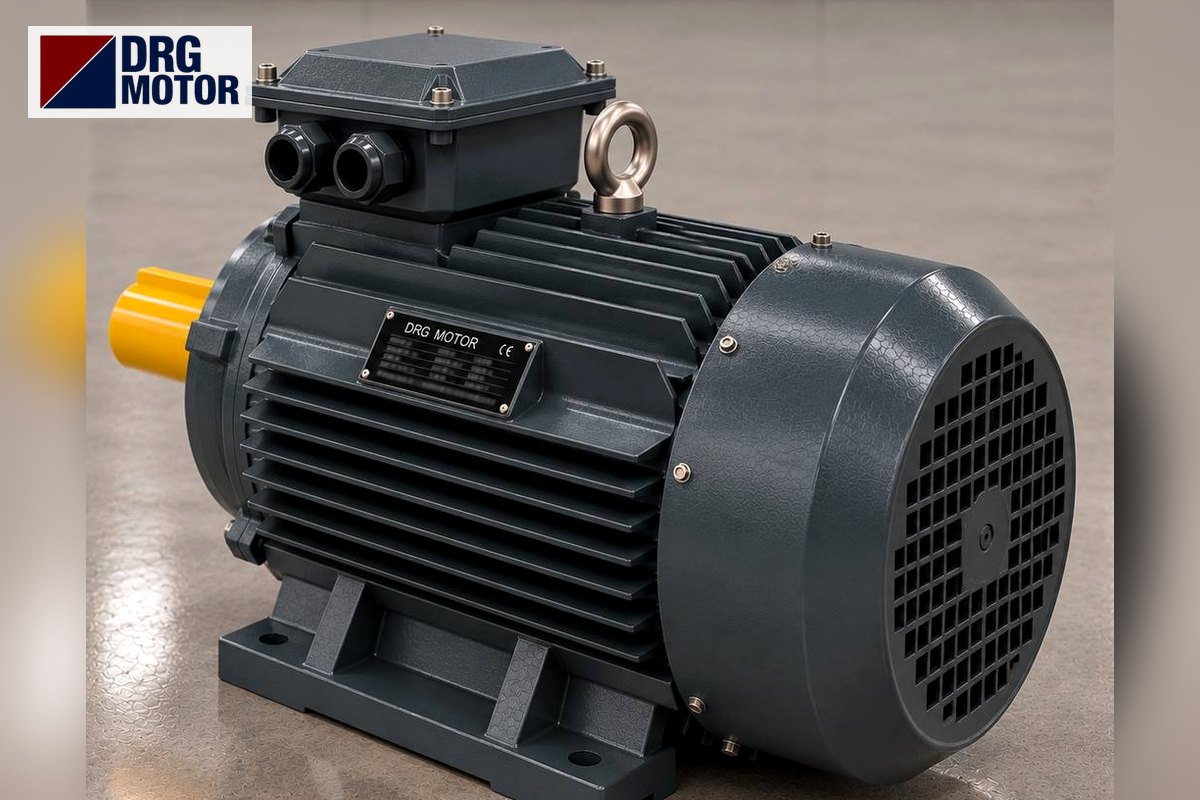

The speed of a three-phase electric motor is not something you dial in like a gas pedal; it is largely built into the pole count of the winding. Fewer poles make the motor run faster, more poles make it run slower but deliver far more torque at the same power. Matching the right job to the right pole count is the most critical choice you make when buying.
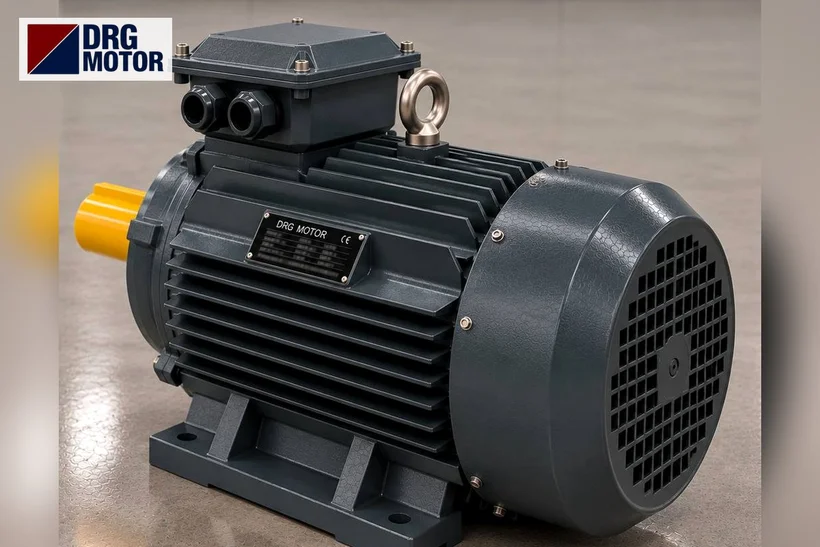
DRG Motor is a manufacturer, supplier and seller of electric motors. It is based in İzmir and ships quickly across all of Türkiye, that province included. Below we unpack the pole-speed relationship alongside real job types; once you have chosen the speed your application needs, browse the models in the online electric motor shop and compare them all in the three-phase asynchronous electric motors category.
How the pole count sets the speed
The stator windings of a three-phase asynchronous electric motor create a magnetic field that rotates around the bore. The speed of that field — the synchronous speed — depends on two things: the supply frequency and how many poles the winding forms. The Turkish grid is 50 Hz and practically fixed, which leaves a single variable: the pole count.
The relationship is inverse. With two poles the field turns fastest; add pole pairs and it slows down. At 50 Hz the rough figures are: 2 poles 3000, 4 poles 1500, 6 poles 1000 rpm. The rotor chases that field but never quite catches it; the small lag is called slip. That is why the actual speed on the plate reads a little lower, for example 2850 or 1440 rpm.
Why are 2 poles fast and 6 poles slow?
A simple analogy: the pole count sets the "step" the field must take per turn. Few poles mean a long step and little work per turn — the field spins quickly. Many poles mean a short, frequent step — the field completes more slowly at the same frequency. Because the frequency is fixed, adding poles divides the speed directly.
Here is the interesting part: when power stays constant, a slower electric motor does not waste anything — it converts the lost speed into torque. Torque is the turning force at the shaft, roughly T = 9550 · P / n (P in kW, n in rpm). At the same 4 kW, as speed drops the divisor shrinks and the result grows. So a 6-pole electric motor offers a far stronger "lever" than its 2-pole sibling.
Same power, different poles: a 4 kW example
Let us see the theory in real DRG models. All three electric motors below are 4 kW; the only difference is the pole count. We computed torque with the formula above using synchronous speed (the plate shows slightly less). Each code links straight to its product page in the shop.
| Poles | Speed | Approx. torque | DRG model |
|---|---|---|---|
| 2 | 3000 rpm | 12.7 Nm | DRG-112M-2-AL |
| 4 | 1500 rpm | 25.5 Nm | DRG-112M-4-AL |
| 6 | 1000 rpm | 38.2 Nm | DRG-132M1-6-AL |
The numbers speak plainly: as the speed halves, the torque nearly triples. That is why "how many kW?" alone is not enough; you also have to ask how many poles? If you need to trim the speed mechanically, the pulley-belt ratio is a separate lever — handle it with the calculator.
Click to see current electric motor prices and order nowSEE PRICES →
Which job wants which pole count?
Not a rulebook, but a well-settled field practice. The nature of the job tells you which speed band it wants.
2 poles (high speed, 3000 rpm)
Where speed itself is the job. Centrifugal pumps, high-pressure blowers, some saws, and grinding or polishing spindles. These want many revolutions rather than high torque. You get high power from a small frame, but the starting torque is limited and heavy loads are hard to start.
4 poles (medium speed, 1500 rpm)
The backbone of industry. Because it offers a balanced middle ground between speed and torque, most fans, the majority of pumps, compressors, general-purpose machines and most gearbox inputs are built around 4 poles. If a machine's speed need is unclear, this is the first class to look at — which is why 1500 rpm is the most common on the shelf.
6 poles (low speed, 1000 rpm)
Jobs that must turn slowly but strongly. Conveyor belts, mixers, crushers, mills, crane and hoist movements and machines with heavy starting loads. The high starting torque gets a loaded system moving without strain, and where high speed is not needed it can even remove an extra gear or pulley stage.
Change the speed, or choose the poles?
A point that often gets confused. The base speed of an electric motor is fixed by its poles; there are two ways to raise or lower it for good. The first is to choose the right pole count from the start — the most robust route. The second, if you must adjust speed continuously, is to feed the motor from a drive (variable-frequency drive); changing the frequency then moves the speed over a wide range. Mechanically, a pulley-belt or gearbox changes the output speed but leaves the motor's own speed untouched.
A simple order of selection helps: first fix the output speed and torque the machine needs, then find the closest pole count, and only then settle the power (kW) and frame. If power and speed are not considered together, you end up with an electric motor that is "strong but at the wrong speed".
The speed range in DRG electric motors
DRG's standard three-phase asynchronous electric motors come in the 3000, 1500 and 1000 rpm classes, at 230/400 V and 400/690 V, in aluminium and cast-iron frames. Below we gathered the most requested 1500 rpm (4-pole) aluminium models with their power and approximate torque. For a wider choice and other speeds, use the electric motor calculator and the online electric motor shop.
| Model | Power | Speed | Approx. torque |
|---|---|---|---|
| DRG-112M-4-AL | 4 kW (5.5 HP) | 1500 rpm | 25.5 Nm |
| DRG-132S-4-AL | 5.5 kW (7.5 HP) | 1500 rpm | 35.0 Nm |
| DRG-112M-4K-AL | 5.5 kW (7.5 HP) | 1500 rpm | 35.0 Nm |
| DRG-132M-4-AL | 7.5 kW (10 HP) | 1500 rpm | 47.8 Nm |
| DRG-160M-4-AL | 11 kW (15 HP) | 1500 rpm | 70.0 Nm |
| DRG-132M-4K-AL | 11 kW (15 HP) | 1500 rpm | 70.0 Nm |
Frequently asked questions
At the same power, should I buy 4-pole or 2-pole?
Look at whether the job wants speed or turning force. For pumps and blowers that need many revolutions, 2 poles; for balanced general use, 4 poles; for slow, loaded starts, 6 poles. Even at the same power, the torque they provide differs.
Can I change the pole count later?
No; the pole count is built into how the winding is wound and cannot be changed in the field. If you need a different speed, either pick the right poles from the start or set the frequency with a drive.
Why do I see 1440 when the plate should read 1500?
1500 is the synchronous speed, the speed of the magnetic field. The loaded rotor turns slightly behind it; that gap is slip and is inherent to an asynchronous electric motor. The plate shows the actual loaded speed.
Does the current drop as the speed drops?
It relates to power and load, not directly to poles. The rated currents of different-pole models at the same power are close but not equal; take the exact value from each model's plate. Use the calculator for cable and protection sizing.
To see the current price of the electric motor matching the speed and pole count your job needs, visit the shop.SEE PRICES
Send a photo of your current motor nameplate and we will find the suitable DRG model together.Send on WhatsApp
Electric Motors Related to This Topic — Models and Current Prices
Suitability is not decided by power alone: compare the speed, voltage, mounting, shaft and fixing dimensions of your machine with the product data; if unsure, send us the nameplate of your current motor.
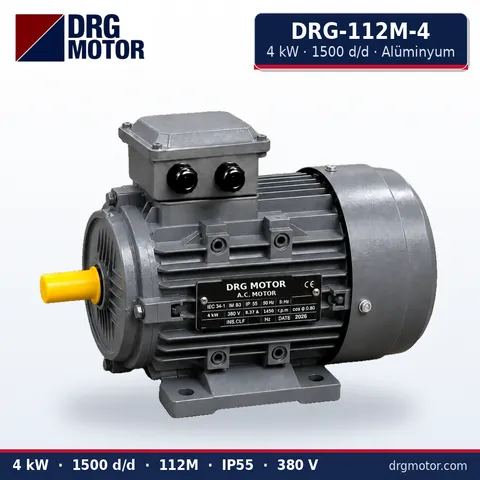
4 kW Three-Phase Motor 1500 rpm – DRG-112M-4 Aluminium
- 4 kW · 1500 rpm (4 poles)
- Aluminium frame · IEC 112M
- Shaft: 28 × 60 mm
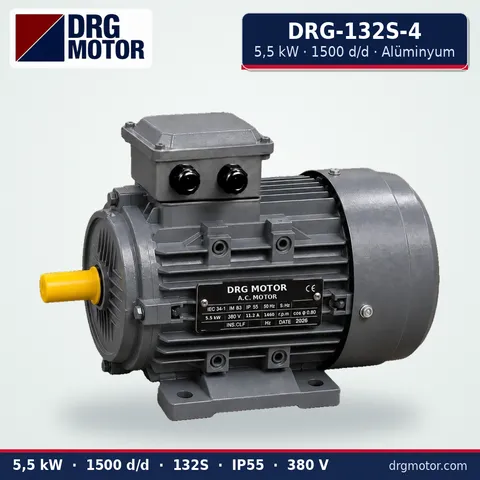
5.5 kW Three-Phase Motor 1500 rpm – DRG-132S-4 Aluminium
- 5.5 kW · 1500 rpm (4 poles)
- Aluminium frame · IEC 132S
- Shaft: 38 × 80 mm
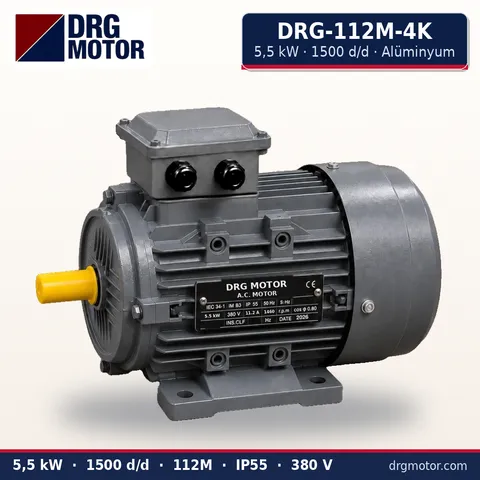
5.5 kW Compact Three-Phase Motor 1500 rpm – DRG-112M-4K Aluminium
- 5.5 kW · 1500 rpm (4 poles)
- Aluminium frame · IEC 112M
- Shaft: 28 × 60 mm
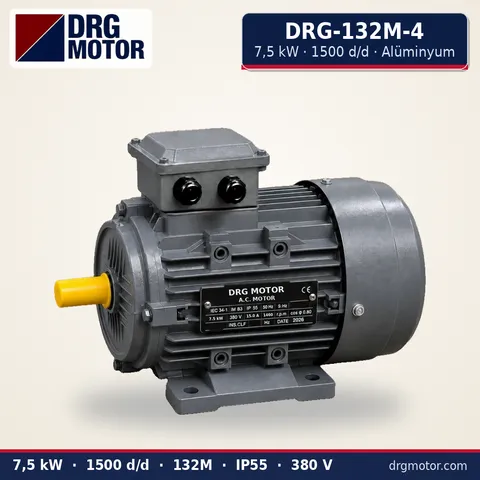
7.5 kW Three-Phase Motor 1500 rpm – DRG-132M-4 Aluminium
- 7.5 kW · 1500 rpm (4 poles)
- Aluminium frame · IEC 132M
- Shaft: 38 × 80 mm
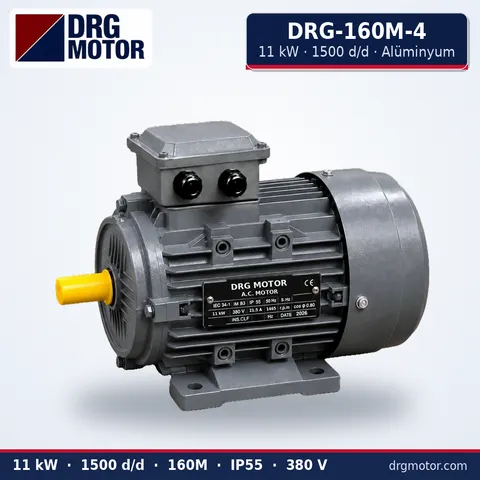
11 kW Three-Phase Motor 1500 rpm – DRG-160M-4 Aluminium
- 11 kW · 1500 rpm (4 poles)
- Aluminium frame · IEC 160M
- Shaft: 42 × 110 mm
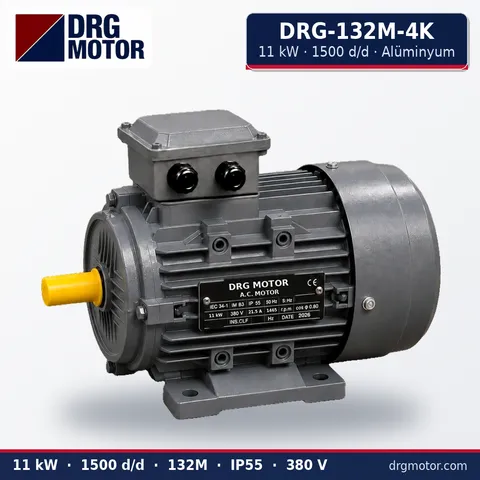
11 kW Compact Three-Phase Motor 1500 rpm – DRG-132M-4K Aluminium
- 11 kW · 1500 rpm (4 poles)
- Aluminium frame · IEC 132M
- Shaft: 38 × 80 mm