 English
 Le français
 Türkçe




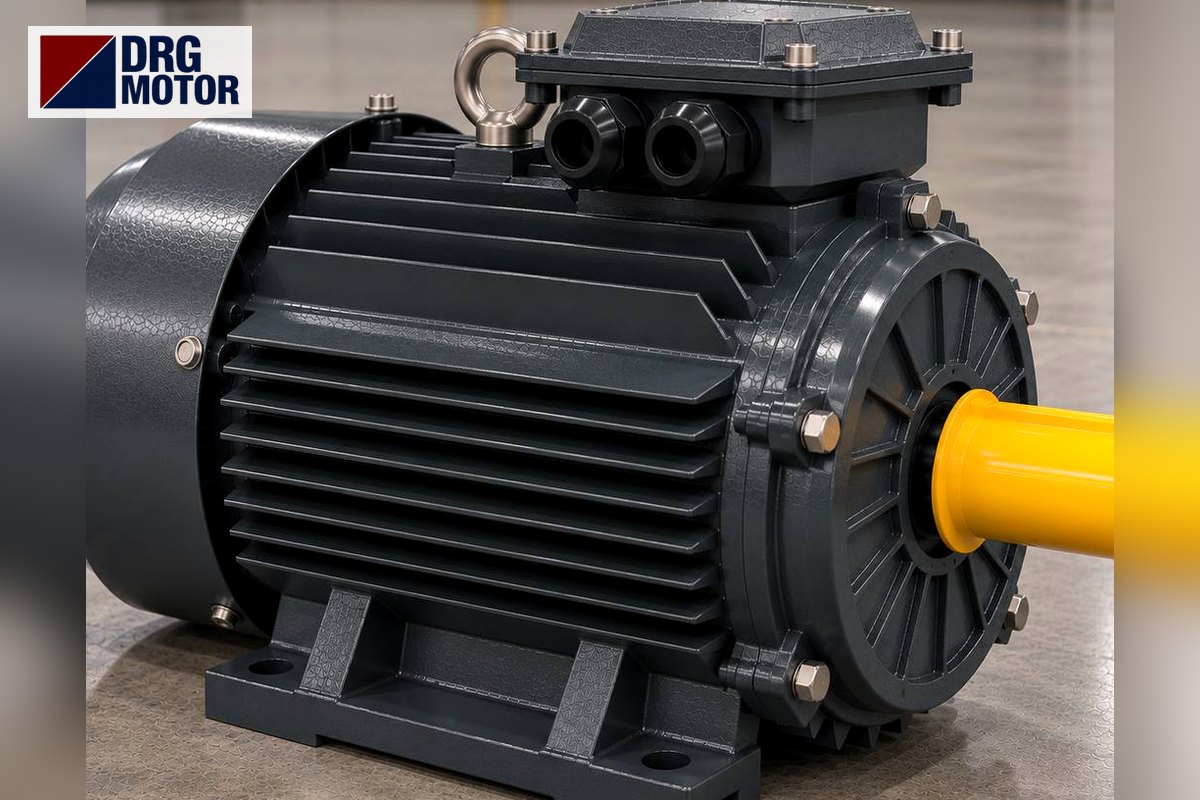

A 4 kW three-phase asynchronous electric motor at 3000 rpm has a 2-pole winding; on a 50 Hz supply its synchronous speed is 3000 rpm and under load it turns at roughly 2900 rpm. In the DRG range this power-speed pair comes in both aluminium (DRG-112M-2) and cast-iron (DRG-112M-2) bodies, in frame size 112.
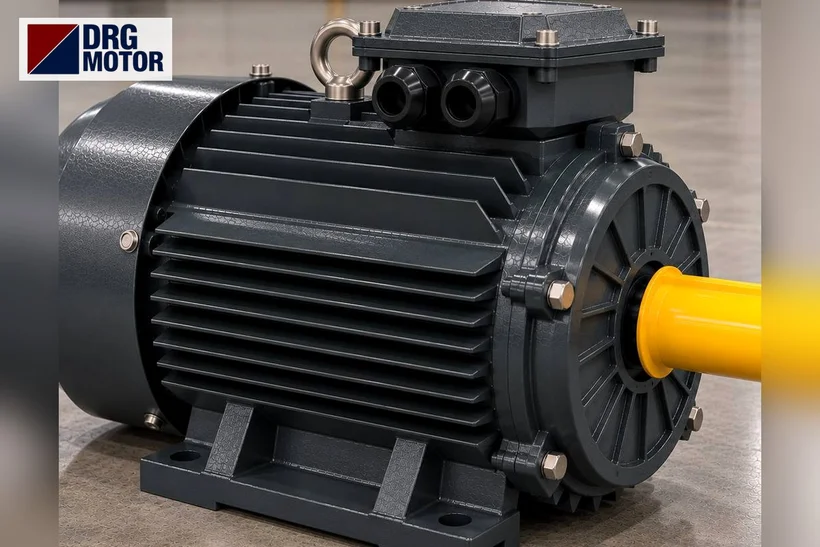
DRG Motor is a manufacturer, supplier and seller of electric motors. Based in İzmir, it ships quickly across all of Türkiye. You can pick the 4 kW 3000 rpm model by power and speed in the online electric motor shop and see the whole series in the three-phase asynchronous electric motors category.
What 3000 rpm really means: two poles, high speed
Speed follows pole count. In a two-pole winding the magnetic field turns 50 times a second, 3000 times a minute. An asynchronous electric motor runs just below this synchronous speed, so the plate usually shows something like 2860–2900 rpm. That small gap is slip, and it is normal.
So a 3000 rpm motor spins at twice the speed of a same-power 1500 rpm one. That single fact sums up the choice: want high speed, pick two poles; want high pull, pick more poles.
Why torque stays low at 4 kW / 3000 rpm
With power fixed, torque drops as speed rises; the link is T = 9550·P/n. For a 4 kW electric motor:
| Speed | Poles | Rated torque (approx.) |
|---|---|---|
| 3000 rpm | 2 | ≈13 Nm |
| 1500 rpm | 4 | ≈26 Nm |
| 1000 rpm | 6 | ≈38 Nm |
The same 4 kW gives half the torque at 3000 rpm and nearly triple at 1000 rpm. That is why a 3000 rpm electric motor is chosen where speed itself does the work, not where heavy starting torque is needed.
Which machines use 4 kW at 3000 rpm?
In the field this speed class is asked for mostly in: centrifugal pumps, blowers, high-speed fans, compressor heads, some grinders and polishers. They share one trait — their output comes from speed, while their torque demand is low.
In a centrifugal pump, head and flow depend on impeller speed; driving the same impeller at 3000 instead of 1500 rpm gives far higher pressure. A blower follows the same logic: airflow and pressure come from blade speed. A conveyor or mixer, by contrast, needs pull more than speed — fitting a 3000 rpm motor there is usually the wrong call.
In short: if the machine wants to "spin fast", go two-pole; if it wants to "push and pull", go four or six-pole.
Click to see current electric motor prices and order nowSEE PRICES →
DRG 4 kW 3000 rpm models
In the 4 kW 3000 rpm class DRG offers two body options, both in frame 112 with a 28x60 mm shaft. The codes link straight to the product page:
| Model | Body | Speed | Current (400 V) |
|---|---|---|---|
| DRG-112M-2-AL | Aluminium | 3000 rpm | 7.45 A |
| DRG-112M-2-GG | Cast iron | 3000 rpm | 7.45 A |
Both are 4 kW (about 5.5 HP) at 400/690 V (Δ/Y). The difference is the body: aluminium is lighter and easier to handle, cast iron holds up better in heavier, more vibrating duty. For continuously running pumps and blowers either works; the pick depends on the mounting place and conditions.
3000, 1500 or 1000 rpm? Choosing speed at the same 4 kW
A common case: a 4 kW electric motor comes off a machine but nobody recalls its speed. Get the speed wrong and, even with the right power, the machine won't run as expected. The three speed options in the 4 kW DRG family:
| Model | Speed | Current (400 V) | Shaft |
|---|---|---|---|
| DRG-112M-2 | 3000 rpm | 7.45 A | 28x60 mm |
| DRG-112M-4 | 1500 rpm | 7.95 A | 28x60 mm |
| DRG-132M1-6 | 1000 rpm | 8.99 A | 38x80 mm |
Note: the 3000 and 1500 rpm models use frame 112 and a 28x60 shaft, while the 1000 rpm one steps up to frame 132 and a 38x80 shaft. Changing the speed therefore changes not only the rpm but the mounting dimensions. That matters for coupling and pulley alignment. If unsure, check the power-speed match with the electric motor calculator.
Voltage, current and starting at 3000 rpm
DRG 4 kW electric motors are wound 400/690 V (Δ/Y) and run in delta (Δ) on a 400 V supply. The 3000 rpm model's rated current at 400 V is 7.45 A. Size the cable and the thermal relay range to this value; set the exact figure per the motor plate and panel documents. For a quick check the motor current chart helps.
Two-pole electric motors draw a relatively high starting current and come up to speed fast. Where direct-on-line starting stresses the panel or supply, star-delta starting is considered. Before any wiring or setting, cut the power, verify it is dead, and have a qualified electrician do the work.
Frequently asked questions
Why does the plate of a 4 kW 3000 rpm motor read 2900?
3000 rpm is the 50 Hz synchronous speed of a two-pole winding. The asynchronous electric motor runs a little below it, so the 2860–2900 figure on the plate is the real load speed. The gap is slip, not a fault.
At the same 4 kW, should I take 3000 or 1500 rpm?
It depends on the machine. For centrifugal pumps, blowers and high-speed fans, 3000 rpm; for conveyors, mixers and geared drives that need torque, 1500 or 1000 rpm.
Why is a 3000 rpm 4 kW motor preferred on pumps?
A centrifugal pump's pressure and flow depend on impeller speed. Higher speed gives more head from the same impeller, which is why many pumps are paired directly with a two-pole electric motor.
Aluminium or cast iron?
For lightness, easy handling and clean environments, aluminium (DRG-112M-2-AL); for heavier duty, vibration and outdoor use, cast iron (DRG-112M-2-GG). Both are the same power and speed.
See the current price of the 4 kW 3000 rpm electric motor and order it in the shop.SEE PRICES
Send a photo of your current motor nameplate and we will find the suitable DRG model together.Send on WhatsApp
Electric Motors Related to This Topic — Models and Current Prices
Suitability is not decided by power alone: compare the speed, voltage, mounting, shaft and fixing dimensions of your machine with the product data; if unsure, send us the nameplate of your current motor.
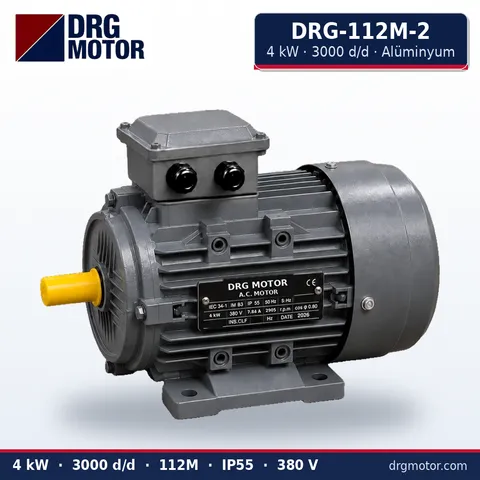
4 kW Three-Phase Motor 3000 rpm – DRG-112M-2 Aluminium
- 4 kW · 3000 rpm (2 poles)
- Aluminium frame · IEC 112M
- Shaft: 28 × 60 mm

4 kW Three-Phase Motor 1500 rpm – DRG-112M-4 Aluminium
- 4 kW · 1500 rpm (4 poles)
- Aluminium frame · IEC 112M
- Shaft: 28 × 60 mm
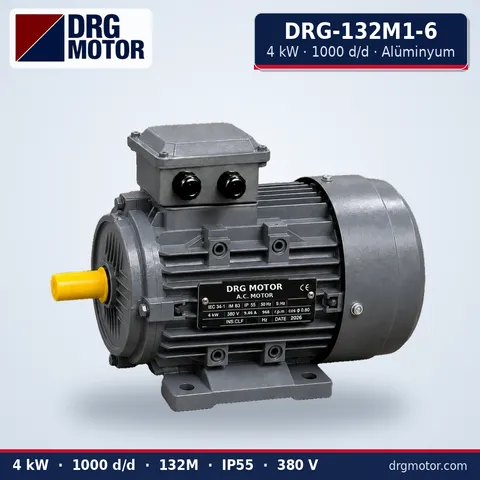
4 kW Three-Phase Motor 1000 rpm – DRG-132M1-6 Aluminium
- 4 kW · 1000 rpm (6 poles)
- Aluminium frame · IEC 132M
- Shaft: 38 × 80 mm
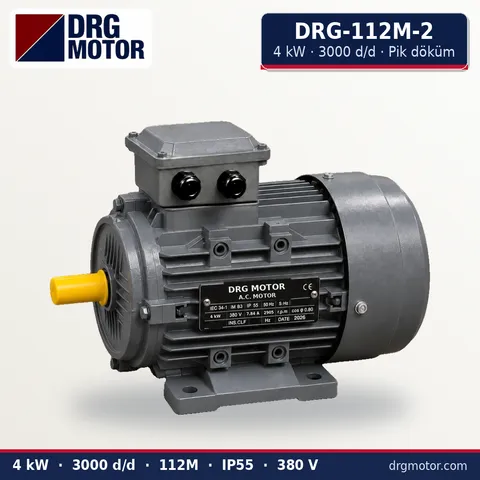
4 kW Three-Phase Motor 3000 rpm – DRG-112M-2 Cast Iron
- 4 kW · 3000 rpm (2 poles)
- Cast iron frame · IEC 112M
- Shaft: 28 × 60 mm
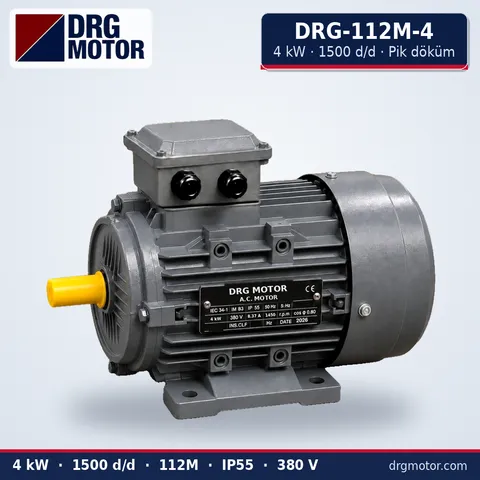
4 kW Three-Phase Motor 1500 rpm – DRG-112M-4 Cast Iron
- 4 kW · 1500 rpm (4 poles)
- Cast iron frame · IEC 112M
- Shaft: 28 × 60 mm
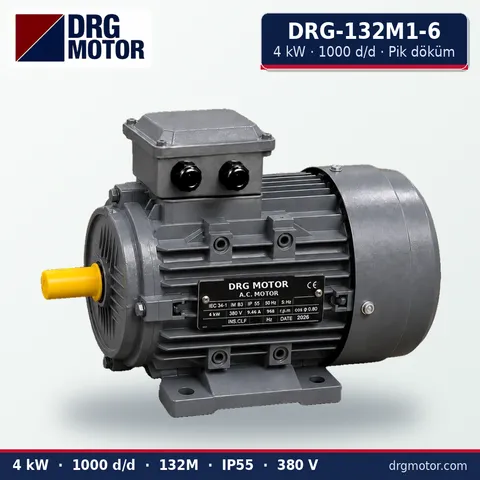
4 kW Three-Phase Motor 1000 rpm – DRG-132M1-6 Cast Iron
- 4 kW · 1000 rpm (6 poles)
- Cast iron frame · IEC 132M
- Shaft: 38 × 80 mm





