 English
 Le français
 Türkçe


You obtain the load inertia for an asynchronous electric motor from the manufacturer of the machine the motor will drive: the figure you need belongs not to the motor but to the rotating mass of the driven equipment (fan, pump, conveyor, centrifuge, mill). Ask the machine maker, "can you give the load inertia referred to the motor shaft as GD² (kg·m²) or J (kg·m²)?" and, if there is a gearbox or a pulley, ask for the speed ratio too. With those two numbers it can be seen in advance whether the motor will start that load safely.
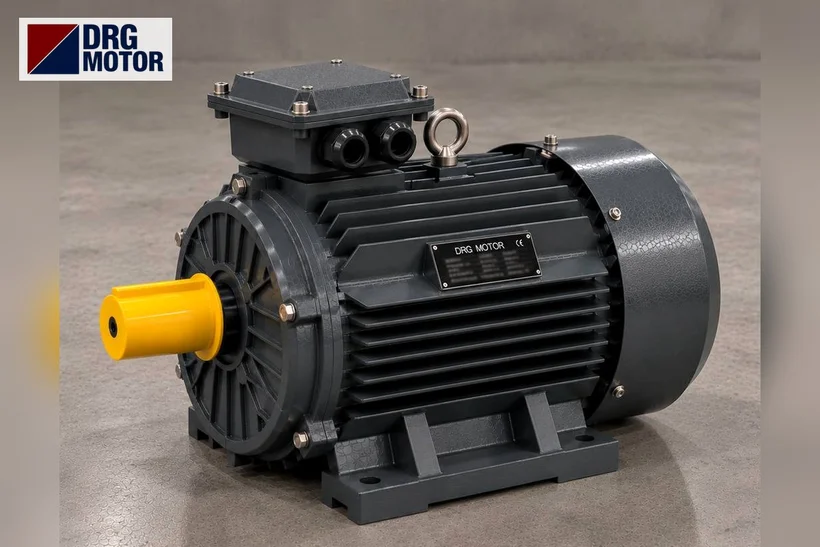
DRG Motor is a manufacturer, supplier and seller of electric motors. Based in İzmir, it ships quickly across all of Türkiye, that province included. Choose the right power and speed in the online electric motor shop and see the same products together in the three-phase asynchronous electric motors category.
What is load inertia (GD²/J)?
Inertia is a rotating mass's resistance to being accelerated. Two notations are in circulation. J is the moment of inertia, in kg·m². GD², an older but still common term, is the "flywheel effect", also given in kg·m². They describe the same physical quantity differently: because GD² is built on diameter (D) and J on radius, they are linked by GD² = 4 · J. So if you receive GD², divide by four for J; if you receive J, multiply by four for GD². Machine catalogues usually print GD², while motor plates and datasheets give J, so knowing this conversion makes life easier.
Why is this number needed at starting?
When an asynchronous electric motor is first energised from standstill, it has to bring both its own rotor and the attached load from zero up to speed. The larger the load inertia, the longer acceleration takes. A longer start means the motor draws several times its rated current for longer, and that current heats the winding. Load inertia therefore directly sets both the start time and how much the winding heats during that start. When the manufacturer knows this number, it can calculate in advance whether the chosen motor can turn the load within the allowed time and temperature limits.
What exactly to request from the machine maker
Be precise on the phone or by e-mail. The items to ask for are:
- Load inertia: "J (kg·m²) or GD² (kg·m²) referred to the motor shaft". The "referred to" part matters; the reason is below.
- Speed ratio: if a gearbox, belt-pulley or chain sits in between, the ratio between drive and working speed. For example, motor 1500 rpm and work shaft 375 rpm give a ratio of 4.
- Load torque curve: the counter-torque the load applies to the shaft during the start (low then rising on a fan or pump, high from the start on a conveyor).
- Expected starts per hour: how often will the line stop and start? Frequent starting makes the inertia calculation critical.
The machine maker usually keeps these values in the machine catalogue or project file. If they struggle to provide them, ask for the mass and dimensions of the rotating parts; inertia can be calculated from that data.
Click to see current electric motor prices and order nowSEE PRICES →
Referred inertia: when a gearbox or pulley is involved
If the load is not coupled directly to the motor shaft, the load's own inertia is not the inertia the motor sees. A speed-reducing transmission shrinks the load inertia on the motor side. The rule is simple: the inertia referred to the motor equals the load inertia divided by the square of the speed ratio. If the ratio is i, then Jmotor = Jload / i². With a ratio of 4, a large inertia on the load side reflects to the motor shaft as one sixteenth. That is exactly why you should ask the machine maker for the number "referred to the motor shaft"; using the raw load inertia directly is misleading.
Example values and DRG models
Below are frequently requested aluminium-frame three-phase asynchronous models in the 1500 rpm class. The inertia ranges are representative; the exact motor rotor inertia is given in the datasheet of the relevant product. You bring the load-side number and we match the right model together.
| Model | Power | Speed | Poles |
|---|---|---|---|
| DRG-90L-4 | 1.5 kW (2 HP) | 1500 rpm | 4 |
| DRG-112M-4 | 4 kW (5.5 HP) | 1500 rpm | 4 |
| DRG-132S-4 | 5.5 kW (7.5 HP) | 1500 rpm | 4 |
| DRG-132M-4 | 7.5 kW (10 HP) | 1500 rpm | 4 |
| DRG-160M-4 | 11 kW (15 HP) | 1500 rpm | 4 |
For a higher-inertia load (a large fan, a centrifuge, a conveyor belt), a 6-pole 1000 rpm model of the same power may also be considered; the lower the speed, the less speed has to be overcome during the start. That choice again needs the load inertia to be known. To see the models on a single page, look at the DRG-132M-4 and DRG-160M-4 product pages.
Step by step: confirming the load inertia
- Collect the brand, model and serial details of the machine you will drive.
- Ask the machine maker for the referred J (kg·m²) or GD² (kg·m²) and the speed ratio.
- If GD² arrives, divide by four for J; if there is a transmission, divide by the square of the ratio to refer it to the motor.
- Send us that value together with the power, speed and starts per hour you want.
- We settle on a suitable model together; if the inertia is borderline we may suggest a step-up in power or a lower speed.
Common mistakes
The most common error is to compare the raw load inertia directly with the motor; if the gearbox or pulley between them is ignored, the number can balloon tenfold or shrink. The second is to skip starts per hour: a load that starts once a month and a line that starts ten times an hour stress the same motor very differently. The third is to mix up GD² and J and create a fourfold error. Where you are unsure, share with us not the raw number but its source (catalogue page, machine datasheet).
Send a photo of your current motor nameplate and we will find the suitable DRG model together.Send on WhatsApp
Click to see electric motors at the power and speed suited to your load inertia and to orderSEE PRICES
Frequently asked questions
Are GD² and J the same thing?
They are two notations of the same physical quantity, both in kg·m². They are linked by GD² = 4 · J; divide GD² by four to get J.
What if the machine maker will not give the load inertia?
Ask for the mass and diameter of the rotating parts; the moment of inertia can be calculated from those dimensions. Do not forget flywheels, pulleys and couplings.
With a gearbox, which inertia should I report?
The value referred to the motor shaft. Divide the load-side inertia by the square of the speed ratio to bring it to the motor side; with a ratio of 4 the divisor is 16.
How do starts per hour affect inertia selection?
Every start loads the winding with heat. With many starts per hour you need a power/speed combination that starts more easily for the same inertia. Always state the expected number of starts.
Electric Motors Related to This Topic — Models and Current Prices
Suitability is not decided by power alone: compare the speed, voltage, mounting, shaft and fixing dimensions of your machine with the product data; if unsure, send us the nameplate of your current motor.
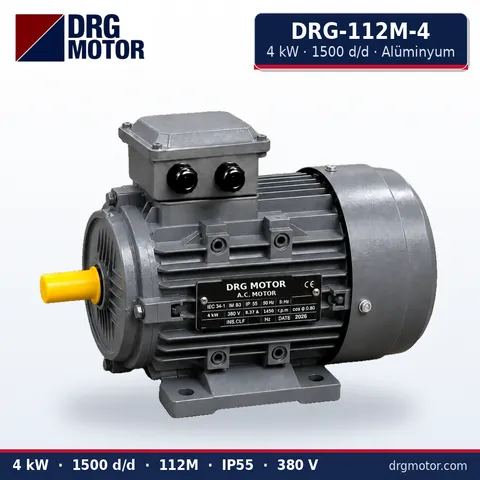
4 kW Three-Phase Motor 1500 rpm – DRG-112M-4 Aluminium
- 4 kW · 1500 rpm (4 poles)
- Aluminium frame · IEC 112M
- Shaft: 28 × 60 mm
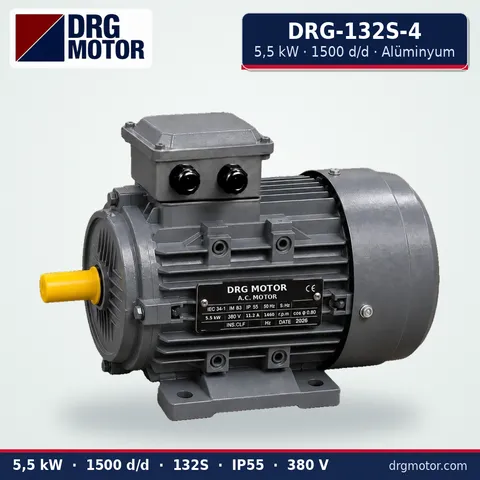
5.5 kW Three-Phase Motor 1500 rpm – DRG-132S-4 Aluminium
- 5.5 kW · 1500 rpm (4 poles)
- Aluminium frame · IEC 132S
- Shaft: 38 × 80 mm
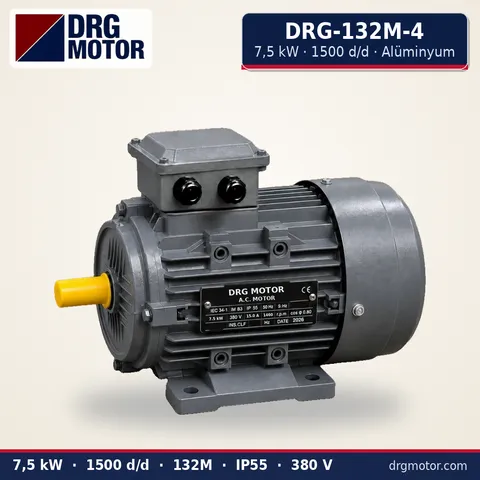
7.5 kW Three-Phase Motor 1500 rpm – DRG-132M-4 Aluminium
- 7.5 kW · 1500 rpm (4 poles)
- Aluminium frame · IEC 132M
- Shaft: 38 × 80 mm
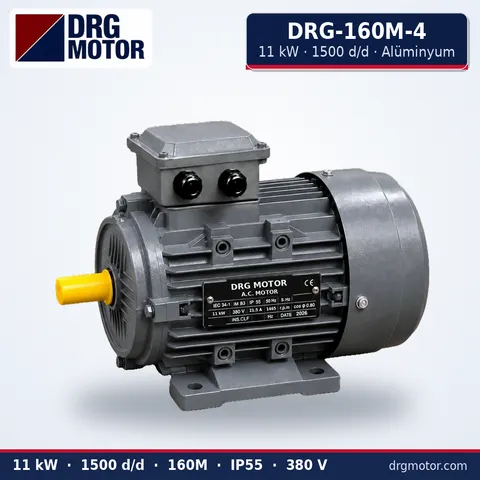
11 kW Three-Phase Motor 1500 rpm – DRG-160M-4 Aluminium
- 11 kW · 1500 rpm (4 poles)
- Aluminium frame · IEC 160M
- Shaft: 42 × 110 mm
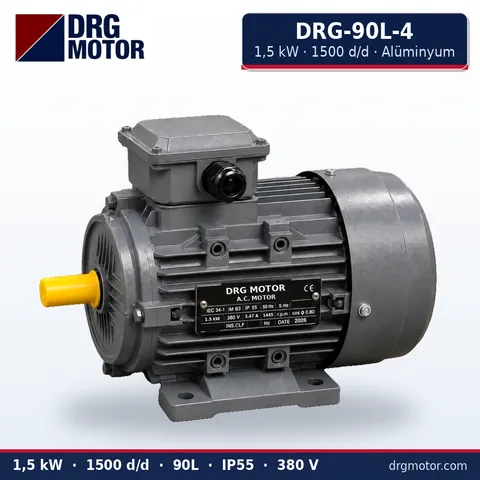
1.5 kW Three-Phase Motor 1500 rpm – DRG-90L-4 Aluminium
- 1.5 kW · 1500 rpm (4 poles)
- Aluminium frame · IEC 90L
- Shaft: 24 × 50 mm