 English
 Le français
 Türkçe


Measure the voltage at the motor's own terminal box — that is, at the very end of the feeder cable — during the start. Even if the reading looks fine at the panel outgoing, voltage lost along a long run means the motor receives less; the only way to know what the motor actually sees is to measure at the end of the line while the shaft is loaded and the start is in progress.
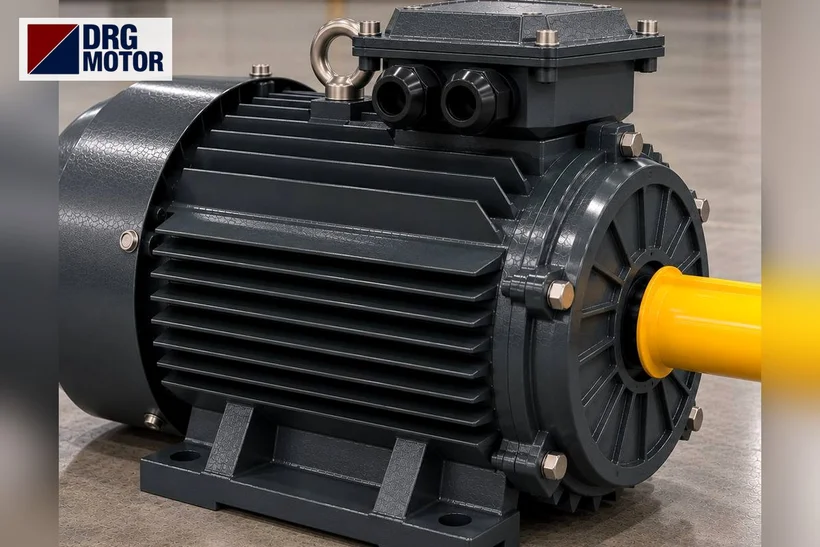
DRG Motor is a manufacturer, supplier and seller of electric motors. It is based in İzmir and ships quickly across all of Türkiye, that province included. Once you have assessed your feeder and its starting behaviour, compare the right power and speed in the online electric motor shop and see the same range together in the three-phase asynchronous electric motors category.
Why at the motor terminals, not the panel?
Between the panel outgoing and the motor terminals there are metres — sometimes well over a hundred — of cable. That cable's resistance is not zero. As current flows, a difference builds up between its two ends; this is the voltage drop. You read 400 V at the panel, but the motor at the far end sees what remains after the part lost in the cable. What governs the motor's performance, heating and starting behaviour is the voltage arriving at the terminals, not the panel figure. So the correct answer to "is the voltage enough?" comes only from a measurement at the end of the line.
Why does the drop grow at start-up?
When an asynchronous electric motor first starts, it draws a starting current several times its running current. As the current rises, the voltage drop in the cable rises in proportion — the drop tracks the current. A conductor cross-section that causes no trouble in "normal" running can collapse the voltage noticeably during those few seconds of starting. The motor accelerates slowly, torque falls, and under a heavy load it may not start at all. That is why you take the reading while the motor is actually starting, not in the quiet no-load moment; the problem shows up right there.
Which points, in what order?
To sharpen the diagnosis, compare three points. Panel incoming: the voltage the supply brings to the panel. Panel outgoing (below the contactor): the value before the cable run. Motor terminals: the voltage the motor actually sees at the end of the line. Watch all three through the start and you see where the drop concentrates. The gap between panel incoming and outgoing points to the supply/panel side; the gap between panel outgoing and terminals points to the feeder cable. That split tells you whether to look at the cable or at the source.
Click to see current electric motor prices and order nowSEE PRICES →
What does a long run change?
The longer the run, the higher the cable resistance and the larger the drop. Two factors dominate: distance and conductor cross-section. The longer the line, the greater the drop; the larger the cross-section, the smaller it is. The same motor that starts cleanly on a short, thick run can struggle on a long, thin one. Imposing an exact cross-section here is wrong; the section is engineered to the motor's nameplate current, the run length and the installation's own conditions. For a rough pre-check, the shop aside, matching nameplate data to the cable is the sound route.
Example values on DRG three-phase models
To gauge the load on the line, start from the motor's power and nameplate voltage; as current rises, so does the drop along the run. A few commonly used DRG aluminium-body, 1500 rpm four-pole models:
| Model | Power (kW) | Speed (rpm) | Voltage |
|---|---|---|---|
| DRG-90L-4-AL | 1.5 | 1500 | 230/400 V |
| DRG-112M-4-AL | 4 | 1500 | 400/690 V |
| DRG-132S-4-AL | 5.5 | 1500 | 400/690 V |
| DRG-132M-4-AL | 7.5 | 1500 | 400/690 V |
| DRG-160M-4-AL | 11 | 1500 | 400/690 V |
The values are for guidance; the real choice depends on load and line conditions. You can review the models by power and speed in the electric motor shop.
Common mistakes and safety
A voltage measurement may require working inside the panel under power. Let a qualified electrician do the work; de-energise wherever possible and confirm the absence of voltage, and where a live measurement is unavoidable, proper personal protective equipment and correct method are essential. Do not impose fixed threshold figures; assess the acceptable voltage range against the motor's nameplate and the relevant equipment documentation. Common mistakes: measuring only at no load and missing the start, looking only at the panel and never at the line end, reading one of the three phases and skipping the others, and treating the starting voltage as the same as the running voltage.
Choose a three-phase motor sized for your line and load — review the modelsSEE PRICES
Send a photo of your current motor nameplate and we will find the suitable DRG model together.Send on WhatsApp
Frequently asked questions
Can I measure the voltage after the start instead?
No. The problem appears exactly at start-up with the large current. Once the motor is up to speed the current falls and so does the drop; you would miss the starting value. For diagnosis you must watch the reading throughout the run-up.
The panel voltage is correct — why does the motor struggle?
Because the motor sees the voltage at the end of the line, not at the panel. Even with a correct panel reading, on a long or thin cable the starting current enlarges the drop and the terminals receive less. Measuring at the terminals is essential to confirm the diagnosis.
Should I measure all three phases?
Yes. If there is imbalance between phases, a single-phase reading will not reveal it. Watching all three together exposes both the drop and any phase imbalance.
If the drop is high, what do I check first?
The line length and the conductor cross-section. On long, thin runs a drop is expected; the definitive fix depends on proper engineering and should be assessed by qualified personnel.
Electric Motors Related to This Topic — Models and Current Prices
Suitability is not decided by power alone: compare the speed, voltage, mounting, shaft and fixing dimensions of your machine with the product data; if unsure, send us the nameplate of your current motor.
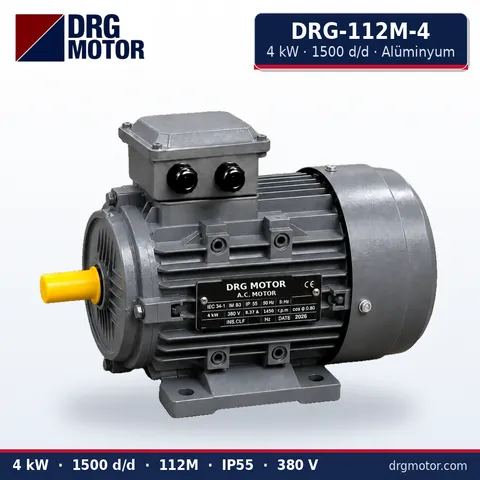
4 kW Three-Phase Motor 1500 rpm – DRG-112M-4 Aluminium
- 4 kW · 1500 rpm (4 poles)
- Aluminium frame · IEC 112M
- Shaft: 28 × 60 mm
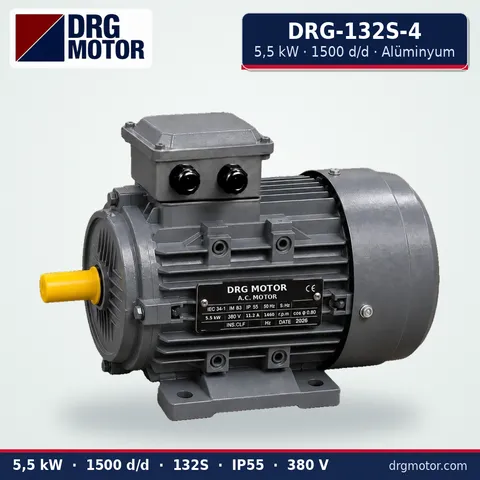
5.5 kW Three-Phase Motor 1500 rpm – DRG-132S-4 Aluminium
- 5.5 kW · 1500 rpm (4 poles)
- Aluminium frame · IEC 132S
- Shaft: 38 × 80 mm
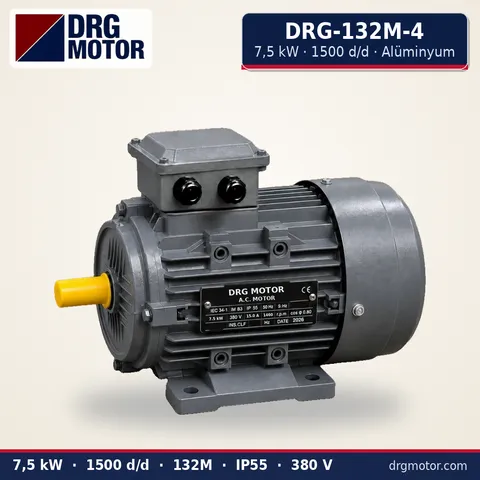
7.5 kW Three-Phase Motor 1500 rpm – DRG-132M-4 Aluminium
- 7.5 kW · 1500 rpm (4 poles)
- Aluminium frame · IEC 132M
- Shaft: 38 × 80 mm
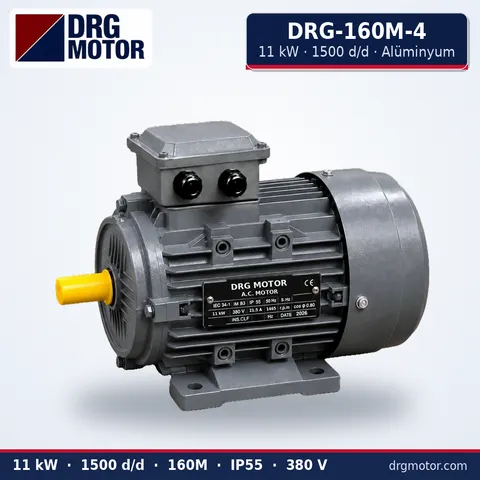
11 kW Three-Phase Motor 1500 rpm – DRG-160M-4 Aluminium
- 11 kW · 1500 rpm (4 poles)
- Aluminium frame · IEC 160M
- Shaft: 42 × 110 mm
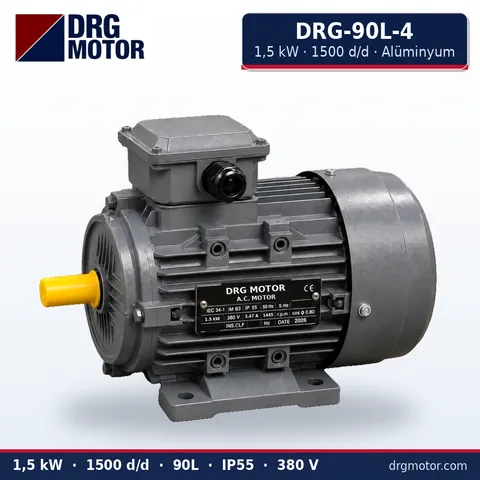
1.5 kW Three-Phase Motor 1500 rpm – DRG-90L-4 Aluminium
- 1.5 kW · 1500 rpm (4 poles)
- Aluminium frame · IEC 90L
- Shaft: 24 × 50 mm