English
 Le français
 Türkçe




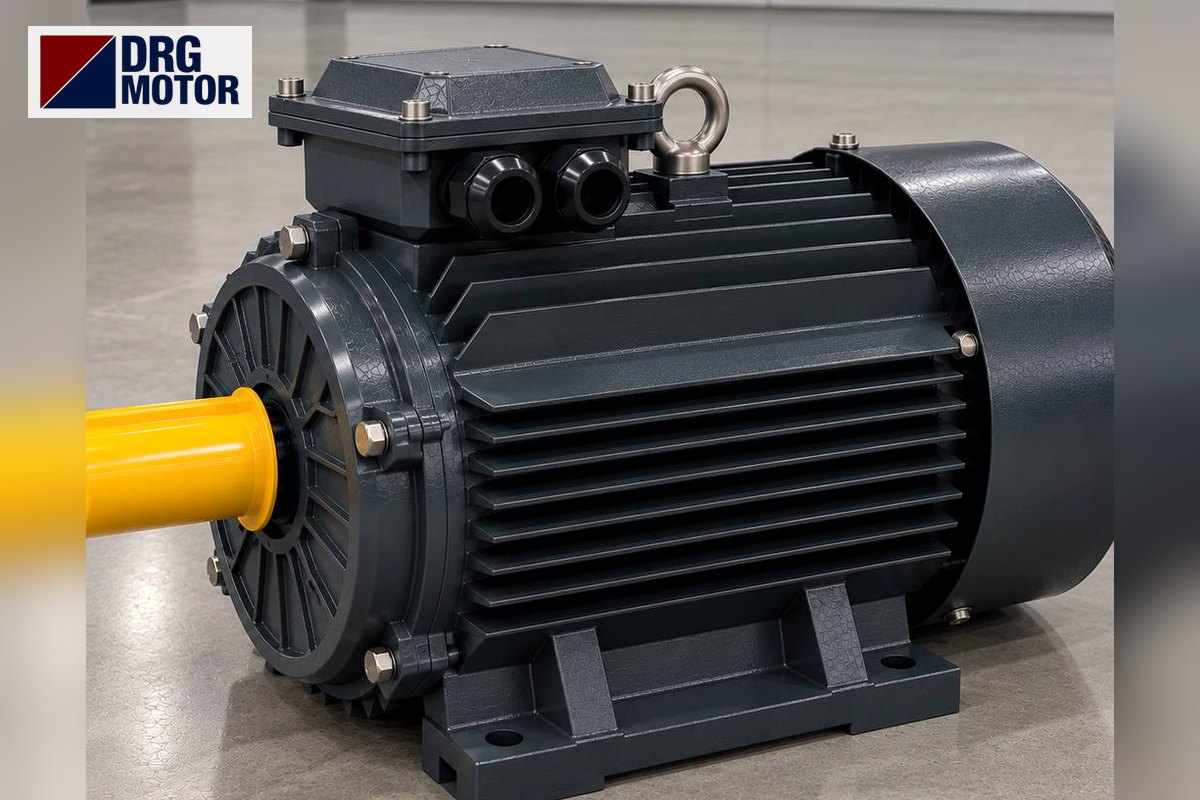

The current a 380 V three-phase electric motor draws is roughly set by its power: a 4 kW model pulls around 8 amps at rated load, a 7.5 kW around 14 amps and an 11 kW around 20 amps. The exact figure is on the motor nameplate; below we show how to read it and why current changes with power.
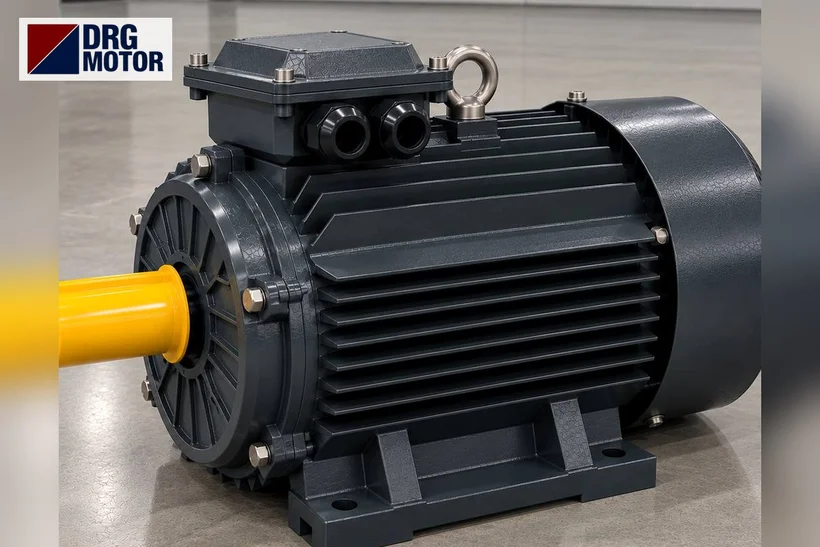
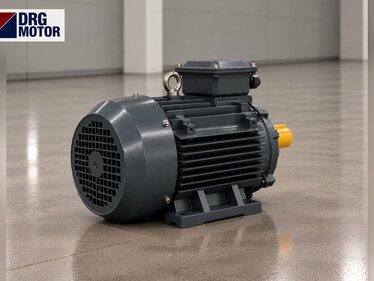
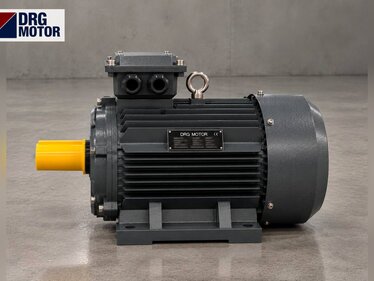
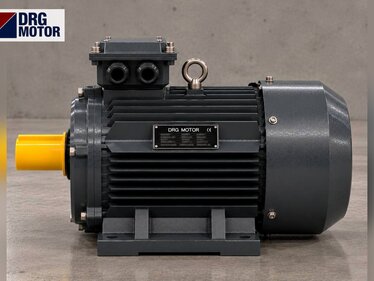
DRG Motor is a manufacturer, supplier and seller of electric motors. To see current values on real models, browse the online electric motor shop, and compare all the power steps in the three-phase asynchronous electric motors category.
380 V or 400 V? Which is on the nameplate?
This is a point that often confuses people. The grid used to be called 380 V; the standard moved to 400 V, yet out of habit people still say "380 volt electric motor". In practice they are the same class. DRG\u2019s three-phase models are wound 400/690 V (Δ/Y) and connect in delta on the common 400 V three-phase supply. The rated current on the label is given for that 400 V; the small voltage difference does not change the current noticeably.
The formula behind current: I = P / (\u221a3 \u00b7 U \u00b7 cos\u03c6 \u00b7 \u03b7)
The link that gives the rated line current in three phase is:
I = P / (\u221a3 \u00b7 U \u00b7 cos\u03c6 \u00b7 \u03b7)
Here P is shaft power in watts, U the line-to-line voltage (400 V), cos\u03c6 the power factor and \u03b7 the efficiency. In a three-phase asynchronous electric motor cos\u03c6 at rated load is usually around 0.8; efficiency is high too, so a rough calculation lands close to the real nameplate current. For a 4 kW model, once you bring in √3, the 400 V and a power factor near 0.8, the current settles around 8 amps. So the "about how much does it draw?" question can be estimated from power alone; but when you build the panel you work from the real nameplate value, not an estimate.
Click to see current electric motor prices and order nowSEE PRICES →
Rated current by power: the DRG 1500 rpm table
Below are the real 400 V rated currents of the most common 4-pole (1500 rpm) DRG electric motors. Each model code opens its product page; the values come from the motors\u2019 own nameplate data.
| Power | Rated current (400 V) | Speed | Model |
|---|---|---|---|
| 4.0 kW (5.5 HP) | 7.95 A | 1500 rpm | DRG DRG-112M-4 |
| 5.5 kW (7.5 HP) | 10.7 A | 1500 rpm | DRG DRG-132S-4 |
| 7.5 kW (10 HP) | 14.3 A | 1500 rpm | DRG DRG-132M-4 |
| 11.0 kW (15 HP) | 20.4 A | 1500 rpm | DRG DRG-160M-4 |
A rough rule of thumb also helps: at 400 V a 4-pole electric motor draws roughly 1.8\u20132 amps per kW. Still, that is only a first estimate. You can see all values at other powers and speeds together in our motor current chart.
Does speed change the current at the same power?
Yes, slightly. The same rated power is built with different pole counts (speeds), and since this shifts power factor and efficiency a little, it also moves the current. For example, in DRG the 4 kW rating draws about 7.45 A at 3000 rpm (2-pole), 7.95 A at 1500 rpm (4-pole) and 8.99 A at 1000 rpm (6-pole) on 400 V. So as speed falls, current at the same power rises a little. The gap is small, but when choosing the thermal relay and the cable you must use this real value.
Starting current: hidden on the label but critical
The rated current discussed so far is what the motor draws once it is settled on the load and running steadily. At the first start it is different: an asynchronous electric motor pulls several times its rated current for a short moment as it comes on line. That is why direct-on-line starting strains the supply at larger ratings and star-delta or a soft starter is preferred. The protection device is chosen with this starting surge in mind too; otherwise the motor trips the protection at every start.
Why are the thermal relay and cable sized by rated current?
Knowing the current is not for curiosity; it is needed to build the panel right. Two things depend directly on the rated current:
- Thermal protection (overload relay): set to the motor\u2019s rated current. Set too high, protection is late while the winding overheats; set too low, it trips for no reason.
- Cable cross-section: chosen to carry the drawn current without overheating. A thin cable heats and causes voltage drop; an oversized one is wasted cost.
So the setting and the cross-section are set to the real nameplate current, not an estimated power figure. For a start, our cable size calculator gives direction, and you can sketch the power-speed-current balance with the electric motor calculator. Always set the exact value to the motor nameplate and device documentation; before connecting, cut the power, verify isolation and leave the work to authorised electrical staff.
Choosing the electric motor at the right power
Current is, in the end, an output of power and speed. So the right choice starts not from "how many amps does it draw" but from "what power and speed does my machine need". Once power and speed are clear, you read the current on that model\u2019s nameplate and build the panel to it. If you are replacing an existing motor, the most practical way is to photograph the old nameplate and send it to us; we read power, speed and current together and identify the suitable DRG model.
You can pick the fitting model in the electric motor shop by power and speed, and see alternatives in the same power class side by side. DRG Motor is based in İzmir and delivers fast by carrier to all of Türkiye, that city included.
Send a photo of your current motor nameplate and we will find the suitable DRG model together.Send on WhatsApp
See the current options for the electric motor at the power you need in the shop.SEE PRICES
Frequently asked questions
How many amps does a 380 V electric motor draw?
It depends on the power. On 400 V a 4-pole motor follows a rough rule of about 1.8\u20132 amps per kW: 4 kW ≈ 8 A, 7.5 kW ≈ 14 A, 11 kW ≈ 20 A. The exact value is on the motor nameplate.
How do I calculate current from power?
With I = P / (√3 · U · cos\u03c6 · \u03b7). P is power in watts, U is 400 V, cos\u03c6 is taken as about 0.8. The result gives an estimate close to the real nameplate current.
Why do I see different current values at the same power?
Because current depends not only on power but on speed (pole count). As speed falls, current at the same power rises a little; so use the motor\u2019s own nameplate value.
Which current should I set the thermal relay to?
To the rated current on the motor nameplate. Use that motor\u2019s real nameplate current rather than an estimate; check the device documentation for the exact setting and have the work done by authorised staff.
Electric Motors Related to This Topic — Models and Current Prices
Suitability is not decided by power alone: compare the speed, voltage, mounting, shaft and fixing dimensions of your machine with the product data; if unsure, send us the nameplate of your current motor.
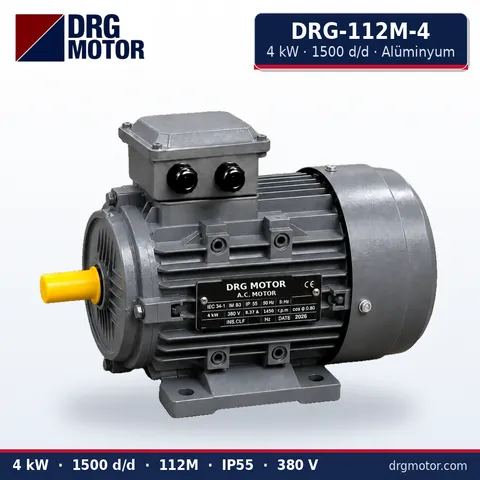
4 kW Three-Phase Motor 1500 rpm – DRG-112M-4 Aluminium
- 4 kW · 1500 rpm (4 poles)
- Aluminium frame · IEC 112M
- Shaft: 28 × 60 mm
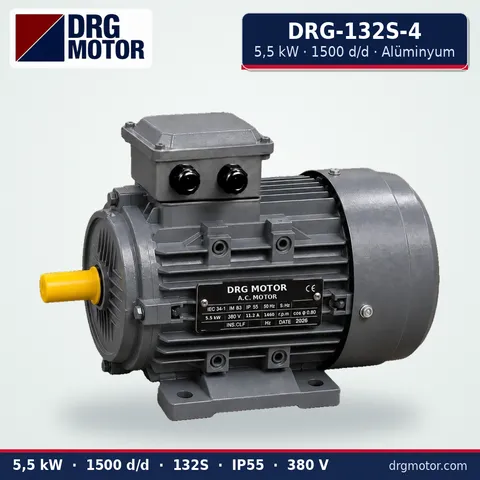
5.5 kW Three-Phase Motor 1500 rpm – DRG-132S-4 Aluminium
- 5.5 kW · 1500 rpm (4 poles)
- Aluminium frame · IEC 132S
- Shaft: 38 × 80 mm
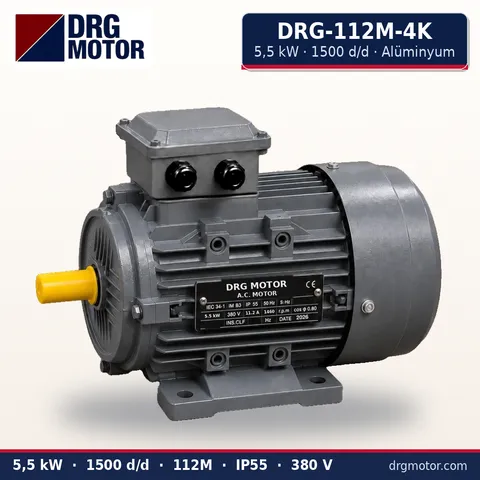
5.5 kW Compact Three-Phase Motor 1500 rpm – DRG-112M-4K Aluminium
- 5.5 kW · 1500 rpm (4 poles)
- Aluminium frame · IEC 112M
- Shaft: 28 × 60 mm
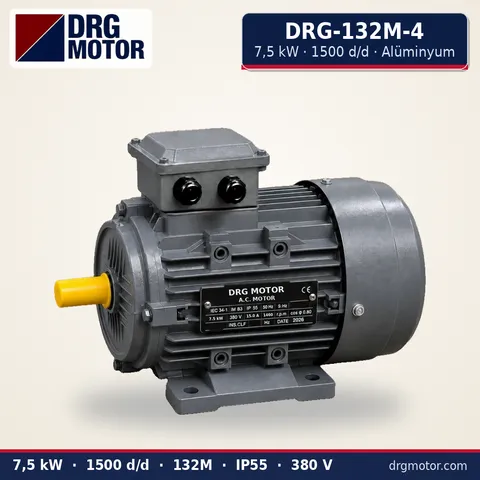
7.5 kW Three-Phase Motor 1500 rpm – DRG-132M-4 Aluminium
- 7.5 kW · 1500 rpm (4 poles)
- Aluminium frame · IEC 132M
- Shaft: 38 × 80 mm
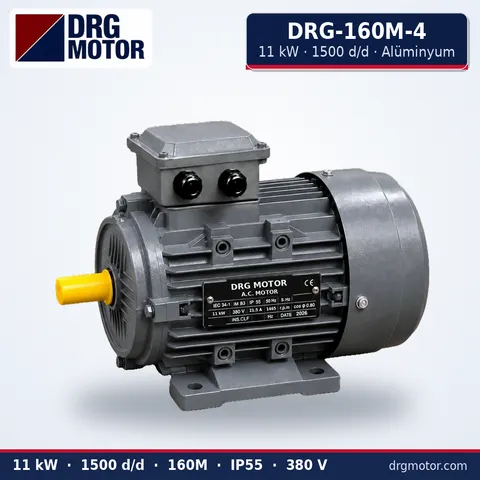
11 kW Three-Phase Motor 1500 rpm – DRG-160M-4 Aluminium
- 11 kW · 1500 rpm (4 poles)
- Aluminium frame · IEC 160M
- Shaft: 42 × 110 mm
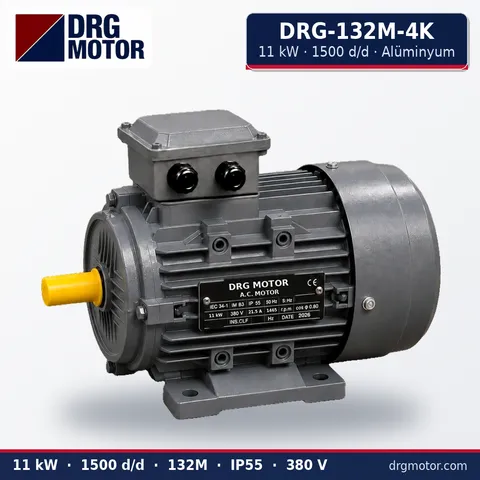
11 kW Compact Three-Phase Motor 1500 rpm – DRG-132M-4K Aluminium
- 11 kW · 1500 rpm (4 poles)
- Aluminium frame · IEC 132M
- Shaft: 38 × 80 mm