 English
 Le français
 Türkçe




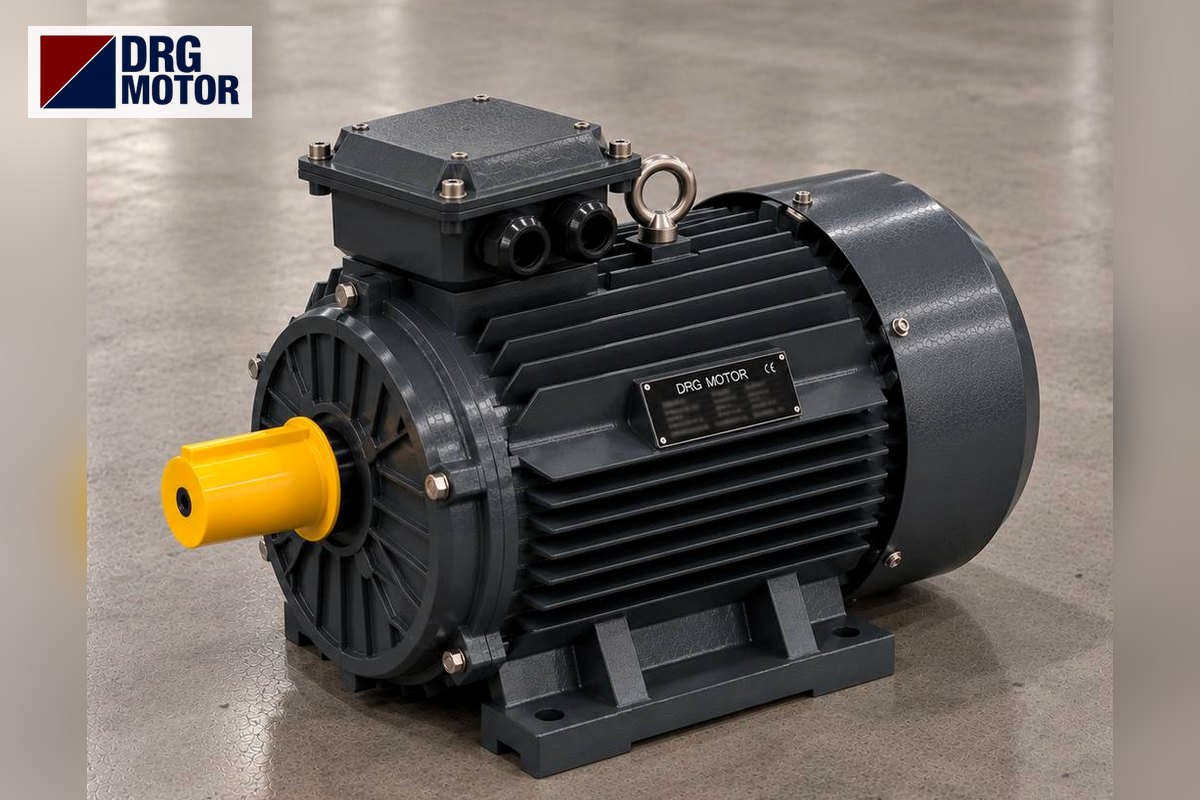

A 37 kW three-phase asynchronous electric motor is the typical workhorse of the 50 HP class and draws roughly 64–68 amps from the grid depending on the number of poles. It runs on a 380/400 V industrial supply; because of its size the winding is designed for 400/690 V (Δ/Y) and in most plants it is started with a star-delta starter.
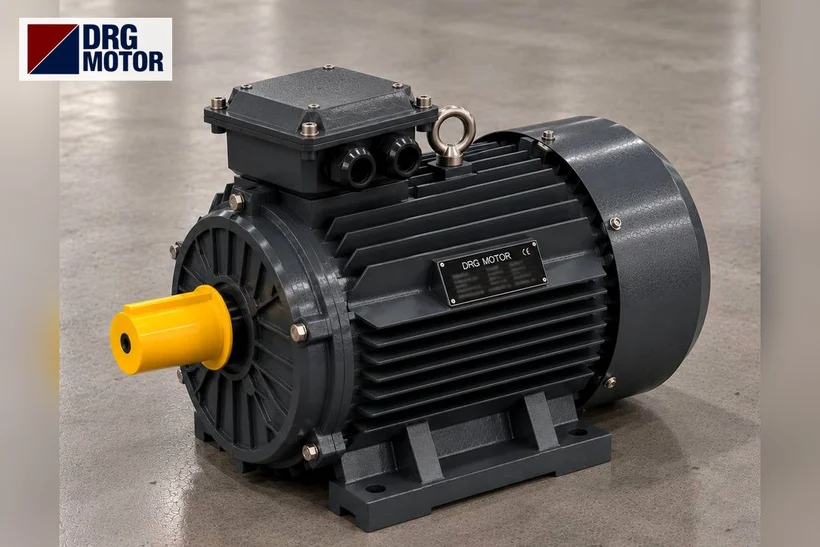
DRG Motor is a manufacturer, supplier and seller of electric motors. It is based in İzmir and ships quickly across all of Türkiye, that province included. You can compare the three speed options in the 37 kW class (3000 / 1500 / 1000 rpm) in the online electric motor shop and see the same product family together in the three-phase asynchronous electric motors category.
Where does 37 kW come in?
This rating is no longer a small workshop job. A 37 kW electric motor appears in screw air compressors, feed and flour mills, large centrifugal pumps, conveyor and crusher lines, plastic injection and granulating machines. The common thread is a high, continuous load. So the choice of a 37 kW is decided not only by power but by speed and shaft size.
50 HP is roughly 37 kW (1 HP ≈ 0.746 kW). Both appear on the nameplate; look for the value where your machine's requirement and the rating meet.
Poles, speed and current are read together
The same 37 kW is built in three pole counts. As poles increase the speed drops and torque rises, while the current changes slightly with speed. The values below belong to DRG's cast-iron models and are for 400 V.
| Poles | Speed | Current (400 V) | Shaft (D×E) |
|---|---|---|---|
| 2-pole | 3000 rpm | 64.0 A | 55x110 mm |
| 4-pole | 1500 rpm | 66.1 A | 60x140 mm |
| 6-pole | 1000 rpm | 68.1 A | 65x140 mm |
Synchronous speed is a simple ratio: 3000 rpm at two poles, 1500 rpm at four, 1000 rpm at six. Under load the motor turns slightly below this; the difference is slip and is normal.
Click to see current electric motor prices and order nowSEE PRICES →
380 V, 400 V or 690 V?
This is what confuses people most. "380 volts" is an old habit for the Türkiye grid in everyday speech; in the IEC standard the value is 400 V. So the electric motor you search for as 380 V and the 400 V model are the same machine. What is different at 37 kW is the plate: because the power is larger, the winding is no longer 230/400 V but 400/690 V (Δ/Y). Delta (Δ) corresponds to a 400 V supply, star (Y) to a 690 V supply.
Why start with star-delta?
If 37 kW is started direct-on-line, it draws a current well above the rated value at the first moment of starting, stressing both the grid and the connected mechanics. So in this rating a star-delta starter, soft starter or drive is usually preferred: the motor starts in star at a lower current and switches to delta once it gains speed. The key detail is that to run star-delta on a 400 V supply the running connection must be delta; a motor marked 400/690 V runs in delta at 400 V and is suitable for star-delta starting.
Connection and starter choice is panel work. Isolate the supply, verify it is de-energised and have this done by qualified electrical personnel; set the thermal and starter according to the motor nameplate and the device documentation.
Frame and shaft: cast iron in this class
Aluminium frames are common at small ratings, but at 37 kW things change: in this class the DRG models are cast-iron (GG) framed. Cast iron carries high torque and vibration better and keeps dimensional stability under coupling and belt loads. Note that the shaft diameter grows with speed: from 55x110 mm at two poles to 65x140 mm at six. If you will fit a coupling, pulley or gearbox, this dimension matters directly.
The IEC frame also changes with speed: 200L at two poles, 225S at four, 250M at six. If you are replacing an old motor and the foot holes or shaft centre height do not match, mounting becomes a problem; so match not only the power but the frame code.
37 kW DRG models
All three models below are 37 kW; the difference is speed, current and frame. Each code links straight to the product page. If you hesitate over the right speed, the motor current chart and electric motor calculator tools help.
| Model | Speed | Current (400 V) | IEC |
|---|---|---|---|
| DRG-200L2-2-GG | 3000 rpm | 64.0 A | 200L |
| DRG-225S-4-GG | 1500 rpm | 66.1 A | 225S |
| DRG-250M-6-GG | 1000 rpm | 68.1 A | 250M |
To see the speed options and current price of the 37 kW electric motor, visit the shop.SEE PRICES
Frequently asked questions
How many HP is 37 kW?
Roughly 50 HP. The conversion uses 1 HP ≈ 0.746 kW; 37 ÷ 0.746 is about 49.6, commonly called 50 HP in practice.
How many amps does a 37 kW motor draw at 380 V?
It varies with speed: at 400 V about 64.0 A at two poles, 66.1 A at four and 68.1 A at six. 380 V and 400 V describe the same grid; cable size and protection are chosen for this current.
Can I start 37 kW direct-on-line?
Although technically possible, the inrush current is very high at this rating; a star-delta starter, soft starter or drive is usually preferred. The exact method is decided for the machine by the qualified personnel who build your panel.
Which should I choose between 2, 4 and 6 poles?
Look at the speed your machine needs: 3000 rpm for high speed (compressors, some pumps), 1500 rpm for medium speed, 1000 rpm for high torque / low speed (mills, crushers). If unsure, describe the machine and we will clarify it together.
Send a photo of your current motor nameplate and we will find the suitable DRG model together.Send on WhatsApp
Electric Motors Related to This Topic — Models and Current Prices
Suitability is not decided by power alone: compare the speed, voltage, mounting, shaft and fixing dimensions of your machine with the product data; if unsure, send us the nameplate of your current motor.
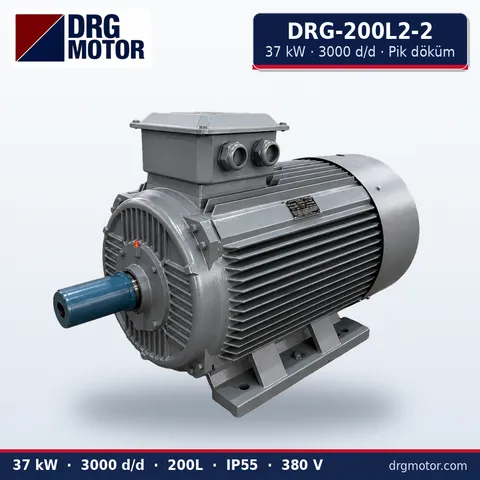
37 kW Three-Phase Motor 3000 rpm – DRG-200L2-2 Cast Iron
- 37 kW · 3000 rpm (2 poles)
- Cast iron frame · IEC 200L
- Shaft: 55 × 110 mm
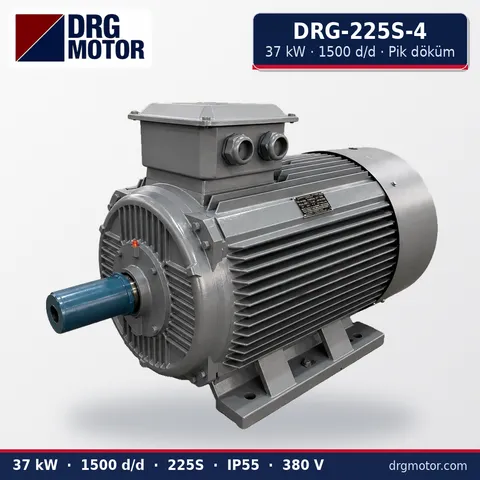
37 kW Three-Phase Motor 1500 rpm – DRG-225S-4 Cast Iron
- 37 kW · 1500 rpm (4 poles)
- Cast iron frame · IEC 225S
- Shaft: 60 × 140 mm
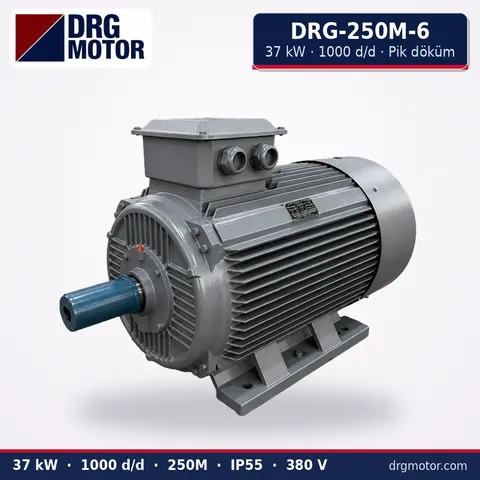
37 kW Three-Phase Motor 1000 rpm – DRG-250M-6 Cast Iron
- 37 kW · 1000 rpm (6 poles)
- Cast iron frame · IEC 250M
- Shaft: 65 × 140 mm





