 English
 Le français
 Türkçe




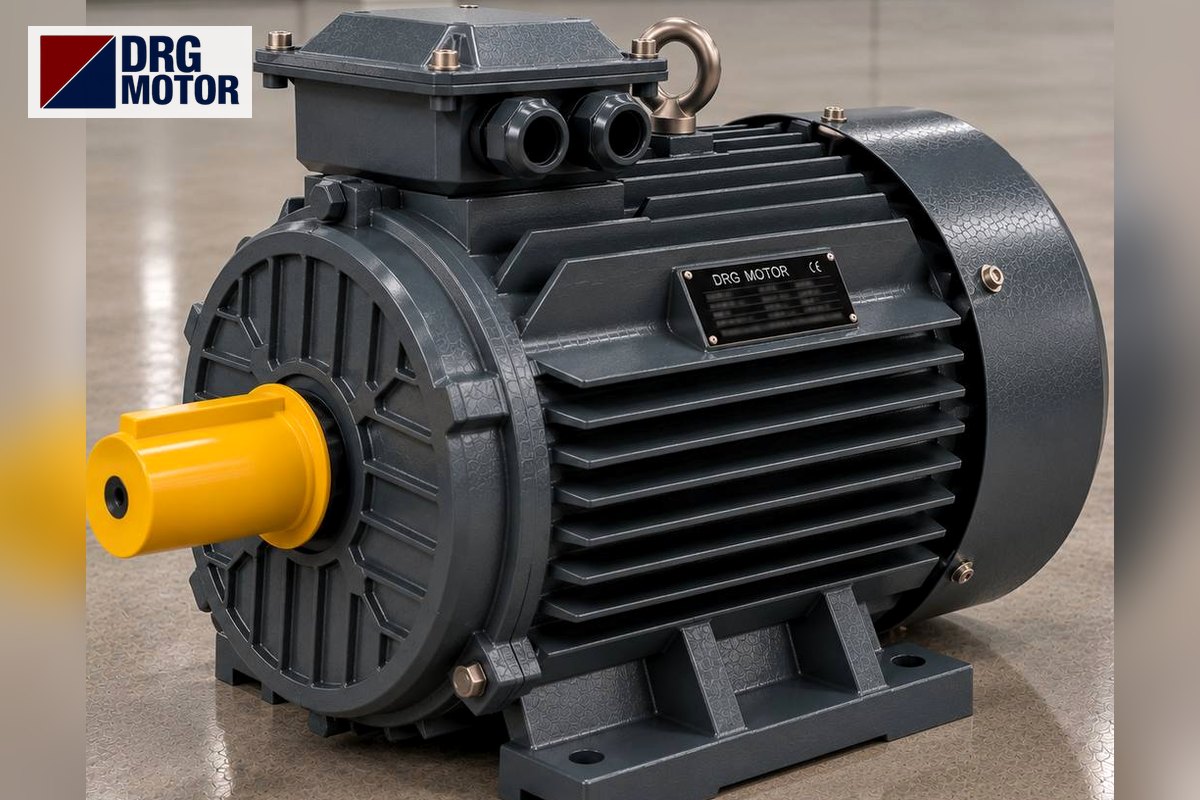

A 30 kW three-phase asynchronous electric motor on a 380 V supply draws roughly 52–57 A depending on the number of poles, and is offered at 3000, 1500 or 1000 rpm. Wiring follows the 400/690 V (delta/star) nameplate; at this rating you start it with star-delta or a soft starter rather than direct-on-line.
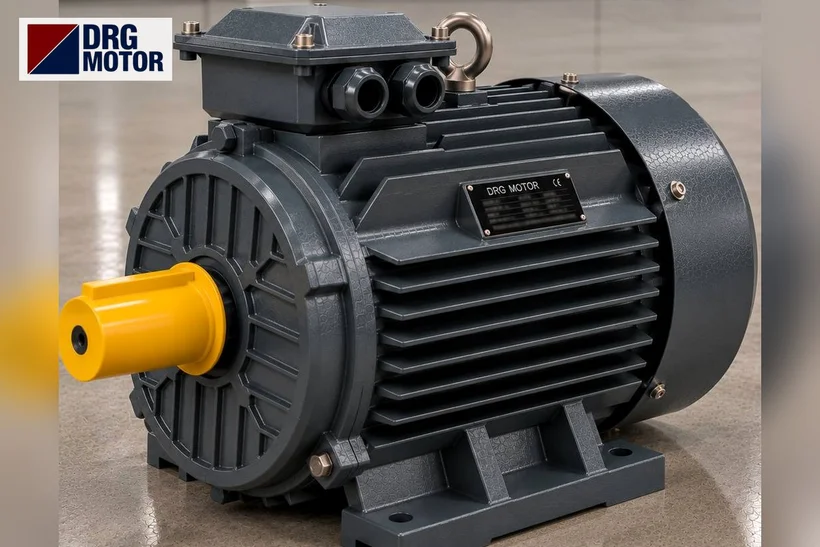
DRG Motor is a manufacturer, supplier and seller of electric motors. Based in İzmir, it ships quickly across all of Türkiye. You can browse these 30 kW models by speed and frame in the online electric motor shop and see the whole group in the three-phase asynchronous electric motors category.
380 V or 400 V? Why the plate shows two values
On site people say "380 volts"; the plate usually reads 400 V. They describe the same grid. The European standard set the nominal voltage at 400 V, while the old 380 V habit stuck. So seeing 400/690 V on a 30 kW electric motor you connect to a 380 V panel is perfectly normal. What matters is that the first value (400 V) matches your phase-to-phase supply. There is no separate product to look for by voltage alone; you simply need a standard asynchronous electric motor rated for a 380/400 V three-phase supply.
Current at 30 kW: what changes with the pole count
Even at the same power, current shifts with speed. A slower (higher-pole) electric motor has a slightly lower power factor, so its rated current rises. The real rated currents at 400 V for DRG's 30 kW group are:
| Model | Speed (rpm) | Poles | Current (400 V) |
|---|---|---|---|
| DRG-200L1-2 | 3000 | 2 | 52.1 A |
| DRG-200L-4 | 1500 | 4 | 53.8 A |
| DRG-225M-6 | 1000 | 6 | 56.2 A |
These are full-load currents. The inrush at start is several times higher; don't ignore that gap when sizing cable and protection. To compare values quickly, the motor current chart tool helps.
Click to see current electric motor prices and order nowSEE PRICES →
Choosing the speed: 3000, 1500 and 1000 rpm
The 30 kW electric motor comes in three speeds, and the choice really depends on the machine you drive. Higher speed means a smaller frame; lower speed means a bigger frame and more turning force:
- 3000 rpm (2 poles): Pumps, fans, blowers — fast-spinning loads whose torque rises with speed. Frame 200L, shaft 55x110 mm — view the DRG-200L1-2 model.
- 1500 rpm (4 poles): The most common choice. Conveyors, crushers, compressors, general drive. Frame 200L, shaft 55x110 mm — view the DRG-200L-4 model.
- 1000 rpm (6 poles): Heavy-start, high-torque work; mixers, mills, some crushing-screening lines. Frame 225M, shaft 60x140 mm — view the DRG-225M-6 model.
At the same power, the frame grows as speed drops: the 1000 rpm model steps up to a 225M frame and a thicker 60x140 mm shaft. That shaft difference is critical when ordering couplings and pulleys; confirm the existing plate and shaft diameter when you order.
How much turning force (torque) to expect
For a rough rated torque, T = 9550 × P / n is enough (P in kW, n in rpm). For 30 kW:
| Speed (rpm) | Approx. torque | Typical use |
|---|---|---|
| 3000 | ~96 Nm | Pump, fan |
| 1500 | ~191 Nm | Conveyor, compressor |
| 1000 | ~286 Nm | Mixer, mill |
Power stays constant, yet turning force rises sharply at low speed. Putting a high-speed electric motor on a high-torque machine is a mismatch; the machine will tell you so by struggling and overheating.
Connection: 400/690 V and the star-delta logic
The 30 kW models carry a 400/690 V (Δ/Y) plate. That means: on a 380/400 V grid the windings are wired in delta (Δ); on a 660/690 V grid, in star (Y). On a 380 V panel the correct connection is delta. Direct-on-line starting at this rating pulls a high inrush, so 30 kW is usually commissioned with star-delta starting or a soft starter. In star-delta, the motor starts in star at low current, then switches to delta once it is up to speed.
Safety first, not as a formality: cut the power, verify the absence of voltage by measuring, and have the terminal connection made by qualified electrical personnel. Before building the circuit — star-delta or direct — review current and protection figures with the electric motor calculator.
Where a 30 kW electric motor is used
This rating belongs to medium-to-heavy industry, not the small workshop. Common places: large centrifugal pumps, air compressors, heavy conveyors and belts, crushing-screening plants, chip and waste mills, large fans and extractors. These machines share either high flow or a heavy start; both are solved with the right speed and the right starting method.
What to check when selecting the model
At the ordering stage, nail down three things: the power the machine needs (if 30 kW is right), the required speed (3000/1500/1000) and the frame and shaft size. If an old electric motor comes off the machine, photograph its plate; the frame code (200L/225M), shaft diameter and speed let us match the new model exactly. You can see all three speeds of the 30 kW group side by side in the shop and pick the right one.
To see the current price of the 30 kW electric motor that fits your need, browse the shop.SEE PRICES
Send a photo of your current motor nameplate and we will find the suitable DRG model together.Send on WhatsApp
Frequently asked questions
How many amps does a 30 kW electric motor draw at 380 V?
It depends on speed: at 400 V roughly 52.1 A (3000 rpm), 53.8 A (1500 rpm) and 56.2 A (1000 rpm). These are full-load currents; the inrush at start is much higher.
Can this rating be started direct-on-line?
Technically yes, but it is not advised. At 30 kW the inrush stresses the panel and the grid; star-delta or a soft starter is the healthier way to commission it.
Can I wire a 400/690 V plate motor to a 380 V panel?
Yes. On a 380/400 V grid it is wired in delta (Δ). The 690 V value is for the star connection and belongs to a different supply voltage.
Which speed should I choose?
Look at your machine: 3000 rpm for fast-spinning pumps/fans, 1500 for general drive, 1000 rpm for heavy-torque work. If unsure, let us confirm it together from the machine and plate data.
Electric Motors Related to This Topic — Models and Current Prices
Suitability is not decided by power alone: compare the speed, voltage, mounting, shaft and fixing dimensions of your machine with the product data; if unsure, send us the nameplate of your current motor.
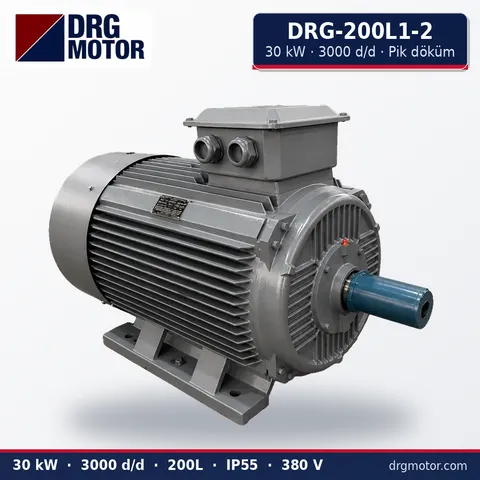
30 kW Three-Phase Motor 3000 rpm – DRG-200L1-2 Cast Iron
- 30 kW · 3000 rpm (2 poles)
- Cast iron frame · IEC 200L
- Shaft: 55 × 110 mm
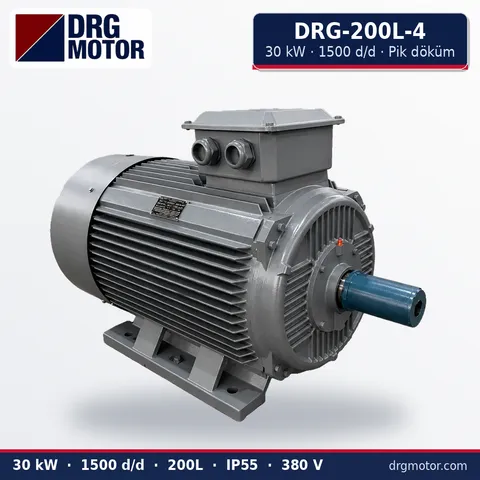
30 kW Three-Phase Motor 1500 rpm – DRG-200L-4 Cast Iron
- 30 kW · 1500 rpm (4 poles)
- Cast iron frame · IEC 200L
- Shaft: 55 × 110 mm
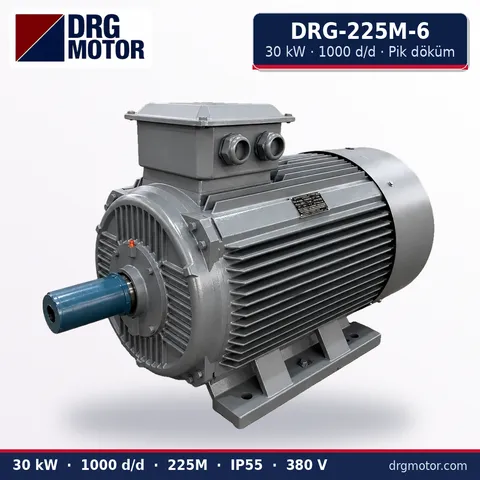
30 kW Three-Phase Motor 1000 rpm – DRG-225M-6 Cast Iron
- 30 kW · 1000 rpm (6 poles)
- Cast iron frame · IEC 225M
- Shaft: 60 × 140 mm





