 English
 Le français
 Türkçe




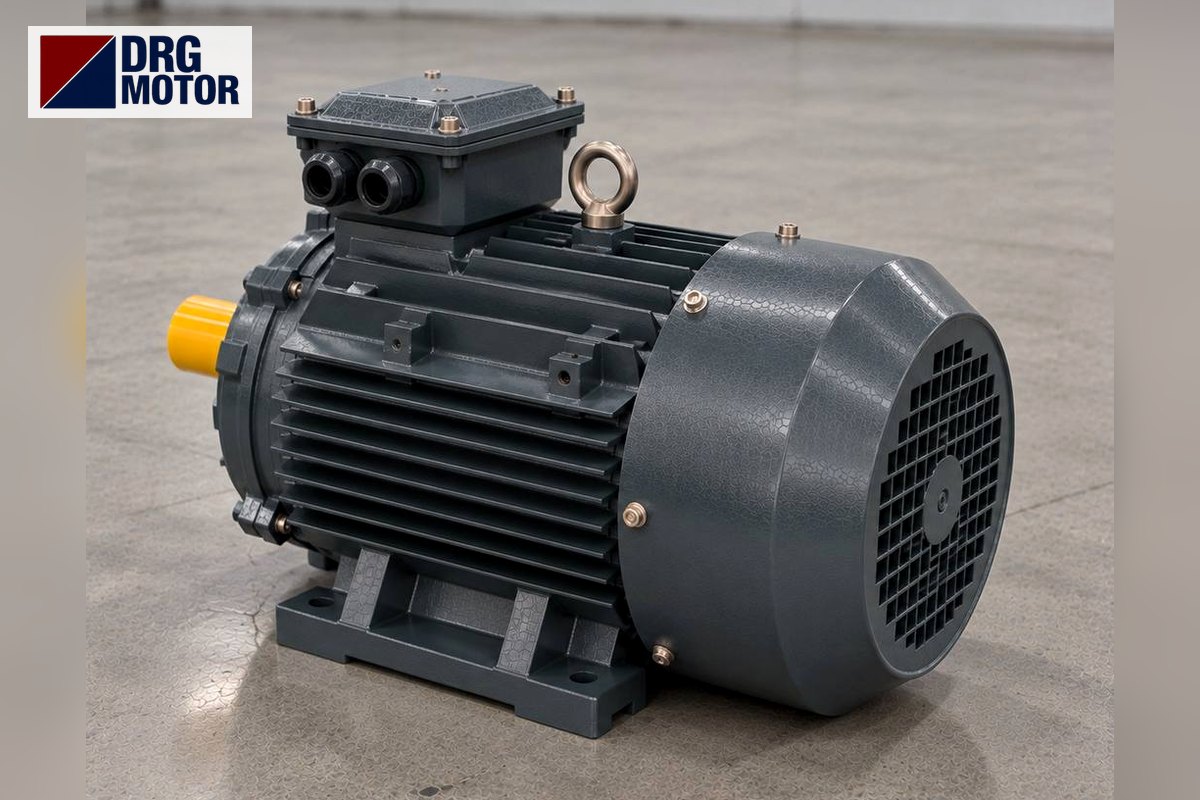

A 22 kW three-phase asynchronous electric motor at 1500 rpm has a four-pole winding; on a 50 Hz supply its synchronous speed is 1500 rpm, while the real speed under load sits around 1460 rpm because of slip. The model in this class is the DRG-180L-4: a 180 frame, cast iron, drawing about 39.7 A at 400 V.
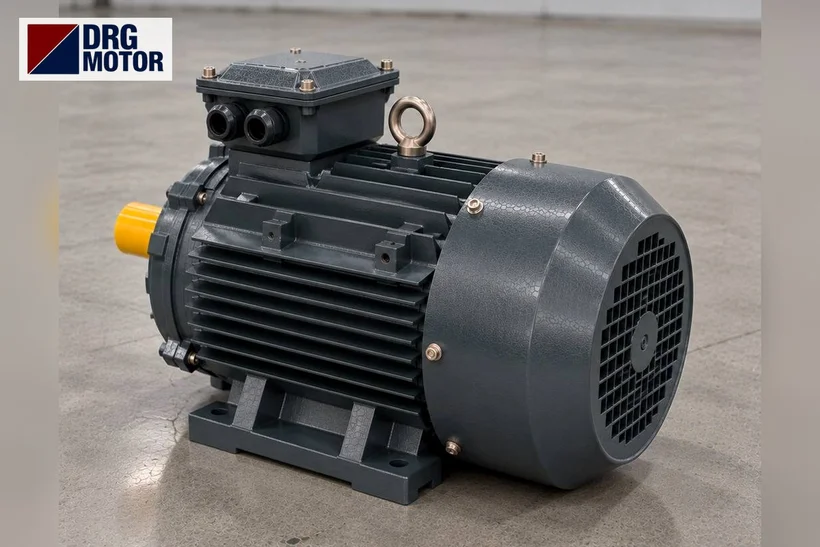
DRG Motor is a manufacturer, supplier and seller of electric motors. It is based in İzmir and ships quickly across all of Türkiye, that province included. To compare the 22 kW 1500 rpm class and its neighbouring speeds, see the online electric motor shop; for the full list of the same products, open the three-phase asynchronous electric motors category.
Why 1500 rpm means "four poles"
Speed is not an arbitrary number; it follows directly from the pole count. Synchronous speed equals 120 times the frequency divided by the number of poles. At 50 Hz, four poles give 1500 rpm. So the electric motor searched for as "22 kW 1500 rpm" is really the 22 kW four-pole model.
On the plate you will usually read not 1500 but a figure between 1455 and 1465. That gap comes from slip: an asynchronous electric motor runs just under synchronous speed under load. No cause for worry — the plate should look like that.
The character 22 kW gives at 1500 rpm
1500 rpm is the most popular intermediate speed in industry; it is a balanced point between speed and turning force. The same 22 kW is delivered with less torque at 3000 rpm and more torque at 1000 rpm. Four poles sit in the middle: about 144 Nm of rated torque at the shaft (from T=9550·P/n at the load speed).
That balance makes the 1500 rpm electric motor versatile. It needs neither the special bearing and balancing care of 3000 rpm nor the larger frame cost of 1000 rpm. Most gearbox inputs are also designed around a 1500 rpm assumption.
Where is 22 kW at 1500 rpm wanted?
In the field we see this power-speed pair most on stone and plastic crushers, plastic extruders, belt conveyor drives, large mixers and agitators, flour and feed mill drives, and heavy-duty fans. In short, anywhere that works with a gearbox and carries a reasonable torque at a reasonable speed.
Crushers and extruders deserve special care: both start under load. A crusher's jaw can stay full, an extruder can start with cold material. In such places 1500 rpm strikes a good balance between starting torque and steady running; the rest is handled by the right gear ratio and starting method.
Click to see current electric motor prices and order nowSEE PRICES →
Same power, different speeds: what is 1500 in the middle of?
The clearest way to place 1500 rpm is to set it beside its neighbours. The values below use the 50 Hz synchronous speed; torque is approximate.
| Poles / Speed | Current (400 V) | Approx. torque | Typical job |
|---|---|---|---|
| 2 poles · 3000 rpm | 38.5 A | ~70 Nm | Pumps, compressors |
| 4 poles · 1500 rpm | 39.7 A | ~140 Nm | Crushers, extruders, conveyors |
| 6 poles · 1000 rpm | 42.5 A | ~210 Nm | Slow mills, heavy mixers |
The middle row is the subject of this article. As speed drops torque grows and current rises somewhat; for the exact shaft torque rely on the data on the product page.
DRG-180L-4: the frame and shaft for this job
The DRG model for 22 kW at 1500 rpm is DRG-180L-4-GG. The frame size is 180L (IEC), the frame material cast iron. At this rating it is cast iron, not aluminium; on vibrating, loaded machines such as crushers and extruders the rigidity of a cast frame earns its keep.
The shaft is 48x110 mm (diameter×length); for a coupling, pulley or gearbox fit this dimension and the keyway are decisive. Mounting can be foot B3, flange B5 or foot+flange B35; for a direct gearbox fit a flanged frame is usually wanted. State the mounting type when you order. The winding is 400/690 V (Δ/Y); on a 400 V supply it is wired in delta.
Choosing a 1500 rpm unit for a crusher or extruder
These two machines push a 1500 rpm 22 kW electric motor hardest, so a few points are worth settling before ordering. First, the starting load: does the machine start full or empty? Second, the gear ratio: the gap between the machine's required shaft speed and 1460 rpm is bridged by this ratio. Third, starting: to cut the high inrush current, star-delta or a soft starter is common at this rating.
The electrical warning is plain: before any connection or measurement, switch off the power, verify it is dead, and have the work done by a qualified electrician. Set the overload relay from the current on the motor plate and the panel documentation; do not use a memorised value. For a quick first check, the motor current chart and the electric motor calculator help.
The 22 kW 1500 rpm DRG model and neighbouring speeds
What you are really after, 1500 rpm, is the middle row; if your machine needs a different speed, the neighbours share the same 22 kW power. Each code links directly to its product page.
| Model | Speed | Current (400 V) | Shaft |
|---|---|---|---|
| DRG-180L-4-GG | 1500 rpm (4-pole) | 39.7 A | 48x110 mm |
| DRG-180M-2-GG | 3000 rpm (2-pole) | 38.5 A | 48x110 mm |
| DRG-200L2-6-GG | 1000 rpm (6-pole) | 42.5 A | 55x110 mm |
If you are replacing an existing electric motor, the safest step is to send a photo of the old nameplate; we will settle power, speed, frame and shaft diameter together.
Send a photo of your current motor nameplate and we will find the suitable DRG model together.Send on WhatsApp
See the current price of the 22 kW 1500 rpm electric motor in the shop.SEE PRICES
Frequently asked questions
How many poles is 22 kW at 1500 rpm?
Four poles. At 50 Hz a four-pole winding gives a synchronous 1500 rpm; under load the plate shows about 1460 rpm.
The plate reads 1460 instead of 1500 — is that wrong?
No. An asynchronous electric motor runs a little below synchronous speed under load (slip). A value between 1455 and 1465 is normal for this power and speed.
How much torque does 22 kW at 1500 rpm give?
About 144 Nm of rated torque at the shaft (T=9550·P/n at ~1460 rpm). For the exact value, see the data on the product page.
For a crusher, 1500 rpm or 1000 rpm?
It depends on the required shaft speed and gear ratio. Very slow, high-torque crushers favour 1000 rpm; medium-speed drives favour 1500 rpm. The final choice follows the speed-torque need stated by the machine maker.
Electric Motors Related to This Topic — Models and Current Prices
Suitability is not decided by power alone: compare the speed, voltage, mounting, shaft and fixing dimensions of your machine with the product data; if unsure, send us the nameplate of your current motor.
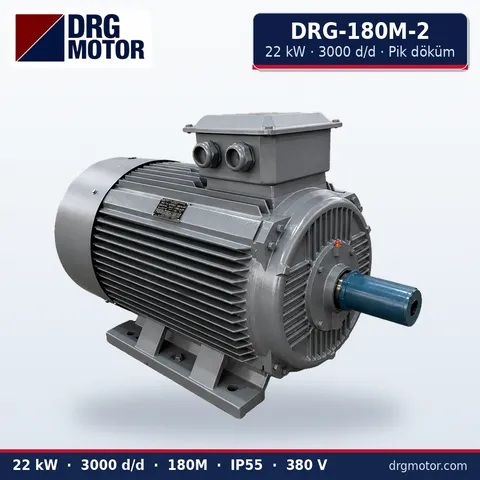
22 kW Three-Phase Motor 3000 rpm – DRG-180M-2 Cast Iron
- 22 kW · 3000 rpm (2 poles)
- Cast iron frame · IEC 180M
- Shaft: 48 × 110 mm
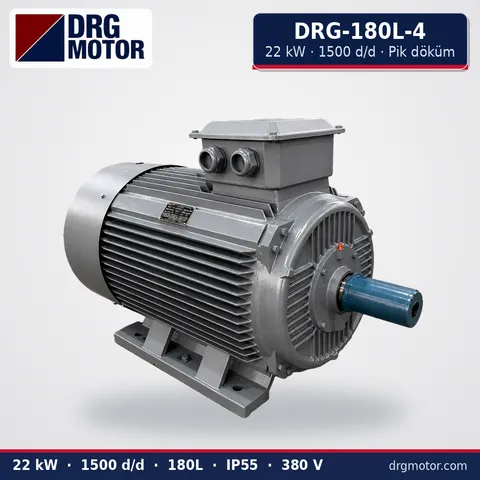
22 kW Three-Phase Motor 1500 rpm – DRG-180L-4 Cast Iron
- 22 kW · 1500 rpm (4 poles)
- Cast iron frame · IEC 180L
- Shaft: 48 × 110 mm
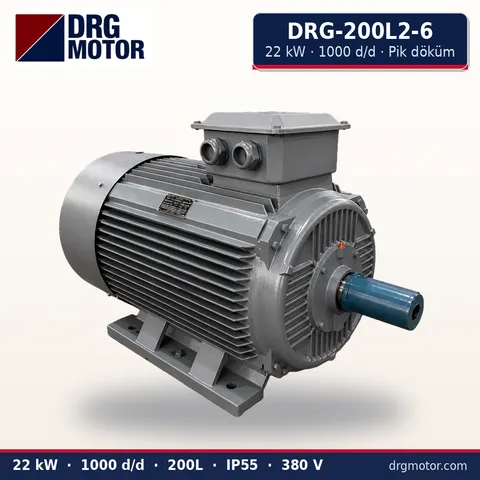
22 kW Three-Phase Motor 1000 rpm – DRG-200L2-6 Cast Iron
- 22 kW · 1000 rpm (6 poles)
- Cast iron frame · IEC 200L
- Shaft: 55 × 110 mm





