 English
 Le français
 Türkçe




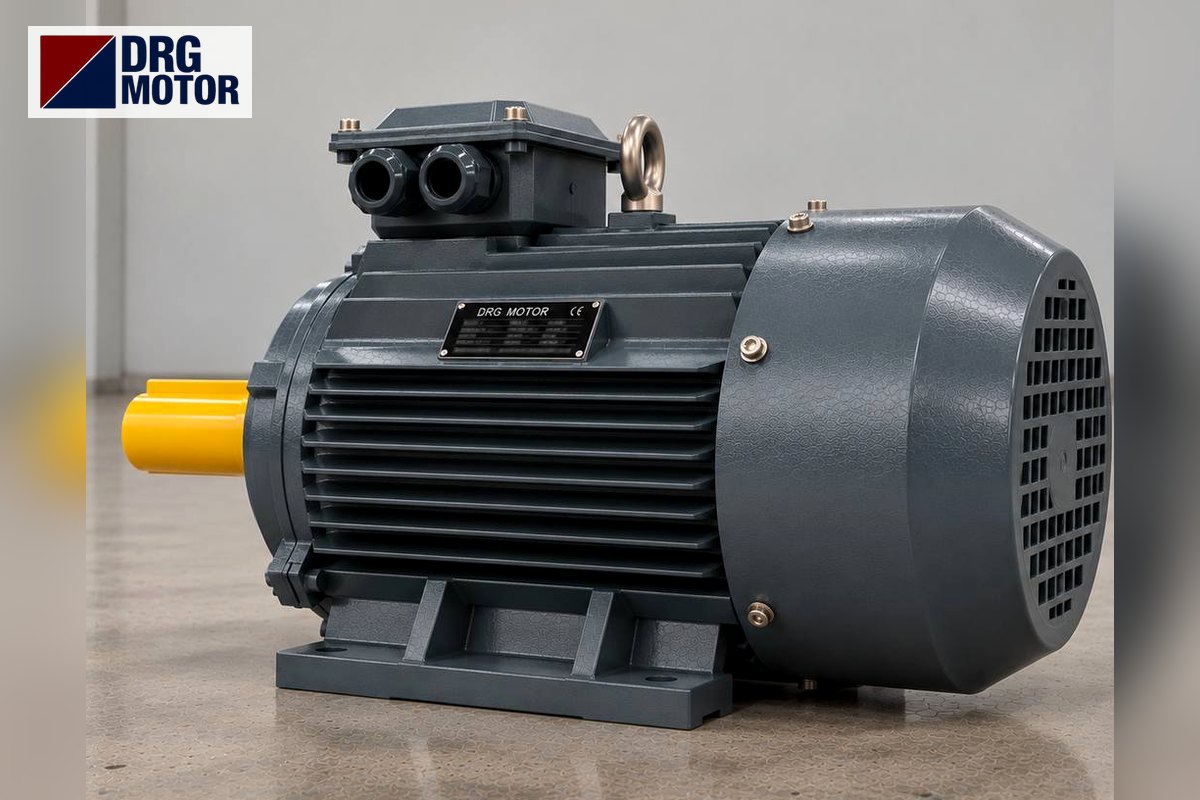

The flow changes because a pump's output depends on the actual running speed of the electric motor driving it. A newer, more efficient motor usually slips a little less than the old one under the same load, so its shaft turns a few rpm faster. By the pump affinity laws, even that small speed difference shifts flow, head and absorbed power together.
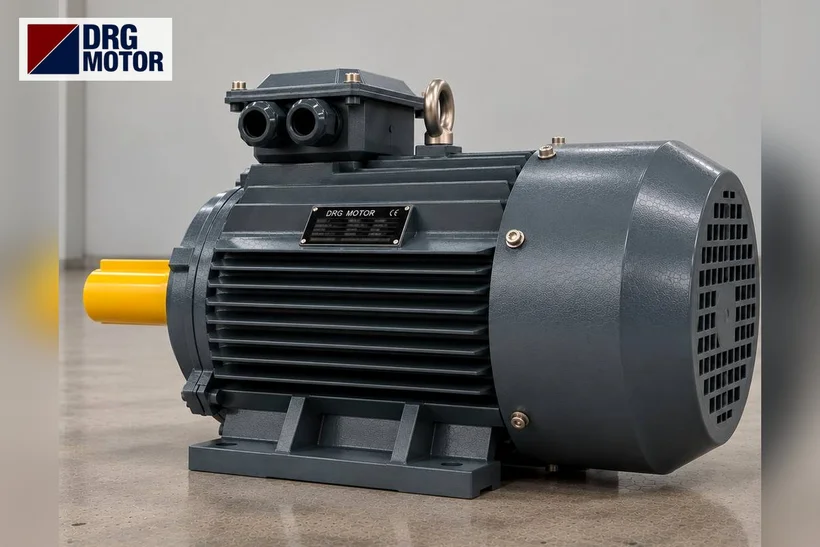
DRG Motor is a manufacturer, supplier and seller of electric motors. It is based in İzmir and ships quickly across all of Türkiye. When you renew the motor driving your pump, you can pick the right power and speed in the online electric motor shop and see the same products together in the three-phase asynchronous electric motors category.
How does speed arise in an asynchronous motor?
The rotating-field speed of an asynchronous electric motor, the synchronous speed, is set by the supply frequency and the number of poles: synchronous speed = 120 · f / p. At 50 Hz a 4-pole motor gives 1500 rpm. Yet the rotor never turns exactly that fast; to produce torque it stays slightly behind. That gap is called slip. Under load the rated speed on the plate (around 1440-1460 rpm, for example) is below the synchronous value.
Here is the key point: two different electric motors can both be 4-pole, both 50 Hz, and still not run at identical speeds under load. The amount of slip varies from motor to motor. On a motor that drives the pump directly through a coupling, that means the pump shaft turns just as much faster.
How does pump flow depend on speed?
For centrifugal pumps the link between speed and the main quantities is summed up by the pump (affinity) laws. Taking the speed ratio as n2/n1:
| Quantity | Relation to speed | Example: speed up 2% |
|---|---|---|
| Flow (Q) | Proportional to speed (Q ∝ n) | rises about 2% |
| Head (H) | With the square of speed (H ∝ n²) | rises about 4% |
| Shaft power (P) | With the cube of speed (P ∝ n³) | rises about 6% |
So a small rise in speed shows up proportionally in flow, squared in head, and cubed in absorbed power. That cubic rise in power also explains where an unexpected overload on the new motor comes from.
Click to see current electric motor prices and order nowSEE PRICES →
What changes when you move from the old motor to a new one?
When you remove a worn motor and fit a new electric motor, the new one often slips a little less at the same load and the shaft turns a few rpm faster. The pump is the same, the pipework is the same; but the pump now runs a touch faster. The result: flow goes up, head rises even more, and the power the motor draws is the quantity that climbs most.
That is not always welcome. If flow overshoots, the motor can move outside its rated power at the pump's new operating point. The opposite happens too: a motor whose shaft turns slower lowers flow and pressure, and the system misses its target. So when renewing a motor, compare not only the kW but also the speed on the plate, one to one.
Direct coupling versus belt-and-pulley drive
If the motor drives the pump directly through a coupling, pump speed equals motor speed and the speed difference feeds straight into flow. With a belt and pulleys the pulley ratio comes in between: pump speed = motor speed · (motor pulley / pump pulley). Here, when you change the motor, review the pulley diameters too; a small change in slip can be compensated with the pulley ratio. A pulley-belt calculator makes the sizing easier, and you can check the required power on the electric motor calculation page.
DRG models often used for pump drives
Pumps most often use 4-pole three-phase asynchronous motors (the 1500 rpm class at 50 Hz), because that is close to the running speed of centrifugal pumps. The DRG models below are from this class; choose by comparing power and speed with your pump's current motor.
| Model | Power (kW) | Speed (rpm) | Voltage |
|---|---|---|---|
| DRG-90L-4 | 1.5 | 1500 | 230/400 V |
| DRG-112M-4 | 4 | 1500 | 400/690 V |
| DRG-132S-4 | 5.5 | 1500 | 400/690 V |
| DRG-132M-4 | 7.5 | 1500 | 400/690 V |
| DRG-160M-4 | 11 | 1500 | 400/690 V |
The table values are for 50 Hz. The rated speed (the real speed under load) is slightly below the synchronous value for every model, and it is this figure that sets where the pump will settle.
Common mistakes
A few mistakes we see again and again make flow change "for no reason":
- Matching only the kW and ignoring the speed (pole count); a 2-pole and a 4-pole motor of the same power drive the pump at very different speeds.
- Assuming the frequency is fixed; if the supply is not 50 Hz the synchronous speed changes, and so does flow.
- Replacing the motor on a belt-and-pulley system while leaving the old pulley ratio in place.
- Blaming the motor for changes on the pump side, such as impeller diameter or pump wear.
Before working on the motor, switch off the power, verify it is dead, and leave the wiring to a qualified electrician. Always confirm speed and power from the motor nameplate and the pump documentation.
Click to see three-phase electric motors in the right power and speed for your pumpSEE PRICES
Send a photo of your current motor nameplate and we will find the suitable DRG model together.Send on WhatsApp
Frequently asked questions
I fitted a motor of the same power, why did flow rise?
Most likely the new motor slips a little less under load and the shaft turns a few rpm faster. Because flow is proportional to speed, even a small speed difference pushes flow up.
Why can more flow overload the motor?
Absorbed power varies with the cube of speed. A small rise in speed makes power climb much faster; if the pump's new operating point moves outside the motor's rated power, the motor is overloaded.
How can I bring flow back to its old value?
On a belt-and-pulley system you can adjust the pulley ratio to bring pump speed near the target. On a directly coupled system, review the motor's speed class (pole count) and, if needed, the pump impeller diameter per the pump maker's guidance.
What are the two most critical values when choosing a motor?
For a pump drive, power (kW) and speed (pole count) decide together. Read both from the current motor's plate and compare with the new motor; if unsure, send us a photo of the plate.
Electric Motors Related to This Topic — Models and Current Prices
Suitability is not decided by power alone: compare the speed, voltage, mounting, shaft and fixing dimensions of your machine with the product data; if unsure, send us the nameplate of your current motor.

4 kW Three-Phase Motor 1500 rpm – DRG-112M-4 Aluminium
- 4 kW · 1500 rpm (4 poles)
- Aluminium frame · IEC 112M
- Shaft: 28 × 60 mm

5.5 kW Three-Phase Motor 1500 rpm – DRG-132S-4 Aluminium
- 5.5 kW · 1500 rpm (4 poles)
- Aluminium frame · IEC 132S
- Shaft: 38 × 80 mm

7.5 kW Three-Phase Motor 1500 rpm – DRG-132M-4 Aluminium
- 7.5 kW · 1500 rpm (4 poles)
- Aluminium frame · IEC 132M
- Shaft: 38 × 80 mm

11 kW Three-Phase Motor 1500 rpm – DRG-160M-4 Aluminium
- 11 kW · 1500 rpm (4 poles)
- Aluminium frame · IEC 160M
- Shaft: 42 × 110 mm

1.5 kW Three-Phase Motor 1500 rpm – DRG-90L-4 Aluminium
- 1.5 kW · 1500 rpm (4 poles)
- Aluminium frame · IEC 90L
- Shaft: 24 × 50 mm





