 English
 Le français
 Türkçe




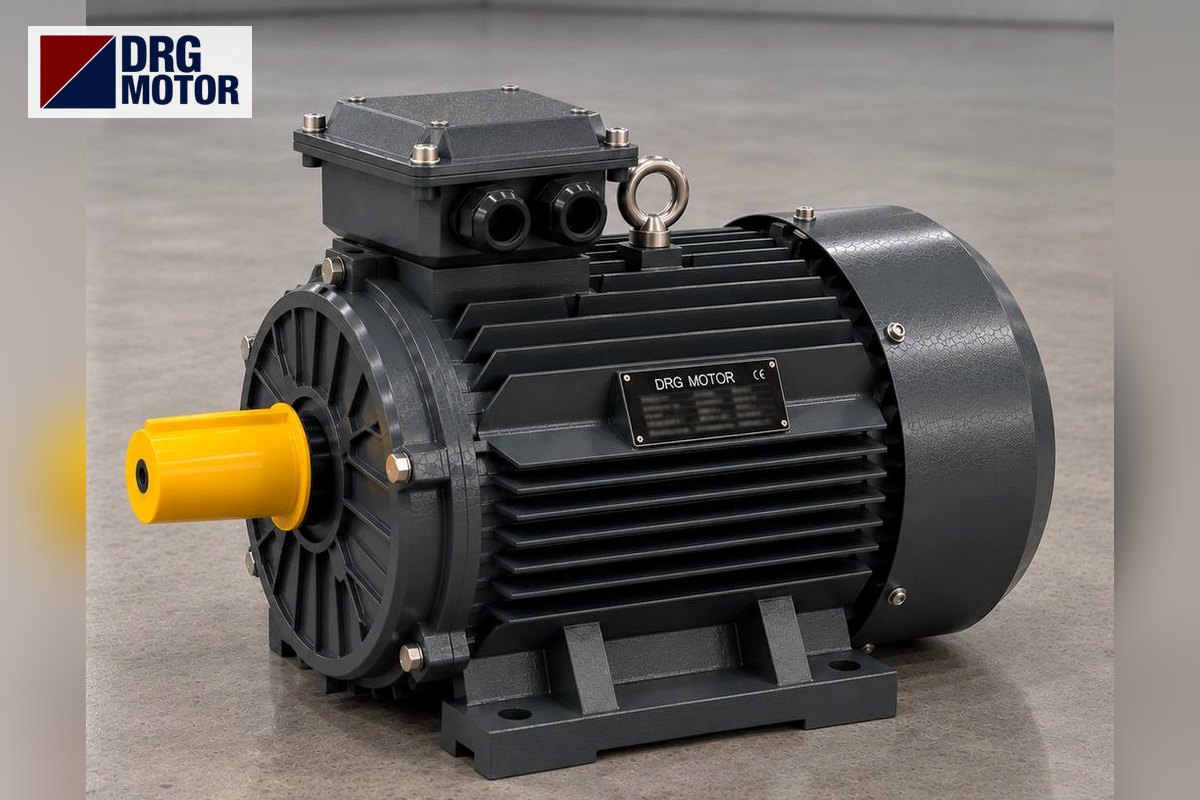

When an electric motor starts, it draws roughly 6–8 times its normal running current from the supply; this sudden load causes a brief voltage dip on the feeder and affects other machines fed from the same panel or transformer. Flickering lights, dropped-out contactors or resetting sensitive devices are usually the result of this starting current.
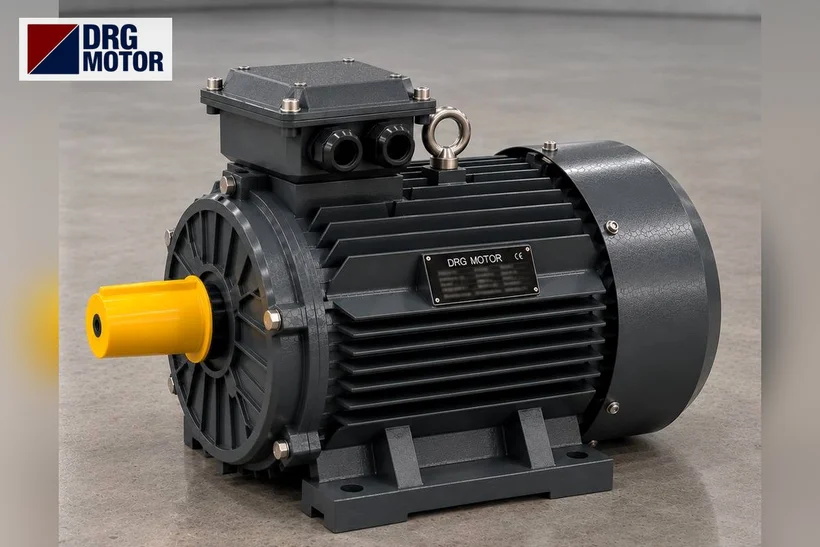
Understanding this explains many "unexplained" faults seen at the panel. A correctly rated motor started with the right method does not disturb neighbouring machines. You can browse models by power and speed in the online electric motor shop and see the same products together in the three-phase asynchronous electric motors category. DRG Motor is a manufacturer, supplier and seller of electric motors, based in İzmir and shipping quickly across all of Türkiye.
What happens inside the motor at start-up?
At the instant an asynchronous electric motor is energised, the rotor is still at rest. While standing still the winding behaves almost like a short circuit; a very high current flows from the supply until the magnetic field is established and the rotor begins to accelerate. This starting current is several times the rated current on the nameplate. As the rotor nears its running speed, the current drops quickly to normal. The event lasts seconds — milliseconds on small motors — but that short moment is the one that stresses the line.
The larger the motor and the higher the load inertia (fan, compressor, big pulley), the longer and higher the start. You would never notice a 1.5 kW motor starting; an 11 kW motor started direct-on-line can make the lighting on the same line flicker visibly.
How does the voltage dip affect other machines?
Every cable and transformer has some resistance. As current rises, the voltage dropped across that resistance rises too (the U = I × R idea). When the motor draws high current at start, the voltage at the common feed point dips for a moment. Other machines fed from that point meet the same reduced voltage.
The consequences vary from machine to machine:
- Contactors and relays: if the coil voltage falls below a threshold the contactor drops out, and another running motor may stop unexpectedly.
- Lighting: visible flicker, especially with older fittings.
- Electronic devices: on lines feeding a PLC, instrument or computer the sudden dip can cause a reset or fault.
- Other motors: running at low voltage their torque falls, they draw more current and the thermal protection may trip.
Click to see current electric motor prices and order nowSEE PRICES →
Which symptoms point to this problem?
If you recognise this picture at the panel, you are most likely facing starting current and voltage dip:
- Lights dimming for a moment every time a large machine switches on.
- One machine stopping or faulting while another motor starts.
- Cables or terminals warming up during the start.
- Protection at the weakest link, rather than the main fuse, tripping unexpectedly.
Symptoms become clearer during busy hours, when several machines run together, because the line's voltage margin is already tight.
Ways to limit the starting current
The goal is to give the motor a gentler current profile at start. Common approaches are:
- Star-delta starting: the motor starts in star at reduced voltage, then switches to delta once up to speed. This markedly lowers the starting current versus direct-on-line. The motor must be labelled 400/690 V (Δ/Y) with a six-terminal box.
- Soft starters: they raise the voltage gradually to limit the current and soften the start.
- Frequency converters: they ramp the frequency from zero so the motor starts at low current. These are separate drive equipment, not the motor itself; DRG Motor does not sell these devices, but the three-phase asynchronous motor side works fully with all of these solutions.
- Correct sizing: an oversized motor stresses the line needlessly at idle and at start. Choose the most suitable power for the load.
Send a photo of your current motor nameplate and we will find the suitable DRG model together.Send on WhatsApp
Suitable DRG three-phase asynchronous motors
Four-pole, 1500 rpm aluminium-bodied three-phase motors cover the power range most often seen at the panel. Models of 4 kW and above are labelled 400/690 V (Δ/Y), which means the six-terminal connection suited to star-delta starting. The models below are example power steps:
| Model | Power | Speed | Voltage |
|---|---|---|---|
| DRG-90L-4 | 1.5 kW | 1500 rpm | 230/400 V (Δ/Y) |
| DRG-112M-4 | 4 kW | 1500 rpm | 400/690 V (Δ/Y) |
| DRG-132S-4 | 5.5 kW | 1500 rpm | 400/690 V (Δ/Y) |
| DRG-132M-4 | 7.5 kW | 1500 rpm | 400/690 V (Δ/Y) |
| DRG-160M-4 | 11 kW | 1500 rpm | 400/690 V (Δ/Y) |
You can review the models one by one on their product pages and see every power step in the three-phase asynchronous electric motors category.
Common mistakes
- Starting every motor direct-on-line: fine on a small motor, but on a large one it causes a serious voltage dip relative to your line's capacity.
- Using a thin cross-section to save cable: a thin cable means a bigger voltage drop at start.
- Starting several large motors at once: staggering their starts reduces the shock.
- Blaming the motor itself: the problem is usually in the supply line and the starting method, not inside the motor.
Safety warning
When investigating start-up, voltage dip or a tripped protection, measurement and work inside the panel must be carried out only by authorised electrical personnel. Before starting, cut the power, verify the absence of voltage with a suitable device, and lock and tag it out. For thermal relay current settings, protection thresholds and the connection method, follow the motor nameplate and the relevant device documentation; do not set exact values by guesswork.
Click to choose and order the right-rated three-phase electric motor for your facilitySEE PRICES
Frequently asked questions
Can a small motor affect the line too?
It depends on the line's capacity. On a strong supply a 1.5 kW motor's start goes unnoticed; on a weak or long line even a small motor can cause slight flicker.
Can star-delta be used on any motor?
No. The motor must be able to run in delta at the mains voltage and have a six-terminal box. Models labelled 400/690 V (Δ/Y) are suitable for star-delta on a 400 V supply.
Does the starting current harm the motor?
A single start is within the design limits. The problem is very frequent back-to-back starting or starting a high-inertia load direct without a suitable method; heating then rises.
How do I choose the right model?
Share a photo of your current motor nameplate and your load; we will pick the suitable DRG model together by power, speed and connection type.
Electric Motors Related to This Topic — Models and Current Prices
Suitability is not decided by power alone: compare the speed, voltage, mounting, shaft and fixing dimensions of your machine with the product data; if unsure, send us the nameplate of your current motor.

4 kW Three-Phase Motor 1500 rpm – DRG-112M-4 Aluminium
- 4 kW · 1500 rpm (4 poles)
- Aluminium frame · IEC 112M
- Shaft: 28 × 60 mm

5.5 kW Three-Phase Motor 1500 rpm – DRG-132S-4 Aluminium
- 5.5 kW · 1500 rpm (4 poles)
- Aluminium frame · IEC 132S
- Shaft: 38 × 80 mm

7.5 kW Three-Phase Motor 1500 rpm – DRG-132M-4 Aluminium
- 7.5 kW · 1500 rpm (4 poles)
- Aluminium frame · IEC 132M
- Shaft: 38 × 80 mm

11 kW Three-Phase Motor 1500 rpm – DRG-160M-4 Aluminium
- 11 kW · 1500 rpm (4 poles)
- Aluminium frame · IEC 160M
- Shaft: 42 × 110 mm

1.5 kW Three-Phase Motor 1500 rpm – DRG-90L-4 Aluminium
- 1.5 kW · 1500 rpm (4 poles)
- Aluminium frame · IEC 90L
- Shaft: 24 × 50 mm





