 English
 Le français
 Türkçe


Measurement uncertainty matters because every efficiency figure carries an invisible "how precisely was it measured" margin. When two motors post close efficiency values, that margin can be larger than the gap between the numbers; then you simply cannot say which one really uses less energy. Ignoring uncertainty leads you to rank two equal motors as if one were better.
DRG Motor is a manufacturer, supplier and seller of electric motors; it is based in İzmir and ships quickly across all of Türkiye, that province included. Once the comparison is done honestly, find the three-phase model that fits your need by power and speed in the online electric motor shop and see the same group together in the three-phase asynchronous electric motors category.
What exactly is measurement uncertainty?
No measurement is infinitely precise. When you read a motor's input power, shaft power or torque, the instrument's resolution, the wiring, temperature and the moment of reading all add small deviations. Uncertainty is the sum of those deviations: it is the proper way to say "the measured value is this, the true value lies within this range." Picture not a single number but a number with a band around it.
The field version is simple: measure the same motor with two instruments on two days and you get two close but different results. Neither is wrong; both sit inside that band.
Why is it decisive in a comparison?
Because a comparison puts two close numbers side by side. Motor efficiencies usually cluster in a narrow range; if the gap is small, the measurement band can swallow it. Say motor A reads a touch "better" than B. If the two uncertainty bands overlap, that touch may be pure noise. A genuine advantage can be claimed only when the gap is clearly larger than the sum of the bands.
Practical result: instead of ranking two motors by "which is a few points ahead," check whether the gap exceeds the measurement margin. If not, treat them as equal and let the choice fall to concrete, measurable items like delivery, frame and mounting.
What widens the uncertainty
A few things stretch the band and distort the comparison:
- Different load point: measuring one motor at full load and the other at half load makes the numbers non-comparable. Load changes efficiency directly.
- Temperature: a cold motor and a warmed-up motor have different winding resistance; reading before thermal balance adds deviation.
- Supply voltage and imbalance: a supply that strays from the nameplate voltage or is unbalanced between phases shifts the result.
- Instrument and method: the class of the power analyser, the current clamp, the wiring and whether torque is found directly or indirectly all change the uncertainty.
Click to see current electric motor prices and order nowSEE PRICES →
Field measurement or controlled measurement?
They serve different aims. The table sums up what separates them.
| Criterion | Field measurement | Controlled measurement |
|---|---|---|
| Conditions | Variable: temperature, voltage, load drift | Fixed and logged |
| Uncertainty | Wider band | Narrower band |
| Purpose | Rough idea, trend tracking | Fair comparison of models |
Field measurement is not worthless; its band is just wider. Factor that in when you decide.
Steps for a fair comparison
If you want to compare two motors honestly, equalise the conditions:
- Measure both at the same load point; bring shaft power or torque to the same level.
- Wait for thermal balance to settle and take both readings under the same temperature pattern.
- Keep supply voltage and phase balance the same; feed both from the same panel.
- Same instrument, same connection, same reading window: do not change the setup.
- Read each value several times; note the average and the spread.
A safety note: if a connection is needed for the measurement, cut the power, verify the dead state and have the work done by authorised electrical staff. Guessing at terminals by the panel is both dangerous and ruins the result.
Common mistakes
Wrong decisions usually come from these: measuring two motors at different loads and declaring "this one is better"; skipping the cold-versus-hot difference; trusting a single reading without repeating it; and most common of all, presenting a tiny gap as if it were larger than the uncertainty margin. There is also comparing a nameplate figure straight against a field reading; the two come from different conditions, so it is apples to oranges.
What do you check on DRG three-phase models?
On the DRG side, the concrete, measurable items you compare are power, speed, frame and connection voltage. The 1500 rpm, 4-pole aluminium-frame models below show a typical span:
| Model | Power | Speed | Voltage |
|---|---|---|---|
| DRG-90L-4 | 1.5 kW | 1500 rpm | 230/400 V |
| DRG-112M-4 | 4 kW | 1500 rpm | 400/690 V |
| DRG-132S-4 | 5.5 kW | 1500 rpm | 400/690 V |
| DRG-132M-4 | 7.5 kW | 1500 rpm | 400/690 V |
| DRG-160M-4 | 11 kW | 1500 rpm | 400/690 V |
These items are clear and carry no measurement margin: they either fit or they do not. Matching the power and speed your machine needs against this list is a far firmer path than entering a blurry efficiency race. Browse the models by the right power and speed in the online electric motor shop.
Browse the shop to pick the right three-phase electric motor by power and speed for your projectSEE PRICES
To settle on the right power, the electric motor calculator and the motor current table make the job easier.
Send a photo of your current motor nameplate and we will find the suitable DRG model together.Send on WhatsApp
Frequently asked questions
If two motors have very close efficiency, which should I choose?
If the gap is smaller than the measurement margin, treat them as equal. Let the choice rest on measurable items: frame, mounting, delivery and the power-speed fit.
Why doesn't my own reading match the nameplate value?
They come from different conditions. The nameplate reflects controlled conditions; your field reading is taken under variable load, temperature and voltage. Comparing them directly misleads.
How do I reduce the uncertainty?
By fixing the conditions: same load point, settled thermal balance, same supply and same instrument. Reading each value several times and averaging also narrows the band.
I don't know which DRG model I need — what should I do?
Send a photo of your current motor nameplate; starting from power, speed, frame and voltage, we will identify the suitable three-phase model together.
Electric Motors Related to This Topic — Models and Current Prices
Suitability is not decided by power alone: compare the speed, voltage, mounting, shaft and fixing dimensions of your machine with the product data; if unsure, send us the nameplate of your current motor.
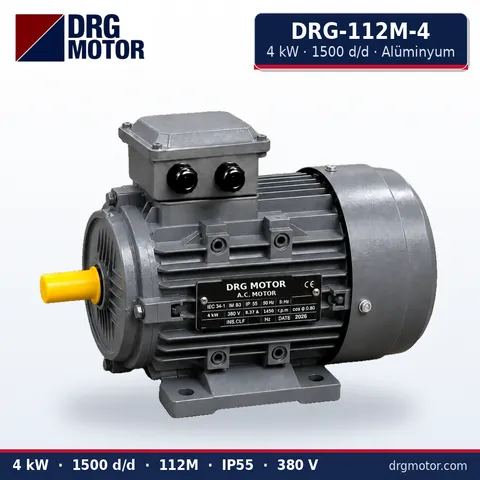
4 kW Three-Phase Motor 1500 rpm – DRG-112M-4 Aluminium
- 4 kW · 1500 rpm (4 poles)
- Aluminium frame · IEC 112M
- Shaft: 28 × 60 mm
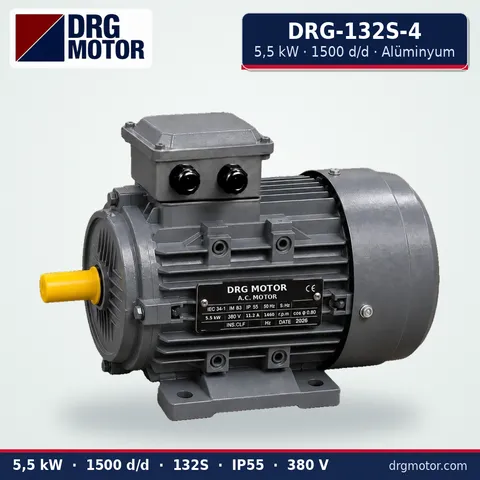
5.5 kW Three-Phase Motor 1500 rpm – DRG-132S-4 Aluminium
- 5.5 kW · 1500 rpm (4 poles)
- Aluminium frame · IEC 132S
- Shaft: 38 × 80 mm
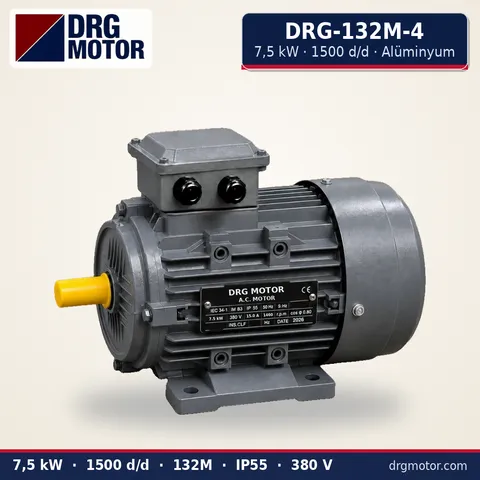
7.5 kW Three-Phase Motor 1500 rpm – DRG-132M-4 Aluminium
- 7.5 kW · 1500 rpm (4 poles)
- Aluminium frame · IEC 132M
- Shaft: 38 × 80 mm
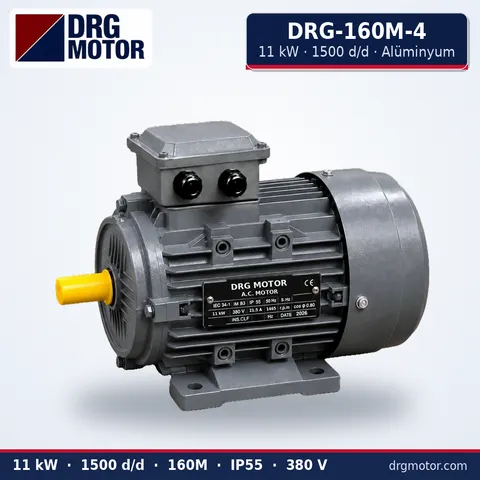
11 kW Three-Phase Motor 1500 rpm – DRG-160M-4 Aluminium
- 11 kW · 1500 rpm (4 poles)
- Aluminium frame · IEC 160M
- Shaft: 42 × 110 mm
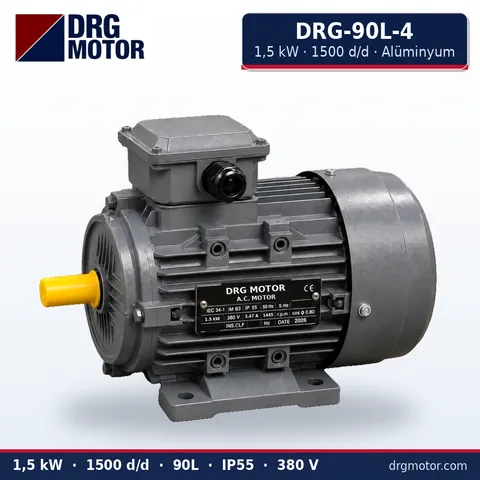
1.5 kW Three-Phase Motor 1500 rpm – DRG-90L-4 Aluminium
- 1.5 kW · 1500 rpm (4 poles)
- Aluminium frame · IEC 90L
- Shaft: 24 × 50 mm