English
 Le français
 Türkçe




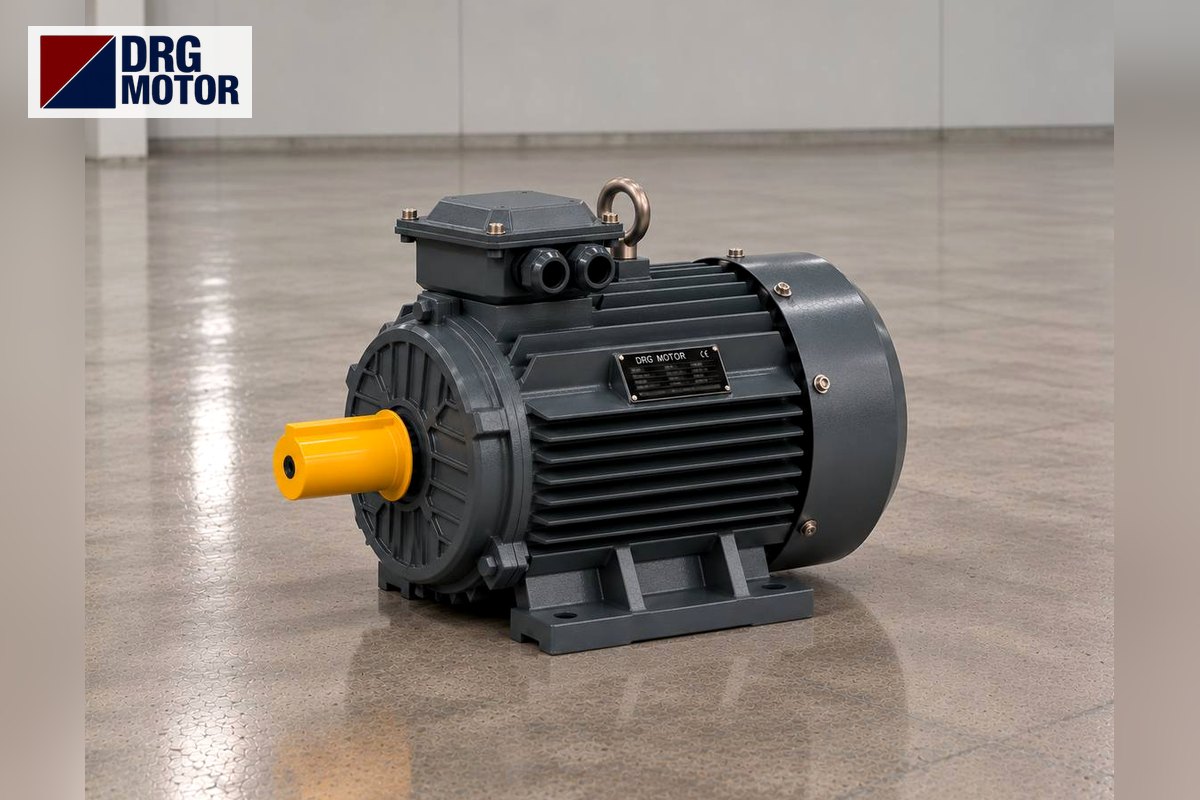

The key point when choosing an electric motor is not to hunt for the single "best" or "most efficient" model, but to pin down the motor that fits your application. Four basics work together for this: the right power (kW), the right speed (number of poles), the right mounting (frame and connection type) and the right voltage. When these four match your application, the motor in front of you is already the most suitable one for you.
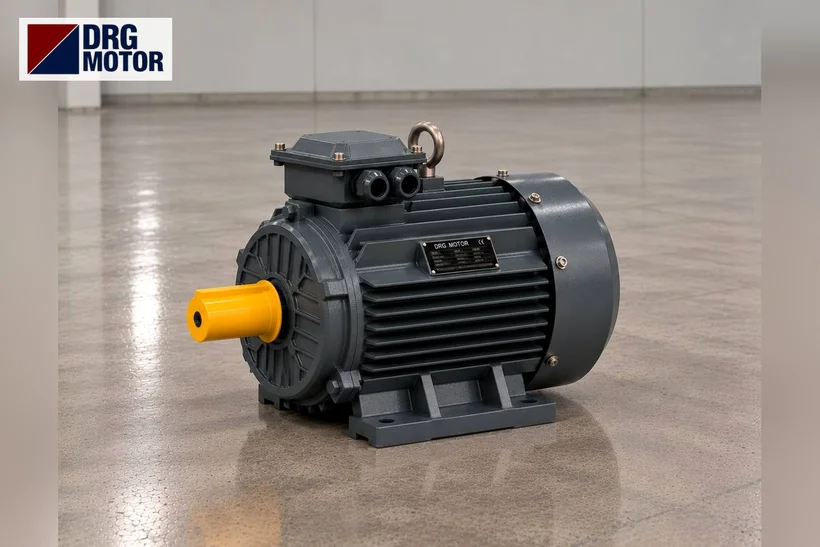
DRG Motor is a manufacturer, supplier and seller of electric motors. Follow the checklist below to pick the right model by power and speed in the online motor shop, and see all three-phase options together in the three-phase asynchronous electric motors category.
Is there one single "best motor"?
A very common search is "the best electric motor" or "which motor is the most efficient". In practice no such absolute model exists: a motor that is ideal for a pump may be unsuitable for a conveyor or a fan. The right question is not "which is best" but "what power, speed, mounting and voltage does my application need". Once you clarify these four criteria, the options narrow by themselves and only a few most-suitable models remain.
This article is a checklist: as you tick each item, you end up with a concrete set of figures that describes exactly the right motor.
Motor selection checklist
Before ordering you should have an answer to every heading below. Once they are all clear, the model choice almost emerges on its own:
- Power (kW): the mechanical power the application demands, rounded to one of the standard IEC steps.
- Speed / number of poles: the speed the job needs. 2, 4 or 6 poles, i.e. roughly 3000, 1500 or 1000 rpm.
- Mounting type: foot (B3), flange (B5/B14) or combined (B35) — how it attaches to the machine.
- Voltage: your mains three-phase voltage and the motor connection (Δ/Y).
- Housing material: aluminium or cast iron — the balance of weight and robustness.
- Shaft and dimensions: shaft diameter, frame size and connection dimensions, especially when replacing an existing motor.
- Operating environment: dust, water, temperature; the protection class you expect (for example IP55).
The right power (kW): neither too little nor too much
Power is set by the continuous mechanical load of the application. An oversized motor is needlessly bulky; an undersized one struggles under load. Rated motor powers are not arbitrary but follow international steps (for example 0.75 – 1.1 – 1.5 – 2.2 – 3 – 4 – 5.5 – 7.5 kW). If your need falls between steps, you round up to the next standard power.
To estimate the required power and check the current you can use the electric motor calculator and the motor current chart. Below are the DRG equivalents of three power classes at 4 poles (1500 rpm); the model codes link straight to the product page.
| Model | Power | Torque | Rated current (400 V) |
|---|---|---|---|
| DRG-100L1-4 | 2.2 kW | 14.5 Nm | 4.52 A |
| DRG-112M-4 | 4 kW | 26.3 Nm | 7.95 A |
| DRG-132M-4 | 7.5 kW | 49.1 Nm | 14.3 A |
Click to see current electric motor prices and order nowSEE PRICES →
The right speed: what does the pole count change?
The same power is offered at different speeds, because what most applications really need is speed and torque, not power. As the pole count rises, speed drops and torque increases. You can see this from T = 9550 · P / n: with power fixed, lower speed means higher torque. The table below compares the torque of the same 2.2 kW power across three speed classes:
| Model | Poles | Speed | Torque |
|---|---|---|---|
| DRG-90L-2 | 2 poles | 3000 rpm | 7.26 Nm |
| DRG-100L1-4 | 4 poles | 1500 rpm | 14.5 Nm |
| DRG-112M-6 | 6 poles | 1000 rpm | 22.0 Nm |
- 2 poles (~3000 rpm): high speed, low torque — small pumps and fans.
- 4 poles (~1500 rpm): the most common medium speed — conveyors, mixers, general drive.
- 6 poles (~1000 rpm): low speed, high torque — mechanisms with heavy starts.
When replacing an existing motor, the safest route is to take the speed on the nameplate and keep the same pole count.
The right voltage and connection
The motor winding voltage must match your mains three-phase voltage and connection. In the DRG range models up to 3 kW are usually wound 230/400 V (Δ/Y), while models of 4 kW and above are 400/690 V (Δ/Y). On a 400 V three-phase mains a 230/400 V motor is connected in star (Y); a 400/690 V motor is connected in delta (Δ). Which connection matches which voltage is printed on the motor nameplate.
Before any connection, switch off the power, verify it is de-energised and let only authorised electrical staff carry out the work. Set values such as the thermal protection current from the rated current on the nameplate, not from memory. For cable sizing the motor cable size calculator is a helpful guide.
The right mounting, shaft and housing
How the motor attaches to the machine matters as much as power. You can see the differences between mounting types in detail in the B3, B5, B14 and B35 mounting types article. In short:
- B3 (foot): bolted to a surface by its feet; the most common general mounting.
- B5 / B14 (flange): attached by the flange on the front cover; used at gearbox, pump and coupling inlets.
- B35 (foot + flange): both foot and flange; where extra support is needed.
The shaft diameter is the dimension that must match the coupling, pulley or gearbox inlet exactly; the shaft diameter by kW table is handy for comparison. As for housing material, aluminium is lighter and easier to handle, cast iron is heavier but mechanically tougher; the electrical figures are identical for both. Aluminium options are also listed together on the aluminium housing electric motors page.
Operating environment and protection
The environment the motor will run in is part of the choice too. In dusty or wet settings the expected protection class (for example IP55) comes to the fore; standard DRG three-phase models come with IP55, class F insulation and IC411 cooling. Ambient temperature, vibration and dust density also affect the housing material choice. Adding these criteria to your checklist brings the model selection close to a single correct answer.
Send a photo of your current motor nameplate and we will find the suitable DRG model together.Send on WhatsApp
Once you have clarified the four headings (power, speed, mounting, voltage), you can compare all suitable models and current prices through the shop.
See the three-phase asynchronous motor models in the power and speed you need, with current prices, in the shopSEE PRICES
Frequently asked questions
Which is the most efficient or the best motor?
There is no single "best" model valid for every application. The right choice is the model that best fits the power, speed, mounting and voltage your application requires. Once these four criteria are clear, the most suitable motor appears on its own.
Should I set the power or the speed first?
They are considered together: the mechanical load of the application sets the power, while the required speed sets the speed (pole count). Because the same power gives different torque at different speeds, both need to be clarified separately.
What should I look at when replacing my motor?
Note the power (kW), speed (rpm), voltage, mounting type (B3/B5/B14) and shaft diameter on the nameplate. If you choose the new motor by these five figures you will avoid fit problems.
Should I choose aluminium or cast iron housing?
The electrical figures are the same; the difference is mechanical. If lightness and easy mounting matter, aluminium fits; if there is high vibration or a harsh environment, a cast iron housing suits the need better.
Electric Motors Related to This Topic — Models and Current Prices
Suitability is not decided by power alone: compare the speed, voltage, mounting, shaft and fixing dimensions of your machine with the product data; if unsure, send us the nameplate of your current motor.
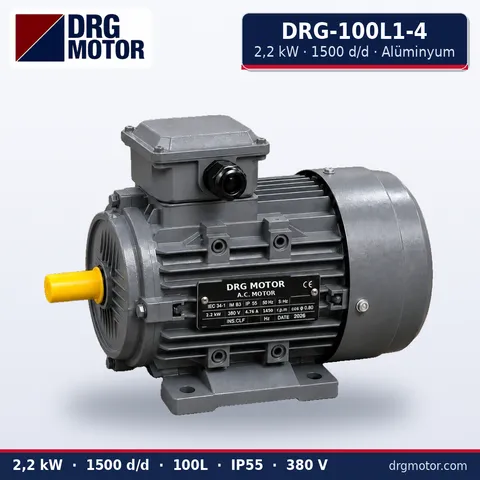
2.2 kW Three-Phase Motor 1500 rpm – DRG-100L1-4 Aluminium
- 2.2 kW · 1500 rpm (4 poles)
- Aluminium frame · IEC 100L
- Shaft: 28 × 60 mm
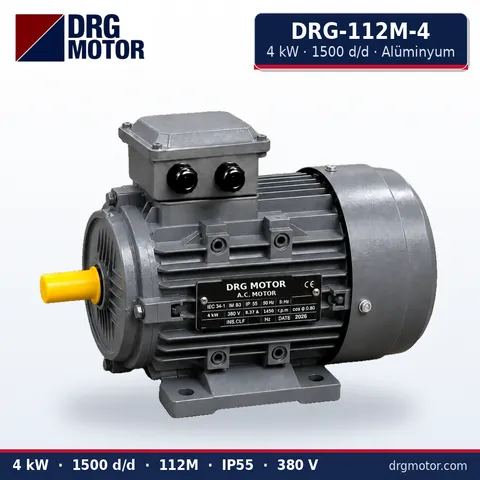
4 kW Three-Phase Motor 1500 rpm – DRG-112M-4 Aluminium
- 4 kW · 1500 rpm (4 poles)
- Aluminium frame · IEC 112M
- Shaft: 28 × 60 mm
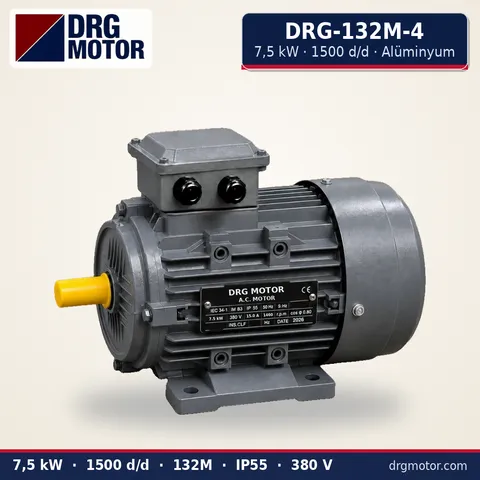
7.5 kW Three-Phase Motor 1500 rpm – DRG-132M-4 Aluminium
- 7.5 kW · 1500 rpm (4 poles)
- Aluminium frame · IEC 132M
- Shaft: 38 × 80 mm
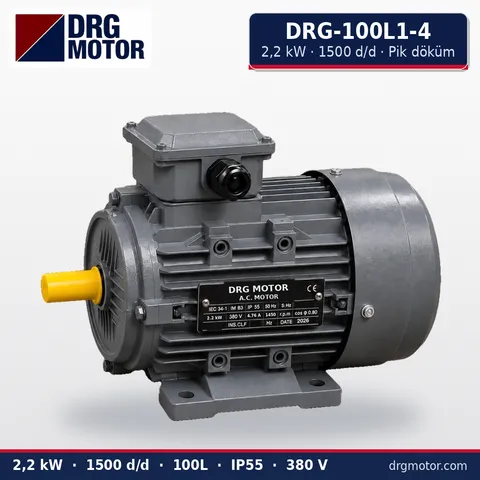
2.2 kW Three-Phase Motor 1500 rpm – DRG-100L1-4 Cast Iron
- 2.2 kW · 1500 rpm (4 poles)
- Cast iron frame · IEC 100L
- Shaft: 28 × 60 mm
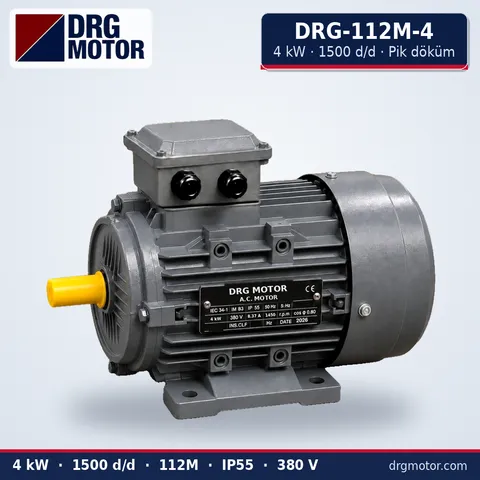
4 kW Three-Phase Motor 1500 rpm – DRG-112M-4 Cast Iron
- 4 kW · 1500 rpm (4 poles)
- Cast iron frame · IEC 112M
- Shaft: 28 × 60 mm
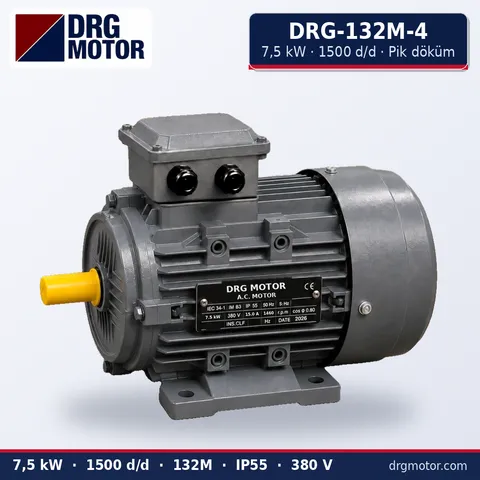
7.5 kW Three-Phase Motor 1500 rpm – DRG-132M-4 Cast Iron
- 7.5 kW · 1500 rpm (4 poles)
- Cast iron frame · IEC 132M
- Shaft: 38 × 80 mm