English
 Le français
 Türkçe




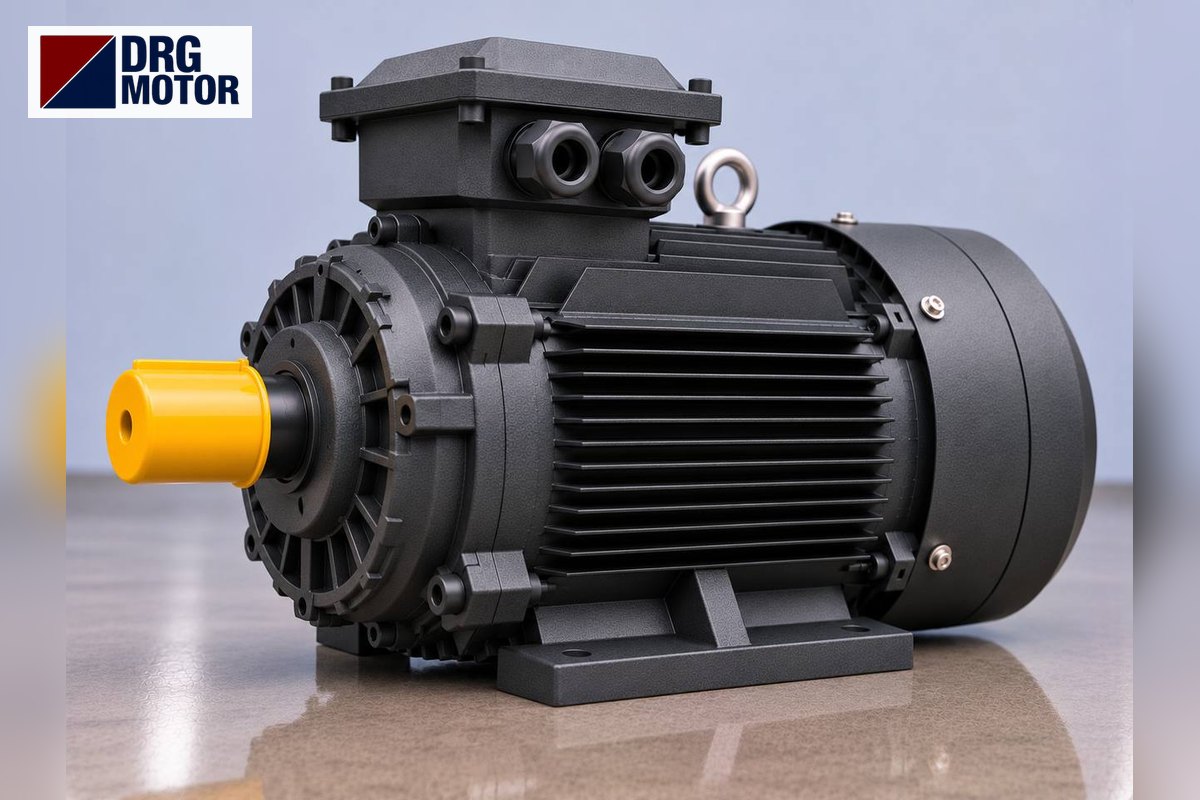

The most productive step before replacing a WAT electric motor is reading its nameplate correctly. If a few values are passed on wrongly, a new motor may look right in power yet not fit the machine or draw a different current. Here you will find the nameplate layout from the WAT catalogue, how the type code is decoded, and which values should be passed to DRG MOTOR.
What do the 20 fields on a WAT nameplate describe?
The WAT product catalogue (IM tr 24.0) explains the current QR-coded nameplate with 20 numbered fields. Not all carry the same weight for a replacement; the table below summarises the priority fields. The catalogue layout belongs to the new QR-coded nameplate; older motors may have a different layout, so check each value by its unit (kW, V, Hz, rpm, A) rather than by field name.
| Field | On the nameplate | Role in replacement |
|---|---|---|
| 1–2 | Motor type and motor code | Key to decoding frame, poles, mounting and frame material |
| 16–17 | Output power and speed | Shows power and rated speed; the speed class is derived from it |
| 18–19 | Rated frequency and operating voltage | First indicator of fit with the supply and existing connection |
| 14–15 | Rated current and power factor | Reference for protection settings and cabling |
| 4–6 | Insulation class, IP class, duty type | Assessing the environment and duty |
| 9 | Service factor | Shows the permissible loading margin under the stated operating conditions; the motor's actual operating load is assessed by measuring it separately. |
The remaining fields are year of manufacture, QR code, motor weight, efficiency class, efficiency values at 100/75/50 % load and the production tracking number. The catalogue states that scanning the QR code gives access to the production date, routine test results and serial number, so it helps if the QR code is sharp in your photo.
How is the type code decoded?
The example code in the catalogue is Q3E-FA225M4C40BN UL. It reads in this order: Q series letter; 3 efficiency class; E motor type; frame material field (empty for aluminium, G or P for cast iron); FA mounting (B5 flange); 225 frame size, i.e. shaft height in mm; M length (S short, M medium, L long); 4 number of poles; C core length; then the special motor number and UL approval if present. If the mounting field is empty the motor is foot-mounted; PA is foot+flange (B35), FB and FC are B14 types.
This decoding shows why "take the same power and fit it" falls short: two WAT electric motors with the same kW and pole count can have different frames and shafts because the core-length or frame-length letter differs.
Do not mix up the 50 Hz and 60 Hz lines
WAT nameplates may show 50 Hz and 60 Hz values on separate lines. On the example nameplate in the catalogue, the Q4H 90L4D motor shows 1461 rpm and 1.1 kW at 230/400 V 50 Hz, and 1766 rpm on the 265/460 V 60 Hz line. For a motor on the Turkish grid, the voltage, speed and current on the 50 Hz line are the reference; quoting the 60 Hz speed can point to the wrong motor.
The service factor field also needs attention: a catalogue footnote states that SF 1.15 applies to efficiency class IE2 and above, and is optional on frames 315 and 355. If the machine uses that margin and loads the motor above rating, the new motor's power should be reviewed accordingly.
From nameplate values to a DRG option
DRG Motor is an electric motor manufacturer, supplier and seller. For a 1.1 kW, 4-pole, 230/400 V motor like the example nameplate, DRG-90S-4 (90S frame, 24×50 mm shaft, rated speed 1445 rpm, 2.48 A at 400 V) is one of the options that can be assessed. If the nameplate shows 1.5 kW, DRG-90L-4 (90L frame, 24×50 mm shaft, 1445 rpm, 3.3 A at 400 V) can be reviewed; for 4 kW, the 400/690 V DRG-112M-4 (112M frame, 28×60 mm shaft, 1450 rpm). These pairings rest on nameplate data; suitability cannot be stated without checking frame and shaft dimensions separately. The full range is in the DRG MOTOR electric motor shop, and general industrial use is covered on the general purpose electric motors page.
When you photograph your nameplate and send it to DRG MOTOR, the values are read one by one and a suitable option is assessed together with the machine data. To compare the nameplate current, the motor current chart can serve as a reference.
Questions about reading the nameplate
Part of the nameplate is worn; is the type code enough?
The type code largely indicates frame, poles and mounting, but does not give voltage and current by itself. Sending every readable line together with the shaft size reduces uncertainty.
The nameplate shows 1461 rpm; should I look for a 1500 rpm motor?
1461 rpm is the rated (on-load) speed; the motor belongs to the 1500 rpm class. A new motor's nameplate speed may differ by a few rpm; the effect on the machine must be assessed for the application.
Should I pass on the efficiency class on the nameplate?
Yes, the efficiency class and values identify the existing motor; it is enough that they are visible in the photo.
Nameplate and dimension data to send
- A legible photo of the whole nameplate, including the QR code
- Type and motor code (fields 1–2)
- Power, rated speed, voltage and current on the 50 Hz line
- Insulation class, IP class, duty type and service factor
- Mounting arrangement, shaft diameter × length and any flange dimensions
- Machine type and daily operating hours
You can request a technical assessment from DRG MOTOR by sending the nameplate photo and dimensions via WhatsApp (+90 542 666 11 11), adding them to the quote list, by phone or to info@drgmotor.com. All channels are on the contact page.
See current prices of DRG MOTOR electric motors and order online in our storeSEE PRICES →
Technical Sources
- WAT Motor Sanayi ve Ticaret A.Ş. — WAT Product Catalogue (Turkish edition) — IM tr 24.0 — Motor type codes, PDF pages 18–19 (printed pages 16–17); Nameplate fields, PDF page 25 (printed page 23).